That sounds impressive. Do you share seeds and have any pictures?
1 Like
It’s been a struggle finding things that grow well where we live. Between our climate, and the heatwaves just seem to keep getting worst, and worst every year. This year I was shocked, it had seemed like the heatwaves in Vermont were just as bad as here this year although people’s gardens in Vermont still dealt with their heat waves better than ours did. I think that it might be the more constant wetness here, as well as the soil, and the additional pest problems. This year was actually way dryer than normal, and the soil still stayed way too wet at times.
This year only one of my pear grafts took successfully, because of the heatwave, and I even shaded the grafts to make it more likely for the grafts to take.
Here it’s impossible to know what is good to produce well, each and every year we are surprised, by which fig tree(s) will produce best. Are any of the fig trees going to produce a decent crop this year. we never really know. This year we had way less tomatoes than normal. I have no idea why. At this point we are just trying to find whatever produces the most reliably here from year to year. And what is the best way to grow them.
The things that grow the best here are tomatoes, fig trees, Sweet potatoes (actually this might be what grows the best here, although it’s our first year with a crop, so I am only beginning to grow them here). Despite sweet potatoes loving the weather here in general, they actually appear to prefer the shade here. Just a few hours sun each day, and they are doing great, way better than they did in the sun, and way less babying at first, than if they were in the sun.
Oh, and we might have finally figured out growing fava beans/broad beans/ful here, and now we are growing two varieties that are a little bit more heat resistant than other varieties. They are also a little bit more cold hardy than the variety ‘Broad Windsor’ is.
Parsley and basil do good here, although just like everything else that does well here, crop size varies heavily from year to year.
Also the water bill here has been skyrocketing making it much harder to afford growing food and vegetables.
Is there any stores in your area that sells large sacs of rice? It can be cheaper buying that way.
1 Like
I feel similar to you. My grocery bills have not gone down at all, however a large proportion of the junk food I ate for snacks has transitioned to fruit. I no longer buy raspberries, strawberries or (Asian) pears during the growing season. Hoping to do the same for blueberries, peaches in the future. I don’t think the apples I grow are as good as from the grocery store so I’ll keep buying those.
I used to love backyard tomatoes but since growing all of the above my interest has declined and pests (likely hornworms) have destroyed my yields.
I grow sugar snap peas. My favorite are the magnolia, very easy to spot as they are purple. Shelling peas taste great too, but too much work so I won’t bother with them in the future. Snow peas are good too, though not as good as sugar snap peas.
One of my favorite things to grow is ground cherry. Super easy, they self seed and you can’t easily find them in stores
4 Likes
It was a lousy year for tomatoes here. First the long drought took forever to get the plants up to size. Then constant deluges ruined pollination.
Going to start them earlier on grow lights indoors this next year. Then move them out in favorable weather.
3 Likes
It was poor year for tomatoes here too…I had a few good tomatoes and two plants of honeycomb hybrid (3/4" orange sweet tomato) that made all the others look like pansies.
However, my SO (of 16 years) finally decided he liked tomatoes this year! Pictured is the tomato that sent him over the edge…

He looked at me and said “you know, this is a really good tomato” and then went out on the porch and ate some more honeycomb hybrids. I felt like I’d won the lottery.
8 Likes
I had the worst tomatoes ever this year. My plants did not enjoy 104-107 F for 2 months. The sun turned the skins into leather. Taste was very good, but not easy to chew. Even our open markets’ tomatoes suffered.
2 Likes
Very poor year for tomatoes here as well. Fortunately a record warm and dry Oct on Southern Vancouver Island has at least salvaged a late crop of tomatoes that finally made up for the poor start.
2 Likes
Dependence and cost savings are two very different goals.
There is value in learning the craft of growing food. It could be a matter of survival since many in our society leans towards having no standards and embraces incompetence. The aforementioned incompetence is an existential threat to all.
The cost savings comes in the form of good health due to a healthy lifestyle. Colon cancer, IBS, strokes, heart disease is a huge liability.
I generally do not buy
Tomato sauce
Canned tomatoes
Potatoes
String beans
Apples
Blueberries
Blackberries
Red Raspberries
Black Raspberries
Peaches
Peppers
Squash
Cucumbers
Leafy Winter greens
Brocolli
I do buy some cabbage
Strawberries
Asparagus
Rosemary
Sweet corn
Sage
Dill
Basil
Thyme
Eggplant
Green onions
5 Likes
I sowed all of this year’s seed in my project area, but I am certainly open to sharing seed in the future.
Also, FYI, this is Zone 6B, and these kales have all survived at least -5°F.
However, I just went out and took some pictures of some of my kale, so here you go:
- This is one of my two oldest (heading into year 5) specimens. It got cooked every summer into almost death and then rebounded in the fall every year but this year, and this year it had no summer issues and is quite happy. It has some of the smallest leaves.

- This one is one year younger (heading into year 4) than my eldest plants, but has been happy in this spot consistently. It’s another with smaller leaves, and this is my least delicious specimen, but it stays beautiful all year.

- This beast grew from seed I chucked last year. I didn’t even know it was there until this spring. It was about 6” high when I found it buried in Strawberries in February. It grew almost 4’ this year, and the leaves are HUGE, like almost the size of a basketball. Really tasty, too. I haven’t staked this one yet, but I will, as I’m curious to see how tall it can go.
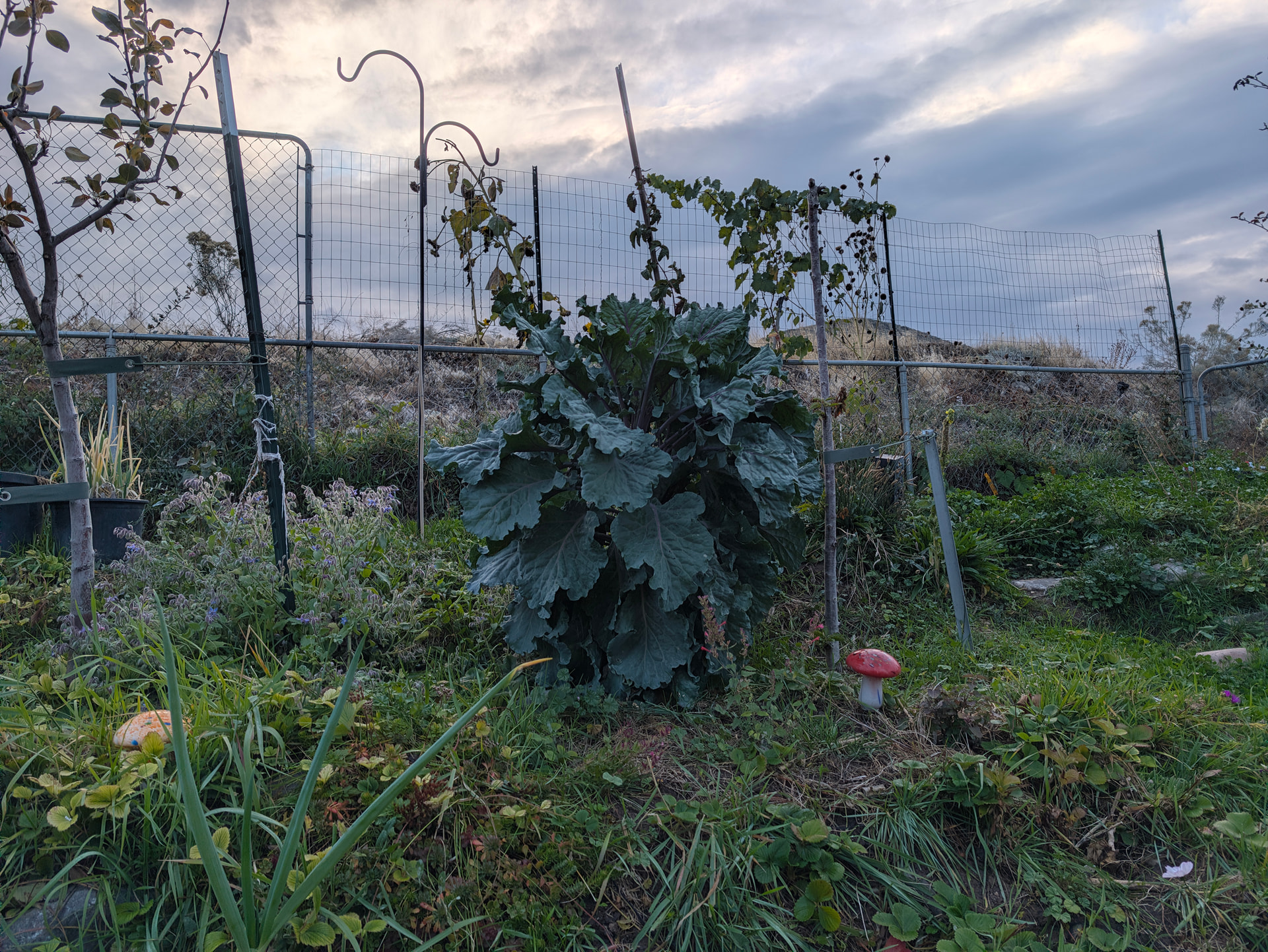
- These two are heading into year 4 as well. The two clumps of larger leaves kale are from a single plant. The one in the back is a separate plant. The larger leaved specimen stayed pretty small until this year, and it’s grown about a foot taller than in previous years. The one in back is an insect trap. They eat it to the stem every spring, but leave my other kales mostly alone. It then recovers in the late summer and fall. It’s the same size it usually reaches in its second, unmolested growth period.

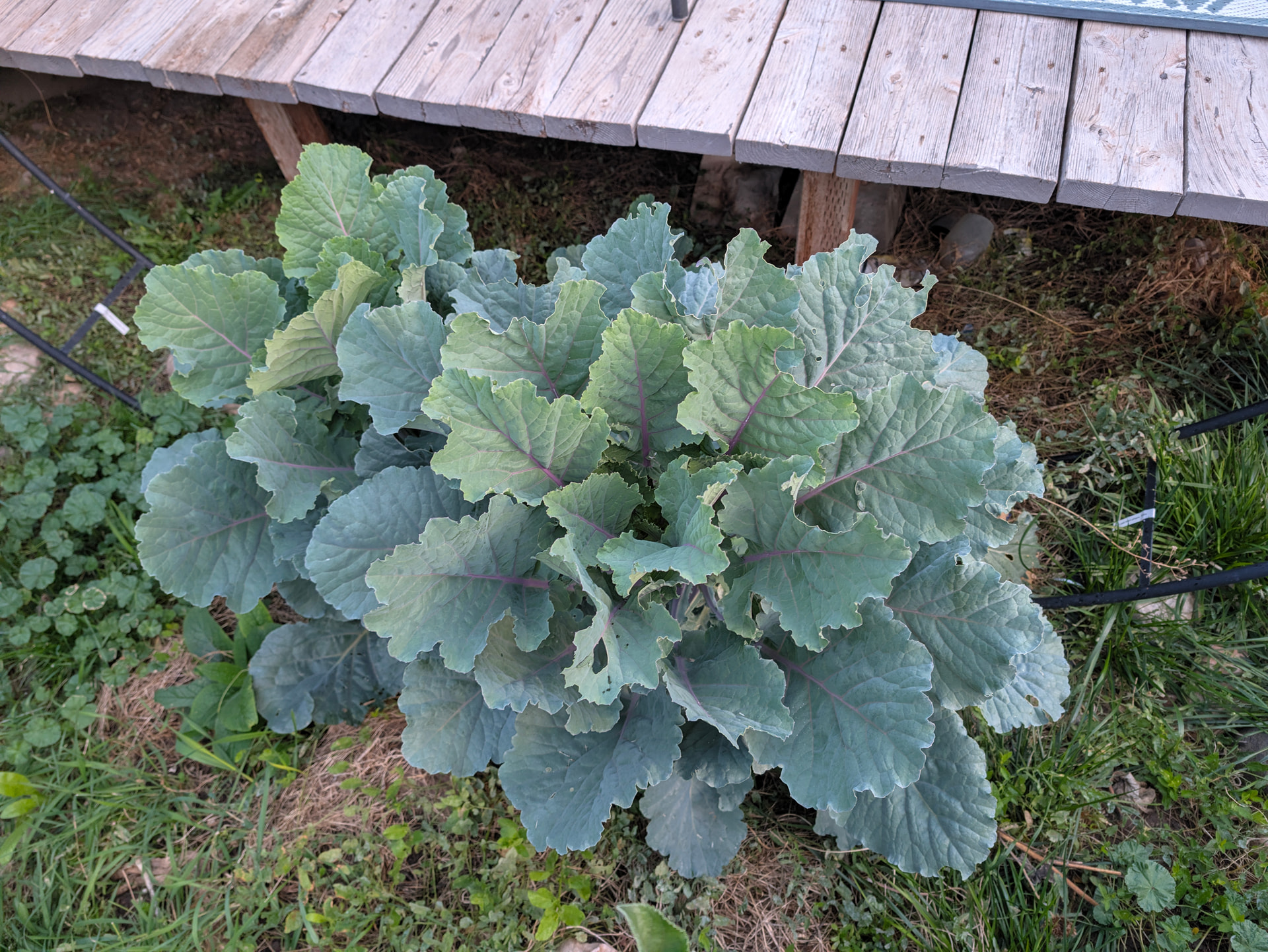
- This guy volunteered off the side of my deck this spring. Not surprising since I winnowed last year’s seed on my deck and swept the mess off the edge afterwards. It was 3’ before it leaned over and lost a foot. I’d have staked this one, except I don’t want it dominating the view. I might transplant it.
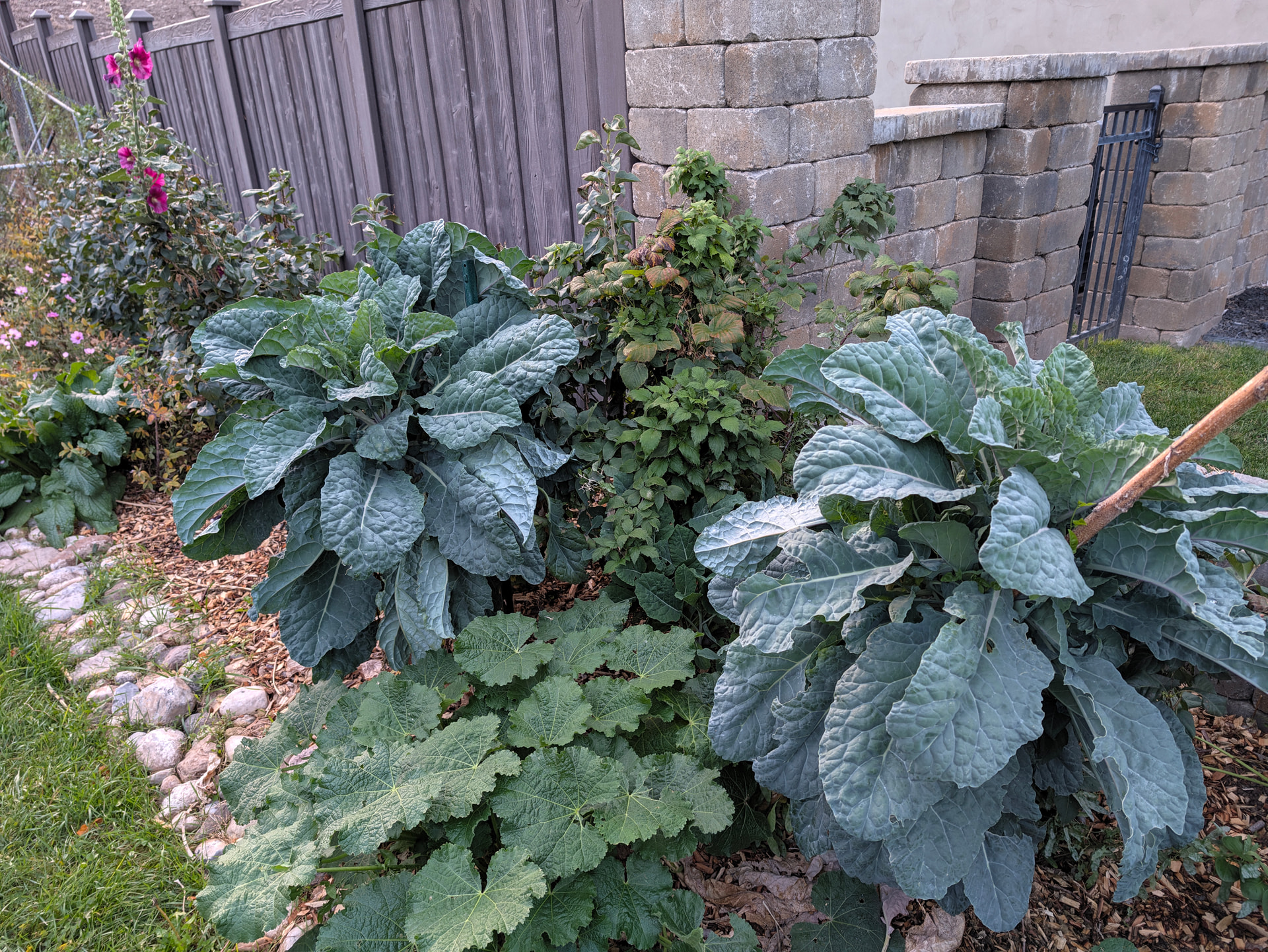
- This is a beast of a kale, and is the second specimen moving into year 5. I transplanted this one two years ago, and I was worried it wouldn’t do well. It thrived, as usual. It grew as a bush type each year before, but this year it’s decided to grow taller and taller, so I’m gonna lean into that behavior next year. I need to replace the temporary stake on the right hand stem, as it’s certainly defeating the dried sunflower stalk I lazily used earlier this year. The stem on the left has a metal post supporting it. I trimmed around 3/4 of this specimen earlier this year to clear space for the haskap and black raspberry it was overwhelming.
11 Likes
That’s tough. I’ve really gotten to appreciate the kind of selection we get around here these days.
To the extent to which it’s even quantifiable, I wonder if there is much difference in environment impact. Sure there’s the fossil fuels used in shipping, which isn’t nothing, but there’s less seasonality with that kind of produce so there’s also less cold storage like with the apples and pears and things you can get year round–and which were also shipped across a continent. And I’d think for some of them at least the inputs and the land use change is actually less harmful. California peaches grown in precious habitat with precious water vs pineapples that took almost nothing to grow and were just planted out in an otherwise mostly barren semi desert. It’s not always going to be favorable of course, oil palm vs canola maybe as a good counterexample, but I think overall it’s probably more case by case than anything else.
@Fusion_power is probably going to have a few recommendations for pecans.
3 Likes
Yes! He has helped me to pick some! but I need to get an area cleared to plant them. I was hoping go do so this summer, but time got away from me.
3 Likes
Yes, I can suggest some pecans if and when you get a place prepared for them. I’m guessing you are somewhere north of Harrisonburg. You could grow Kanza, Hark, Earlton, and Seneca for a few possibilities.
I can also suggest walnuts if you want them. Cranz, McGinnis, and Sparks 127 all have origins further north than where you live so would mature nuts anywhere in Virginia.
I spent a summer working in Fulks Run Virginia back in 1982. It is beautiful country.
3 Likes
Those last picks look like a lacinato cross. Beautiful plants, let’s get some seed!
3 Likes
Just bookmarked this post and set a reminder for next June. 
2 Likes
I want some smaller stature pecan varieties but the significant other will not approve. I guess she has visions of some of the monstrous old trees around here. I thought Kanza, Pawnee and Excel.
1 Like
Kanza shows quite a bit that it is not adapted very well that far south plus it is fairly susceptible to the strains of scab prevalent in that area. Pawnee is an absolute scab magnet, avoid it like the plague. Suggest Gafford, McMillan, Syrup Mill, and Amling as a few to investigate. You could also grow Avalon though it is showing significant scab now that it is 10 years past release.
There are no true dwarf pecans though a few are smaller stature.
3 Likes
Spring summer fall are relatively easy to maintain a food flow from the garden, winter is an issue. Building a greenhouse now, with LP gas heater. Being efficient in there will be a challenge, vertical growing methods to use. Hoping to continue from outside to inside seamlessly, with starter plants already in growth. IMO we will all experience a slow trend into food supp,y shortages in stores, increase prices, best to make sure U R ready for it now.
2 Likes
Being in the great white north, I typically reduce my dependency on the meat side (beef, lamb, deer, chicken, grouse, fish).
Preserves, freezing, and root vegetables work alright for reducing winter/spring dependency. I’m heavy on the early stages of my berry bushes and fruit trees. If everything keeps pace I’ll have plenty to share with others in my community in 5-7yrs.
4 Likes
Sproutd and microgreens may the solution for me. I grow sunflower seed greens and theyre pretty nutritious and I just do it in my counter. And bean sprouts of various types
That plus the winter squash, potatoes, sunchokes, sweet potatoes, turnips, frozen greenbbeans and Brussels sprouts im hoping I can make with little veggie buying till asparagus etc starts
4 Likes
So far I don’t have anything consistent enough to reduce my dependence on stores. I am hoping my greenhouse helps. A family nearby with the same build says they get day neutral strawberries ten months of the year! I do think that reducing berry costs would be a great place to start, as these are often expensive and taste subpar when purchased from grocery stores.
5 Likes