My recommendation would be for another European plum, for a complmentary pollination partner. If you’d like a yellow variety, then the yellow egg plum would be a good choice IMO.
From Google:
A European Yellow Egg plum tree is typically rated for USDA hardiness zones 5 through 9
My family home of 60 years, has an ancient yellow egg plum tree that is likely 100 years old. Google says a plum tree will only last 60 years max, but the farm has been in the family for 60 years, and the tree was quite old when my dad bought the property in the 60’s. The property was originally homesteaded in the early 1920’s, and I assume most of the well established fruit trees still here were planted in the 20’s.
In the entire time I can only recall cutting black knot from the yellow egg plum tree once in 60 years. Yellow egg is generally very productive if another Euro plum is planted close by. The yellow egg plums are also one of the largest size Euros you can grow. I’m talking about the size of the fruit, the tree itself is fairly small and you can expect it to reach no more than about 12 - 14 ft on a full size rootstock. With a dwarfing rootstock and summer pruning I would think it would be pretty easy to keep the tree to no more than 6-8 ft in height (if that is something you’d like).
It’s a nice flavored plum, but it can become overripe quite quickly, so better to harvest it before it gets on the soft side.
Look like you are in zone 6b, which is a tad warmer than my 6a.
You will need a Euro plum to help with cross pollination of your Castleton. I don’t know many non-blue Euro plum. Green Gage-type like Bavay Green Gage could be a choice. It’s light green, color-wise, it is not pretty. But I’ve found gages take a bit longer to produce and mine is not productive.
You may be able to grow Coe’s Golden Drop. I grow it. When we have heat into early fall, it produces very delicious, beautiful yellow fruit.
I have multi-grafted Euro plum trees. I do not have an issue with cross pollination. I can’t tell you if Castleton can cross pollination with all Euro or not. Some Euro plums seem to have an issue if a pollination partner is not a match.
Here’s an example of pollination chart but not a complete one.
One more thing, black knot will likely show up after 3-4 years and will continue to be an issue. I don’t have any plums (Euro or Japanese) that are resistant to black knot, not even Empress (Euro) or Lavina (hybrid).
Picking ahead of the storm is always a gamble but cracking losses are brutal, good call. What’s getting through the netting? We had the same problem with blackbirds last year, somehow squeezing through gaps I couldn’t even see.
Thank you everyone for weighing in and sharing valuable insights.
While I was really hoping to mix up the colors, it sounds like adding another blue/purple European plum is the most reliable way to complement the Castleton and increase my chances here in our climate.
I just placed an order for a Bluebyrd. Looking forward to watching both of these take over another patch of my lawn
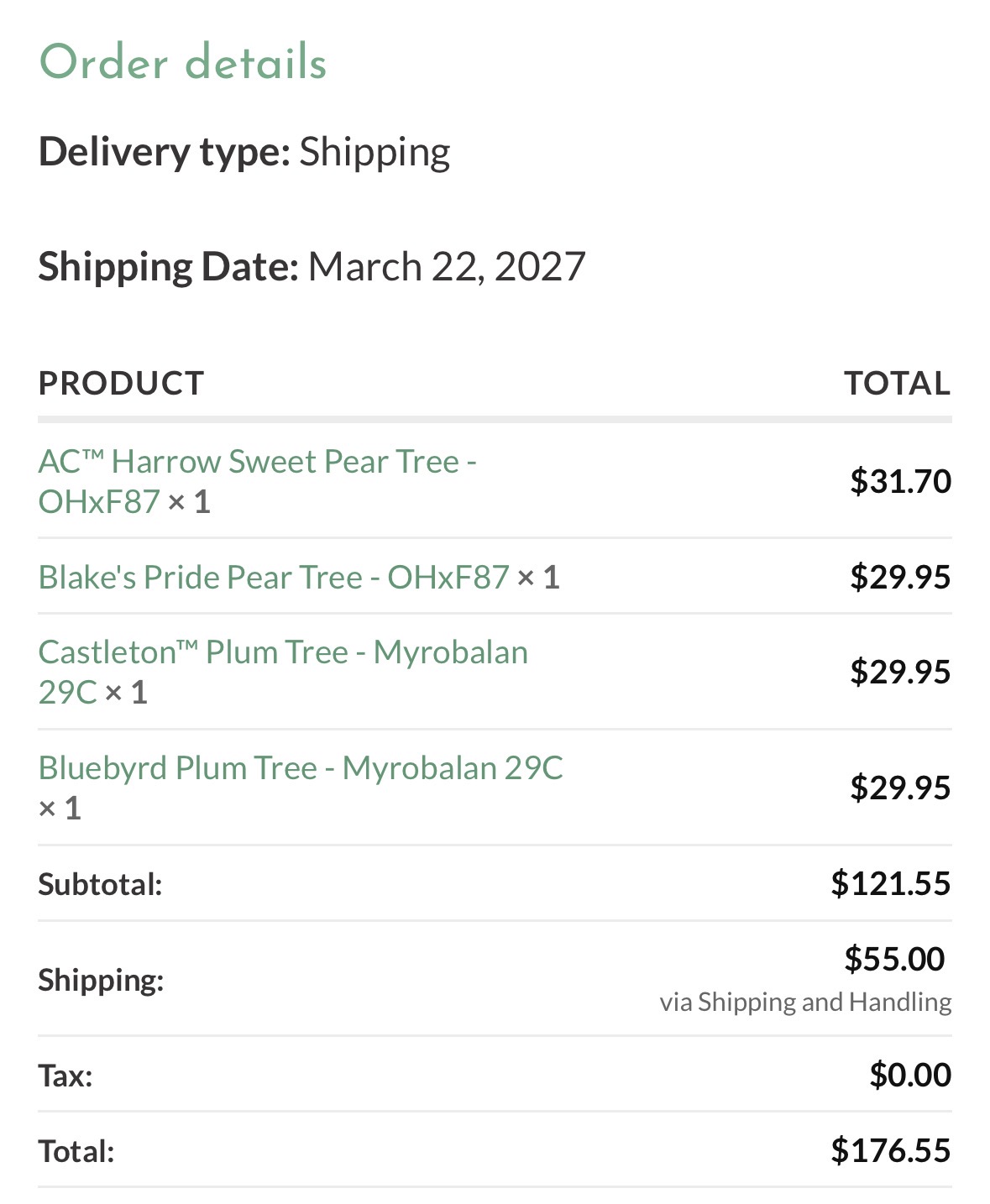
These are the trees I locked in an order with Mehrabyan Nursery for the 2027 spring.
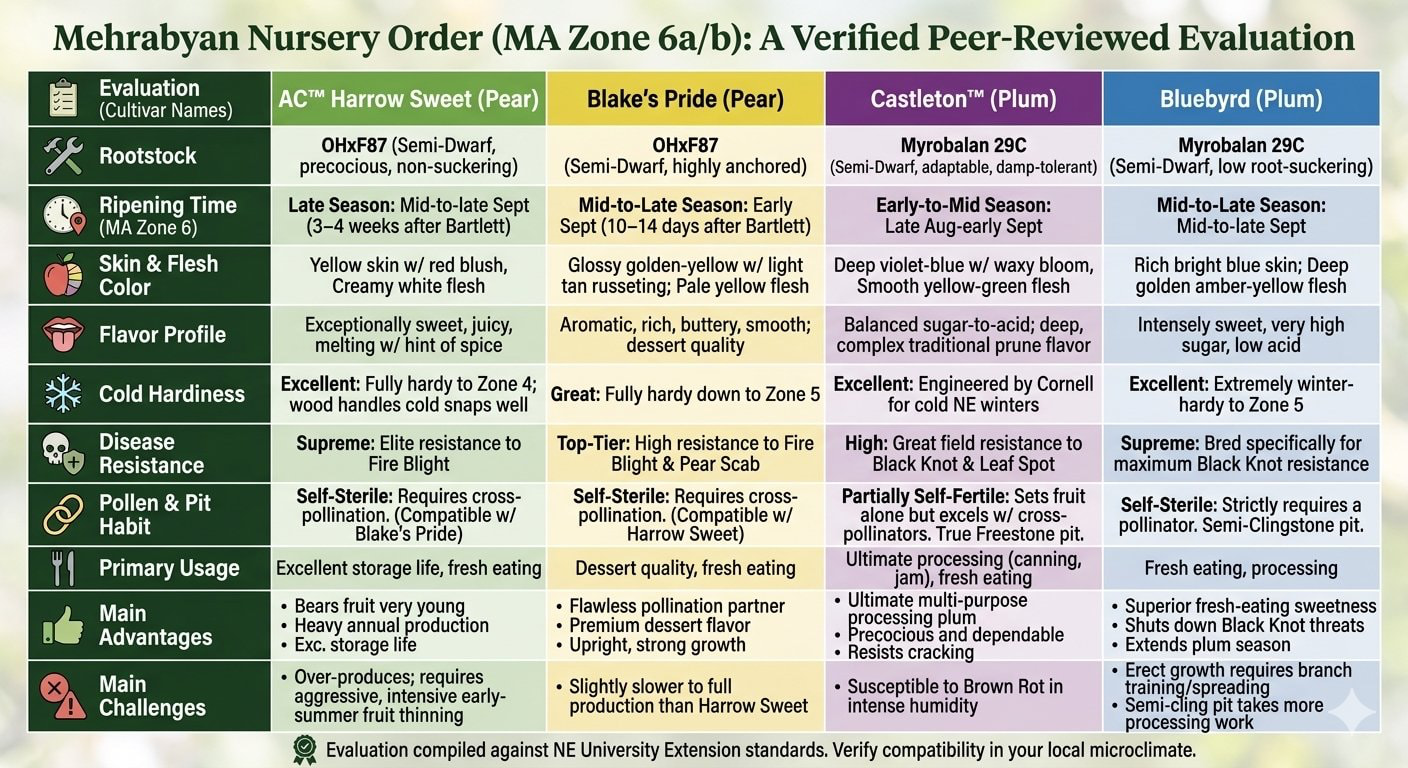
I ran the invoice data through an AI agent to cross-reference university extension specs and build a clean (?!) breakdown of their disease resistance, pollination partners, and pros/cons in general. Here is what my AI bud came back with. Love to hear any real-world tips or corrections you may have.
My first two Euro pears were Harrow Sweet and Blake’s Pride many moons ago. They were from Schlabach Nursery, an Amish nursery in NY.
Harrow Sweet was great. Early production, tasty fruit and disease resistant. My rookie mistake was that I planted it in a partial shade spot. After several years, the tree has been less and less productive and fruit have gotten smaller. Don’t do like I did.
Blake Pride - took a couple of years longer to fruit. Unfortunately, fruit’s taste and texture did not match the description. It was not that sweet and texture was a bit gritty (not smooth). It could be that I did not know how to ripen them i.e. how long to refrigerate them before counter-ripen or I got a mislabeled pear. I cut down the tree to about a 4 ft stump years. Before I could removef the stump, new shoots have leafed out and this year, it set fruit!! This tree is in a sunnier spot. I wish I had swapped their planting spots.
Thanks for the added insight. I really appreciate you sharing your experience with both varieties.
I had totally forgotten that my folks used to refrigerate pears before ripening on the counter!
The sunniest spot in my yard gets about 8 hours of unfiltered sunlight starting at 10:00 AM; will that be plenty for these two? I also hope my two plum trees, Castleton and Bluebyrd, will produce well under similar conditions.
8 hours should do. I dislike plum refrigeration because I can’t keep track what varieties need how much time. Some of them don’t need refrigeration and that are the varieties I should grow. Fortunately, Harrow Sweet can be eaten off the tree.
After 4 years, your plums should start producing. Branch bending will help your fruit trees producing sooner.
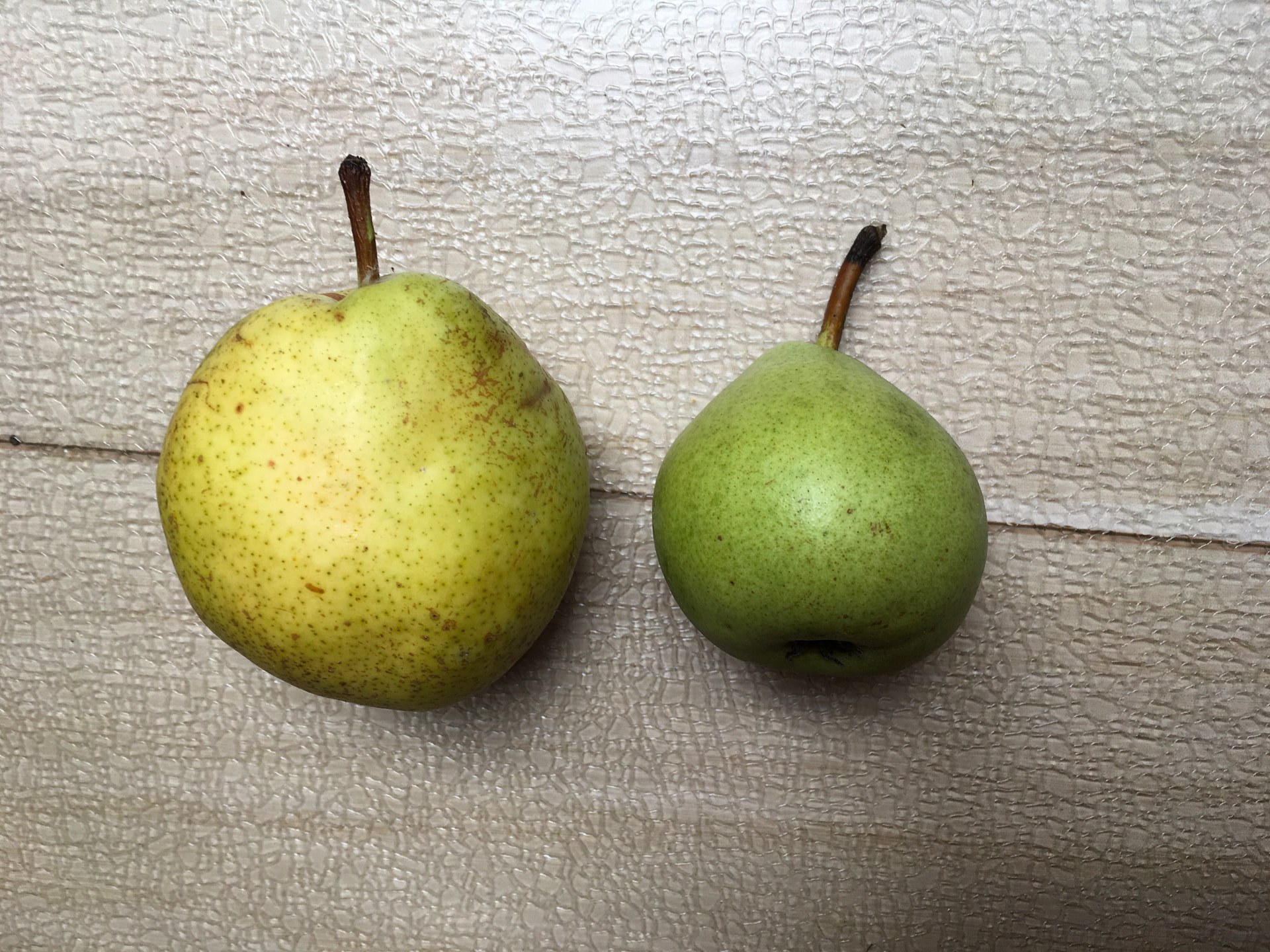
about half of the 20 pears on my trees were ripe when they colored up. the other half are still green despite them coming off with the lift test. those have been on the counter for a few days now. about 4 of the 6 cultivars grafted produced fruit this summer. the other 2 never bloomed. maybe next year. last year i had lots of blooms but no fruit so when they bloomed this spring i pollinated with a small paint brush and got near 100% fruit set. had to thin 1/3rd off but in reality i should have thinned more. pears were about 80% store size. flavor was excellent due to the moderate drought. i didnt water either of them.
Recently, @Robert created a thread listing Euro pears that do not need refrigeration. I’ll try to find it
I wish someone created another thread listing pears that need refrigeration and how long each variety should be refrigerated before allowing to counter-ripen. I think there were some info mentioning here and there over several threads. If it could be organized into one pear refrigeration requirement thread. It would be very helpful and could be used as a reference.
That one is a little more difficult. Comice, Bosc, and D’Anjou are about the only ones you can find info on. I thought FDML needed the fridge, but after experimenting I found out they ripen just fine on the counter. Who knows how many more are like that.
A couple of days ago, I had one Potomac that turned light green while the rest are still green. I put it on a counter and will see if it could ripen with refrigeration.