Ok Chance for those of us who wish do start guerrilla orchards on public or unused private land do you have some tips? Do you bring a large sack in a night? How do you water the stuff in the beginning? How do you bring in say small trees ? etc. etc.
This comment tells me you don’t have a lot of first hand experience with mullein. It grows just as happily in my amended garden soil as on my worste soil. Nowhere on my property has ever been anything even remotely close to a monoculture, but I still have to manually control the mullein to keep the population in check.
I’ve had mullein in my garden for 20+ years and it grows wild everywhere around me as it has done since before I arrived on the planet. Is that enough experience?
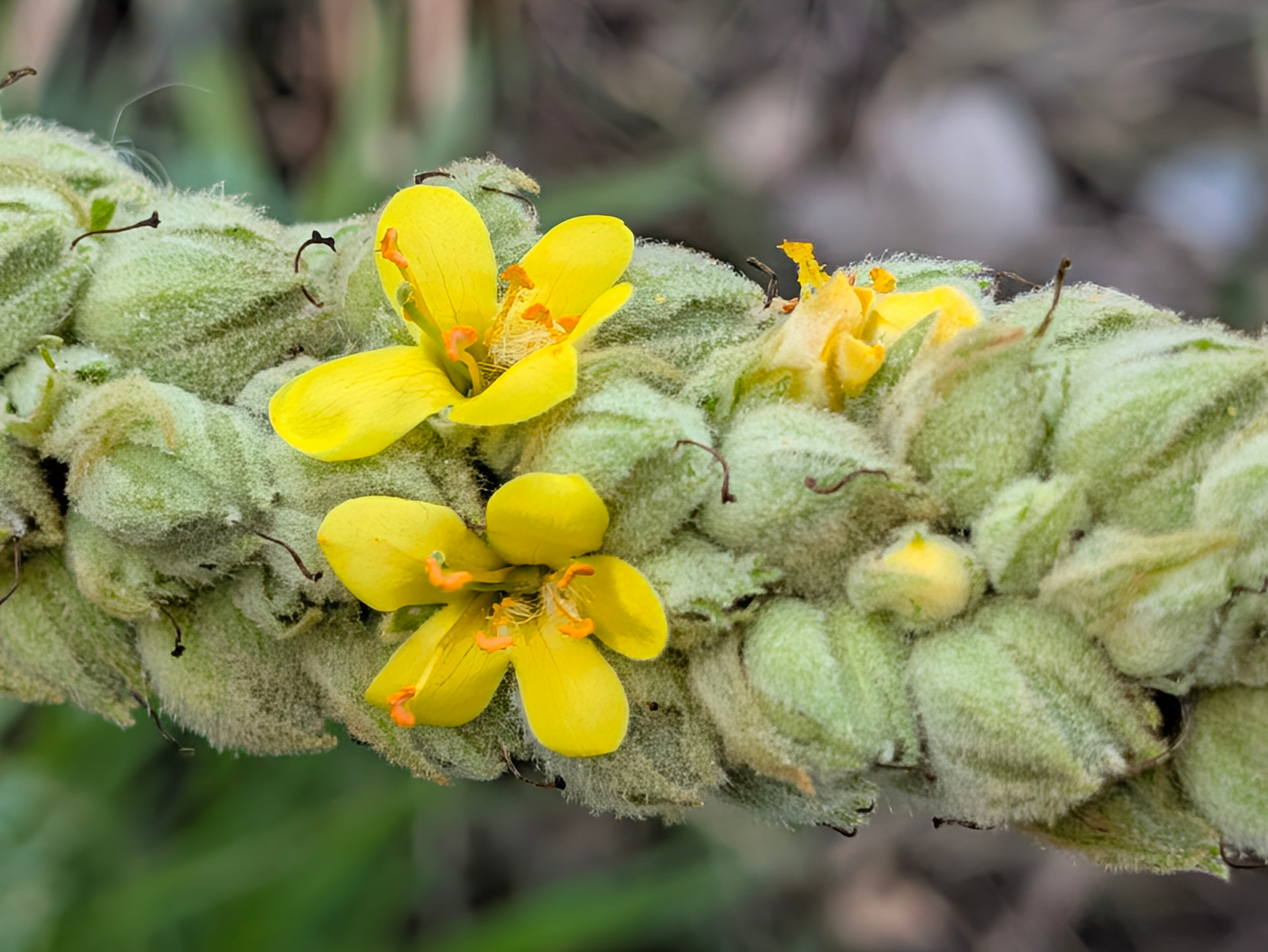
Here’s a nice picture of some mullein blossoms from my yarden for you to enjoy while you ponder.
You should get a well put in which is a must for any well done food forest project.. I am sure you have already thought of this but if you haven’t, you now have. That is the first and most important part before a single plant is purchased.
Mullein is a prolific producer of seed, and said seed seems to have great longevity, allowing it to saturate the seed bank over time. I like mullein so I used to just let it grow where it wanted, but over time it started to proliferate to the point that I’ve had to begin actively managing it. A couple of years ago, I started limiting how many were allowed to go to seed. Last year, I had a zero tolerance policy of letting any of them go to seed and yet this year the population still increased.
I must bring up, now that I’m done being a bit intentionally obtuse, that I’m in the American West, and mullein grows wild here, but does not misbehave.
Part of the reason for that is the annual heat and drought cycle. 0-0.2” of rain for three months in a row combined with temps that soar into the 100s frequently (°F) does a pretty good job of managing the population.
Even in the mountains, where moisture is more consistent, they simply don’t outcompete anything in an obnoxious way.
Another part is the rugged nature of the competitive pioneer species that populate the high-desert. Mullein isn’t the only local with plentiful and/or persistent seed. A couple of the local asters will choke out a mullein patch if given any advantage, for example.
Mullein is deemed as invasive in my state, but not to the point that removal is mandated. I’m not personally trying to eradicate it, but am controlling it to ensure balance on my property. I am happy to keep it around, but do want to limit its alloted space.
I’m of several minds on this. I’ll try to concisely outline them:
Start subtly: Walking onions, wildflowers, perhaps (if your local soil is acidic) some blueberries, or any low shrubs that are pretty and unobtrusive. If there’s existing irrigation, put these kinds of things along the edges of the irrigation zone (or just beyond it).
A great place to start is wildflowers and herbs along any existing paths. That will get people subconsciously on your side. When the paths that they already regularly walk become more beautiful, they start expecting that beauty and desirous of its presence.
Eventually, you can start planting more obvious plants, and maybe even develop a positive relationship with the groundskeeping staff so you can have unrestricted or mildly restricted access
Jump right in: Head over to your local park with some potted plants and/or bare roots in the wee hours, if you’re nervous just put on a reflective orange vest and a hard hat and act like you belong, and start digging and planting. Dig out turf circles, plant your plants, mulch the area so it looks official. Make everything obvious you do look nice and pretty and intentional. Then, let the park’s sprinklers keep your plants happy.
Clandestine adjacencies: If there are untended areas of the park, or unmanaged adjacent areas, you can work in these areas over time, only making obvious and inviting paths once things have gotten established. Do whatever you feel like in these areas, the only people who frequent these areas are nature lovers, kids with imaginations and the homeless. None of them will care. When you start bearing fruit, carve out a path that people will notice and use, then move on to the next area or keep building out in the existing area.
Couple of Finer Points:
Water: If there’s no irrigation, and no local sources, and the ground doesn’t retain moisture through the summer, then it’s buckets until they’re established. That means starting small. How far can you carry 5 or 10 gallons. I’m a physical specimen, and carrying 140 lbs isn’t a big deal, but if I had to do it for a mile every several days (maybe even for multiple trips), that would get old in a hurry. Choose locations close enough to fit within your fitness, willingness, and timeliness needs. This is obviously also a call to limit yourself to a few initial plants. Whatever you can successfully water with the amount of water you’re willing/able to carry. It’s also an encouragement to test the limits of drought tolerance, especially once established. Species and variety choices will matter here.
I’ve planted more than 100 plants in my project area, and many more across the mountains and valleys of my home region, having done so across many outings, and I’ve never had anybody question what I’m up to. I stand up straight, make pleasant eye contact, say hello, and otherwise act like I’ve nothing to hide. Don’t get all weird, or furtive, or chucklehouse. Just be cool and do what you’re doing. Also, I take my kids a lot if times. They disarm anybody who might question a dude with a bunch of potted plants and a shovel.
If your city sells merch shirts with the city name and emblem on it, but one and wear it while you’re doing your guerilla work.
There’s obviously more one could say, but this seems a fine opening salvo.
@Chance_Lunceford I’m following your project from a bit farther north near Sun Valley, Idaho. Looks like a lot of fun! I’d love to graft some of that plum onto my wild seedlings here whenever you get enough scion wood.
Being in a similar high, dry, cold and hot climate, I can say that mullein is well behaved here. Even in disturbed areas, it never gets out of hand. If your soils are similar to mine, Canadian Thistle, hounds, tongue, burdock, rush, skeleton weed, and bindweed are all much much more aggressive.