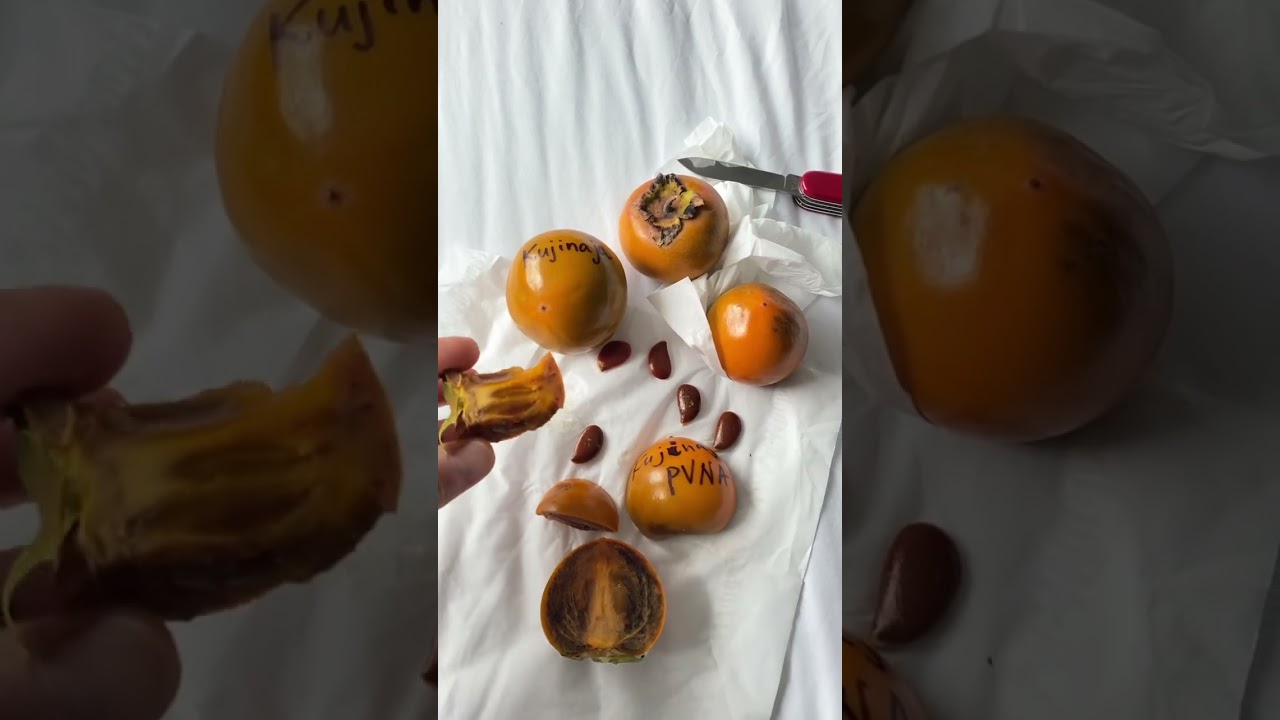
Absent more data, I’ll try my best to respond. . . .
You are describing a recessive trait (e.g., blue eyes) that can be passed on to children even if not expressed in parents. All true. For example, my two sons and their spouses all have dark brown hair but their 4 children include 1 redhead and two platinum blondes. And in case you’re cynical, paternity is established by 23&Me.
The PVNA mutation is not recessive. The persimmon genome is hexaploid – 6 sets of chromosomes. Breeding experiments show that cross between a PVNA parent and a PCA parent produce a mix of PVNA, PVA, and PCA offspring. This is not possible if the PVNA trait is recessive. Moreover, the proportions of PVNA, PVA, and PCA offspring suggest that it take 1 PVNA allele to produce a PVA phenotype, 2 or more PVNA alleles to produce a PVNA phenotype. The unambiguous take-away is that the PVNA trait is not either dominant or recessive but rather additive.
That said, the key question here is: How did two or more PVNA alleles enter the Kuji Naja genome? I’m looking for an answer that involves more than magic.
It has been established to look similar to a PVNA but we don’t know that any change in color and/or astringency is caused by pollination. What does the unseeded fruit look like? Taste like? The author says that she spit out the unpollinated fruits before ascertaining whether they were astringent. And there are no unpollinated fruits to inspect: I quote from the video, “I did not get any unpollinated fruits from the orchard.”
Pollination variant means that pollination causes a change. We have no basis for assessing whether there was a change due to pollination.
yes, i hear that, my experience however is when i eat an unripe persimmon it doesnt take long for astringency to set in. Either way hoping more are growing this
I just grafted a Kujinaja tree this Spring and unfortunately it will take a while for it to fruit if it can handle my Z5B Omaha, NE.
In addition, Dax gave me 8 seeds of the Dark flesh pollinated Kujinaja crossed with Rossy male at Cliff orchard. All 8 seedlings are about 2 feet tall now since planted this May. I do have male pollinators in a pot to pollinate the kujinaja whenever it decides to flower in a few years. Btw, Cliff will be sending me 20 seeds of Kassandra crossed with Rossy male to trial in my zone 5B. I got tons of hybrids growing now on my average lots. Cheers.
Yes, she says that she spit out the non-pollinated fruit.
No, it is not clear that she spit them out because they were astringent.
This may be what you wanted to hear and, knowing nothing else, it might seem the most likely explanation. But what she actually said is that she spit them out quickly so that no astringency would enter her mouth. It was preemptive. And it was successful – she tasted no astringency. Thus, she also stated explicitly that she could not confirm that the unpollinated fruits were astringent. Here’s the verbatim quote:
“I also tried a number of non-pollinated fruits but I spit them very fast because I didn’t want to get any astringency in my mouth but I cannot confirm for sure that they were, however, astringent . . . .”
It’s a 57-second clip, which you sent to me. How could you get it so totally wrong?
Of course, I can’t know for sure whether Kujinaja somehow is PVNA. What I do know is that the evidence presented here doesn’t prove it:
The fruit looks PVNA, but as noted above there are many ways to turn persimmon flesh brown.
There are no unseeded fruit shown (or eaten), so we can’t tell whether anything varied. Maybe the unseeded fruit grown in the same conditions also have brown flesh – and there’s no “pollination variance” at all.
The easiest way to sort this issue is to check more fruit. Did anybody eat this variety this season?
Can you verify that your Kujinaja tree has both pollinated and unpolluted fruits on the same tree? Or is it always pollinated with seeds and dark flesh and able to eat firm without astringent taste. Have you ever cut open a Kujinaja fruit that turned orange color without dark flesh and with astringent taste.
A scientist, a mathematician, and a regular guy are riding a train through Scotland.
The regular guy looks out the window and says, “Wow, all the sheep in Scotland are black!”
The scientist shakes his head: “No, only some of the sheep in Scotland are black.”
The mathematician sighs: “No, gentlemen — there is at least one sheep in Scotland, at least one side of which appears to be black.”
Easy solution, which did you mean? did you taste astringency and therefore spit it out, or did you spit it out because you feared it might be astringent
The one in which you say, “I also tried a number of non-pollinated fruits but I spit them very fast because I didn’t want to get any astringency in my mouth but I cannot confirm for sure that they were, however, astringent . . . .”
I did spit out the fruit as soon as I noticed that it’s orange and not browned inside. I can’t confirm that it was astringent when not pollinated. I don’t grow Kujinaja. It was perfectly non astringent when pollinated
Cliff verifed with me that Kujinaja was indeed PVNA. His 115-30 Bohzy Dar aka God’s Gift has both male and female flowers that pollinated his Kujinaja. The fruit seeded with dark flesh that can be eating while being firm and the unpollinated ones with no seeds on the same tree with yellow color flesh were astringent.
Thanks. I’d always like confirmation from other growers to ensure that this result is not something related to the specific tree or location rather than to its variety per se, but I’ll take the report at face value.
That leaves my original question: Where do the PVNA genetics come from? I ask this question knowing that (a) Rosseyanka is PCA with no evidence of PV ancestry; and (b) Costata is widely (though not universally) believed to be PCA. So there’s no obvious source of PV genetics within the presumed parents.
Here are some (not all) possibilities:
Kuji Naja exhibits a novel PVNA trait, unrelated to the PVNA trait exhibited in Kakis such as Nishimura Wase. The reason might be some new mutation. This would be an intriguing outcome, and we should try to test this hypothesis, but IMO the odds seem low.
Kuji Naja is mis-labeled – Cliff’s PVNA tree is not David Lavergne’s Costata x Rossey male hybrid but rather some other variety, such as a PVNA Kaki. Accidents happen. But IMO, the fact that two “twin” trees are planted together seems to eliminate this risk.
David Lavergne may have committed a breeding error, messing up the cross, inadvertently pollinating Costata with some PVNA Kaki, such as Nishimura Wase. While not impossible, this seems unlikely. But if that’s what happened, the outcome is very positive serendipity.
The Kaki mother Costata (aka Picudo) has some occult PVNA genetics that are revealed more readily for some reason in the hybrid than in the mother. The consensus appears to be that Costata is PCA, but the opinion is not unanimous. For example, the Spanish manual (“El Cultivo del Caqui ”) reportedly describes the variety as “astringente variable a la fecundación (tipo PVA)” —i.e., PVA.
The reason we can’t be sure is that the PV trait is not purely dominant or purely recessive but rather additive – more PV is expressed when there are more PV alleles. So maybe Costata carries only 1 or 2 PV alleles (of 6), and the trait is expressed in the phenotype only rarely under special circumstances.
So then the question would become: Why is the PV trait rarely if ever expressed in the mother Costata while it appears to be regularly expressed in the offspring Kuji Nana? What we see reported could be the result of (a) 1-2 PV alleles transmitted from Costata to the offspring Kuji Nana, plus (b) some facilitation of the expression of the PV trait. But how / why?
The existence of a PVNA hybrid (if not somehow disconfirmed) is promising. It’d be great to have a tool to reliably remove astringency from hybrid varieties. But we shouldn’t stop here with Costata and Kuji Nana. If the PVNA mechanism that is operative in Kakis can be expressed in hybrids, we ought to grow lots of PCA Hybrid x PVNA Kaki crosses – just to see what pops up. For example, we can use an unambiguously PVNA Kaki such as Nishimura Wase as the male, getting PV genes from the male parent. And if we want a cold-hardy PVNA hybrid, we can use a cold-hardy hybrid such as Kasandra or JT-02 as the female.
Coincidentally, last year I gave hundreds of seeds from my hybrid Kasandra, pollinated by my PVNAs (Coffee Cake, Chocolate) to an entrepreneurial grower and to a few other friends. Many of these seedlings are now growing. A PVNA Kasandra child would be spectacular.