Did you save any Kassandra or JT -02 X Nishimura wase seeds this year that you can grow some yourself for trials. I do think Kujinaja fruit shaped definitely took a Costata shaped but way smaller fruit.
Tony
Did you save any Kassandra or JT -02 X Nishimura wase seeds this year that you can grow some yourself for trials. I do think Kujinaja fruit shaped definitely took a Costata shaped but way smaller fruit.
Tony
So far, no. But I probably should start. Last year the crop of JT-02 was small, so I didn’t save those. But I harvested hundreds of Kasandra fruits and I must have saved / gifted >500 seeds.
Anyway, I probably have 30-40 uneaten JT-02 and 500 Kasandra fruits left. So there’ll be plenty of seeds.
That said, I don’t think I want to grow them out myself. But I’d send them to any ambitious forum member. 
I got 20 seeds of Kassandra X Bohzy Dar from Cliff. I can try 10 seeds of your Kassandra and JT-02 X Nishimura wase for trials that would be great.
Tony
Sure, just PM me your mailing address.
To be clear, I have Nishimura Wase (Coffee Cake), Tsurunoka (Chocolate), and Giboshi (Smith’s Best) in close proximity, all ~10 yards from JT-02 and 3-5 yards from Kasandra. As you know, all of these are PVNAs. I didn’t see males flowers on Giboshi; there was a decent batch of male flowers on Nishimura Wase; and there was a massive batch of male flowers on Tsurunoka, which I grow mainly as a pollinator. So the pollen donor is likely to be PVNA but not necessarily Nishimura Wase.
Technically, I should also point out that there were male flowers on Taishu, which was also nearby, though of course Taishu is PCNA. If by chance Taishu pollinated JT-02, then there’s a 5% chance by my calculation that the offspring is a PCNA hybrid. That would be an historic find.
So it’s a bit of genetics roulette.
This is what I have experienced concerning Kuji Naji.
I visited Englands open house in 2024, looking for tasty fruit to graft on my probably 60 chromosome native American persimmon rootstock, seeds planted in spring of 2024. I sampled firm, or hard, or “green” Kunji Naji. It was not astringent. I didn’t pay attention to whither or not there were seeds. Being fascinated by the diversity of Kuji Naji, I ordered scion and now have two 6’ successful ,spring of '25, grafts in my fledging persimmon patch.
My friend Larry Burton, of Bear Wallow fame, and I attended this years field day, still looking but not totally satisfied when we left, due to a lot of Kaki hybrids of large size , recently released , UKR and England crosses not being ripe enough to sample.
We made an appointment with Cliff for last Friday to return to farm #3. In his accompaniment, we walked and sampled and gathered fruit to take home and kitchen counter ripen, which we paid for by the pound upon leaving.
Just us three, talking persimmons, and eating and comparing sizes and origins of the sometimes mysterious orbs. I recommend it as a learning experience And I’m straying here, but this is important to me because it portrays who Mr. England really is. As he was driving me back to my automobile , he received a phone call from a representative of a veterans group, making an appointment for twenty some defenders of our nation, all suffering from PTSD. Upon questioning, it come out that Cliff, himself a sufferer, will tour the orchard with them and explain that you have to concentrate totally on a project, and persevere, in order to survive. Bless you Cliff! And I thought it was all about persimmons?
While there, Larry sampled a firm Kuji Naji, and declared it "not astringent. I found one softening a bit, and sliced off a piece. It was not astringent. I brought the rest home. It ripened. Was delicious. Had 6 seeds!
thanks
Joe Dunkum
Joe – Thanks. Additional data is very helpful.
Some follow-up questions, if you don’t mind:
Since all persimmons become non-astringent when soft, the best way to identify a PVNA variety is to check whether it is non-astringent when firm. That’s what we see in Marta’s video.
But here’s the key – in PVNA’s, non-astringency is caused by chemical compounds produced by the seeds. So a true PVNA persimmon with be non-astringent when firm and seeded (as in Marta’s video) but astringent when firm and unseeded. This leads to two diagnostic questions:
You report that Larry sampled a firm Kuji Naji and declared it non-astringent. Was it seeded (like the one you brought home)? A firm, seeded, non-astringent persimmon would almost certainly be PVNA and would confirm Marta’s report.
Did you or Larry sample any firm unseeded fruit? A firm, unseeded, astringent fruit would seal the case by eliminating the possibility, however remote, that the non-astringency in Kuji Naja is caused by something other than the seeds. Basically I’m just asking whether you can confirm Cliff’s report (above) that the firm unseeded fruit are astringent.
Thanks again!
if the firm unseeded fruit are non astringent isnt that basically better
Yes but it would imply something very different than PVNA. Something never observed.
In a PVNA fruit, the seeds (if present) produce compounds (e.g., ethanol) that the fruit uses to produce other compounds that cause the tannins to polymerize, making them inert in the mouth, so we perceive no astringency.
If unseeded fruit are non-astringent, it implies that the fruit produces minimal amounts of tannins, just like a PCNA Kaki. Both the parents of Kuji Naja (Costata and Rosseyanka) produce tannins. So if the unseeded, firm Kuji Naja is non-astringent we’d have to postulate some novel process or mutation that disables the tannin-producing processes inherited from the parents.
I think now that we have verified the fruits have brown flesh and that they are non astringent when firm they are like 99.99999999999999999% PVNA
Do we know for sure it’s not a brown fleshed PCNA? I guess not but I think any other explanation is vanishingly unlikely
That was my take on what she was saying too, but I found it a little confusing.
Like the 5 second rule for dropped food, it doesn’t really make sense. I was of the impression that if astringent persimmon touches my tongue the sensation is practically instantaneous and is lasting.
edit: I posted this before I saw that Marta herself had replied to the conversation.
How Kuji Naja might have become PCNA, given its parents, would be a much bigger mystery.
Anyway, I’m pretty sure that a “brown flesh PCNA” is a PCNA that has one or more PV alleles. Fuyu is an example. Breeding experiments show pretty clearly that Fuyu has some PV genetics, even if the PV genes are irrelevant to its non-astringency.
I’ve just checked with Larry. He went to storage room and cut open his last one. So between us both, we brought home 4 Kuji Naji. All 4 , when soft were non astringent, chocolate and seeded. I’m now out of subject matter so can’t contribute further.
But I’m now aware of the question seeking answers , so will be more observant next time.
thanks
Joe Dunkum
I read the thread. Looks like once again I will be hunting for a new set so scions to graft next year. So, Englands is where everyone is getting scions for this cultivar?
I tried reading as much of this thread as I could, but isn’t this variety Kuji Naja a unicorn regardless? Unless I’m wrong, isn’t this the first variety ever discovered that can be non astringent when hard and can survive -16f? According to the information I can find, it was planted back in 2013. McKee, KY got down to -16f to -18f back in 2015.
The only other documented cold hardy “PVNA” I can find is Pamyat Chernyaeva. It is rated down to about -11f. They describe it on this website as being non astringent when adequately seeded. If not, it’s astringent. They have a photo of the inside flesh when seeded and it’s not brown fleshed.
Time to see whether we have more data . . .
Tony - That was 2023. What did you learn?
@Arhus - Also 2023. What did you learn?
[quote=“tonyOmahaz5, post:29, topic:50649”]
Well Dax and I are going to grow out a bunch of Kujinaja seeds that Cliff sent to us. Cliff think Rossyanka male was the pollen donor. Any guess what are the seedlings will be?
[/quote] toos
Tony – This was 2025 so probably it’s too soon, but I’ll ask anyway: Anything yet?
Jobe – Grafted n 2025. Often grafts will fruit the following year. Anything yet?
One set fruit, but dropped them early.
Keeping fingers crossed as both are grafted on my native 60 chromosome rootstock as I’ve lost three such grafts to SKDS.
But maybe next year!
IMy Kujinaja graft got destroyed by an 70 mile straight wind several years ago and I did regraft last year. It is about four feet tall now.
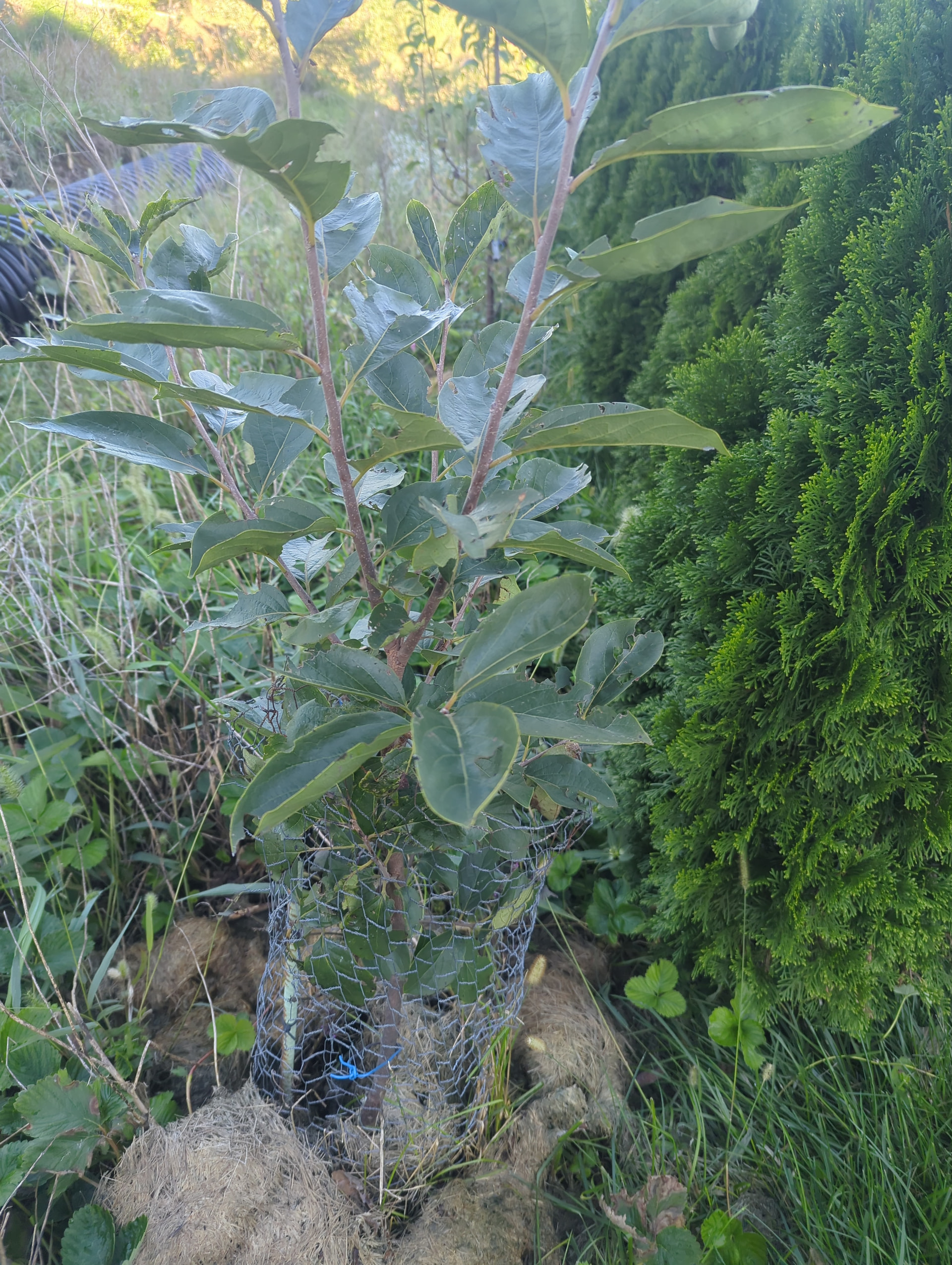
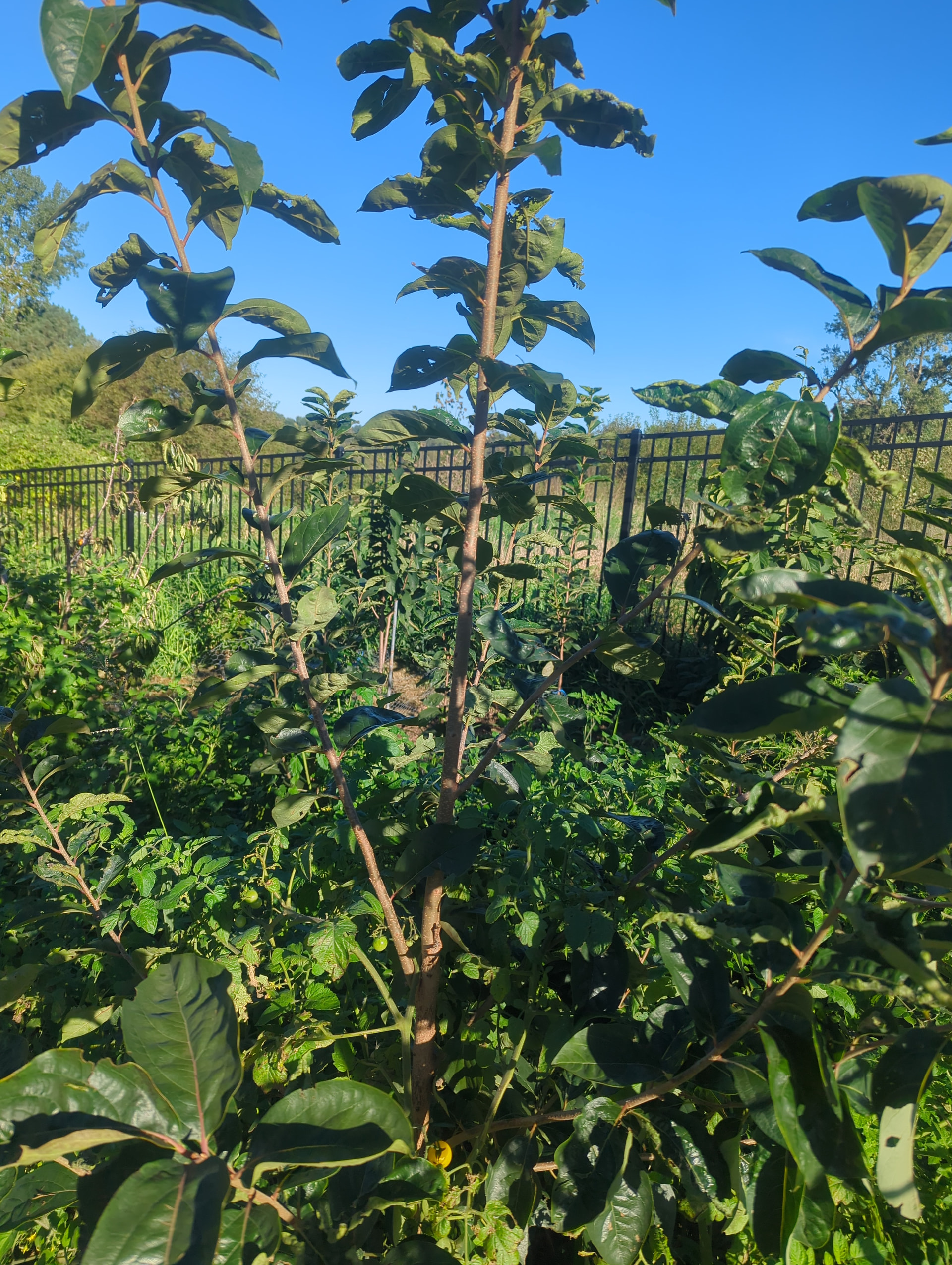
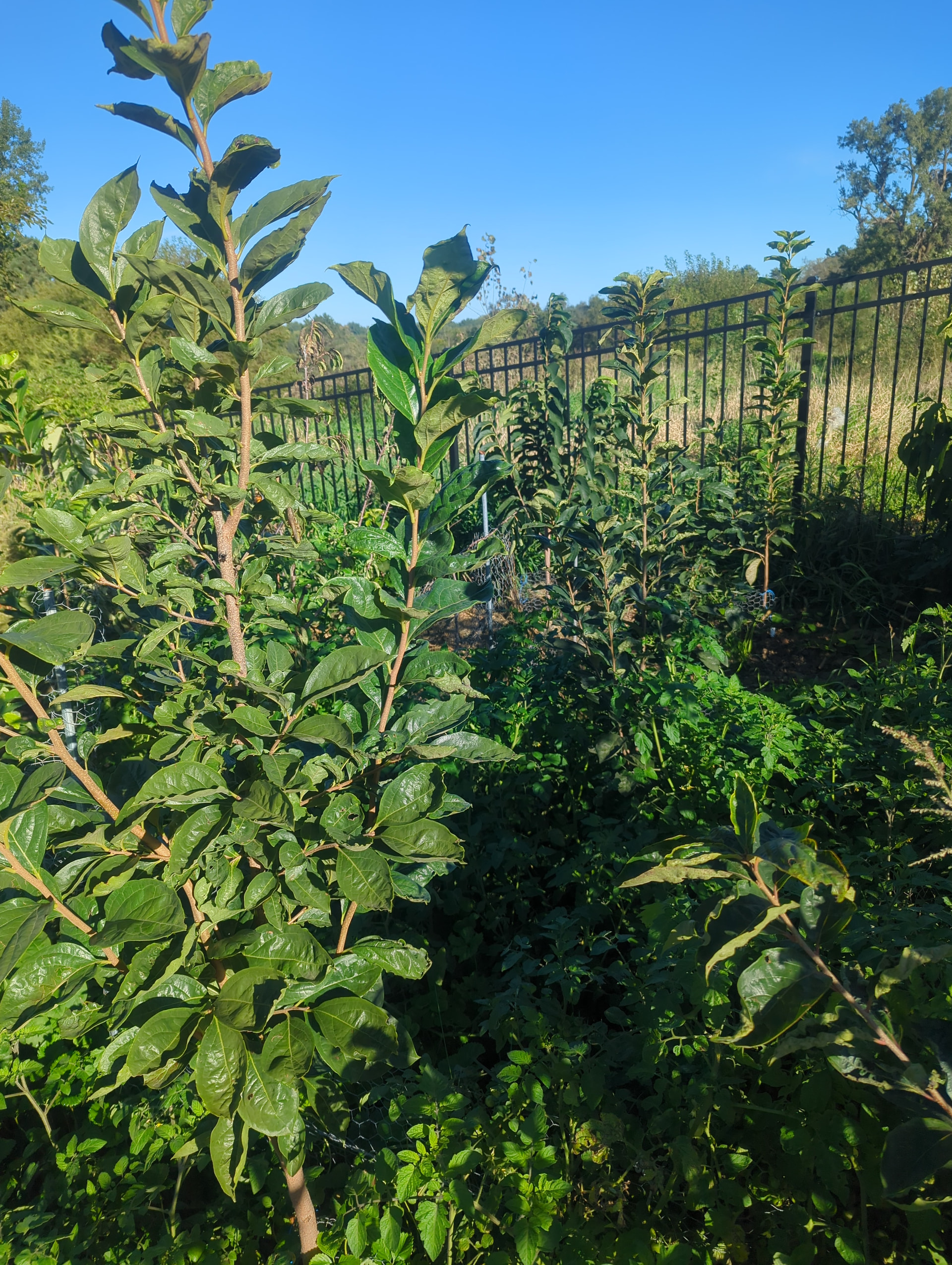
The seven Kujinaja seedlings x open pollination seeds from Cliff England three years ago are six feet tall now. Not sure when they are going to flower. They handled the cold to -18F so far without any issues.
Those trees look great, wonder if theyll make flowers soon