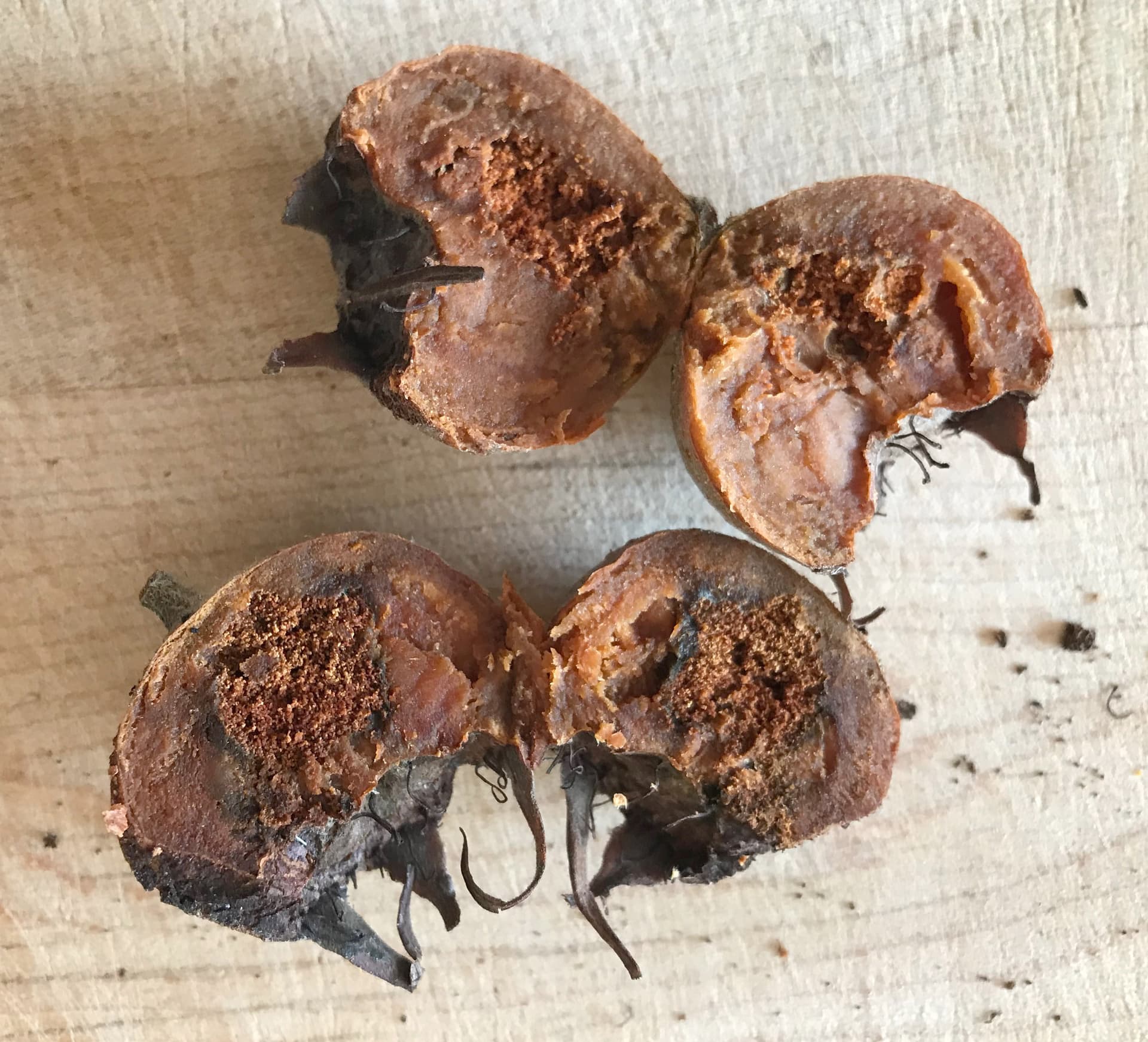
I grew medlar successfully for years, but for the past few years almost all fruits are inedible, rust-colored, and dryish inside. Does anyone know what the problem is? Rust disease? And any way to control it?
The leaves do not show any signs of disease or other pest problems.
Had problems with mine last year. It was suggested to me that they were infected with brown rot. Never heard of them getting rot, but I googled it and it appears that they actually can. I was also thinking rust, but it didn’t really look like rust.
The first two years my medlar tree bore any fruit, all the medlars were hard, dry and crumbly inside. I assumed it was me and I was still learning when to pick and how to blet them. But a clue came in the second year. I had let them blet in a box above my wheel barrow, and in the wheel barrow were a hundred dead little grubs or worms. I assume they crawled out of the medlars and out of the box, but couldn’t crawl up the sides of the wheel barrow.
Last year I sprayed the medlar tree once or twice when spraying for plum curculio, and every medlar I tried was moist and lightly sweet. (I also let them blet on the tree last year.)
I have a lot of plum curculio pressure here that hit the stone fruits, apples, and pears hard and have never seen any on or in my medlar fruits. I’m not sure what your grubs were, but I’m betting they weren’t plum curculio.
I don’t blame you. For me, they are no spray and maybe my lowest maintenance fruit trees, but I’m fortunate not to have much of an issue with fire blight or rust here. If they were more prevalent in my area, then I wouldn’t be enthusiastic about medlars.
This happens in Kentucky as well. I strongly suspect codling moth or a similar lepidopteran. The heart of the fruit is filled with what looks very much like frass (my massacred medlars look exactly like the pic in the OP) and the seeds are often missing. Sometimes a small, round hole will be present in affected fruits—likely an entry sting and/or exit. These—the hole, the focus on the core and seeds of the fruit—definitely sound like the calling cards of the CM. I did find a few scattered references on the web to M. germanica being attacked at times by CM. It seems no pome fruit is entirely safe from them.