Thanks for sharing. I didn’t know about this podcast series which seems very interesting.
1 Like
i think i found out about it here on the forum.
2 Likes
My Kha Kheti medlars are finished. Tasty but small and tart.
I just tasted my first Nottingham the other day. Delicious! My pineapple guavas used to ripen first, then medlars. Now it seems it’s the reverse. Nottingham may ripen later than Royal…
John S
PDX OR
What about the ‘Iranian’ mentioned in the podcast and book? Sounds like one to track down. Anyone have any luck sussing out if its in the US, perhaps with a different name? Someone should ask the USDA person, probably in Corvalis. I don’t have time or bandwidth at the moment. The description of its flavor and reliable ripening and on tree bletting sound really appealing.
One interesting takeaway from the podcast was talk of failed bletting attempts, particularly with ‘Breda Giant’. That’s been my experience at times and its good to know Im not the only one. Im bletting mine in a cardboard box outside this year. They started on the tree and were definitely dropping, so I picked the lot. They seem to be going off pretty well so far, with the slight puffiness that tells me they’ll be moist and tart, not dry and off flavored.
3 Likes
I grafted Iranian in 2025. I got scionwood from Cliff England.
6 Likes
I wonder if i gave that Iranian Medlar one to Cliff …
i gave him some things in 2014 (although Karp’s Sweet quince was a mislabeled Raintree Nursery tree as the shape was different than expected).
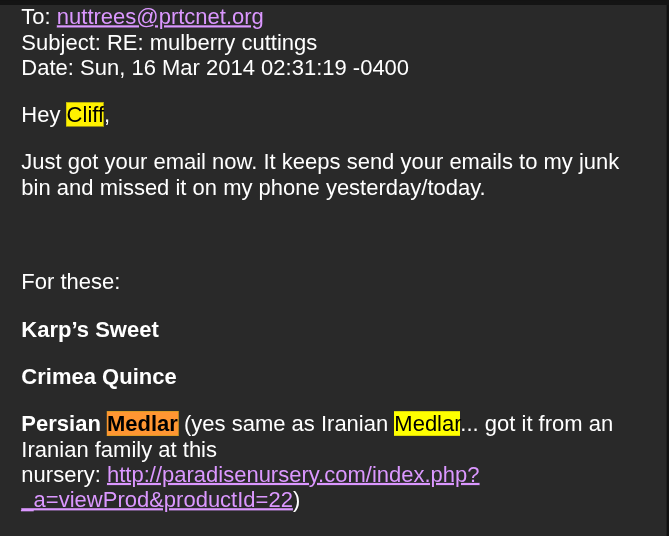
Anyway, It came from my Persian Medlar from an iranian-owned nursery in CA (Paradise Nursery)… Which could be from Iran or just renamed, you’d have to ask them (the same way ‘Iranian Tart Cherry’ is renamed from ‘English Morello’ to sell more to Iranian community in CA  ).
My parents are from Iran so i wanted to grow some fruits from Iran so i paid a premium to get it shipped from them (i still have it still and grafted some more medlars varieties onto it last year).
Here is the email i sent to cliff on what scions was sending him.
 .
2 Likes
On a sidenote: is USDA Corvalis doing quince/medlar scionwood this year?
i thought scion orders would still be open, but the many links i click on seem to show they aren’t in stock.
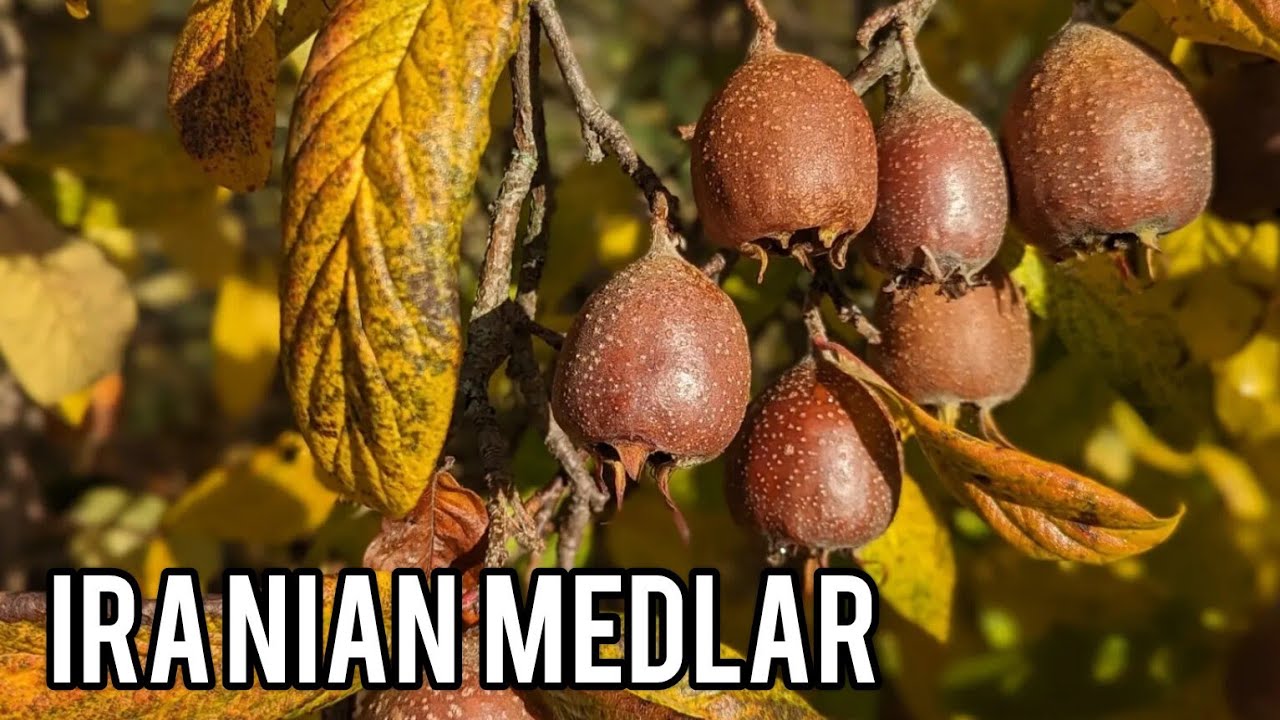
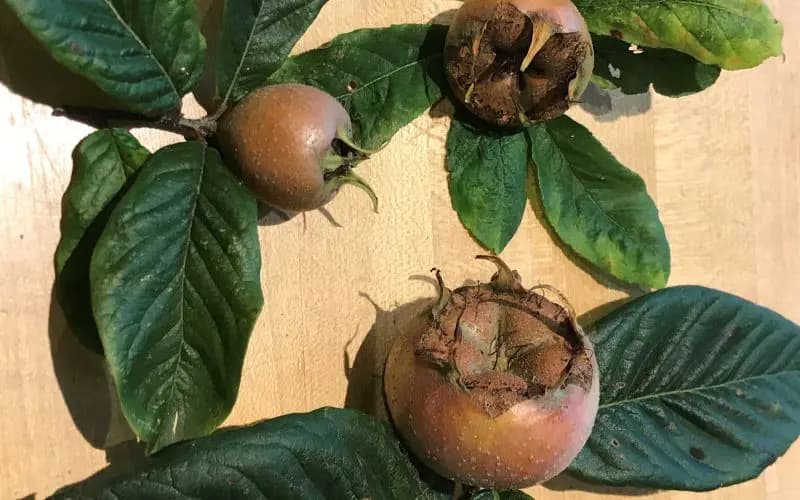
Iranian medlar (top left), which is characterized by a long and narrow shape with a closed calyx, whereas Nottingham medlars (top right and bottom) are shaped like a UFO with a really open and flat calyx. Photo credit: Jane Steward.
2 Likes
PS i got an answer from USDA Corvalis.
"We are not going to be distributing scion this year. Our tree curator, Lauri ***** has left, this is my last week and the Repository will be down to a skeletal crew. Hopefully scion will be available again next year.
Jane *****
Curatorial Assistant
ARS | NCGR"
4 Likes
After some codling moth control (medlars are not no-spray trees in some areas—see here), I’ve finally bletted quite a few medlars from my Puciu Mol tree—both indoors and on the tree. The ones bletted indoors (under glass worked best, as those I attempted to blet in open containers tended to dry out) developed a funky aroma, with definite notes of Elmer’s glue. I now see—or rather smell—why old sources refer to the bletting process as “rotting.” The tree- and indoors-bletted specimens have identical flavor, and, to be frank, it’s a little underwhelming: a fairly acidic, nondescript fruit pulp, sometimes with just a hint of that glue fetor, especially in specimens not completely or ideally bletted. If you use your imagination, you might detect some apple in them—though “spiced apple sauce” (as some of the catalog copy would have it) is rather a stretch, at least with this cultivar, in this climate.
They’re edible, and not really horrible, but only starvation and lack of better would compel me to eat more than a handful of them in a season. And you’d need a heaping basketfull of them in order to ease your hunger (or to process into preserves and the like—which is probably the better use for them), as the seeds take up about as much space as the mushy “meat.” I’m sure they would’ve been great to have during a harsh “Little Ice Age” winter in late Medieval or Early Modern Europe, but I found them rather disappointing as fresh fruit. The mockingbirds like them well enough.
This was one of the best-tasting specimens, bletted under an overturned bowl on my kitchen counter:
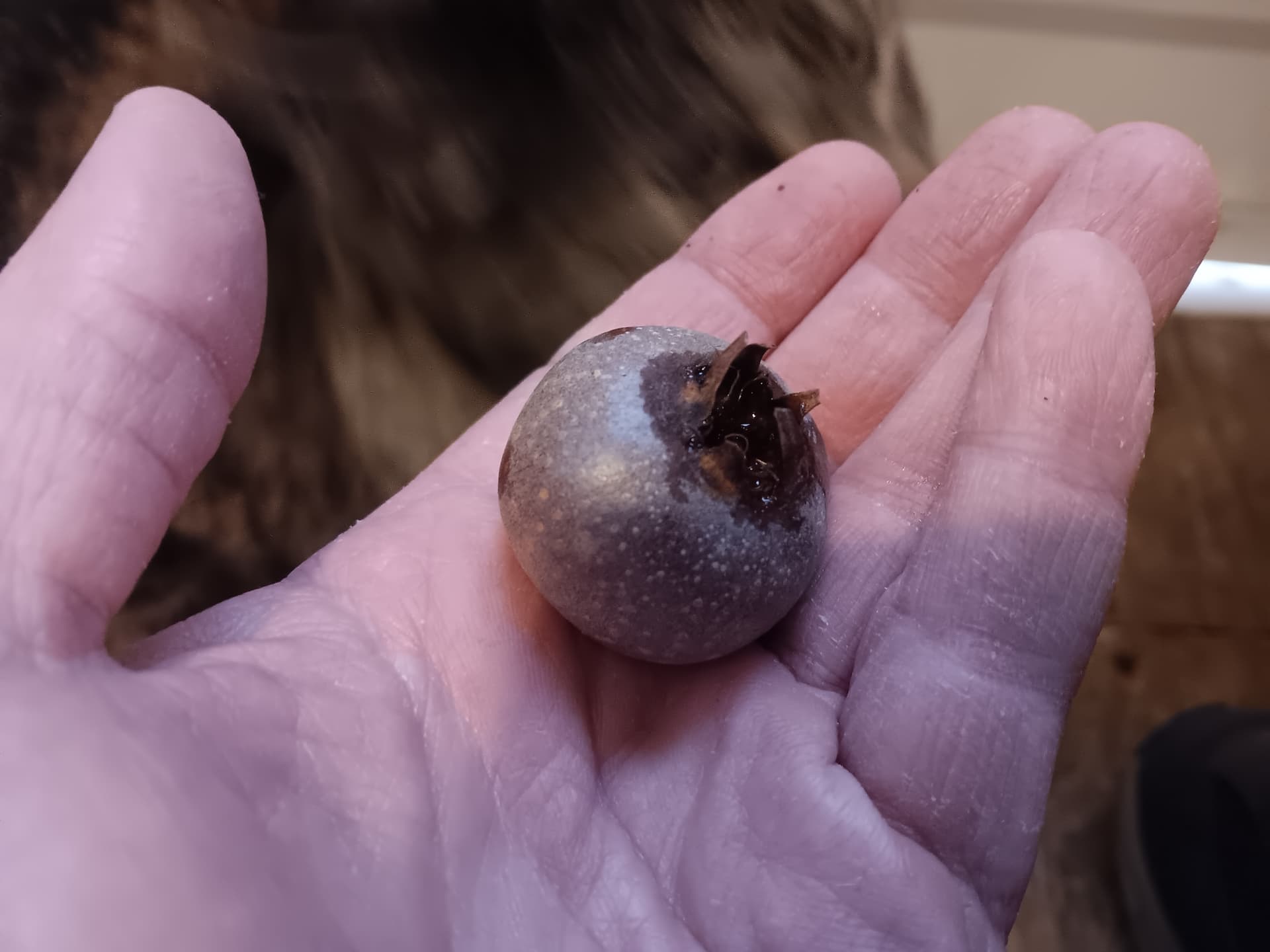
Note the syrup collecting in the calyx, the dark color. The fruit is very soft, but also slightly turgid from gases accumulated inside the skin by the bletting process. Based on my tests this season, this is the height of ripeness. If they are eaten before this state, they tend to taste “off”; eaten much past it, they begin to dry out.
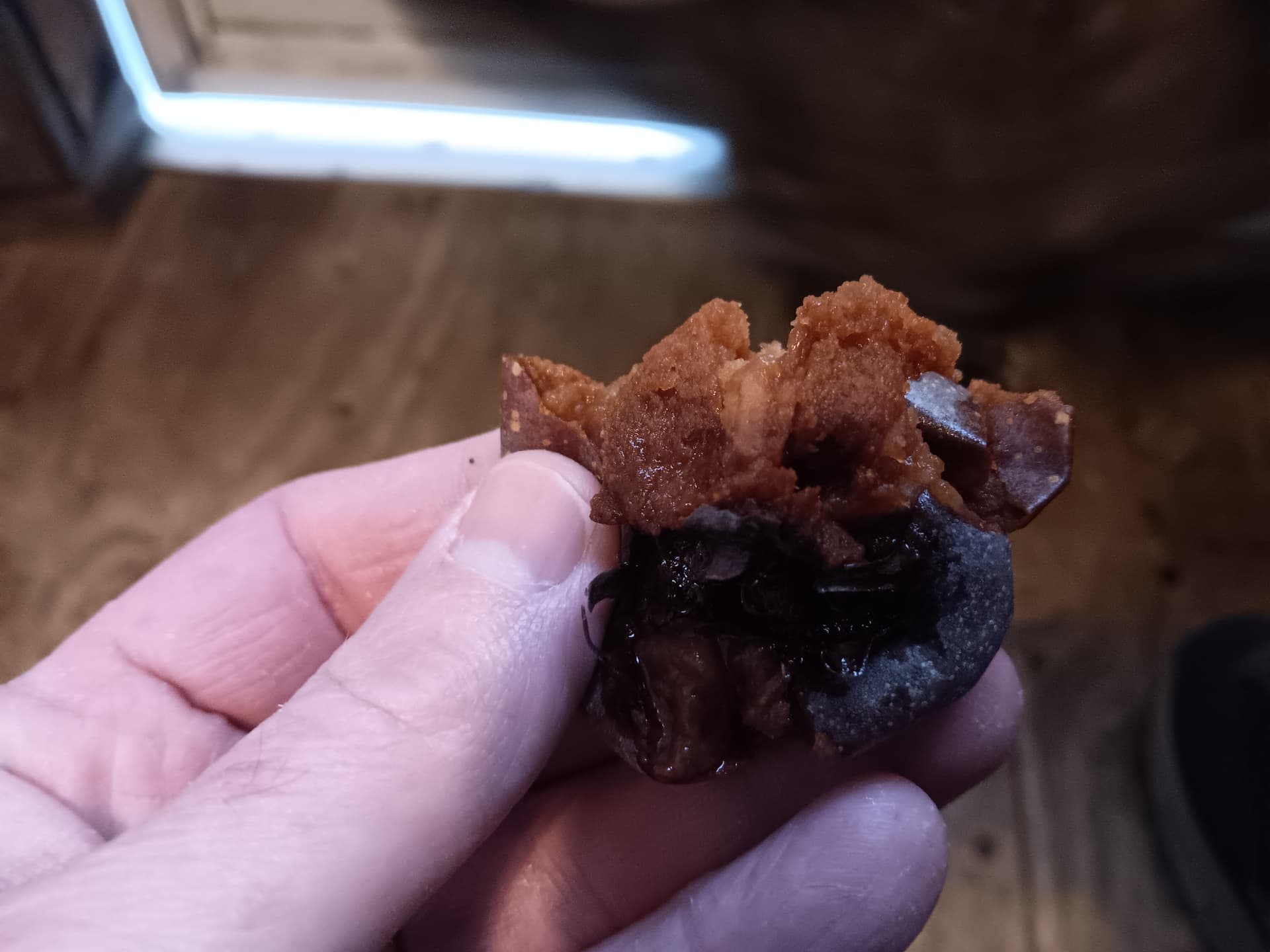
The pulp’s tangy, no glue funk. There’s a nondescript fruitiness, maybe a bare suggestion of apple, perhaps even a fading ghost of some sort of spiciness in this specimen, which was one of the better ones. Not bad, but not great. Cooking could well bring out some flavor.
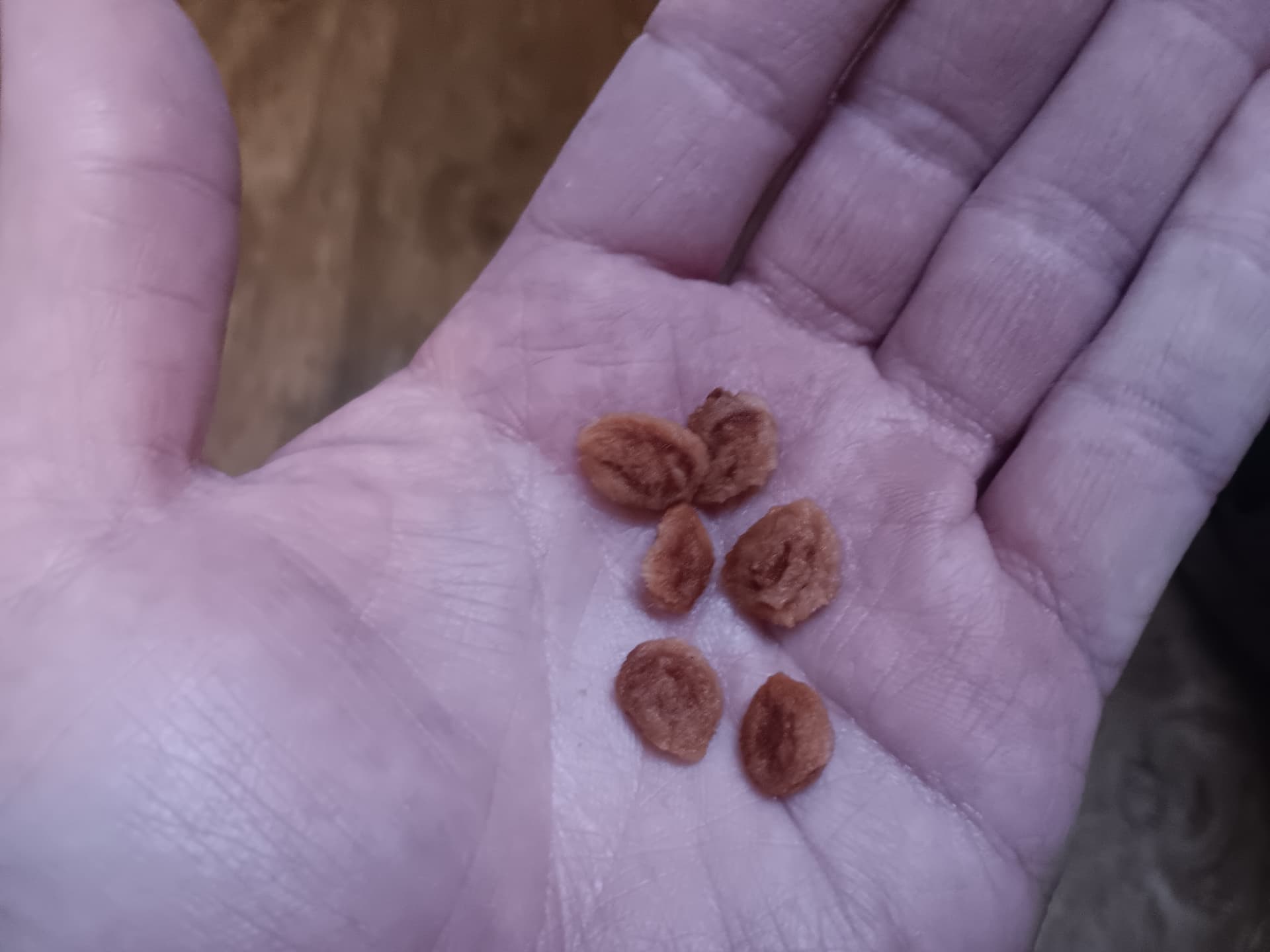
The seeds.
I’ll keep a couple of these trees around for the time being. They’re becoming pretty specimen trees, are historically interesting, and may have potential for processing. The Piedmontese medlars seem to resist disease well in Kentucky. No rust, no signs of fire blight in the several years I’ve had them. (I wish I could say the same for apples and pears!) Grew the Dutch cultivar “Sultan” years ago, and it was very sickly.
4 Likes
I agree that medlars are not no-spray, at least here in the northeast, although I grew them for years without spraying and reaped good, blemish free fruits.
I disagree about the flavor. I find them delicious fresh. I know that slight glue flavor and think that is from the fruit being damaged or having a pest. The very dark color of the skin on the one you pictured usually indicates to me off-flavor. Sometimes only part of the fruit is damaged, but this also throws the flavor off.
I’ve collected seeds for sowing but never have gotten them to germinate.
What are Piedmontese medlars?
5 Likes
As far as bletted fruit goes, I took my children and nephew and nieces out sledding yesterday. There were lots of bletted hanging crab-apples. Some of the children and I we’re eating them. Some were very good, like spiced applesauce without requiring any wishful imagination needed to justify the purchase of a tree. I’m thinking that the reality is when it comes to the fruit, apples are superior to medlars in every way. Just most people don’t think of imbibing on bletted apples on a regular basis, and that seems to be the only way medlars are even edible. A few of my Breda Giant fruits bletted on the tree this year. I didn’t get to try any; my Dad picked them and ate them. He said they weren’t very good, kind of like eating an insipid ragosa rose hip. Like you, I will leave mine in the ground, but more for the ornamental appeal. One thing they have going for them, is here they are a truly a no spray fruit. I may be wrong on Medlars, and I haven’t tried many, but bletted apples can be pretty good.
3 Likes
What are Piedmontese medlars?
They’re from the Piedmont region of northwestern Italy. “Puciu Mol,” “Puciu Super Mol” are the ones most available in the U.S. “Puciu” is a better grower here than “Super.”
I agree with your assessment. They are not bad, but not good either, and they are a hassle to get any quantity of pulp. I reduced from three trees down to one which I made a multi variety tree of. In my orchard I have a number of fruits and berries that I keep just as a collector of novelty fruits (just to have them), but I don’t personally eat them. Next year I’m going to try some processing with them to see if they produce something more appealing.
5 Likes
ii went to check the orchard up the hill and noticed wickson had set 2 small apples that i didnt notice. they were well bletted and translucent. tasted like a good spiced applesauce. looking forward to more of these.
2 Likes
Keep in mind that just like any other fruit, medlars also vary between cultivars in flavor and texture. I got lucky in that my first experience with medlars was a great variety (‘Macrocarpa’). I’ve since had medlars of other varieties which would make me not care to grow them if I didn’t already know how good the right ones can be.
4 Likes
Are they different enough from bletted apples/crabs to be worth while in your opinion? I have a scion of Nottingham coming the spring.
1 Like
I’ve only had a few varieties of crabapples bletted, but they were all good. My favorite medlar was better than any of them and my least favorite medlar was not worth even eating.
‘Nottingham’ is supposed to be indistinguishable from (and possibly the same as) ‘Macrocarpa’, so I think you’ll like it.
4 Likes
"The Mespilus collection at the USDA National Clonal Germplasm Repository (NCGR) at Corvallis, Oregon, USA, includes 60 seed and plant accessions with origins in 10 countries. Several ancient cultivars with different names and sources have indistinguishable phenotypes and synonymy has long been suspected. Twenty-one simple sequence repeat (SSR) markers from apple and two from pear were tested for polymorphism in eleven medlar accessions. "
“One of the five SSRs (NZ05g8) distinguished ‘Marron’ and ‘Macrocarpa’ from the ancient English cultivar ‘Nottingham’.” This indicates Nottingham and Macrocarpa and Marron™ are very similar though likely not exactly the same (Macrocarpa has larger fruit size).
"Seven very large fruited clones with five different countries of origin were genetically indistinguishable from ‘Monstreuse de Evreinoff’. " These were:
- Monstreuse d’Evreinoff (original name from France)
- Sultan
- Dzevera Garden (collected in Republic of Georgia)
- Puciu Big
- Puciulot
- Skra Selection No. 2
- Norashenik AM06-197
Limitation: It’s possible a different selection of SSRs could have distinguished more Medlars. But this indicates the group of 7 are at least very similar.
Citation:
Schaefer, K., Nyberg, A., Postman, J. and Bassil, N. (2015). GENETIC DIVERSITY OF MEDLAR (MESPILUS GERMANICA) GERMPLASM USING MICROSATELLITE MARKERS . Acta Hortic. 1094, 47-56
DOI: 10.17660/ActaHortic.2015.1094.3
4 Likes
Who’s going to track one of these down?!?!
Amazing to me that the response to “critical endangerment” is to forbid collection and propagation. It may go extinct, but at least it will be protected!
5 Likes