It’s interesting to see the different flavors/notes people pick up on and how much even the same cultivar can vary year to year, by location, etc. Allegheny remains on my wish list, thank you for describing your experience.
3 Likes
Any seeds left?
Respectfully, as someone who does not have an orchard but just enjoys reading about stuff,
Yes, the time to fruit can be about 2 years earlier in a grafted cultivar, but the cost of setting up that orchard is cost prohibitive compared to planting seedlings and optionally grafting at a later time. Not only that, but there are not enough nurseries that are grafting at a large enough scale to make purchasing a few acres worth of trees easy. I think that bottleneck may be solved eventually, but there is another huge kink in standard orchard practice, which is the fact that bare root trees do not transplant well enough, so now you have to factor pot grown trees instead of field grown trees that you are buying to setup an orchard, which adds massive cost comparatively.
Their biennial nature is at least apparent in the research that I have access to, so a supposed two-year advantage is not as much as it may seem. Additionally, if someone has a field graft success rate of 80%, that is still 20% of their trees that are set back another year at least. I would still recommend people graft out some of their trees, but a majority of present and future consumers will not be able to tell the difference. When I sell people my grafts of apples, a universally grown and consumed fruit, people still don’t know much beyond yellow, green, red and Honeycrisp. Nobody out there is buying single variety applesauce, or asking what apples went into the pie or juice either.
I just don’t think there is enough good data out there to show that grafts have much more advantage over select seedlings (at scale) at this point. Despite breeding efforts, these are not like apples where named varieties have extreme advantages over seedlings. There are no rootstocks, harvest windows are long, bloom times are not even properly mapped out and accessible. When I look at the data, and maybe you have access to other sets, it follows only a handful of trees over a small period of years. Some data sets are only 2 years. Some data sets only have 5-10 trees per variety being tested. I have not been able to find one that tests the performance of, say an acre, of seedling trees and comparing them to grafted KSU varieties. I am sure KSU has that data somewhere, when they were evaluating what selections to name in their test orchard, but I have not seen it. The lack of transparency in that regard is a bit of a red flag to me, but again I could just be ignorant of those data sets. To me, that is all over the place compared to the Cornell studies on apple yield efficiencies on different training systems, or the effect of rootstock on Brix, or the yield per acre depending on planting density. Most of those studies, like this one, measure over a decade of harvest numbers, with hundreds of trees. That is data that is not all over the place. It has large samples sizes, long observation windows, and has very clear trends expressed in the data sets.
here is one by OSU
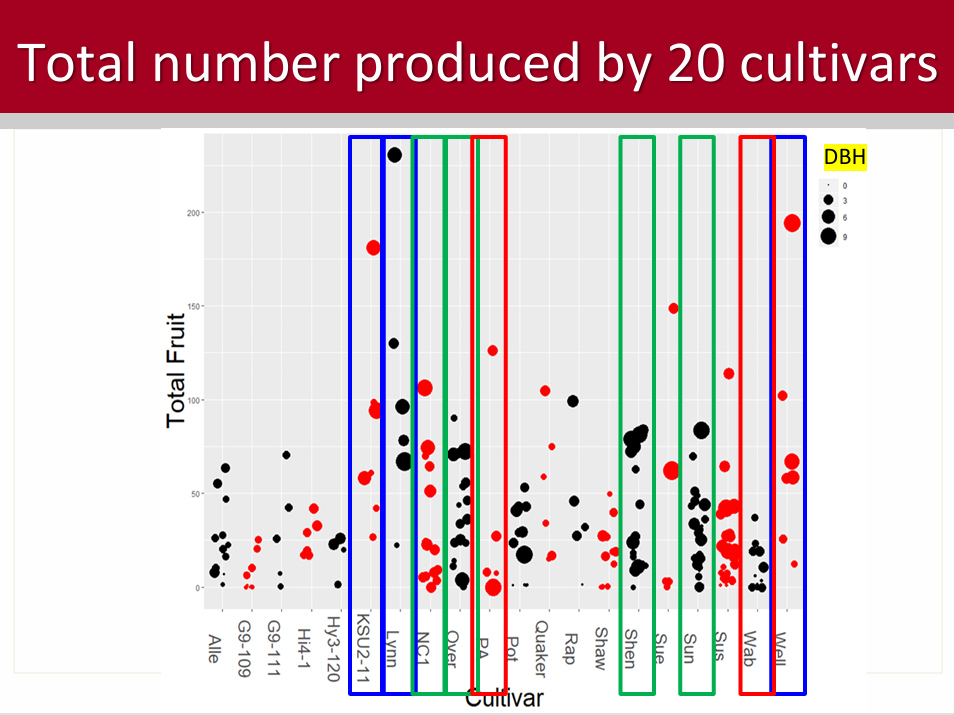
if you count the amount of trees they looked at, it is about 12 per variety, and the diameter at breast height is extremely scattered for the trees, so they are all different expressions of vigor/ plant maturity. They found that bigger trees make more fruit. This seems to be the case, in general, with other fruit, where caliper is maximized to create higher yields. Apples are often grown as whips, with other leaders being removed and branches getting bent down, in order to funnel growth into the apical bud and increase caliper sooner. Fig growers often do this to their 1st year cuttings as well. I would imagine that the most important factor in getting pawpaw seedlings to fruiting age would be getting their caliper up with staking, tree tubes, irrigation and fertilization. That stuff is all controllable, whereas relying on the success of a graft is variable.
There is one decently high-quality study I was able to scrape, but it was in German. and it did not include KSU cultivars or a comparison of improved seedlings.
This one had a decent period of observation, but groups the trees by genetic group because it just didn’t have enough of a sample size to do anything else. The studied cultivars ranged in sample size from from 1 -_-… to 34. That is not good data comparatively.
As far as the “established orchards” in Japan, I was unable to find any sources on Japan growing them in large plantations, as apples or bananas would be grown. Sure, some very small patches have been grown as a niche or novelty, but a banana replacement doesn’t make sense as they do not ship well or store well or have the yield efficiency of pretty much any other fruit.
I pulled up this map on reddit, which is sourced from the USDA Agriculture Census.

Pawpaw orcharding is in its infancy, even if hobby growers and some colleges have done a bit of evaluation. I would consider anyone planting an orchard in pretty much any state besides Ohio, Kentucky or Indiana to be doing something brand new. You, Blake, are a pioneer!
I am in NJ, the most densely populated state and within access to two major cities by a mere 2-3 hour drive. I probably would not have a difficult time finding a market for the fruit, hell small farms could pop up everywhere here and it still probably wouldn’t satisfy demand, which will only grow as people become more aware of the fruit. Project Pawpaw just planted out a small orchard which is neat. they planted bare-root seedlings that were grown in milk crate pruning beds with a success rate of about 90% which is very good. They are grafting over after 3 years of establishment, so their grafts may make a couple of fruits in year 5 or 6. I am saying that there is room for doubt as to whether or not those trees would have produced fruit in that time if they had not been grafted over along with a significant savings in labor and scion costs.
4 Likes
Sorry, no. One forum member took them all. He’s a grower who could credibly clam to make good use of them all, potentially for our collective benefit, so I didn’t try to ration them. He’s active on this forum, so if he wants to regift them he can.
I don’t disagree with anything you said there. Pawpaws are basically where blueberries were in the 1950s. A mostly wild fruit with most hybrids and selections only removed 1-4 times from the wild. Which to me is quite cool. There will likely come a day when pawpaws have been hybridized so much they are seedless and also not as high quality eating, but shippable and with shelf life.
About Japan. Not everything can be googled. Also I didn’t say there were ‘large plantations’. At the International Pawpaw Conference held back around 2015 (I think), at KSU, a Japanese KSU student gave a presentation called ‘Pawpaw: Big in Japan’ where he showed there was a small but active pawpaw culture in Japan. They were brought in via seed as a banana replacement during WWII when fruit shipments to the Pacific islands were disrupted. Now there are orchards growing the fruit and selling large plump fruits on styrofoam squares wrapped in plastic, Asian style. I know it sounds incredulous but I saw the whole presentation on it. Jerry Lehman also presented. Perhaps KSU has a copy of his presentation.
The time line to production just depends on how one starts. If you start seeds, you’re looking at 7-8 years to first fruits and 10+ years to meaningful production that could bring in returns. That’s a while, but orchardists have patience.
If you have access to 2-3 year old seedlings and you graft them, you’re again looking at about 3-4 years to fruit and 5-6 years to solid production, which is significantly faster.
Almost every tree in my orchard I started the seeds and grafted them 2 years later. My trees therefore cost me a few dollars each - a pot, potting soil, water, organic fertilizers, and time.
A pawpaw orchard would make a great money making hobby or profitable side hustle, but likely not a full time occupation. I even say that in my book. Don’t quit your day job. Build it on the side and if you work hard and know what you’re doing, before long you’ll have fruit and lots of very eager customers looking for it. As well as other benefits and products. They also would be great in a mixed orchard or You-Pick operation. People will literally drive hours to pick pawpaws.
About KSU, as many of us have observed, their record keeping and studies are sometimes messy. Contrasting KSU to Cornell isn’t really fair because Cornell and the apple industry have millions of dollars of investment, research, lobbying, etc by large corporations, while KSU and the pawpaw research they do runs on a shoestring budget with zero industry support whatsoever. People hardly knew what a pawpaw was 20 years ago, and many still don’t. KSU’s work was very ambitious and has helped propel pawpaw from an obscure wild food to a burgeoning new crop.
Despite their failings at record keeping and proper scientific protocols, their selections are still some of the best cultivars in existence and far better than 90% of what’s out there. KSU Chappell is far superior eating then practically any older cultivar out there. Even Peterson said it was the best flavored pawpaw he’d ever had.
We just cannot compare pawpaws to apples, and there’s no need to. They’re a completely different crop. They just happen to both be fruit trees. Apples will always be more popular, more versatile and more productive, with much better shelf life. Pawpaws can stay pawpaws; an unusual and tasty short season specialty fruit crop that gets people excited once a year and then disappears, and also pops up in ice cream and processed goods here and there.
One of the main limitations with pawpaw is it’s resistance to clonal propagation. With apples you can clonally produce rootstocks that dwarf, adapt to heavier soil, increase precocity, resist disease, etc. Pawpaws it’s all seedling rootstock. This decreases uniformity, but could also be seen as an advantage as it increases genetic diversity. We all know about genetic monocultures and their extreme dangers and limitations through time.
About bending branches, I have wanted to know if training pawpaw branches at 45 degree angles from the trunk increases precocity, similar to training apple branches down. When the apple branches are bent down, it stimulates spur production which also hastens fruit production. So far I haven’t tested that theory out.
I do agree that high quality seedlings could do just as well profit wise as an orchard of grafted trees, but there are pros and cons to both methods that have to be weighed, the largest of which is cost for grafted trees versus time to yield.
6 Likes
How much azomite did you apply per tree?
1 Like
3 lbs per mature or near mature tree, 1 lb per young 3-4 year old back in Feb or March. Between that and spraying liquid calcium my orchard and land has never looked better. BSD infected trees appear to possibly be recovering.
3 Likes
do you give your trees any at planting or just if you see signs of BSD? if the former have any been infected later in life?
1 Like
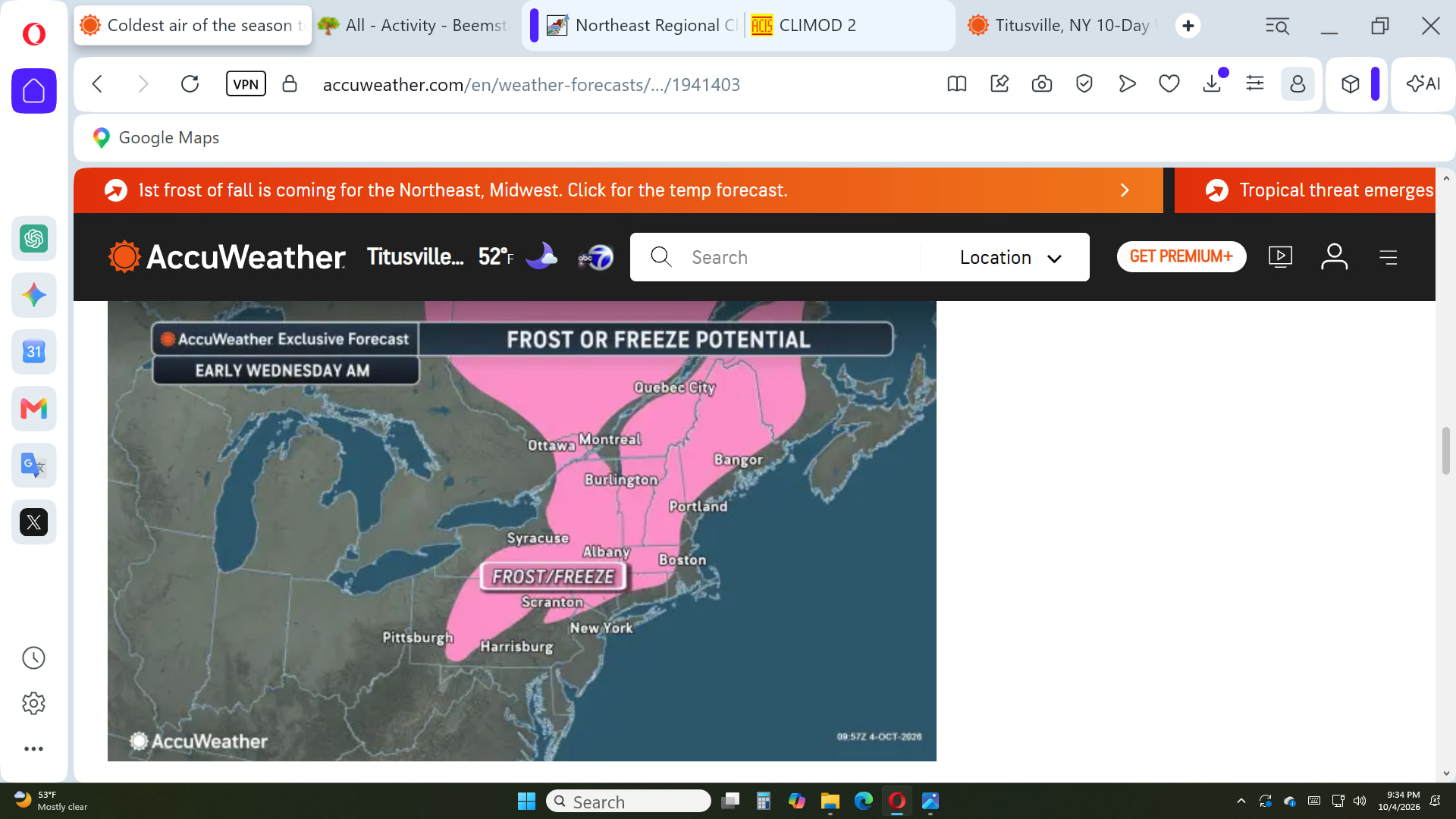
Dutchess County NY Z6A…first frost predicted for Wednesday morning 10/7… last year was 28F on 10/8 at 2835 Gdd 50F from a May 9 bloom…this year would be 10/7 at about 2801 Gdd 50F from a May 10 bloom…hopefully a mild frost as there are a lot of pawpaws still on the trees…Beemster
…
I should start doing it at planting. I need to order more azomite! For ones that have been infected it seems to aid in recovery.
1 Like
I will try to look for the presentation, that sounds really interesting!
I would venture to make the claim that the Asian market would go BANANAS for the Pawpaw and Persimmon. The H-marts around me always sell persimmon, and the astringent ones are more expensive. These markets also sell Durian, Soursop and Thai bananas, so they seem to cater to similar tastes. The biggest issue is the shipping and such, like you say, but when I went to Japan, they had crazy amounts of fruit gift sets. I imagine a future where growers are able to sell Pawpaw like Mangos that are bid on and given as expensive gifts.
2 Likes
Thanks Blake! I did see some photos of R8, it looks very nice. When do you think you will be selling scion? Thanks for the info on the newer releases. I didn’t realize so many of them trace back to Susquehanna.
1 Like
Can anyone please compare taste of Nyomi’s Delicious vs. Jerry Lehman’s VE-21 (both very early)? I want to extend friend’s pawpaw orchard in the earliest part of season. Is one a clear taste winner?
1 Like
Ive heard a lot of buzz around nyomi’s delicious, and i picked it up. not heard the same about ve-21 so id lean that way
2 Likes
I’ll have scions available in November for many varieties.
R8 I’ve named PHN Seraphim. All scions are going to grafts on that one, I won’t have scions available for quite some time. Here is the new listing: https://peacefulheritage.com/products/phn-seraphim-pawpaw-tree
5 Likes
Haven’t had enough VE-21 to say for sure but out of those two Nyomi’s is more a vigorous and healthier tree. The flavor is pretty good too. Other early varieties would be Summers Delight, Lehman’s Chiffon or KYC. @TrilobaTracker can weigh in on Lehman’s. I think it was always his earliest. Summers Delight is a good flavored fruit.
3 Likes
Pawpaw season is finally over for us here in Nashville, TN. I picked the last one today before heading out of town for a few days.

This year’s season stretched from August 1 to October 5. Nyomi’s and Wabash kicked things off, and Susquehanna was the last to finish.
4 Likes
My Chinese MIL loves pawpaws more than anyone I have ever met.
4 Likes
IIRC, Timothy Lane has said similar about the growth. His ND is a strong, healthy tree with a lot of fruit, but the flavor and size don’t wow him. His VE21’s are larger, but he’s not wowed by their flavor either. Not that they taste bad, but just more average for improved cultivars. I think he said banana musk. He liked the flesh on that one too.
3 Likes
Are these specific intended crosses or just OP?
1 Like