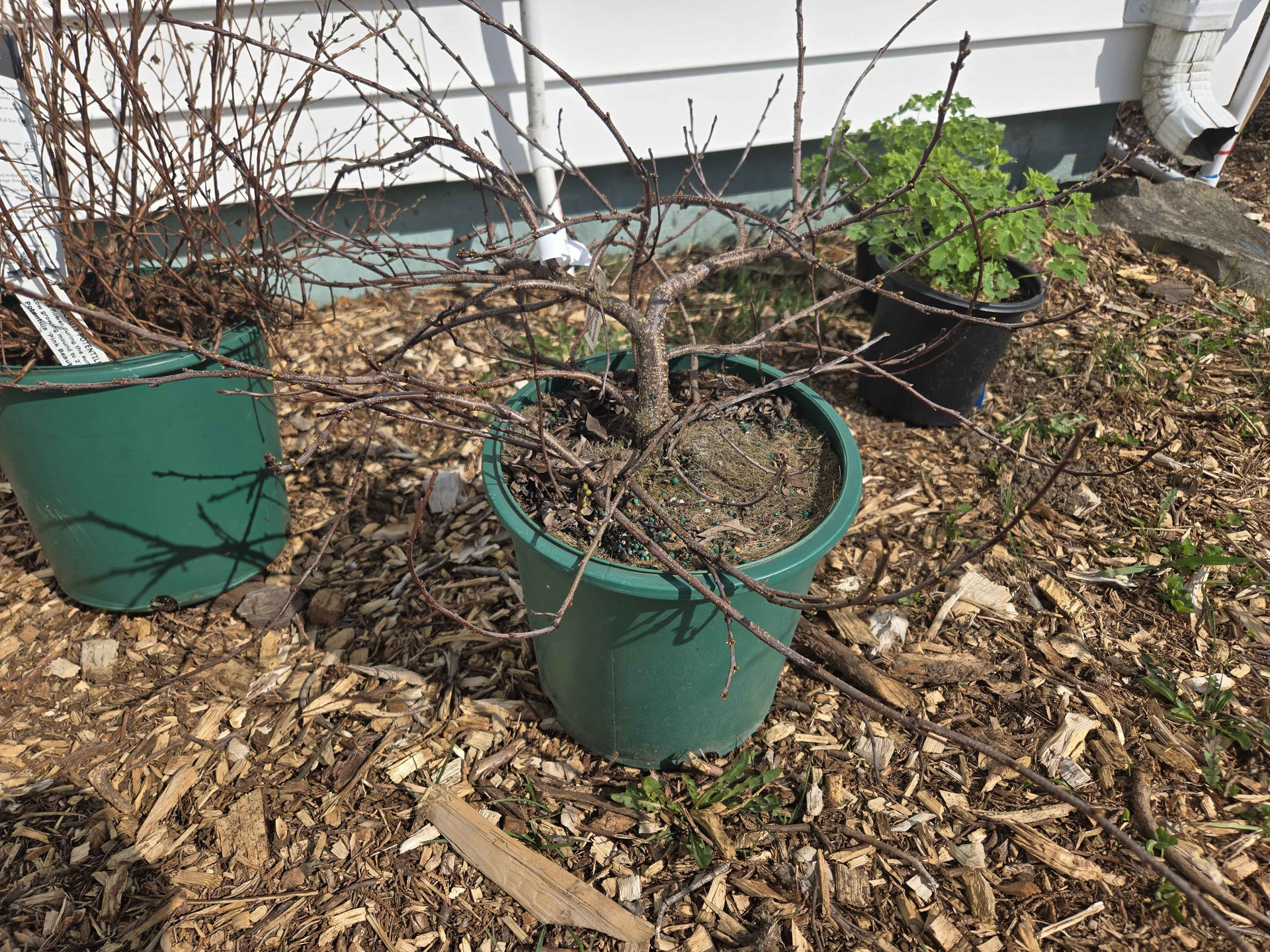
That looks like a great nursery—thanks for sharing. I’m out that way every now and then, so I’ll definitely plan to stop by.
I know there are some self-fertile sand cherries, but even those don’t seem to produce nearly as much fruit without a pollinator, and I think most varieties aren’t that self-fertile. The ones I have aren’t, and neither are my neighbors’. Several nearby houses have the same cultivar of purple-leaf sand cherry hybrids, and one has an ornamental sand cherry with a bloom that didn’t overlap. None of them produced much fruit—if any—until my Prunus showed up. Now they’re all dealing with loads of not-so-great-tasting ornamental cherries dropping all over their parking spots.
They’re not too happy about it. Fortunately for me, they haven’t connected the dots. I do feel a bit bad, but honestly, I think the bees deserve most of the blame.
Is that the sand cherry in the middle? Looks really tall, I thought they stayed fairly short. Where did you get yours from? Any idea on the specific type (besseyi or pumila)?
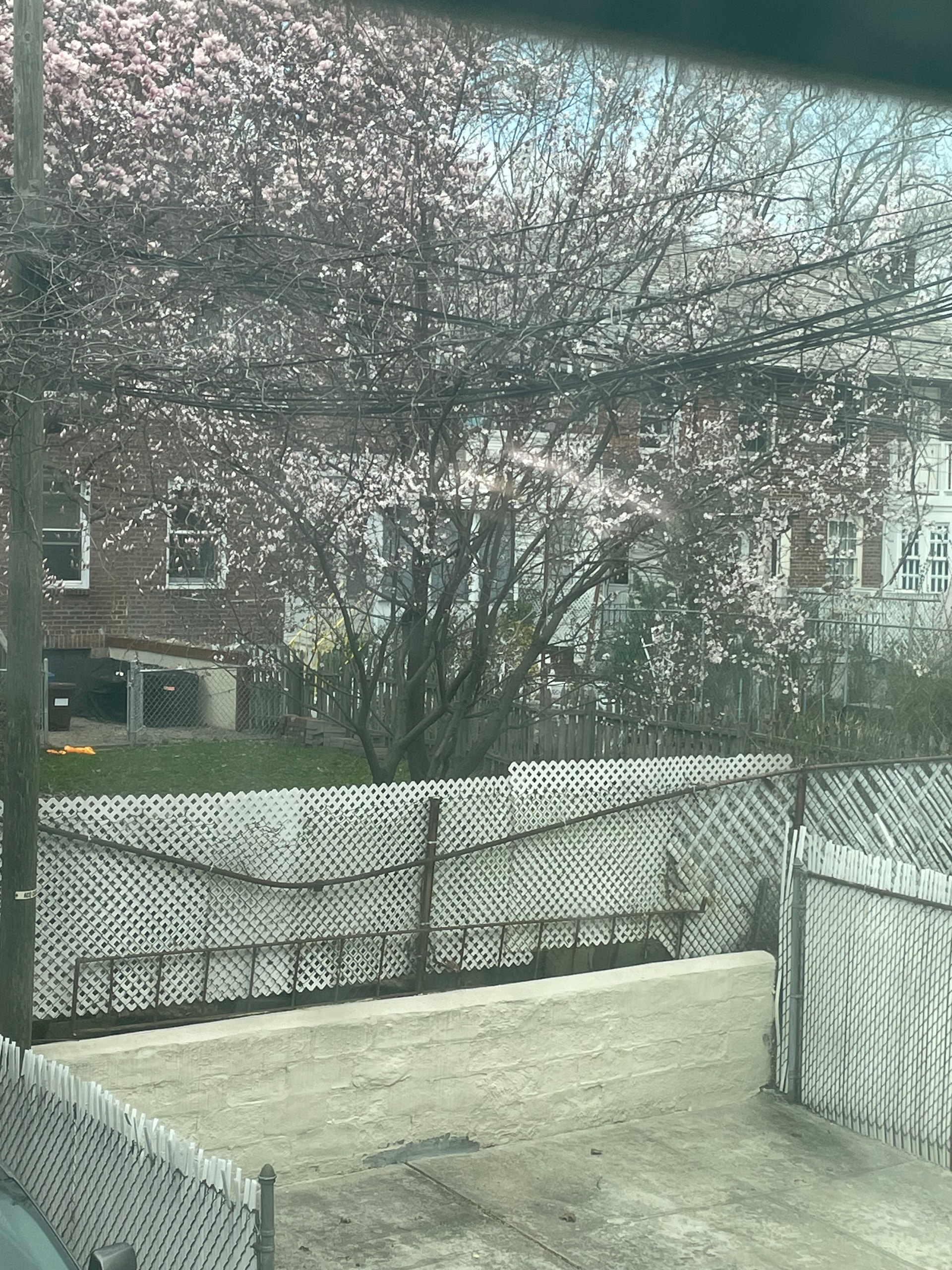
That’s my neighbor’s purple leaf sand cherry hybrid hanging over another neighbor’s parking spots. The photo is a bit deceptive, since there are several different trees flowering back there, and the parking spots sit about five feet below the lawn behind it.
This one is growing in a tree form, but most stay much shorter and grow more like bushes. I have a few ‘Hansen Bush Cherry’ plants from different sources, and each one is slightly different. I also have a few of Dr. Hansen’s hybrids crossed with other plums.
I have ‘Sapalta’ and ‘Compass’—I bought both from the same Etsy seller, who no longer appears to be active. I also have a couple of cultivars of purple-leaf sand cherries from family and neighbors’ plants. I’d like to pick up a ‘Black Ice’ eventually.
The purple leaf plums which are tree size are generally straight Prunus cerassifera, not hybrids. The purple leaf plums which are derived from that species hybridized with sand cherries only grow to bush size.
Edit: I should probably have posted this as a reply to @AdamNY rather than @Jessizzles.
It’s definitely possible that it’s straight Prunus cerasifera. I haven’t paid enough attention to that one but it look similar to the hybrids in the front of the house that are trained as a hedge and on an arch. It’s hard to tell from the photo since a few trees are blooming, but this one is multi-stemmed and not very tall. I assumed that since it blooms at the same time and produced little to no fruit until my Prunus started flowering, it might be the same cultivar—but maybe not. The hybrid in front of the house now fruits heavily—unfortunately, the arch is over a walkway.
I’ll check to confirm whether they’re the same or not. I assume there would be enough of a difference to tell if it’s truly P. cerasifera, but don’t know for sure. I’d actually prefer that, since the hybrids are everywhere, and it might be fun to try some crosses with it—I already have hybrids, but not any P. cerasifera . It also suckers, and the owner has given me other plants before—I do love free plants.
Hey! Just curious—did you get those for hummingbirds, and do you have any around you? I’ve noticed a few near me lately and would love for them to come back, but I don’t have anything planted specifically for them. I’m also not sure I’m ready to deal with feeders.
Some of the ornamental Prunus cerasifera selections have been selectively bred for reduced fruit set. I’ve got one I selected out of a batch of seedlings which emerged from a wood chip pile (someone cut down and mulched one of the ornamental selections when it had fruit on it) which sets no fruit most years, but has made a couple here and there. It seems like maybe the female parts of its flowers are underdeveloped, but the male parts still look good on average.
Yes! I have this and trumpet honeysuckle which rhey like. Its nice because its a shade plant and an early flowerer. The honeysuckle is nearly evergreen tbh
I remember as a kid picking sand cherries along the south side of sheltetbelts. They were astringent until ripe. They weren’t great fruit but I liked them. I remember my mother making jam out of them. Im not sure but I think the jam was a bit milder than wild plum jam.
Where I live (Michigan), Prunus pumila has been separated into 3 varieties by the work of J.D. Rohrer, who has published on them 3 times now. The heights the plants attain are attributed to the different varieties.
I have seen the prostrate version on Great Lakes sand dunes. However I have also seen Sand Cherry reach 8 feet in height on such sites.
Meanwhile on inland locations they are neither prostrate nor tall, rather they top out at knee high on single individual plants. But these are very xeric nutrient-poor sites (Jack Pine flats) where even Bracken Fern can’t survive.
So for a long time I figured the aerial moisture from a Great Lake made all the difference as sand dunes aren’t very fertile either. But now I have to deepen my thinking on that.
I do plan to keep looking for more examples of the prostate variety (P pumila v. depressa) to see if I can collect enough different examples to produce plants from seed that remain flat in growth habit.
But I also see routine conclusions that the plants are “continuously variable” and this is all a spot where phylogenetics just gets a bit too exhausting. One of the 3 varieties mentioned is now given species rank, as if eastern/western pumila/besseyi wasn’t already exhausting enough. Particularly when I can barely explain the concepts of aiding wildlife by increasing plant diversity on a given site. So most plant people, including NRCS & Conservation District employees can’t well articulate that concept anyway and will just suggest “Dogwood” to help wildlife, generally being unaware of a plant like Sand Cherry. It all becomes a chicken/egg problem - no one ever plants it, so no one has ever heard of it.
As for fruits falling from plants, I have heard that as a reason not to plant even Highbush Blueberry! We are an indoor species now…
Well I had an interesting Sand Cherry experience the other day.
I found them in a most unusual place - a site with near zero sand. Not only that, it is a very large Fen, possibly the largest in Michigan. The ground is almost pure rock - Limestone. That means a very alkaline soil pH. Most of the plants out there are known calciphiles; I was there to pick some seed from Rhamnus alnifolia, a native Buckthorn. I couldn’t believe I had to carefully check a stem before pulling the black fruits off of each species. There were occasional Choke Cherry (P. virginiana) plants out there too, not nearly as surprising of a find.
What was a little intriguing to me about it was that I kept returning to the Sand Cherries for a quick snack while I was working. Normally I eat a couple-three of the cherries out on a dune site and then stop because the fruits are just thoroughly, I’ll say “flat” in taste. Not bitter, not sweet, little flavor. Also not as astringent as Choke Cherry. Just, edible, but not reach-for-more-edible. But that’s what I was doing. Was the flesh:stone ratio a little better, too? Too much possible confirmation bias to answer that one. Maybe.
Out on this Fen the cherries reminded me more of Black Cherry (P. serotina) in that a flavor trending towards sweet was inside, though still not as strongly as serotina fruits.
Made me wonder if this was an example of soil determining flavor, rather than genetics. I have long thought that about White Oak - why are the acorns better on one site than another site?
Of course with pH, humans have long assigned the adjective “sweet” to certain higher pH situations.
Perhaps would be interesting to pour a bunch of Lime out around some Sand Cherry plants in the winter and see what happens to the fruit flavor come summer time.
Still haven’t read the Rohrer paper, but now that Cherry picking season is here, I need to get that done. I continue to see dune plants that might be considered prostrate - but would they still be so 10 years later?
Well I have finished up Sand Cherry exploration for this season. Along the way I have begun to appreciate their taste quite a bit more than previously and would happily “clean” seeds by eating them. Though occasionally would still encounter some that were simply “edible,” which is not the same thing as “enjoyable.”
I did fully absorb the 2000 study by Rohrer; it was published in The Michigan Botanist and takes a few more clicks to find than an average Journal article.
Rohrer argues against elevating Prunus susquehanae to species rank, and rather keeping the Prunus pumila complex as a single species with 4 varieties rather than 2, with one having 3 varietals. Along the way he investigates leaf Length:Width ratio and this is very useful for untangling the varieties, much more so than small patches of pubescence on 1st year susquehanae twigs, imo. These are after all of course in the Rosacae, where variation is just part of the deal.
His work touches on taste/flavor just briefly. Also more in passing is thoughts on the complex having 2 separate glacial refugia, explored by other authors elsewhere. For me this would explain the variety and the rise/creation of 4 types once the refugia populations met each other later on. But I am by no means deeply versed in such concepts
Intriguing to me is the habitats occupied by the 4 varieties. P. susquehanae / P. pumila v. susquehanae is found on acidic Pine sites while the other 3 are found on higher pH substrates. Picking Sand Cherry in perhaps the largest Fen in the State of Michigan, where one is at times walking directly on pure Limestone bedrock, was very illuminating about the pH proclivities. It can be easy to forget that dune sands are not necessarily the same as outwash sand plains. This will be useful to us; I have to understand many things about how the varieties actually perform in a planting, not just how to identify them, nor only how the fruit tastes.
I did try one brief search for any more recent phylogenetics work on the complex with only marginal success, so far. What I could find seemed more concerned with arrangements of the Prunus genera rather than relationships of the 4 Sand Cherries. Might try that topic again some day.
That further search however kicked up a recent-ish bit of work in Russia, where apparently Prunus pumila is used as a root stock for Plums & Apricots. On that subject I would be interested to learn which of the 4 choices is considered best.