I’m doing fig airlayers into one gallon milk jugs. They’ll be ready to ship soon after being cut off the mother plant. On most I’m running the shoot up thru the bottom of the jug after girdling the stem. On one the stem goes in the side and out the top.
3 Likes
Depends on what plant.
I just set some on my fig plants to make duplicates for trading, gifts.
Apple rootstock that has branches below my graft (the grafts are growing fine). And possibly redbud (Cercis canadensis).
I don’t have experience with redbud, apple should work, you can scarify and even use rooting hormone for additional insurance. I made some ground layers on bud 118 2nd year shoots from a stool bed I am establishing this spring, and they have roots showing at the sides of the clear plastic tube I used. There were already root initials forming from last year’s growth, so they had a headstart.
Here’s an AL I set out 4 weeks ago on a Danny’s Delight fig plant, I am taking the top off to make a duplicate of this variety as I intend to put it through a Maine winter next year and don’t want to lose the variety if it doesn’t make it.
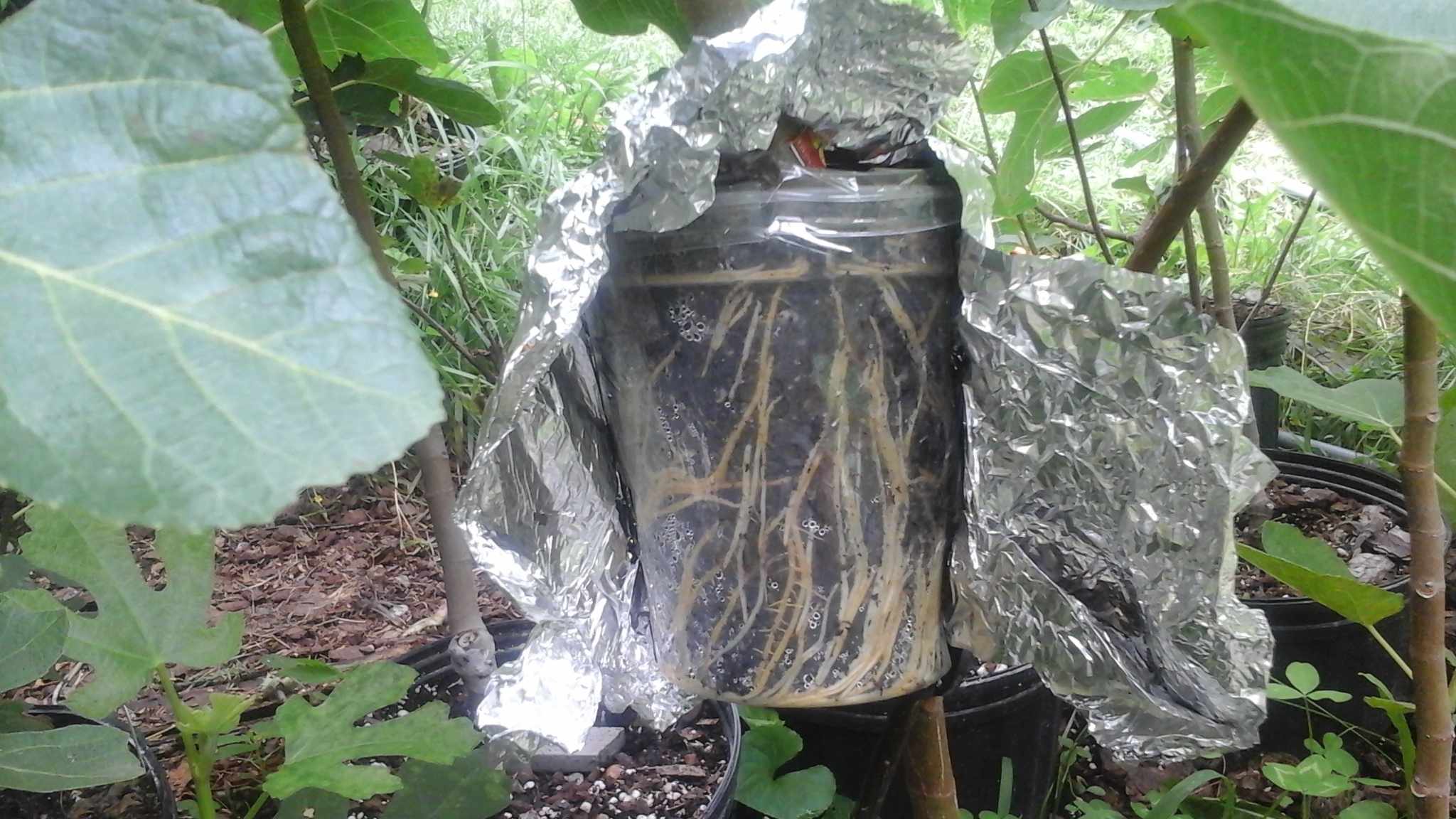
Using a recycled deli container made the process a snap!
5 Likes
Well done!
It looks like people use everything from complete girdling to no scarring at all, but I think I’ll go for girdling because of a warning I read about partial bark removal trying to heal itself. My candidate is a shoot that is coming from the base of a young fig ‘tree’ barely over two feet tall, so it doesn’t even have hardened bark yet, though the shoot is about a foot tall. I was going to just remove it but maybe I can capture it. Is it too late in the year? I’m in western Oregon…no frost worries for months.
Seedy,
If it were me I would paint the stem with some clonex rooting gel to hedge my chances of success.
Thanks. I picked up some Dip ‘n’ Grow (I hope that’s similar) a while back and it’s time I put it to use. I found an unusual Hazel tree in the woodsy area (near my unusual apple tree, both of which are near the old Grange Hall…I suspect somebody planted them and ?) and I could probably find a few other candidates and have a session of rooting and layering.
1 Like
peaches and nectarines generally have short lifespans/short productive lives, even when grown from seed or grafted on the most disease-resistant/pest-resistant rootstock, so not too keen about air-layering as the roots will be as old and as susceptible as the budwood. Very likely that when obtaining an air-layer from a desirable peach tree(which was grafted on desirable/young rootstock), the seemingly ‘new’ or ‘young’ air-layered specimen will decline so much faster than the mother tree it was taken from.
any marcot will always exhibit its true age, and is only conferred some degree of immortality by grafting serially to younger rootstock.
only worth the trouble with longer-lived and relatively disease- or pest-resistant fruit trees/nuts.
1 Like
Thanks Raf. That’s extremely interesting. I certainly would have assummed that a “new” peach tree created from air layering would be the equivalent of a “baby” tree with a corresponding new, full life-span ahead of it. From what you are saying, if I understand you correctly- is that the newly created tree from air layering would be the same (equivalent) age as the mother tree, and therefore have the same or similar number of productive years left before it declines and dies. Is that right? If so, that is very interesting. Nature is amazing.
1 Like
unfortunately it is not. Roots will be as old as the budwood they are growing from. And possible that if it is an heirloom variety, then it will be very very old. Grafting to young and disease-resistant rootstock is the only way of buying time for old(but choice) budwood.
cuttings/air-layered specimens only give the impression of youth/rejuvenation when the species are naturally much longer-lived than humans. An airlayer from a 500 year old baobab or jujube could live 200 years more, and further obtaining cuttings from those 700 year old ‘babies’ could live another 200, etc, until ultimately they assume their pre-programmed age of ‘senility’(barring lightning strikes or inclement weather damage), and will likely die at about the same time as the mother plant, or earlier.
at the other extreme, you could test it on short-lived tomatoes(relative to humans). Tomatoes tend to root higher up on their stems as they age, you could readily obtain rooted cuttings from your toms and replant, you’d notice that the cuttings will die at about the same time as the mother plant’s demise. As with baobabs, marcots will probably die sooner, since none of the cuttings will benefit from the apical roots(taproots) that only seedlings are lucky to have.
yes, that’s how i see it. Possible others here have other ideas.
THanks for that, Raf. That really is one of the most interesting things I’ve read in long time. If true- and it sounds like you know and I trust you do- then that would seem to remove most incentives for air layering a peach. Of course a person might just want several “copies” of a tree, but I would think if most people air layer they expect the new tree to have a new, full life span. You challenge to test it on tomatoes is a great idea and I very well may try that! I don’t know, but I’d assume tomatoes are extremely easy to air layer, because of a tomato plant isn’t staked and lays on the ground, in no time at all there are nice white roots forming on the stem all along where it touches the dirt.
Thanks again for that very interesting bit of info!
kevin
i actually hope it is false, and that anybody here who’s more knowledgeable could elaborate why…
i did it as a kid, but of course it was just a few specimens(though admittedly, it made me conclude about what have written earlier).
so now, and all of a sudden, quite curious if yours or anyone else’s findings would have similar results 
I’d be very surprised to find your observations generally true. What you are stating is that vegetative material taken from a mother tree is on the same biological “life clock” as the mother tree itself, and therefore both will experience decline/death at the same time. If this were true, then logically grafting/budding/layering would be impractical and all useful cultivars of all grafted fruits would have died out b/c their lives would have been spent. We know this isn’t true. Some cultivars can be dated back to at least 2000 years to Roman times. I hope what you’re implying is that if you have a ‘sick’ tree (i.e. infected w/ a virus or bacterium), your scions/cuttings/buds etc will be infected as well, thus both will have shortened life spans.
5 Likes
i have to differ, and in fact by saying the exact opposite, that logically— grafting/budding would be the only practical approach for all important cultivars.
again i differ, because it is true.
grafting dates back to ancient chinese, way before the romans. From there, the science and practice spread( presumably via silk road) westward, along with the pears, apples, citrus, plums and peaches that were likewise being trafficked.
grafting is hands-down the earliest form of biotechnology. It was revolutionary then, and is revolutionary up to this day.
while i agree with you on that, i was referring to the hypothetical condition where there is zero infection and growing conditions are identical.
i find it hard to imagine that a marcot could revert to absolute juvenile status having been detached, and find it hard to visualize that in hypothetical sterile/pest-free conditions with identical soil and climate conditions-- that a clone will considerably outlive the mother plant, especially when planted on its own roots.
if you graft a 40 year old lemon branch to a seedling, say, trifoliate, you won’t have to wait several years for flowering and fruiting. If you plant a lemon seed, and as soon as it sprouts you graft its bud to a very old trifoliate, you will still have to wait a long time and run its course to maturity before it will bear flowers and fruit.
the longer ‘childhood’ of budwood from the seedling sure adds years to the lifespan, whereas the 40 year old mother plant will ultimately require pruning and have some of its stems grafted onto younger rootstock should the mother plant start declining, if intending to preserve the cultivar.
lastly, would it be reasonable to expect a marcot(of identical-size and condition) taken from a 40 year old lemon have a longer productive life compared to an identical sized 5 year old marcot? growing on their own roots?
forgot to add, the longevity of lemons is reportedly 50 years
quite intriguingly, and speaking of romans, mentioned in the link below is ‘the book of romans’-- biblical acccounts of grafting. Also mentioned were independent discoveries of graftage in china and greece, BC.
https://courses.cit.cornell.edu/hort494/mg/history/HistGB.html
Anyone have luck layering mulberries? I have a Girardi that has put out a lot of growth on a side branch and don’t want to waste it by pruning for shape since these grow slow and that branch could be a lot of tasty fruit next year and beyond. It would also be interesting to see how they do on their own roots since the two I have are both grafted to rootstocks.
I was thinking of trying a wire around it to constrict sap and some rooting hormone, then bag it in wet sphagnum. But if layering isn’t a good option with mulberries I might just let it keep growing in its unbalanced state for the sake of a good crop.
Thoughts?
Well some of our rootstocks are very old as well. Malling M.7 apple rootstock was once called Paradise and before that Doucin Reinette or Douchin Vert. It has been around since about 1688. Since then it has been propagated from root cuttings or in stool beds. Apple rootstocks for historical English gardens
So I am not so sure that new root sprouts are fully juvenile. Stool-bed propagated Geneva rootstocks and M9 surely aren’t given that it is standard to expect them to produce a crop in their second year in high density plantings.