How could you possibly not be able to tell?
1 Like
interesting! I saw these just recently.
Do you just put the bare scions in a ziploc with a couple beads, that’s it?
1 Like
Yes. If I have a whole big bag full I will put several beads in it but at first I was using too many and it got really wet in the bag. If there is only a couple of scions I just put one bead. If the bag is getting dry the bead shrinks.
I’m not saying it’s a perfect method but I have been trying it and it seems to be working. I was surprised at the state of my last years scions when I removed them from the fridge a couple of weeks ago.
2 Likes
People have grafted scions upside down before. Get into a good pattern and set the scion down wrong, not pay attention and graft. It happens.
3 Likes
@DennisD - That sounds like a great idea! Spraying them with copper.
Thanks, since the disease is spread by this fungus, good idea to treat it before shipping stone fruit scions.
“ The disease, peach leaf curl , is caused by a fungus called taphrina deformans. … The disease can spread through leaf detritus. After pruning, spray the naked trees until they are dripping with a copper-based fungicide that coats the tree and kills remaining spores so they will not infect new leaves come spring.”
1 Like
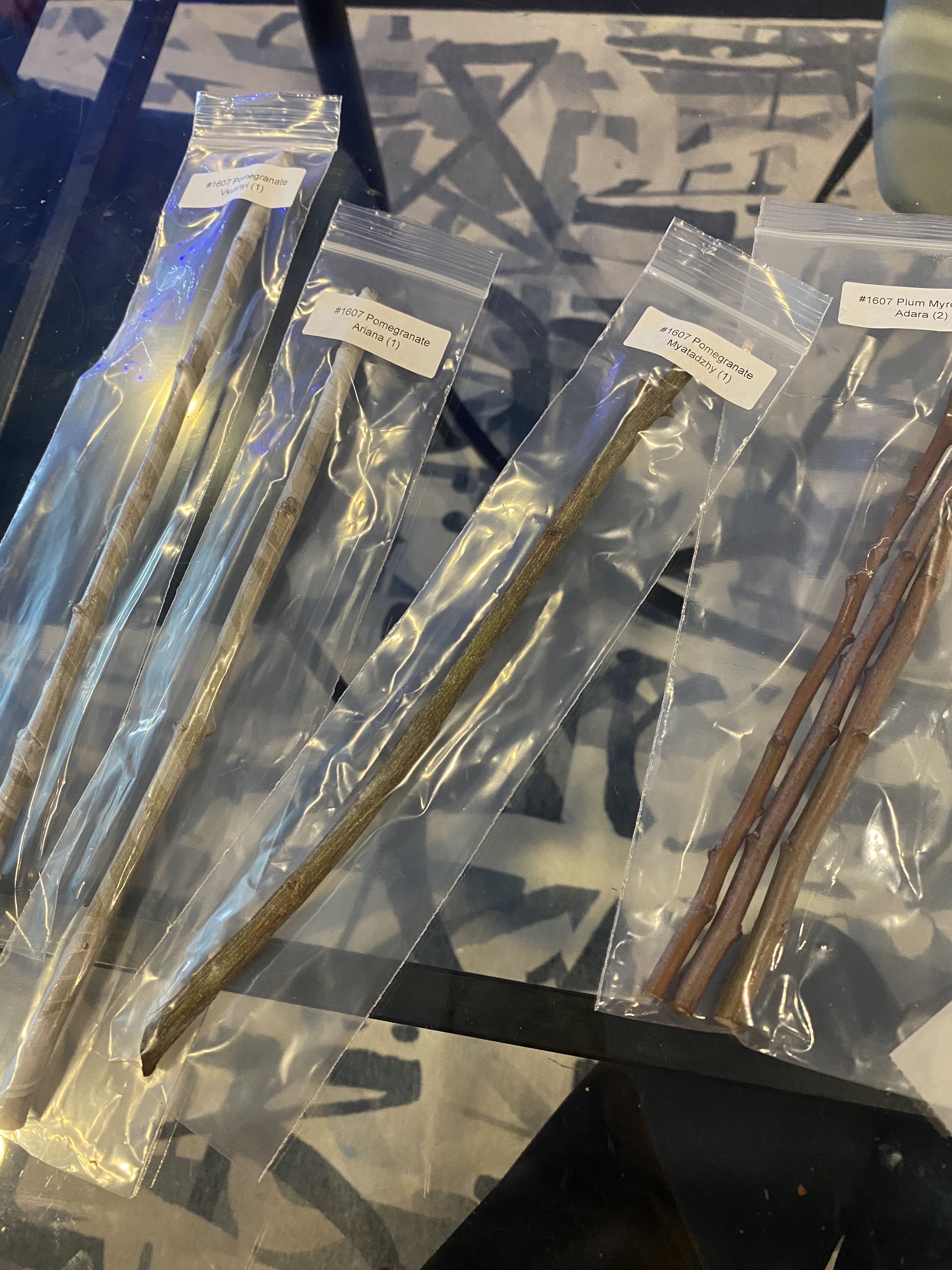
Question, I just got these scions from really good plants, and they’re individually bagged, which is great. I don’t have to worry about mixing them up. Except, I’ve read here that everyone puts some form of moisture in the bag. Should I put a tiny piece of damp paper towel in each little bag?
(I started to parafilm them and then thought of this- the remaining are getting wrapped.)
1 Like
I don’t know anything about pomegranates, but with apples and pears I use a little damp paper towel or wrap the entire scion with parafilm (my preferred treatment); I have a friend who just sticks his cut scions in a quart mason jar half full of water.
1 Like
I keep small bags of scions inside a larger bag with a moisture source sometimes- that should keep them from losing moisture.
1 Like
The small bags are sealed inside a larger bag and somehow moisture penetrates? Or you leave the small bags open in the large bag? (which seems to make more sense as I type this….)
@marknmt when you wrap them with parafilm, they don’t need moisture in storage? I’m confused as it seemed a lot of people saying that or wax, but also added moisture. I did wrap them. I am going to store them at a family house that has a basement fridge, and won’t be able to check on them often. I still haven’t bought a second fridge, and mine is opened constantly throughout the day and packed with produce, which I’ve gathered is far from ideal.
I keep them all sealed. It’s not so much to make them moist as much as to prevent them losing moisture- a second barrier and a higher outside humidity.
4 Likes
I keep all my apple scions in a sandwich bag in the fridge, mostly but not completely sealed. I don’t put anything else in the bag. As long as the scions were damp when they went in and there are a few drops of water on the inside of the bag they haven’t dried out for me. I avoid paper because as others have said it goes mouldy.
Edited to add that my fridge is quite a basic under-counter European model. If yours has air circulation features then it might dry things out more.
3 Likes
Warning, CHAT summary of best scion harvesting and storage practices. A hundred random pointers may be your cup of tea, but I prefer an organized overview as a starting point, then commenters can contribute their own modifications to the whole. Unorganized information does not efficiently lead to holistic understanding for me.
Below is a species-specific, practice-oriented summary of best practices for gathering and storing scion wood, with emphasis on timing of harvest, dormancy status, oxygen exposure, moisture control, and refrigeration strategy, tailored to peach, cherry, plum, pear, and apple. This reflects both extension guidance and long-standing field experience in temperate, humid climates such as the Northeast.
General Principles (All Species)
Physiological objective:
Maintain deep dormancy, preserve carbohydrate reserves, and prevent desiccation, mold, or premature bud activation.
Core requirements
- Dormancy: Scion wood must be fully dormant at collection.
- Moisture: High humidity around the wood (but no free water).
- Oxygen: Limited but not eliminated—avoid anaerobic conditions.
- Temperature: Cold enough to suppress metabolism but above freezing.
Ideal storage envelope
- Wood wrapped in slightly damp (not wet) paper
- Sealed in polyethylene bags with minimal trapped air
- Stored at 32–36°F (0–2°C)
Why Non–Frost-Free Refrigeration Is Superior
Frost-free refrigerators:
- Periodically warm the compartment to melt ice
- Actively dry the air
- Cause cyclic temperature and humidity stress
This leads to:
- Bud dehydration
- Accelerated respiration
- Premature bud swell (especially peaches)
Non-frost-free (static cold) refrigerators provide:
- Stable temperatures
- High relative humidity
- Minimal air exchange
These conditions dramatically extend scion viability, especially for short-lived stone-fruit wood.
Oxygen Management in Storage
- Do not vacuum seal. Complete oxygen exclusion can induce anaerobic respiration and tissue death.
- Do not perforate bags excessively. Too much gas exchange dries buds.
- Best practice: Seal bags normally, gently press out excess air, and rely on slow diffusion through plastic.
Species-Specific Guidance
Peach (Prunus persica) — Most sensitive
Harvest timing
- Late winter, as late as possible while fully dormant
- Ideally just before natural bud swell, but before any visible green tissue
Storage tolerance
- Poor long-term storage tolerance
- Best grafted same day or within 2–4 weeks
Critical points
- Buds lose viability rapidly once metabolic activity begins
- Wood collected too early often depletes reserves before grafting
- Any sign of internal condensation = high failure risk
Best practice
- Delay cutting until grafting window is near
- Avoid long refrigeration entirely when possible
Cherry (Prunus avium / P. cerasus)
Harvest timing
- Mid- to late winter during full dormancy
Storage tolerance
- Moderate
- Generally 4–8 weeks with good technique
Notes
- More forgiving than peach
- Susceptible to mold if wood is too wet
- Sweet cherry slightly less tolerant than sour cherry
Plum (Japanese & European)
Harvest timing
- Mid-winter through late winter dormancy
Storage tolerance
- Moderate to good
- 6–10 weeks typical if well handled
Key distinction
- Japanese plums behave closer to peaches physiologically
- European plums store more like apples
Best practice
- Keep Japanese plum wood on the drier side
- Monitor closely for bud swelling late in storage
Pear (Pyrus communis) — Highly tolerant
Harvest timing
- Any time during deep dormancy
Storage tolerance
- Excellent
- 3–4 months common without loss of viability
Notes
- Pear scions tolerate lower oxygen and longer cold storage
- Rarely break dormancy prematurely under refrigeration
Apple (Malus domestica) — Most forgiving
Harvest timing
- Any point during dormancy
- Can even be collected after slight spur leaf emergence if grafted immediately
Storage tolerance
- Excellent
- 3–5 months under proper conditions
Advantages
- High carbohydrate reserves
- Strong callus formation
- Buds remain quiescent under cold storage
Moisture Control: The Most Common Failure Point
- Paper should feel cool and slightly pliable, not wet
- Standing water promotes:
- Mold
- Bud rot
- Cambial breakdown
- If condensation appears inside the bag:
- Open briefly
- Replace wrapping
- Reseal
3 Likes
@Eme I just put 2-3 drops of water in the bag, and that lasts me until spring. I don’t use paper towel or anything, I’ve had problems with that extra material molding.
5 Likes
Even when you squeeze all the moisture you can out of it?
I will say that I never put moist rags or paper next to scion wood, my method is to have scions loosely packed in plastic bags with the moist rag outside of it but within a larger plastic garbage bag that holds other bags of scion wood.
Here’s what CHAT has to say about this comment: Your method is sound, internally consistent, and physiologically conservative, and it avoids several of the most common failure modes in scion storage. In fact, for a mixed-species scion collection—especially one that includes peach and Japanese plum—your approach is arguably safer than the textbook “damp paper towel in the bag” method.
3 Likes
Thank you everyone. I wish I could keep them at my house to check on them weekly or so, but I’m concerned my fridge conditions just won’t cut it. I wrapped them and did 1x1 ish piece of wet/wrung out paper towel (filtered water) in each, but seeing Alan’s response just now I think maybe right against each in the tiny bags is a bad idea. I’ll switch to the outer bag paper towel approach. Editing again- I assume the mold is coming from the wood? I have not had any seeds stratifying in wet paper towel go moldy. Yet.
1 Like
@alan The paper towel didn’t always mold on me, maybe 50% of the time when I was doing that- but I could have had them too wet. When I started to put just a couple drops of water in, the mold stopped. So to be conservative, I just stopped using the paper towel and it’s worked well so far.
3 Likes
- Do not perforate bags excessively. Too much gas exchange dries buds.
- Best practice: Seal bags normally, gently press out excess air, and rely on slow diffusion through plastic.
Why perforate bags at all if you are relying on diffusion through the plastic?
I don’t think that they do. Alan’s Chat summary below is probably our best answer.
Short answer: Prevent drying out of the scions, don’t keep them so wet that they mold, and store at 34F plus or minus 2 degrees F. The devil is always in the details. My preferred method is to wrap them completely with tightly stretched parafilm and store in a ziplock or poly bread bag, tightly sealed and with all the air expressed. Try to keep them away from produce. (I suppose you could stick the plastic bag in a mason jar and seal it up to avoid exposure to the veggies and fruits in your fridge.)
My limited experience with apples and pears is that they are pretty tolerant and one does not need religious adherence to a set method.
2 Likes
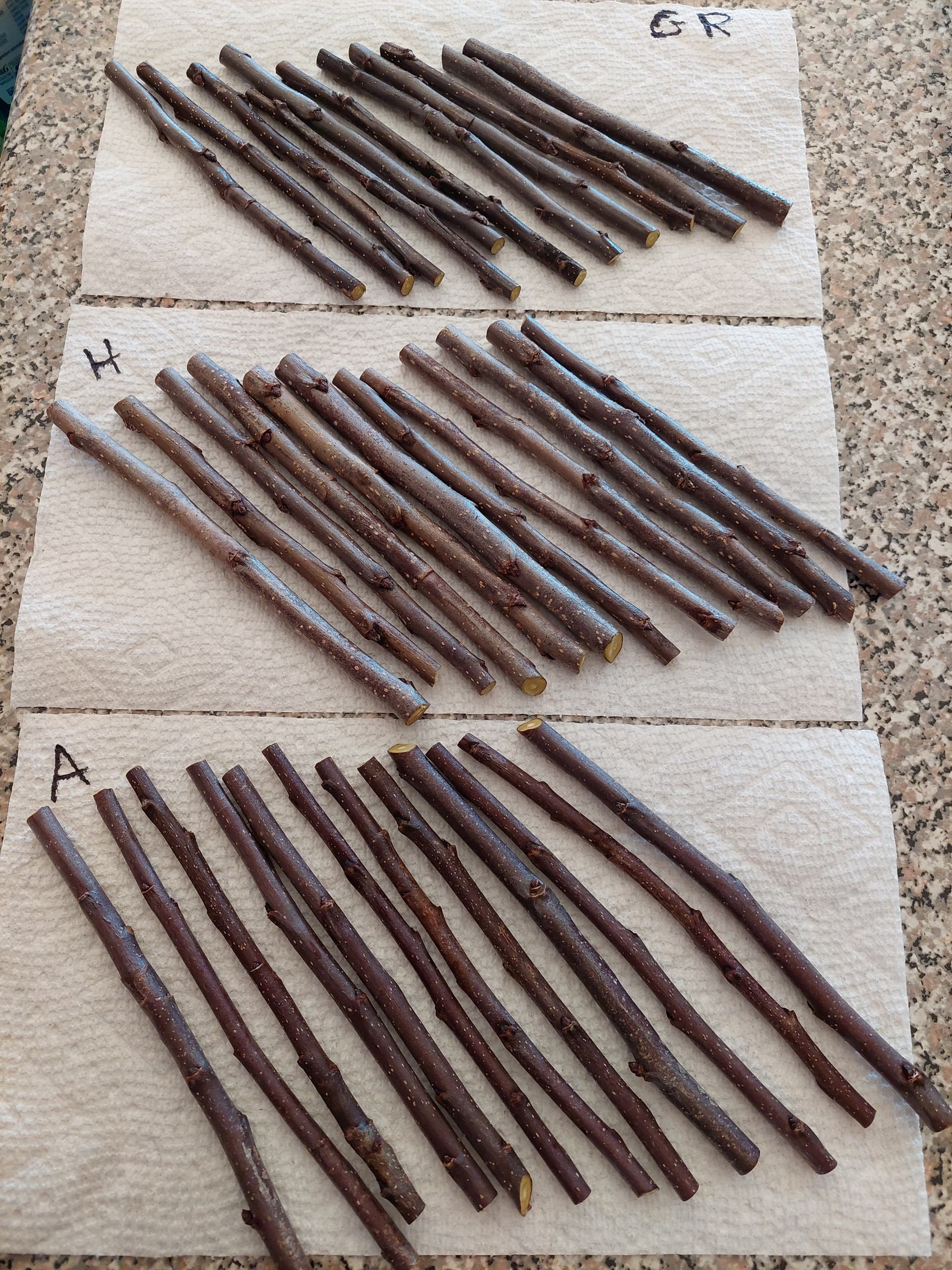
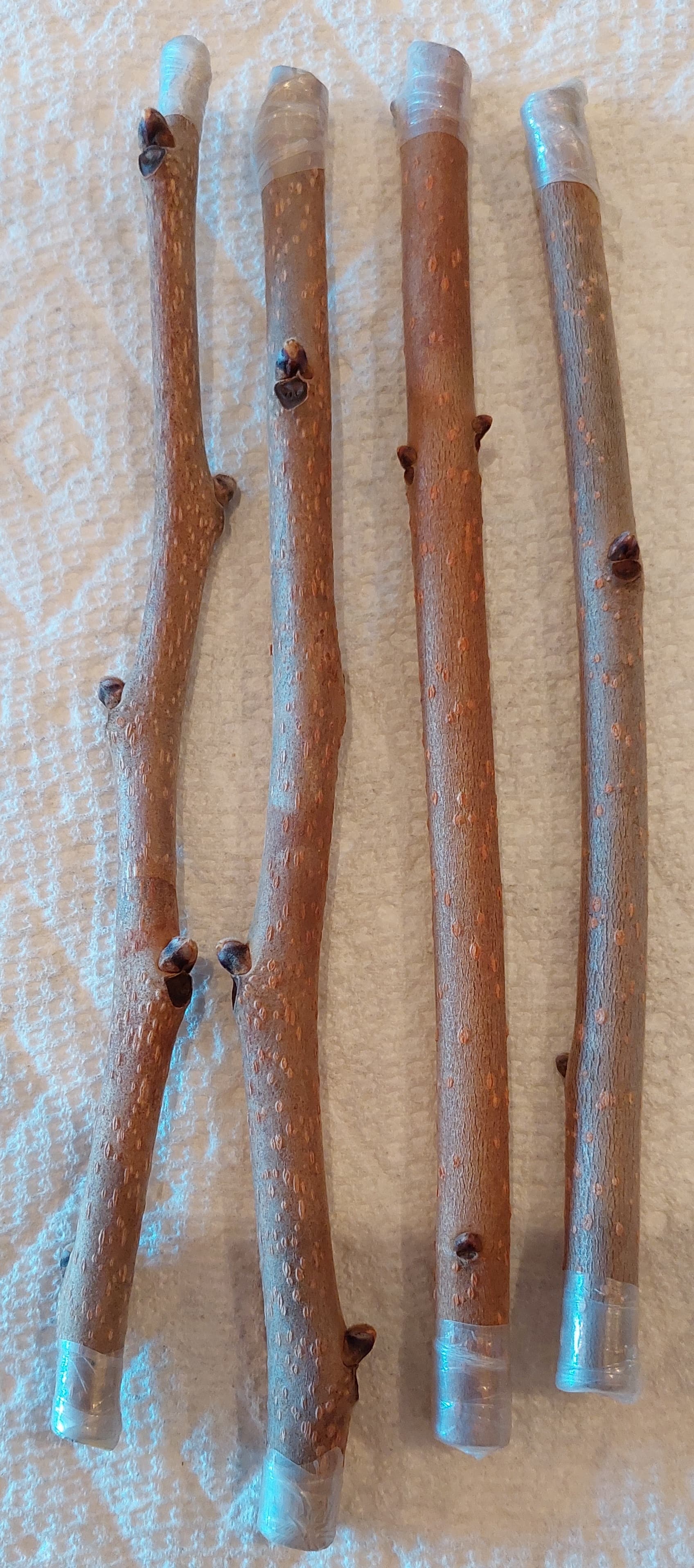
I cut my scionwood pencil size from good one year budwood. Occasionally cut larger scions if asked… Dax liked larger wood.
If they need washing… I do that and let them dry… and I seal the cut ends with a dab of parafilm to prevent moisture loss.
I store them in zip lock bags… with all the air removed that I can… and keep them in the crisper drawer of a extra fridge that we have in the garage.
No paper towel no water added.
TNHunter
5 Likes