The carbide toothed chainsaw blades can be sharpened with the correct size round file that uses industrial diamonds. They aren’t super expensive.
2 Likes
OK, looks like you are right. OSHA requires using chaps at least for lumber jacks. https://www.osha.gov/laws-regs/regulations/standardnumber/1910/1910.266
The employer shall provide, at no cost to the employee, and assure that each employee who operates a chain saw wears leg protection constructed with cut-resistant material, such as ballistic nylon. The leg protection shall cover the full length of the thigh to the top of the boot on each leg to protect against contact with a moving chain saw. Exception: This requirement does not apply when an employee is working as a climber if the employer demonstrates that a greater hazard is posed by wearing leg protection in the particular situation, or when an employee is working from a vehicular mounted elevating and rotating work platform meeting the requirements of 29 CFR 1910.67.
1910.266(d)(1)(v)
The employer shall assure that each employee wears foot protection, such as heavy-duty logging boots that are waterproof or water repellant, cover and provide support to the ankle. The employer shall assure that each employee who operates a chain saw wears foot protection that is constructed with cut-resistant material which will protect the employee against contact with a running chain saw. Sharp, calk-soled boots or other slip-resistant type boots may be worn where the employer demonstrates that they are necessary for the employee’s job, the terrain, the timber type, and the weather conditions, provided that foot protection otherwise required by this paragraph is met.
1910.266(d)(1)(vi)
The employer shall provide, at no cost to the employee, and assure that each employee who works in an area where there is potential for head injury from falling or flying objects wears head protection meeting the requirements of subpart I of part 1910.
1910.266(d)(1)(vii)
The employer shall provide, at no cost to the employee, and assure that each employee wears the following:
1910.266(d)(1)(vii)(A)
Eye protection meeting the requirements of subpart I of part 1910 where there is potential for eye injury due to falling or flying objects; and
1910.266(d)(1)(vii)(B)
Face protection meeting the requirements of subpart I of part 1910 where there is potential for facial injury such as, but not limited to, operating a chipper. Logger-type mesh screens may be worn by employees performing chain-saw operations and yarding.
2 Likes
When my wife and I met I had one big chainsaw and no safety gear but glasses. For my next Christmas I got from her, full masked helmet, chaps, and boots.
I more scared of her seeing me cut without the safety gear than the saw. 
This is a wise statement. The only thing about it is some old saws rarely quit. My big ole Stihl 056 is from the mid 80s and still rips like a new one. Only every piece of it is metal and can take a beating. I get nervous every time I pick up one of my newer smaller saws and they are wrapped in plastic…
4 Likes
My father in law keeps amassing a collection of OLD (big) saws. I’ll probably inherit them some day, with a healthy dose of safety and re-training on best practices.
Probably my favorite part of the electric Milwaukee is that it stops when you let off the trigger. Not so much for some gas saws I’ve wielded.
3 Likes
Good to know, I’ll have to try it out 
2 Likes
Around here is embedded fence staples and barbed wire from long ago pastures. I have a black cherry I need to take down but there’s an old fence post in line next to it. I’m going to use a neodymium fishing magnet on it before I cut.
1 Like
I bought the largest version of a Sachs Domer used from an arborist in 1990 who claimed it didn’t cut straight. I replaced the bar (maybe 36") and it cut just fine and would start after sitting for year with one pull (very hard pull that I needed to use both my arms for while kneeling on a stake holding it to the ground). It was a true lumberjacks saw that could take down any sized tree that grows here with a single felling cut. It was at least 10 years old when I bought it. I sold it 10 years ago when I couldn’t find a replacement chain-break for it, the company stopped manufacturing parts for the model, even though they’d sold a lot of them all over the world… I sold it to a Jamaican-American buddy of mine who used to work as a lumber jack in Jamaica. It was so much saw for $100 that he couldn’t resist it. It is still going strong and my friend still has two arms and two legs, but I wouldn’t use the thing.
I’ve got the Greenworks 80v chainsaw, and it’s great. Super powerful and fast cutting. I’ve been going through 12-14 inch ash without a problem. But, I would still recommend having two batteries. It drains pretty quickly on those bigger cuts. They do charge quickly though. (30-40 minutes)
1 Like
I have some DeWalt tools that are about 20 years old and still going strong. I bought a bunch of those converters which I keep permanently affixed to the old tools and they fit the new 20V batteries. The only tools that die on me are the drills, two DeWalt battery op drills bit it. The newest one has a brushless motor and I hope it will last longer.
Re: chain saws, I don’t have a big one but I have one of the DeWalt 20V ones which I find very handy for fruit trees. It its a couple inches in diameter I will just use my hand saw, but for the stuff from 3"-6" I really like the little chain saw.
2 Likes
Heh… The only Dewalt 20V tool I’ve killed is also a drill. Replaced with a better model which is brushless and am hopeful it will last longer too.
3 Likes
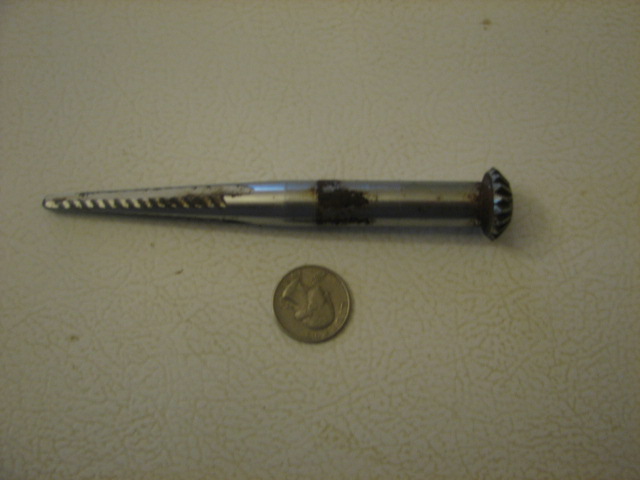
Did you hit one of these?
1 Like
I’ve seen a lot of unusual fasteners in my time but I cannot identify that. What do you reckon it was?
2 Likes
It is a cotton spindle for use in cotton pickers. The deerhunters would sometimes drive them into trees for steps. I’m sure that at least one chainsaw has hit one. A sawmill operator once told me that it can cause serious downtime when the blade hits one.
I commonly use one to remove staples out of posts.
If I have ever driven one into a tree, I plead the 5th. 
3 Likes
And how to go about deciding which make and model to purchase?
Someone analyzed how the rental companies chose their equipment and found that there were 3 keys.
- Machine must be safe
- Low maintenance
- Machine must be productive
Thought that I should share this.
2 Likes
Most online tool reviews are unfortunately just paid commercials, but There are a couple few youtube channels devoted to disassembling power tools and evaluating the build quality- including choice of components, fit and finish, etc. They really give you a no holds barred take on whats under the hood, and help you see past the marketing wank, since every tool is the best according to the package/commercial.
One that I really like is aVe, which stands for “arduino vs evil”. his stuff isnt for everyone, particularly since he has quite a colorful sense of humor. He really knows his stuff though. From watching his videos, Ive pieced together that he is a field tech for heavy industry- likely mining. As such, he has to know a bit about everything, kind of like a millwright in days of old. He talks you through lots of obscure details of manufacturing, like sintered vs forged parts, ins and outs of die casting, various metals used as well as formulas and grades of plastic. He tells you where theyve cut corners (as they almost always do) and where they’ve splurged. He hazards a guess often about the likely failure modes of a given tool, which often as not is where it meets the (in his words) “200 lb gorilla” (ie often the trigger or other human actuated components).
He did a teardown of both the smaller dewalt 16” 20v saw and the comparable milwaukee saw, and he basically said the milwaukee was built much better. That has nothing to do with the brand though. Equating brand with a certain level of quality has always been dubious, but dramatically more so in this era of global supply chains. Nor is price a good proxy for quality. He’s disassembled a bunch of very expensive units (Festool track saw, Dyson vacuum) to find cheap poorly engineered components and low build quality. Globally made goods are very much a value added proposition, and in many cases the majority of the value is added at the very end!
7 Likes
As far as chaps and the relative danger of chain saws, it appears there really aren’t a lot of very serious accidents in this country although in my county, I assure you, there’s a lot of careless use of them. Figure if it’s anything like driving, over half of these injuries may be related to alcohol.
During the five-year time period, there were an estimated 115,895 emergency department visits for injuries related to the use of a chain saw occurring in the US. This yielded an average annual frequency of 23,179 injuries. Table 1 depicts the frequency and percentage estimates of injuries. Adults aged 30–59 accounted for the majority of ED visits for injuries (57%), with males representing 95% of the visits for an injury related to a chain saw. Most of the injury visits occurred during the spring, summer, and fall months, while 58% of the injuries occurred at the person’s home.
Table 1
Average annual number and percent of emergency department visits for injuries related to chain saws, United States, 2009–2013.
Lacerations were the primary diagnosis for 81% of the ED visits. Among body parts injured, 29% of the injuries occurred to the hand or fingers, 18% to the knee, 12.5% to the lower leg or ankle, and 11% to the upper leg. Closer analysis of injuries to these body sites revealed that lacerations were the predominant injury diagnosis, accounting for 87% of hand/finger injuries; 89.3% of lower leg/ankle injuries; 97.9% of knee injuries; and 97.4% of upper leg injuries.
Only 3.6 of the patients were hospitalized, with 94% treated and released. While we could not discern the severity of injuries in the present study, there were average annual 139 amputations and 983 injuries to the head and neck, with 69% (57.1–78.8) of head and neck injuries diagnosed as lacerations. No fatalities were reported, though deaths reported would have been specific to death on arrival to the ED or death in the ED.
Verbatim narrative entries that characterize the circumstances precipitating the injury were analyzed. However, the majority of the entries were vague (e.g., “cut arm with chain saw while cutting tree; laceration lower arm”) and did not add enough information to further delineate the circumstances precipitating the injury. Therefore, analyses of verbatim injuries are not presented.
2 Likes
The two serious chainsaw injuries I know of where death from falling out of the tree. ALWAYS use a safety harness if climbing and be cautious of possible swinging branches.
3 Likes
Towards the end of my chain sawing while bucking logs today I noticed a little smoke. Didn’t think much of it at the time but while putting away the chainsaw, I noticed that it had ran out of bar and chain oil. It seemed to have plenty in the little window after I had recharged the battery earlier. Hope that there was no damage. Need to get in the habit of filling with oil after recharging even if it seems that it doesn’t need any. The Milwaukee M18 is a nice saw but it really wasn’t meant for any diameter greater than about 16" - if that.
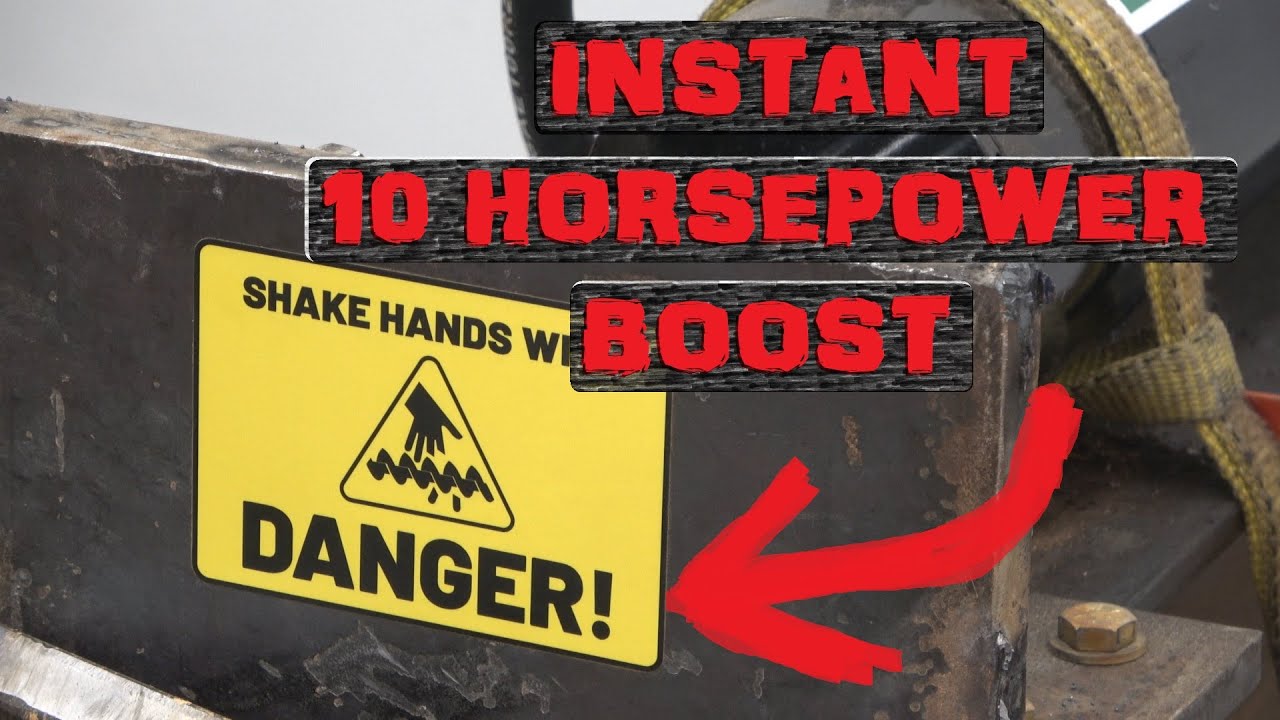
@hobilus - Been viewing AvE YouTube posting. He really does get into detail. Just wish that he would get into log splitters more. Having a tough time deciding which one to purchase. The kinetic splitters are intriguing.
1 Like
looks like hes into this one
2 Likes
I’ve run saws dry but don’t really remember them smoking, what I have seen smoke is trying to run a dull chain in wood. This also makes your chain very hot.
On the matter of splitters my dad has a 27ton with a Honda engine that can split vertical or horizontal. Seems to do a good job around here. I’d at minimum stick with a Honda or Briggs and Stratton engine.
2 Likes