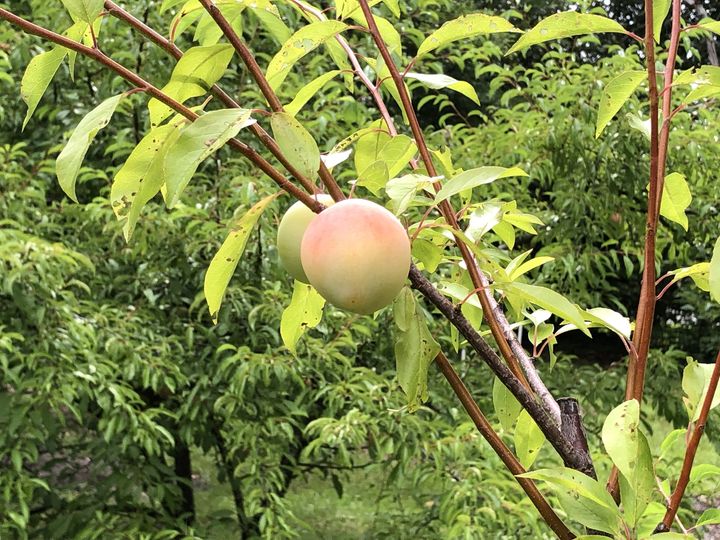
The large tree in the foreground is the Sonny’s Yellow Chickasaw plum. The coppery color one in the background to the right is Drag Queen which is a hybrid between the Chickasaw cultivar Guthrie and an unknown ornamental cherry plum. The small three to the left is a young wild type tree planted for pollination. Both Sonny’s Yellow and Drag Queen are pushing 12 or 13 ft tall. They are much bigger trees than the photo might imply.
As you can tell the Sonny’s Yellow looks a little lopsided. I had a major limb to split last summer. It was compromised enough that I cut the whole thing out this spring. Two water sprouts are growing from the stump of the old limb which I will allow to grow out and replace it.

2 Likes
I will have room for an unknown (but hopefully well-parented?) chicksaw or two next season. I need to take out a couple of old apple trees (supermarket varieties planted by the former homeowner), but that’s how I made room for two northern pecans this spring - I took out my two callery pear street trees!
All this talk of Chickasaws…
Thanks @coolmantoole for the thorough descriptions.,Wondering what the ‘hardiness’ or adaptability of these is to northern growing. I’m seeing in that Arnoldia that @Petebacher posted above that Chickasaw types grew prolifically in Iowa. I guess that would bode well for trying them out here in the banana belt of VT, at least in terms of winter lows.
There are quite a few wild plums here in places. Not sure if they’d rightly be classified as americana? I’ve observed a fair bit of variation in phenotype. Very little direct observation of fruit traits, though. They often seem to bear very little, and the hot spots for these are in W VT from what I’ve seen- an hrs drive+ for me. The local types Ive brought into my orchard for polllination and trialing are low growing- 6 ft.-ish- extremely thorny -true thorns, not just the sharp short thorn-like twigs I see on some- and they sucker prodigiously. I’ve bought purported Prunis americana rootstock (Fedco) and these are nothing like that, IME
1 Like
I should add that I looked for years for wild plums in my own neck of the woods. Nearly every field guide to trees and shrubs lists them as “common to roadsides and field edges”. Well it took years, but I finally got eyes for them. The key is to look when they’re blooming. I wouldn’t call them common, but I’ve found several patches within 10 minutes drive. Funny thing is a lot of them seem to be clonal stands, which would also explain the lack of fruiting. But then where, I’ve wondered, would the seed have come from?
Anyone in VT looking for wild plums, I’d suggest driving rt 22a. It’s all over the side of the rd. between Middlebury and Vergennes. Also on the state T&E list. Look but don’t touch! And don’t dare pick any fruit. Tsk tsk
Marcus- thanks for all those descriptions. Question: are Chickasaws a subset of Beach Plum? Or vice versa?
I would think in your neck of the woods it would be mostly Canada plum (prunus nigra) or hybrids thereof. That is what I have been locating and doing some work with here in Maine. I find it easiest to drive the roads and search for blooms like you mention. They flower here the same time as the Amelanchier canadensis. Would love to get some further genetics though so keep me in mind if you ever get plant material of your local ecotype.
Interesting. Well state DNR thinks it’s americana at least. Not sure they’ve done due diligence. Yeah, they’re out right at the same time as shadbush, but they’re flowers are different enough at 40 mph that I can spot them. These are pretty distinctive compared to other wild type plums I’ve seen. Not sure how the fruit is. Some of them are not only suckering, but completely stoloniferous, with no propensity to form scaffolds or canopy of any real kind. I’m away but will try to post some pics. Interesting as with many of these marginal / obscure fruits with long histories of human use, to consider the range of eco types and what that might say about their origins and potential for improvement.
Looks like I’ve got to do some driving and walking around near home. All I ever see on the roadside around here are escaped callery pears. They are all blooming now, as are the intentionally planted street trees up and down our neighborhood. When do Native plums tend to bloom relative to calleries? My wild goose just bloomed on the branch closest to the house today. It should be in full bloom Thursday. So here, my particular wild goose blooms about a week after the Bradford street pears, and maybe 1-1/2 weeks after the start of the escaped callery flush.
Oh, and my established BPs are probably a week behind my wild goose bloom timing wise, give or take a few days. There’s definitely some variability across the four seedlings I have in the yard.
Speaking off the top of my head here, but plums are definitely well before Bradford pear. There are literally tons of Amelanchiers here, and they along with plums are the first to bloom, even before street pears, not that there are that many of those here. Coming up in a couple weeks. I’ll try and post when it happens if I get a chance.
2 Likes
@hobilus funny you mention that because I live along rt-22 in NY right near vermont and just planted a native plum along the road. Great sign it has a good chance
I love this site for threads like this! I got very interested in plums this year and discovered native plums. I got two prunus americanas (just called native plums) from gurney’s. No idea how the fruit is on them though.
Would be interested in reading more about varieties. It seems raintree has two different beach plums for sale- premier and jersey, maybe they can tell you more about them if you ask
1 Like
I will type up a list of the Beach Plum selections I’ve come across as a result of this thread and my research and reaching out to people… probably later in the week as I have several new to me scions coming in the next day or two. It will start out as just a list with sources, no real descriptive information. Descriptions will come with time or with help of those who may have these varieties already. Stay tuned…
3 Likes
From right to left, Ms Bessie Chickasaw Plum, Odom Chickasaw Plum and Guthrie Chickasaw Plum. Ms Bessie is a sucker on its own root. Odom and Guthrie are grafted onto Toole’s Heirloom. Once again all of these trees are bigger than they look. Odom is easily pushing 15 ft. I plan to give it a heavy summer pruning to bring the height down some once it ripens its plum crop. It has the heaviest crop it has ever had this year. Guthrie seems to be an every other year sort of tree. Ms Bessie acts like it may be self fertile. The guy I got it from has one that’s producing with no other plum trees around that he knows of. Mine set fruit with very few flowers and with the only plums around still having lots of flowers being cherry plums. I may germinate a few seeds just to see if the little plants look like they are part cherry plum.
See less

Highway departments have long planted native plums along freeway right of ways. I don’t think they do that anymore once they realized that they attract deer to highways which is a bad thing.
Same here in eastern KS, large scattered americana thickets of a single clone, almost no fruit.
Is it Americana or Chickasaw in your neck of the woods? Or both?
The reason I ask is I acquired some seed last year from Kansas and pretty sure it’s Chickasaw/sand hill but I know Kansas reportedly has an abundance of both species.
I’m in Topeka area, all I’ve seen around here is always americana. But I was young in north central KS, different plum the old people called “sand plum”.
Eastern plum grows in stiff clay with limestone, lots of trees and humidity. Sand plum was in open windswept low humidity area’s, mostly dry, broken up “caliche” limestone excuse for soil.
Both I always saw as single clone thickets.
3 Likes
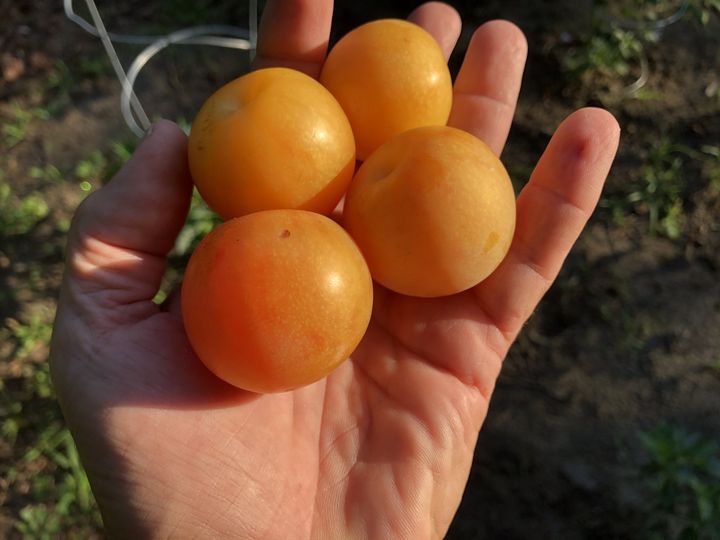
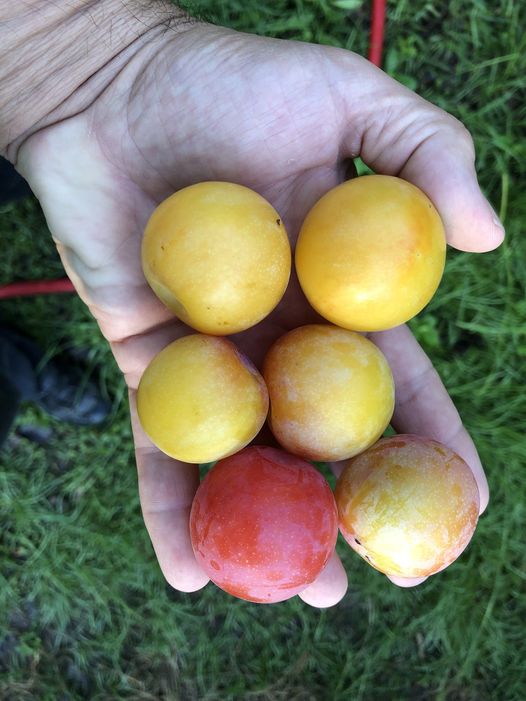
From top to bottom: Sonny’s Yellow, Guthrie, and Toole’s Heirloom. The plums on Odom look a lot like Toole’s Heirloom except they are much bigger. They also don’t have as much flavor.
7 Likes