Well there we go! I thought the queen came by herself in a little box like that with a sugar wall that she had to eat thru while the other bees were getting used to her. Apparently, as you say, she has attendants to do that for her! 
The bees in the queen cage is from her original hive and they are there to feed and take care of the queen. After a brief period the other bees will accept the new queen as their own.
thanks bill! I’m definitely learning!
1 Like
You probably already know all this. The queen secretes pheromones and all the worker bees associate with it and become one working unit. The reason she is initially separated is to gradually spread her scent around. If she is immediately introduced the worker won’t accept her and she will be eliminated. Bill
2 Likes
Wow, so much more to learn still. its all very exciting.
1 Like
A swarm went through today and i didn’t catch it. I’ve caught two others this year. The winter was mild here and those are the best years for swarms.
2 Likes
Well, its official. I am a beekeeper!!! (for 2 whole days). Built and painted hives last week and set them up. Picked up bees on Saturday and put them in and everything looked great.
But wouldn’t you know it…2 days in and I’ve already got something mysterious going on that even my “teacher” isn’t sure what’s going on, so maybe some of you can help?
Basically, I got 2 packages of bees complete with a queen and a few attendants in the little box. We put one of the little queen boxes in each hive, and put one 3 pounds of bee packages in each hive. We also put a jar of sugar water at each hive entrance to sustain them until they find food. I watched with facination most of the afternoon, hoping to see a big orientation flight (didn’t) and had fun watching the bees come and go.
Anyway, today when I checked on them for first time it was around 3 pm. One hive had tons of bees comming and going, most of the sugar water was gone, and all was well. The other hive…almost no sugar water gone and no bees to be seen. I figured maybe the queen had died or maybe even left, so even though i know you aren’t suppossed to open the hive much if ever, I just had to check and see what was going on.
So, I took the top off and sure enough- almost completely empty. There were about 20 bees TOTAL and all of them were clinging to and climbing around the little queen box. To my surprise, though, when I checked it the queen was still in it and was still alive and moving around!!! So my obvious question is: WHY DID ALL THE OTHER BEES LEAVE??? Will they come back? Is there anything I should do?
One other bit of information. I couldn’t resist the urge to check my other hive a little bit, so I lifted the lid off it just enough to peak in. I cannot be 100% sure, but I think it had a lot more bees than we put in there yesterday, leading me to wonder if maybe the bees from my other hive went into the first one? Does that happen? If so, can I get them back?
Anyway, any insights would be appreciated. Thanks.
kevin
I’m new at this also, I think I would steal a few hundred bees from the first hive in hopes of not loosing whats left of the second package. Than move the hives, facing them toward each other to confuse returning bees, similar to a split. Or I could be totally wrong.
It makes it sound like all six pounds of bees moved into one hive. I’ve never put more than one package of bees into a hive at once. I wonder if @Auburn could shed some light on what is happening.
Although this has never happened to me I’m guessing that your correct especially since you visually checked the other hive. My bees were place within 1-2’ of each other and this never happened but these were established hives. Were these hive place very close to each other. If so the bees may not have been acclimated to their new queen and just got confused. If you had more bees from another source you could go back through a new introduction period but if it were me I would take good care of the remaining hive and when the population is strong you can divide the hive and they will raise a new queen from existing brood. When I say divide I don’t mean to physically go in and take bees out of one and put into another. You want to separate supers that have brood in each. The super without the queen will start several queen cells to replace the missing queen. Right now I would concentrate on taking care of your remaining hive. Just for side note I would reduce the entrance from a full open to about 2" wide until they get strong enough to defend itself from other bees coming in and robbing the hive of it’s honey. If the bees are doing well I would not open it very often. I’m not sure if any of this helps but If I can help/advise just let me know. Bill
Honey flow is happening now in my area. When the privet bushes smell wonderful outside this corresponds to the fastest input of nectar to the hive in my area. Bill
Thanks Bill. THat was very helpful, and I’ll take your advice and try to keep the 1 hive strong and later “divide” it to another. And to answer your question, the hives are about 2 feet apart…so I guess that makes it even more likely that they just all went to the one hive.
@ChrisL - my understanding is that what you are suggesting would not work, but others here know more than me. The problem with moving bees now from the one active hive over to the hive with no bees but a queen is that the queen, who will be out of her little sugar-door box probably by tomorrow, would be killed by the bees from the other hive since they would have no time to get acclimated to her pheromones. Once she is killed, none of the bees would stay sine there is no queen, no wax, and no honey. But I’m as new to bees as you are- I’ve read everything I could get my hands on but that doesn’t equal experience, which we will both be getting.
Since the queen is still alive and still has her attendants and at least a few other bees still with her, my hope is that the few remaining bees will be enough to establish a new colony, albeit a very small one. If not, I’ll try to split the other hive at some point.
My other possibility is that since I might end up with an empty hive, perhaps I will find a swarm and be able to catch them and put them in the hive. I’ve had hives on my land before and had people call me to tell me they found a hive, so its not as unlikely as it sounds.
ANy more advice and explanation on what is happening to me would be appreciated.
Kevin, what you think you observed does happen sometimes when multiple new pkgs are installed.
It has to do with the same reasons the queen is in a separate cage. The bees in each pkg come from multiple hives. The queen and her attendants have to be gradually freed from their cage as the bees eat their way through the fondant plug. During the time the are in their shipping container and while she’s confined to quarters, waiting to be released in their new home, the rest become conditioned to her pheromones, and recognize her scent as being “home turf”.
Sometimes the bees find that a different queen’s pheromones are more attractive to them than those being secreted by the queen with which they were packaged. This can leave you with more bees winding up in one hive than the other. When all the hives and pkgs are new, as in your case, the ladies don’t recognize that other bees are outsiders from which their home would otherwise be defended. So, they are allowed to freely come and go.
The reason they did this could be minor, or could be due to something important, as the one queen may have been injured or poorly fertilized. It’s possible to try to rebalance the numbers early on, but as a new hive owner you’re probably safest following the advice Auburn gave you. Also, if you wait until evening to install bees it gives them more time to settle in before taking flight. I keep my entrances reduced until numbers build up and until they need the wider opening for more ventilation and easier summer bearding.
At least both hives didn’t abscond on you right away.
Thank-you, @MuddyMess_8a, for that very helpful information. It makes sense. Also, the place I bought my bees from said they had just collected the bees from their own hives the afternoon before, and I picked them up at 8 am. So each package had only been exposed to the queen that was put in with them for a few hours before I put them into my hive. That seems to make what you just said even more likely since the “girls” weren’t even exposed during shipping- there was no shipping. They were gathered up, a queen put in with them, and they were dumped into my hives all within 18 hours or less. Seems like that would make what you proposed even more likely, right? In other words, they really had almost no time to recognize her as the home turf you mentioned.
It would be pretty easy for me to move one or two frames from the full hive over to the empty one, but it sounds like you are against that, which is kind of what I thought. So it sounds like you and bill both think I should leave things alone and try to split my good hive later on.
thanks
Right.[quote=“thecityman, post:114, topic:4536”]
So it sounds like you and bill both think I should leave things alone and try to split my good hive later on.
[/quote]
I do think you’re probably safer following the bees’ decisions until you have some better understanding about beekeeping and some successful experience under your belt. Enough observing and experience will give you an intuitive understanding of what they need you to do, but it takes time to get there.
1 Like
If you are close to your b supplier, get them to shake 3# of bees and use that lonely queen as the queen to that package, that way you don’t ‘waste’ that lonely queen. To make it easier to get the queen accepted, remove the attendants with a thin wire that has a small hook at the end to grab the attendants and drag them out of the queen cage. If an attendant dies she can plug the escape hole and the queen can’t get out. This is a bit hard on attendants, but they will be killed as soon as they are loose in the colony.
A nifty trick to boost the second hive, if you get a 3# queenless package, pull a frame of brood from the strong hive and shake most of the bees off in front of their hive and place the frame of brood into the middle of the weak hive. This will ‘lock’ the workers to the brood as workers won’t leave brood. Pulling workers from a strong hive to a weak hive is a good way to lose a queen and get robbing started.
You don’t have enough bees to defend the colony, forage, feed brood, feed queen, clean etc.
Keeping asking questions, you help every one.
When you see a lot of capped bee cells in the strong hive steal a couple of frames and add them to the weak hive. When the capped cells hatch their queen will be the weak hive queen. Wait until the strong hive is very strong. Give them as much sugar water as they will use.
All very good advice. One mention of installing packages during the late evening is a good recommendation. Been doing bees now for 20 years as well as teaching classes and when you think you have them figured out they will surprise you.
Here is a pic from yesterday I thought I would share.
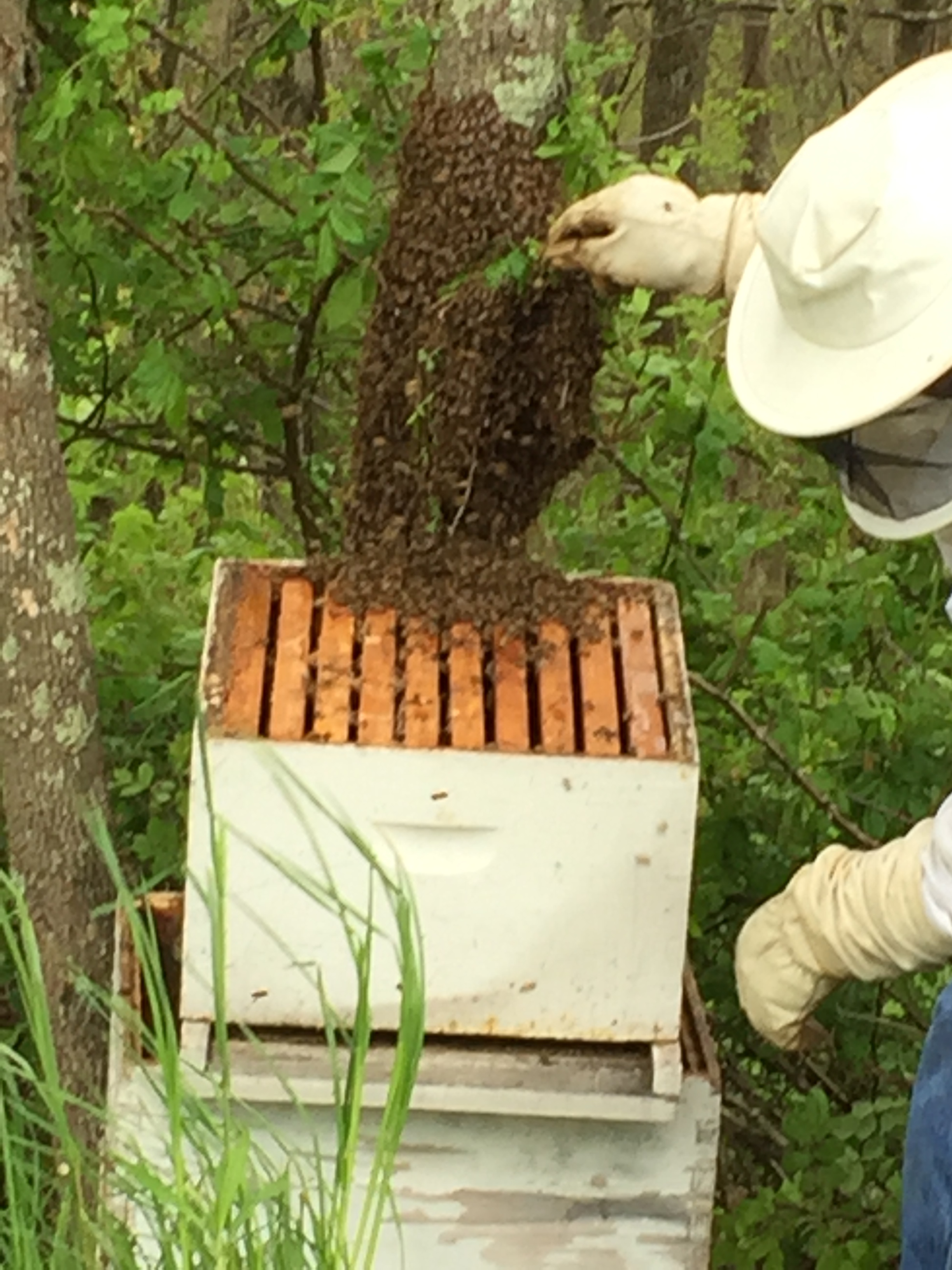
4 Likes
I had no idea there were so many bee experts around here, and I very much appreciate all your help.
@Chikn, unfortunately my bee supplier is 2 hours away AND the day I picked up my bees was the last day of the year for them to have bee pickups. So getting more bees will require mail ordering from some where. If you add up everything I spent to get started on my bee hobby (suit, hives, bees, etc) was right at $1,000. Thats about all I’d hope to put into it right now, but if I need to buy another $200 (bees + shipping) I guess I’d consider it. But if I can do what you and others mentioned and just move some from one hive to the other, I’d obviously prefer that. Or better still, maybe I can do what @BobC is doing in that cool photo: capture a swarm.
As much as I love everyone’s advice, I must confess that I got a little lost in some parts. Phil suggested pulling a frame of brood and transfering it to the weak hive- is that just the capped cells without any loose bees? You said that workers won’t leave a brood. Did you mean after they are born they won’t leave, or that live adult workers that cling to a frame won’t leave if I move the brood from one hive to the other? I got confused because you also said that pulling workers from a strong hive might result in loss of a queen and robbing. So…how do I move them without those risks?
thanks for everyone’s help. Just my luck that the first time I ever try bees I get a scenario that is, apparently, fairly uncommon! oh well.
My experience pales in comparison to others here but let’s just kind of go over the situation. How many bees are left in the weak hive? What do they have for comb, un-drawn foundation?
The strong hive will start to build wax cells(draw comb) and the queen will lay eggs in the new cells. Once the eggs hatch they will feed them until they are fat grubs then they will cap them with a brown cap , as opposed to the lighter colored cap on honey. They will usually be in the center of the frame. Now they just have to wait to change into bees, 21 days from egg to bee. If your week hive can hang on the strong hive may be able to donate a frame of capped brood. You could pull it out and brush the bees off and add it to the week hive. When the new bees pop out of the cell they do not know they are in a new hive and will go to work.
1 Like