Ammonium sulfate is made by spraying sulfuric acid in a container of ammonia gas.As any water evaporates,a powder is left,which contains sulfur.
so the ammonium lowers the ph in the short term and then the remaining, separated sulfur, in the long term? if so, no issue with buildup?
also, is the ammonium sulfate soluble and be applied via watering vs granular?
Ammonia supplies nitrogen and sulfur reduces the pH.Like other fertilizers,it is a salt,which can build up.
It is water soluble.I use warm water to melt it faster.AS can also be sprinkled on top the ground and either watered in or added before rainfall.
1 Like
I don’t think that sounds quite right. Can’t remember the math but pH is all about hydrogen ions. Ammonia (base) and sulphuric acid neutralized each other to form a buffer. But sulfate is a weak base (raises pH). Elemental sulfur encourages acid forming bacteria and is not the same as sulfate.
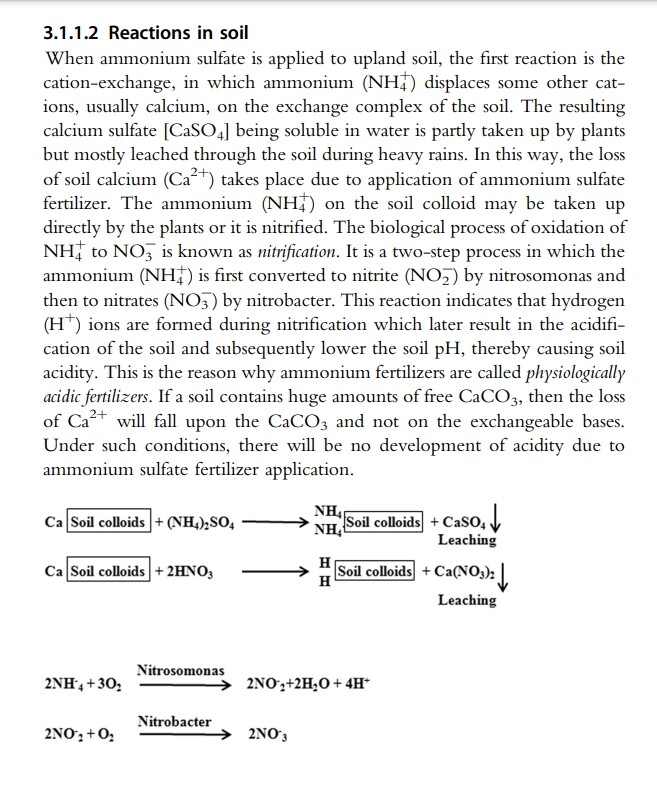
1 Like
so is calcium sulfate acidic? otherwise the acidification of the soil wouldnt happen for a long time going from nitrite → nitrate via bacteria. and people use ammonium sulfate because its instant soil ph drop. so thats confusing. the nitrification process is the same that happens in water as aquaponics and fish keepers know.
Sulfate is a compound,that contains sulfur and oxygen and will lower pH.But not all sulfates are equal,with potassium sulfate or gypsum being less able.
Well, technically all sulfates are equil, its the other ion that matters. It’s essentially sulphuric acid that already lost both the protons that made it an acidic. But thats just nerdy details 
Ah, I see, my point was i think it the ammonium that lowers pH rather than the sulphate.
kinghat,
I’m not sure if the pH of your soil or growing medium was mentioned or if it needed to be adjusted.
1 Like
I don’t think it can be changed instantly with ammonium sulfate. I think the only way to change it almost instantly is by injecting sulfuric acid in irrigation water.
Ammonium sulfate is first of all a good N-S fertilizer, and as “a side effect” it gradually acidify the soil (without overdoing N). It is not a soil acidifier that should be used to improve the soil pH reaction. It is added to the soil moderately and periodically, thus achieving a maintaining effect.
So the acidification process with ammonium sulfate takes months, but having a relatively quick reaction as a fertilizer, its other positive effects are seen before.
7 Likes
had a saved article from an in state university on changing your soil ph: How To Change Your Soil's pH | Yard and Garden. most of it seems to track but some is confusing:
Elemental Sulfur
Elemental sulfur and aluminum sulfate are the most common amendments used to decrease the soil pH. Elemental sulfur is the safest option to decrease soil pH; it is relatively inexpensive and available via local agriculture suppliers and garden centers. Unfortunately, it is slow to react. Elemental sulfur must go through two processes, a biological process and a chemical process, before soil pH is decreased. This often takes 3 to 6 months of warm soil temperatures when soil biology is active. Aluminum sulfate reacts in the soil very quickly as it must only undergo a chemical process. The change in pH happens within days or weeks. However, aluminum sulfate is not an ideal amendment because requires more material than elemental sulfur to reduce the soil pH and aluminum is toxic to plants.
Ammonium Sulfate
Soils that are naturally high in pH or highly buffered will tend to return to their natural state. Ammonium sulfate is sometime used by commercial growers on these soils because it is somewhat soluble and may also be used as an annual nitrogen source. It is intended as a safeguard to help hold the soil pH down within the desired range. It is not an effective means at reducing the soil pH post planting nor should it be used to decrease the pH preplant. Other fertilizers such as diammonium phosphate, monoammonium phosphate, and urea are acidifying agents that may decrease pH over time or help hold pH down on naturally high pH soils. These fertilizers should not be used to decrease the soil pH, but are often responsible for the gradual decrease in soil pH in commercial agriculture fields.
Sphagnum Peat Moss
Sphagnum peat moss is often suggested as a soil amendment to decrease soil pH. However, most peat moss found in garden centers is neutral or slightly acidic. Only Canadian sphagnum peat moss has a low pH of 3.0 to 4.5 and will effectively reduce soil pH. Canadian sphagnum peat moss is best used in addition to sulfur applications when building raised beds for acid-loving plants or when large pH adjustments are required.
in regards to ammonium sulfate, they are only using it annually for N. they say its not effect at reducing the ph post or pre planting  then they talk about the other acidifying agents but you should use those either lol
on the peat moss, if its already so low in ph, why would they recommend adding sulfur as well? seems like you might want to bring it up a tad 
1 Like
Not sure about all that… but I have a bunch of varieties of blueberries and one, an older heirloom called Elizabeth, seems to be the alarm bell when my pH is rising. If I see any chlorosis starting on Elizabeth, I apply ammonium sulfate and water it in and within a week or so all is well and the plants are happy again.
My beds are a mix of native soil, peat moss and pine fines (probably 1/2, 1/4, 1/4). And I apply elemental sulfur and hollytone in equal parts in the beginning of the season, then Hollytone probably twice more over the season. I use the ammonium sulfate when Elizabeth sounds the alarm bell and sometimes when I’m trying to push new growth after harvest. It seems particularly good at triggering new replacement growth from the bottom when I’m getting to the point that I’ll need to prune out some existing growth that is getting old and tired.
6 Likes
Mine are on their 3rd year in 15g pots and I have not acidified. Its about 1/3 peat moss. Getting lots off berries still and don’t really see any issues.
6 Likes