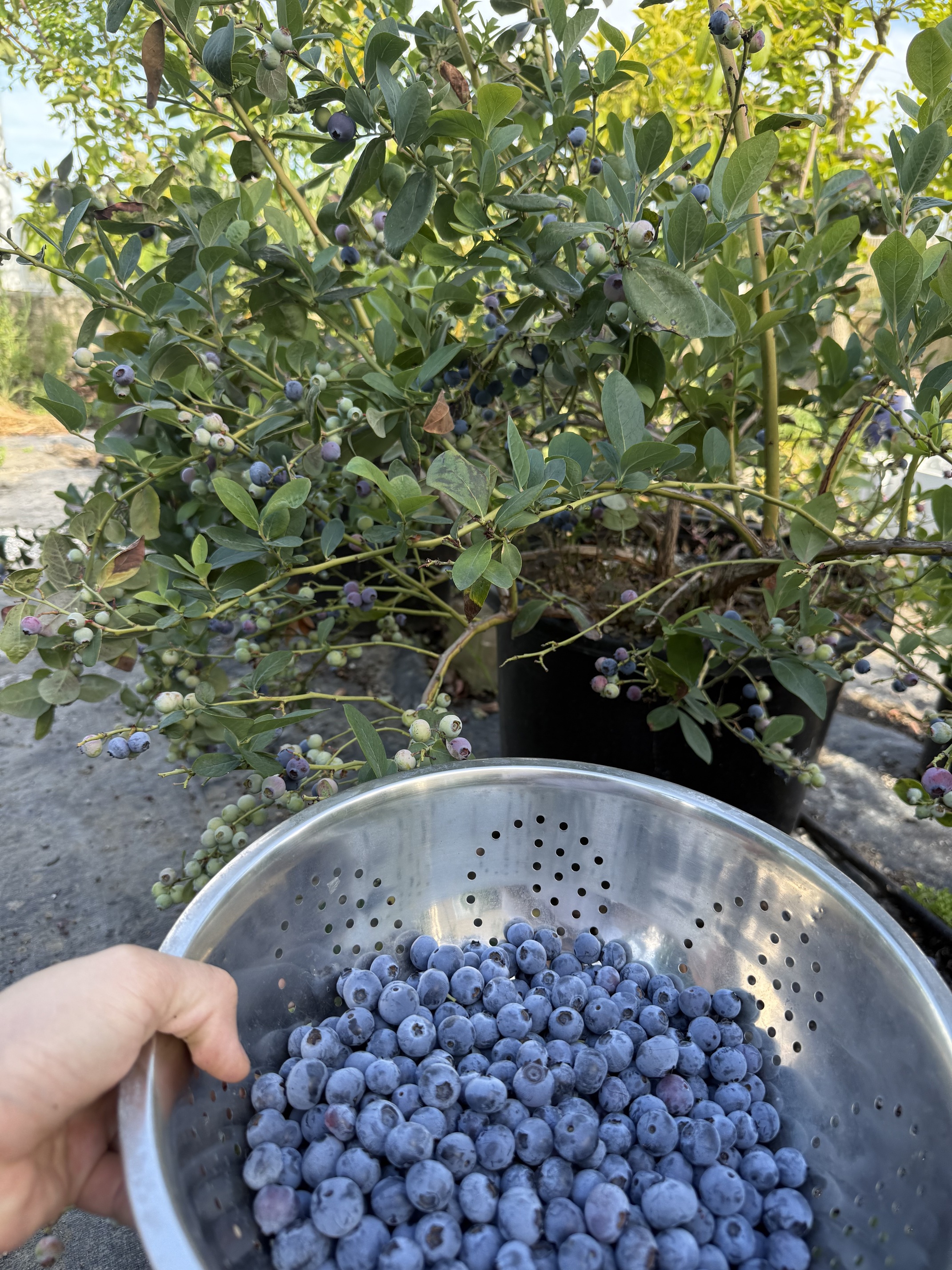
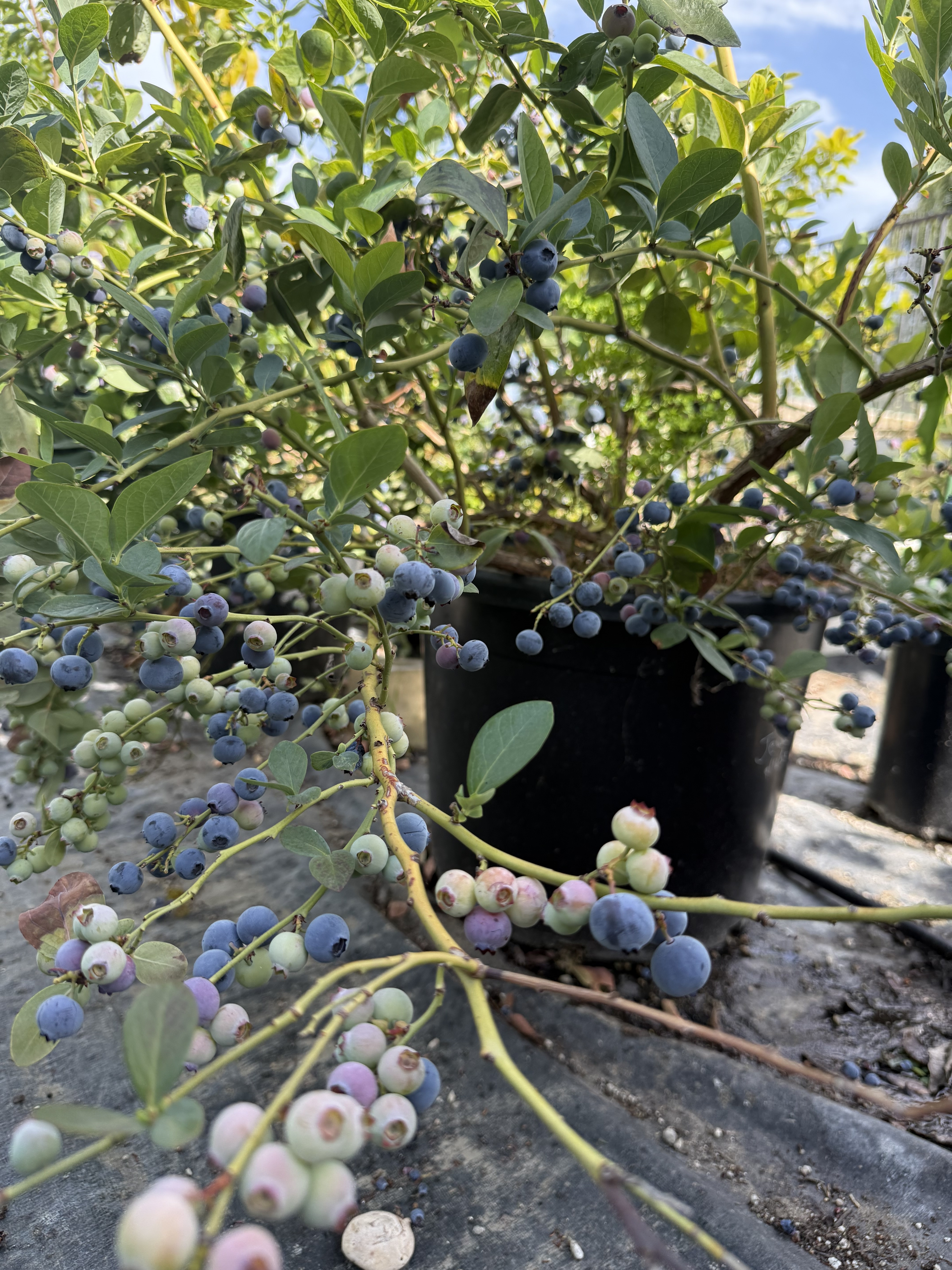
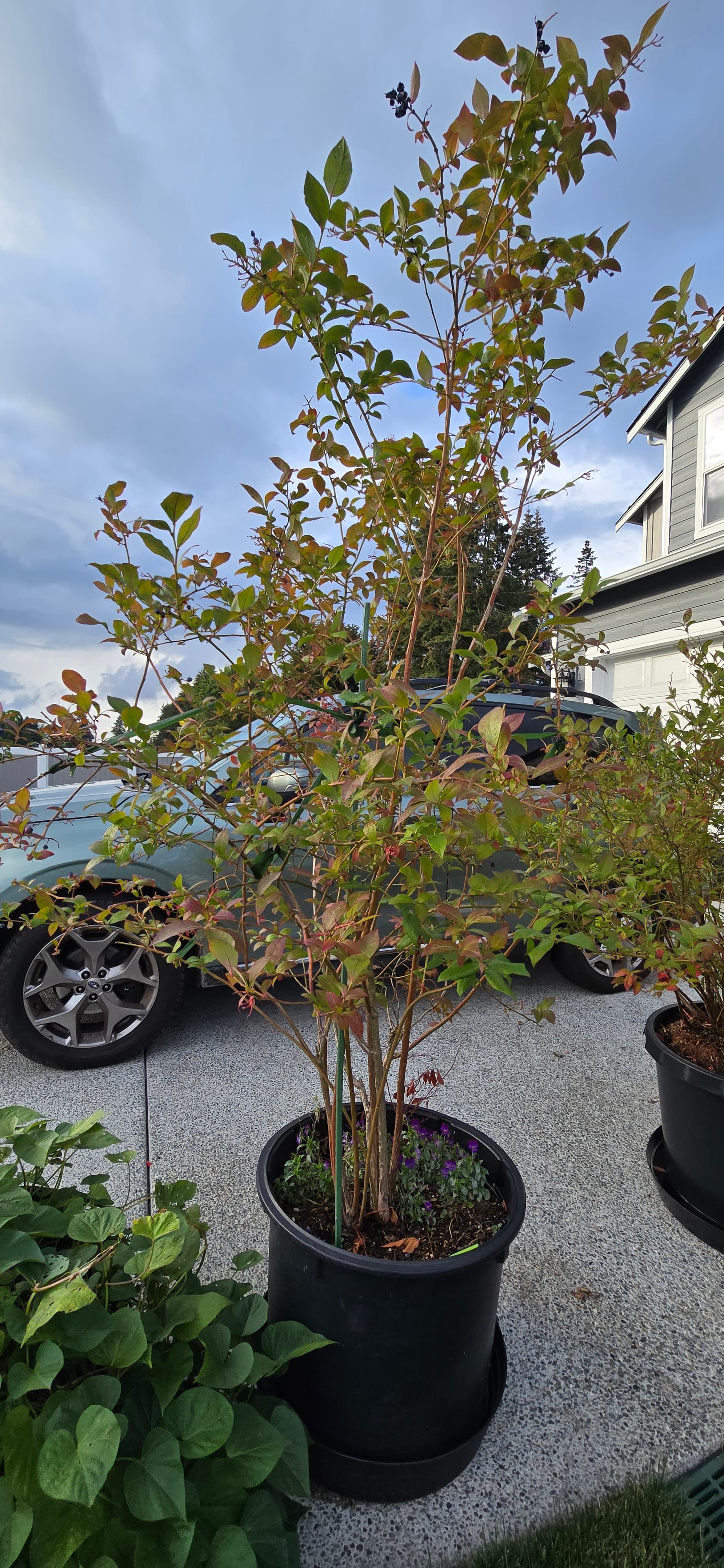
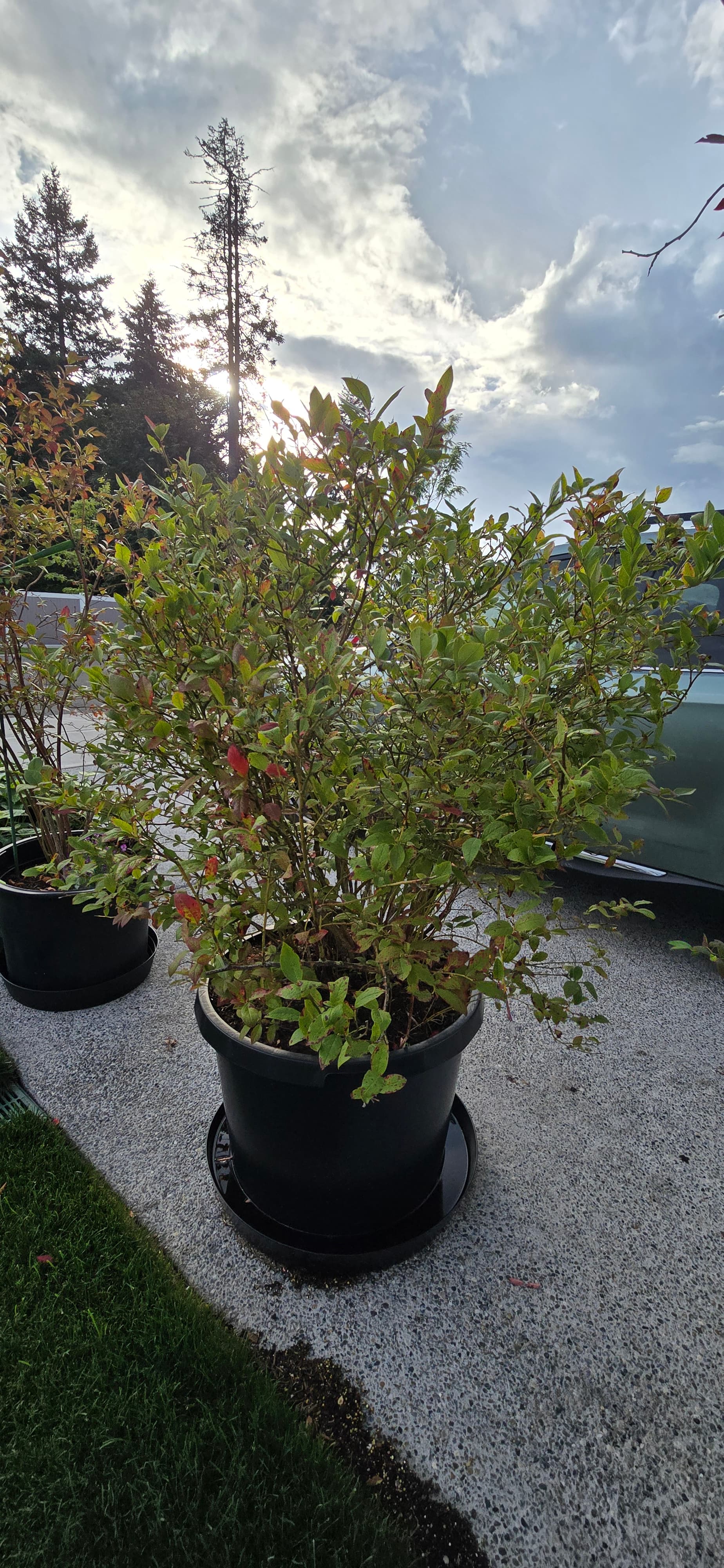
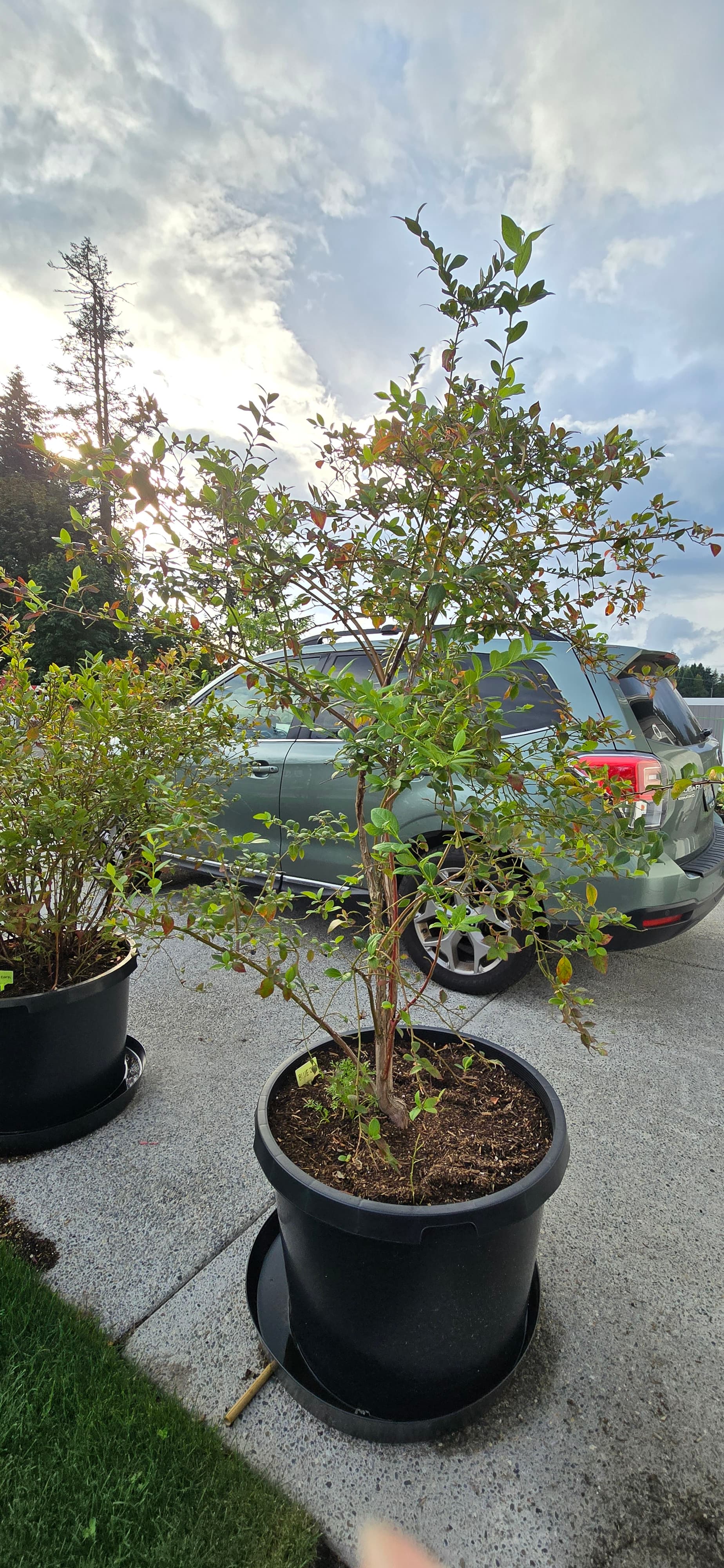
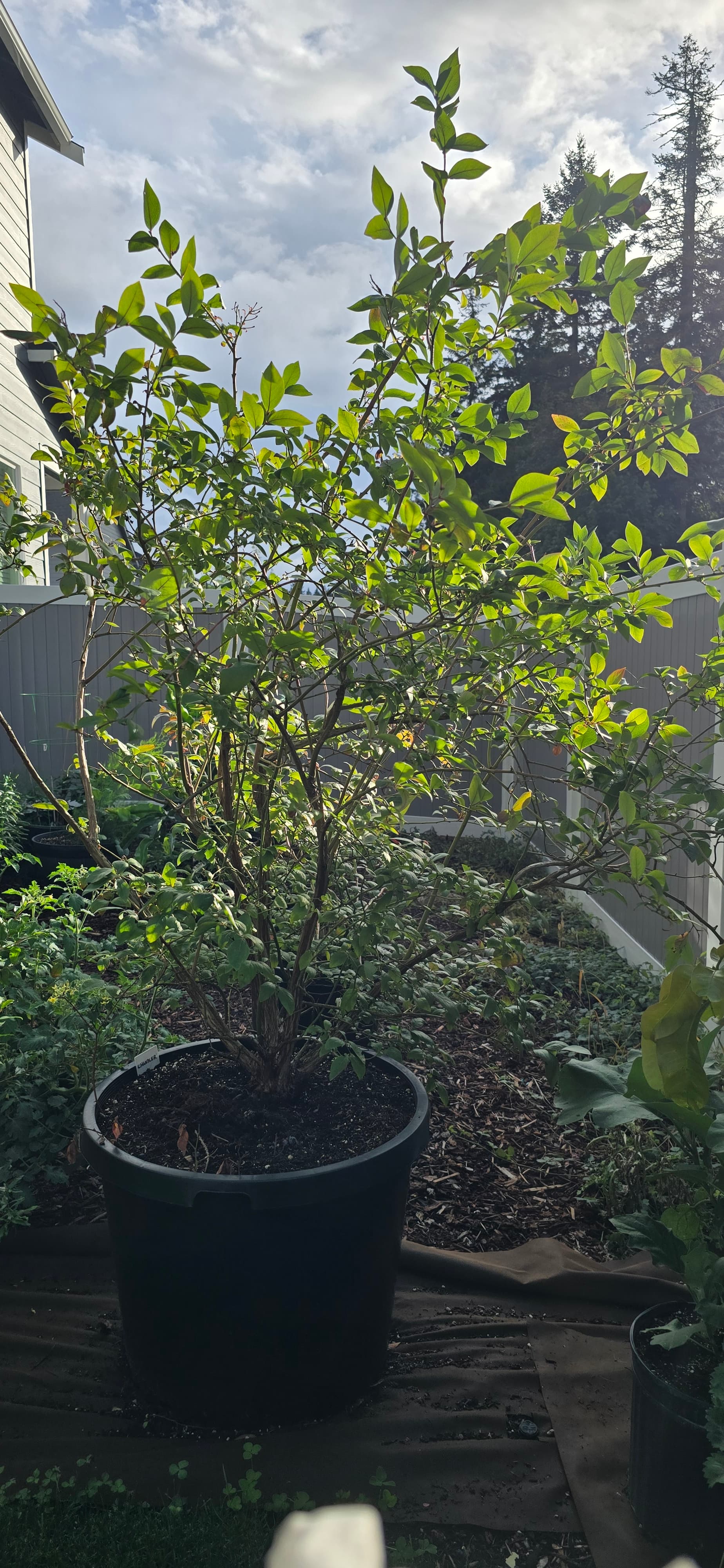
I beg to differ. Here in Washington state, there’s a blueberry u-pick farm within 30 minutes of each other on the west coast. I’ve been to a lot of them and in comparison on a 1 vs 1 scale, their plants don’t do nearly as well as mine in pots. This is 5 of my current bigger ones that have been in pots their entire lives and they’re about 8 years old or so. I have another 3 25 gallon blueberry pots at a friend’s house and two 45’ish gallons at my moms. The ones I’ve seen in the field don’t produce nearly as much per plant and they seem to have a lot of issues, whether it be with sooty mold or blueberry fly maggots. Once they turn dark blue though, it’s hard to see the sooty mold from the u-pick places.
I water during the summer months and short periods of dry spells but during the fall and winter, i let the rain do it.
Personally i don’t like bugs or issues so it’s easier to keep plants healthy and happy in pots than in ground. I still have 1 more i have to repot into a 25 gallon but from my Chandler and bluejays, i get berries from July to just about 2 weeks ago. I don’t see that type of progress in the fields. There’s even a few onesies and twosies hanging on the plants that i don’t pick it stop picking. Also my mom has a 10 acre farm that has about 8 or so of my blueberry bushes in ground that are just as big as mine in pots but they don’t do as well fruiting wise compared to the ones I’ve potted up for myself and everyone else.
Also i have all the neighborhood kids within a block or so radius, coming by every day during summer to raid my bushes. I also don’t like frozen blueberries so i don’t know how much i get if i were to save them but I know i get enough to feed a block of kids throughout the summer almost every day
I was unimpressed with your anecdotal observations and wrote a long rebuttal but decided to check my facts with a quick reference to Chat…
And according to that source the winner is…umm… you. Dammit!
Pot culture of blueberries is becoming increasingly popular, especially in areas with unsuitable soils for traditional in-ground production. Here’s how pot culture compares with in-ground production in terms of per acre yield:
1. Yield Per Acre
In-ground Production: Yields can range from 6,000 to 10,000 pounds per acre under optimal conditions, depending on variety, soil, and management practices.
Pot Culture: Yields can be higher on a per-acre basis due to the ability to control soil conditions, irrigation, and nutrients. Reports indicate that yields in pots can reach 12,000 to 15,000 pounds per acre, especially in high-density systems that maximize space and allow for closer planting distances.
2. Plant Density
In-ground: Traditional systems have lower plant densities (600 to 1,000 plants per acre).
Pot Culture: The spacing between pots can be reduced, allowing for up to 2,000 to 3,000 plants per acre in high-density systems. This higher density is a major reason for the potential yield increase.
3. Management Benefits
Pot culture allows growers to adjust the pH and soil composition easily, leading to optimal conditions for blueberries. This leads to more consistent fruit production and quality.
Drainage and irrigation can be better controlled in pots, reducing the risk of root diseases and other issues that might negatively affect yield in traditional in-ground production.
4. Challenges
Initial Investment: Pot culture requires higher upfront costs for pots, substrate, and infrastructure, such as irrigation systems.
Labor: It may involve higher labor costs due to the management of individual pots, including frequent watering and monitoring.
Conclusion
While pot culture can yield more blueberries per acre due to higher planting density and controlled growing conditions, it requires significant investment and attention to detail. However, in areas with poor soil, pot culture offers a viable alternative that may result in higher yields.
References:
Strik, B.C., et al. (2012). “Blueberry Production Systems.” Oregon State University Extension.
University of Florida IFAS Extension, “Blueberry Production in Containers for Small-Scale Commercial Operations.”
I don’t care, real gardeners grow stuff in real soil!
Well thank you for that and i understand the want to grow it into Gaia but for a lot of people, it isn’t feasible due to just nature in general. I feel like teaching people about how to grow against the odds/in pots is beneficial for those who’s native soils may not cooperate.
love you for bringing up that study though. I’ve never personally looked it up so thank you for that.
I’ve always just gone by “let’s check this blueberry farm to see if it’s worth me leaving it to other people to grow them for us”. From there, I’ve come up with my conclusion that i can’t rely on all the 5 farms around me and countless ones a little farther from me. I check all my 100+ potted plants once a day to make sure everyone is good and no one is infested with anything or the alike. I have over 20 blueberry plants with me and about 10 floating around my mom’s farm and her house. Honestly I’ve lost count of how many is in her backyard or at the farm but i know at least 10. Some are planted in ground as well at her farms but I think the potted ones taste better cause with the fertilization throughout the year that i give them, they essentially get more nutrients than the ones left alone. I don’t wanna have to drive around and duck down to fertilze the ones in ground so they’re growing as nature intended.
I do spoil the hell out of my plants too i feel like this is easier to do so in pots than in ground.
I’m in downstate NY where blueberries are native and the soil is usually on the acid side. It was 5.6 on my own property when I moved here. Most spots on my property are also well drained with soil that is somewhat hydrophobic.
The only pest problems occur towards the end of the season and the worst offender is yellow jackets who like the fruit the most when hot temps soften it. I don’t need those berries anyway. SWD is also strongly present by that time.
I’ve never had to do a thing to defend my plants from pests once I built a chicken wire cage to keep birds and squirrels off the plants. The exception is mice and chipmunks- amazingly Alvin can somehow squeeze through 1" chicken wire and I’m too lazy to enforce protection with monofilament netting, which, combined with the wire netting, apparently keeps them out. They are a nuisance outside the cage so I just trap and kill them like rats when they get inside- I don’t have to worry much about killing birds accidentally in peanut baited spring traps I use because they can’t get to them.
The only maintenance I do is mulching every other year over fabric that I lift up over the nearly composted existing wood chips before applying fresh chips. That and making sure the cage is still tight enough to keep birds out. During droughts I may give them water for the benefit of the crop, but I haven’t had to do that for years now- our summers are in a wet cycle. I pray for summer drought to benefit all my other fruit.
I seldom read about the specific blueberry variety when discussing their soil needs. 20 years ago I planted 3 blueberry plants in native sandy soil about 5 ft from each other. They where three different varieties. One grew very poorly, stayed small and seldom had fruit. One grew a little better but not much fruit. The third one grew very well and still produces plenty of quality fruit.
The other factor that seldom gets mentioned is amount of sun light. The three plants mentioned only get 4 hrs of sun.
In some areas container growing of Blues is the best option. After years of battling varieties that weren’t adapted to a southern climate (Late1970s- 1980’s),lessons in Ph in both the soil and the water we apply, and the effects of low humidity on blue (particularly the northern varieties) in California i started to research how to be successful in areas where it appeared nothing was right for Blueberries. I found that creating a controlled environment where i could adjust the inputs was the best option. Though plenty of people will site success in growing blues in the ground in California, I still do not recommend it. It is rare that someone in California plants a Blueberry in the ground and ,get a healthy producing plant in short order. Amending the soil with acidifying organic materials works, but not without considerable cost. The same applies to containers but I have raised Productive Blueberry plants to over 20 years old growing in 23 to 25 in containers. Any adjustments i need to make can be done with a simple soil test (Most often for Ph) I fertilize with organic acid based fertilizers oh and I do recommend the G &B Acid Planting Mix, but without 1/4 minus bark and or the Chunked Coir the mix is only good for about 2 years before it turns to dust. You loose the Cation exchange as these planting mixes are for amending soils not as a fixed media.
Even when the pH isn’t especially high, like in the mid 6’s, I’ve had difficulty establishing BB’s in heavy soils, no matter how much peat and sand I add. I’m not sure what the issue was because I never quite solved it on the site I’m talking about. It wasn’t because I was creating bathtubs either- the light soil I created led right to a ditch with nothing to interfere with drainage in between.
The client had about 120 fruit trees I installed and managed for over 20 years and couldn’t even keep up with the BB harvests the stunted plants created with all the other amazing fruit going on.
I cannot quite understand why you couldn’t grow blueberries in any soil if you made the top 10 inches pure sand and peat and incorporated a lot of both into the next few inches down. I don’t believe alkalinity moves upward. and I know that blueberries don’t even need a low pH throughout their root zone, they can get all the iron they need from the top few inches of soil and maybe less than that, based on my experience and Carl Whitcomb’s experiments with another acid needing plant- pin oaks. He was able to correct an iron deficiency within a few months with a surface app of pelletized sulphur on very alkaline soil even without measurably altering the pH (the change was only on a very narrow strip on the soil’s surface).
Of course, base irrigation water would have to be altered.
I just up potted my 4 container blueberries and the roots were great. They also all grew beautifully. They outpaced the in ground ones despite the fact that I revamped the in ground soil mounding and followed the same recipe but kept the native clay soil instead of coir.
If anyone is looking for a peat-free mix, here’s what I did:
Mini pine nugget
Coconut coir
Compost
Dash of native soil
Espoma sulfur
And I added alfalfa into the mix at the time of planting.
It was very chunky with nugget being the main component and I had a heavy hand with the sulfur. The dash of native soil was just out of concern not knowing if all the right microbes were in the compost. Probably stupid, but it’s just my second year with blueberries and I was desperate to get it right because last year, they all struggled in soil that was way too rich and alkaline. The roots encompassed all the chunk and came out nicely for up potting.
I used peat moss, perlite , cal-phos, wood ash, kelp, manure and soil sulfur.
Yes, you can use higher ph stuff as long as you lower it with sulfer.
In a 45 gal container I used maybe 1 cup cal-phos, 2 - 3 shovels full chicken manure, 2 cups wood ash, 1 cup kelp, then used 3 tsp. sulfur. You can OD on sulfur very quickly so best to use slightly less if you don’t have a PH meter and build up. Blue berries are doing fine, lots of new growth.
I don’t use bark for much if I can help it because for me at least it attracts Psyllid bugs and I found they eat fine root hairs when they get out of control. YMMV. I would have used leaf or pine needle compost if I had it at the time.


 love you for bringing up that study though. I’ve never personally looked it up so thank you for that.