E. Plum suggestion

Of course, and I’ve long since conceded that. All I’m suggesting is that there may be more than one strain of Mt. Royal or Hilltop was selling the wrong thing under that name.

That debate is over and I conceded your point- you win and I’m grateful for learning from you. But I want to know if your Mt Royal bears every year for you the way my Hilltop version did for me and the round version has not.

My Mt. Royal bears every year. One year heavily, the next moderately but I don’t have to worry about a drastic drop of production like mirabelles have been.

How did you come on it… I’m not clear although I probably should be. Did you order a Valor from Adams?

The Valor/Mt. Royal debate/mystery/resolution needs no rehash.

1 Like

I find plums very mysterious in how they respond to different sites in terms of reliable cropping. My current version of Mt. Royal seems an unreliable cropper even when surrounded by many potential pollinators. True Valor is less variable for me, but at some sites still less dependable than others. Empress, Castleton and Stanley are the most reliable prune-plums I work with.

A possible discussion point on Mt. Royal however-

A non grafted Mt. Royal from the reading is a natural semi-dwarfing tree. And in turn sends up and gives suckers

I believe that St Lawrence sells them this way… whereas other nurseries and most folks reviews on here have been from grafted examples.

Raintree i think lied in their Q and A of this plum.

I only bring this up because Stephan tends to make videos of interesting things and he did a video of digging up Mt Royal suckers and planting them in new rows.

So a few points to ponder is that this may be a good tree to have not only for the great fruit… but sending up suckers that are true are nice for folks that want more semi dwarf trees… but possibly also nice for folks that want a semi dwarfing hardy rootstock.

It may have been discussed already but… i have seen old writings of various plum rootstocks that discussed ‘consistant crop’ such as Lovell. I have not read enough nor have the experience to compare and contrast whether if one person has Myrobalan and another has Citation that one gets better or more consistant crops.

The variation in Mt Royal is that some folks may have it on its own rootstock… which i am also not sure if that makes it more or less ‘consistant’.

If one person on here has ‘consistant’ crops then i think there may be knowledge in which rootstock gives them that. As well as vice-versa.

I dont mean this to be investigative or a debate…but just curious if there is knowledge to be had.

1 Like

Interesting… I asked CHAT about creating new trees by stooling. Doesn’t seem easy. CHAT isn’t reliably accurate, but it certainly accesses a lot of accurate information. If it is right about this, own root Mt. Royals are likely rare. As far as rootstock and reliability, I have observed no difference between Myro and Citation- although this is not based on careful evaluation. .

Can Mount Royal be successfully stool-layered?

Yes — Mount Royal will stool, but it’s not a naturally strong stooling genotype.
You will get some rooted shoots, but nowhere near the productivity of classic clonal rootstocks.

Ranking (from decades of nursery observations)

  • Very easy to stool: Myrobalan seedlings, Marianna 2624, St. Julian A, Krymsk 86
  • Moderately easy: Some European plums like Green Gage, Stanley
  • Difficult: Many European cultivars, including Mount Royal

Mount Royal sits in the “doable but not commercially efficient” category.

Nurseries historically avoided stooling most Euro-plum cultivars because:

  • many European plums produce few basal shoots,
  • the shoots don’t root as readily,
  • the bark tends to harden early,
  • rooting percentages vary wildly year to year.

Mount Royal behaves like a typical P. domestica dessert plum: you can coax it, but it won’t behave like Myro.

1 Like

You’ve hit on something that I never observed or understood, but could be important to plum growers and an issue with varying annual production of Mt Royal. Bear with this long CHAT explanation and thank you for contributing to my fruit tree education.

1. Does rootstock affect annual cropping in plums?

Yes, but only through the rootstock’s effects on:

  1. vigor (excess vigor → poor flower bud formation)
  2. precocity (early bearing vs slow bearing)
  3. tree size & carbohydrate storage
  4. tree anchorage / drought response
  5. compatibility and nutrient uptake efficiency

Rootstocks for plums do not directly impose “biennial vs. annual” bearing tendencies the way they do in apples (M9 vs seedling, etc.).
But they strongly modulate the conditions that create reliable cropping.

This matters especially for Japanese plums and pluots, which are far more sensitive than European plums to:

  • spring frost survival
  • tree carbohydrate reserve levels
  • flower bud initiation after heavy crops
  • degree of summer shading (big one)

All of these are influenced by vigor → which rootstock controls.


:peach: 3. How plum rootstocks differ in their effect on cropping

Here’s what matters for annual reliability in plums, in order of importance:

A. Vigor control (most important factor)

Excess vigor → reduced flower bud initiation.
This is why people get maddening variability in varieties like:

  • Elephant Heart
  • Satsuma
  • Flavor Supreme
  • Burgundy
  • Santa Rosa strains

A highly vigorous rootstock pushes:

  • long shoots into mid-August
  • heavy internal shading
  • late maturity of wood
    All of that kills flower bud set.

Rootstocks ranked by vigor influence (approximate):

Very vigorous

  • Myro 29C
  • P. americana seedlings
  • Marianna 2624

Moderate

  • St. Julian A
  • Krymsk 86
  • Mount Royal (if used as rootstock)
  • Myro seedlings (variable)

Moderate-to-weak

  • Krymsk 1
  • Pixy (weak for Euro plum; too weak for most Japanese plums)

For Japanese plums and pluots, the more vigorous rootstocks reduce cropping regularity; moderate vigor stocks improve it.

This matches your orchard experience:
When you keep canopy open, light penetration deep, and vigor in check → annual cropping improves dramatically.

Rootstock contributes a lot to that baseline.


B. Tree size = carbohydrate buffering

Larger trees (both seedling and vigorous clonal stocks) store more carbohydrates, which:

  • increases cold hardiness of buds
  • reduces post-frost blank years
  • reduces biennial tendency after a heavy crop
  • gives more redundant flower buds

A big Japanese plum on a semi-vigorous rootstock is more frost-tolerant cropping-wise than a small tree on Krymsk 1.

This is why Mount Royal as a rootstock can give reliability:
decent vigor → good storage → more “insurance.”


C. Precocity

Some rootstocks push a variety into bearing before the wood architecture is stable.
This can create biennial issues if the tree sets a huge crop too young.

Plums with early-bearing rootstocks (like Krymsk 1):

  • may bear early heavy crops
  • then shut down flower bud formation the next year

If you thin them well, annual cropping is good.
If you don’t → they swing wildly.


D. Rootstock–scion incompatibility

If the scion–stock combination is slightly incompatible (not common, but it happens):

  • uptake of water/nutrients fluctuates
  • tree loses vigor unpredictably
  • cropping becomes irregular

Flavor Supreme is notorious for acting differently on different stocks.
Some pluots behave almost like they are mismatched grafts.


E. Rootstock and frost timing

Rootstock affects:

  • sap flow rate in spring
  • rate of dehardening
  • water status of buds

A vigorous, water-pushing rootstock can advance flowering slightly, which can reduce reliability in cold pockets (your property is perfect for observing this).


:peach: 4. Where Mount Royal fits

Mount Royal used as a rootstock gives:

  • moderate vigor
  • very good cold hardiness
  • decent anchorage
  • solid carbohydrate reserves
  • not overly precocious
  • good compatibility with Euros and most Japanese plums

Thus, it tends to produce fairly reliable annual cropping, assuming the scion is not innately biennial..

1 Like

Chat does suggest that the issue is much more important with J’s than E’s.

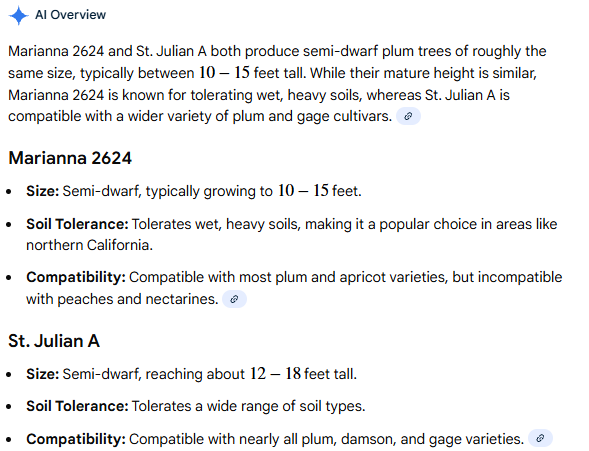
I’m surprised to see Marianna in the Very vigorous category. My own search returns:
image

The above says Marianna and St Julian are both 10-15 ft, though it also says St Julian is 12-17’. On the other hand, Raintree says Marianna is 80% size and St Julian is 75%. Seems about the same.

This question has some relevance to me, as there are a number of suckers from a Marianna 2624 tree in my yard that I am planning to dig up and establish a new planting from, at another property. I’ll be either transplanting or eliminating the mother tree, so I should be able to get a lot of roots with the suckers, hopefully giving the trees a faster start than whatever rootstocks I could buy online.

Another possibility I have is to take some of the roots (there are always some broken ones, no matter how careful…) when transplanting a plum on Krymsk 1 and graft scions directly to the root. I haven’t tried that with plums before, but it has worked well with jujubes. At least for good sized root sections- just a few inches isn’t enough, but 8-12"+ works well.

1 Like

I looked up P E Von Fellenberg: Swiss German aristocrat (“von”) who bought Swiss property and established a self-supporting farm & school to train poor children in farm methods and basic education. He went on to create a classical school for middle class kids, again, to raise their condition. Apparently his status prompted people to associate the Italian plum he promoted with his name.

Thanks for raising the question. BTW: Philip Emanuel Von Fellenburg June 27, 1771 - Nov. 21, 1844, dying at the site of his farm & school.

1 Like

I have grown European plums on St Julian, Marianna, and Krymsk-1 rootstocks. None of them affected how late in the season that branches put out new growth. They always seemed to stop growing in July, while the Japanese plums and hybrids usually produce new growth until the weather turns cold.

1 Like