ive read its a open pollinated haschberg euro. elder found growing wild in K.S. named after the Wildewood wineries owner that discovered it. the website i read that on also tested it and it is a pure haschberg . not a cross like some websites say.
3 Likes
That makes sense given that ‘Haschberg’ is self-fertile.
I’ve actually tried to intentionally cross pollinate American and Euro black elderberry, and got zero berries to set from it. I’m not saying it’s impossible, just that they don’t seem very prone to crossing.
4 Likes

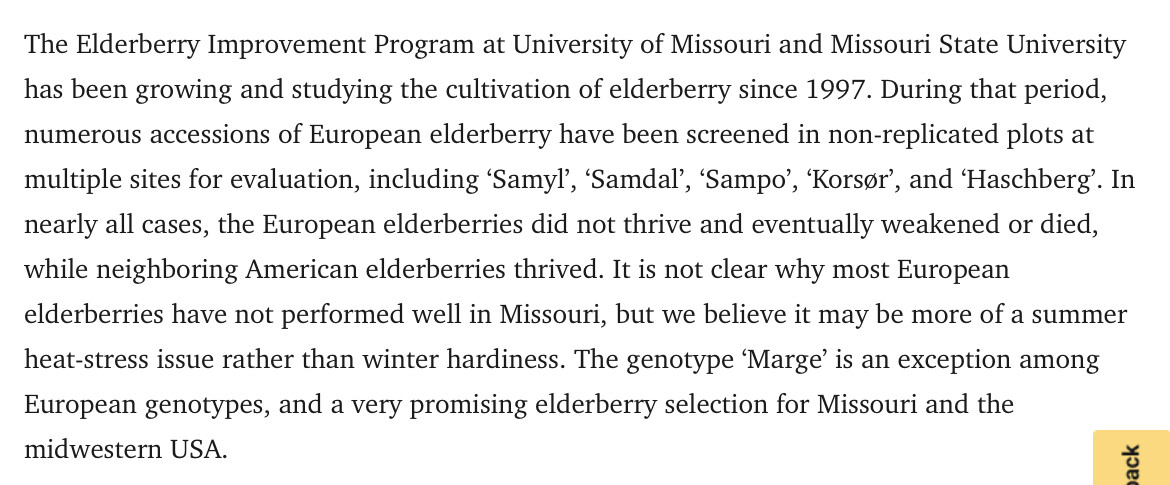
It looks like that comparison is all American elderberries except for Marge. It would be more useful to find a chart comparing it with other European elderberries.
4 Likes
Does anyone know of an elderberry identification chart? There are minor variations in the leaves of my elderberries so there’s gotta be a way to actually identify them. I’m pretty sure at this point that at least 2/4 of my established elderberries are not the variety they were sold as. I supposedly bought 2 pairs of pollinating partners, but they bloom A/C and B/D not A/B and C/D… I’ve been trying to guess what they are/I’m missing etc…
5 Likes
I agree it would be more useful to find a chart comparing it with other Europeans. I looked and didn’t find anything. I didn’t look that thoroughly though.
The study that chart was from attempted to compare American and European elderberries. The reason ‘Marge’ was the only European included was because all the other European elderberries died. I only have ‘Nova’ and ‘York’ so the chart made me want to pick up a European elderberry.
Obviously the study is site specific. It’s interesting though that ‘Haschberg’ died and ‘Marge’ did not since I read the same thing as @steveb4. Seedlings do have an incredible ability to adapt to their environment.
Not related to elderberry, but even apomictic clones can epigenetically adapt to their environment and change. Interesting stuff.
3 Likes
I was suprised it did so well here as we are nearly as cold as even the most northern parts of the mid west. also suprised it flowered at the same time as my york, johns and wild elder. seems marge is just as adaptable to extreme cold as it is to heat. it would probably more popular if it fruited on 1st. year wood.
3 Likes
From the nursery stock I’ve seen of European elderberries, I think propagation methodology might be at least partly to blame for failure to thrive. Since the European species does not tend to form rhizomes like the American species, I think the way the cuttings are planted makes a huge difference. The propagation standard I’ve seen for the Europeans is to take cuttings with one node at the base and one or more node above ground. Because the cuttings often have very wide internodal spacing, this typically results in the buried node being too deep to reliably push shoots and the above ground node(s) being higher than ground level. Since they like to push their most vigorous growth from as low on the plant as possible, I’ve had much better establishment using my non-standard protocol for European black elderberry. When making my cuttings I leave enough stem below the lowest node to plant so that the low node is right at ground level. Then when up potting (after shoots have pushed from that node), I’ll place that node slightly below the surface. If this practice were more widely adopted for European elderberries, I think we’d see a great improvement in planting stock and subsequent establishment after planting.
8 Likes
@EJh this validates your observation- Marge has lower avg cyme weight.
3 Likes
I can vouch that Euros do poorly here (AR). My Hachsberg has yet to grow higher than 3’ and looks like it has the mange. My Marge has been pruned twice now to 7’ and it’s nearly double that now, planted at the same time. All the established black lace, etc landscaping euros around here also look like they have the mange. Whatever does that in euros here, Marge does not have.
5 Likes
Shriveled bubbly-wilted looking damage on new growth? I’m pretty sure it’s eriophyid mite damage.
I looked up a picture again, and that’s what I see on mine. It can damage the cymes on established plants sometimes, but they mostly just outgrow it and the plant has a few jacked up looking flower clusters. I only spray for it on new plants I’m trying to get established.
There’s pictures of other problems there too if you’re seeing something different.
1 Like
Great link!
I may have missed it, but I haven’t noticed any distinct mite damage. My Hachsberg leafs out and blooms fine. Sawflies and borers bother all of my elderberry, but never more than they can handle.
The best I can describe it, euros just aren’t excited to grow here. Short internode spacing and thin canes that fall over. Mine still fruits- impressively for its minuscule size actually. But none of the vigorous 3/4” new canes that shoot up like the others. Maybe something here stunts the roots?
2 Likes
I’m surprised no one’s mentioned using the flowers. I made some elderflower syrup and elderflower fritters last week from a few wild plants.
My Bob Gordon is blooming for the first time and smells utterly disgusting—a too sweet smell like something rotting. All the wild black elder I’ve encountered has a nice yeasty and citrusy smell like champagne. Has anyone else noticed that particular cultivars have better smelling flowers than others?
3 Likes
Both John and Adam for me had a very soft light sweet smell. Similar to like a weak lilac smell but very florally, it smelled pretty good, but very weak.
4 Likes
Anyone have a good water bath elderberry jam/jelly recipe? I found one online from I think Minnesota extension? But curious about anyone else before I use that one.
Interesting. I haven’t noticed much of any scent. But, I have two Bob Gordon that should bloom next year, so we’ll see if it’s different at my house.
@EJh let me know how the jelly goes. I’ve been exclusively making syrup for the family as a health tonic.
4 Likes
I’ve had (still have, but have lost IDs on all) a number of the named cultivars (Bob Gordon, Wyldewood, Scotia, Johns, Adams, Nova)… but in my experience, none have been better than any of the myriad of ‘volunteers’ (some of which may be seedlings of those cultivars) that have popped up all around the farmstead since I first planted the cultivated varieties.
Have one ‘volunteer’ that came up in the blueberries several years ago, that has the largest clusters I’ve ever seen. Another, at the edge of a woodchip pile, produces clusters that ripen weeks after all the others are done… and clusters and all berries in the clusters ripen at the same time… considering rooting more of it. Picked and froze 1.5 gallons of berries from that one, a couple of weeks ago.
9 Likes
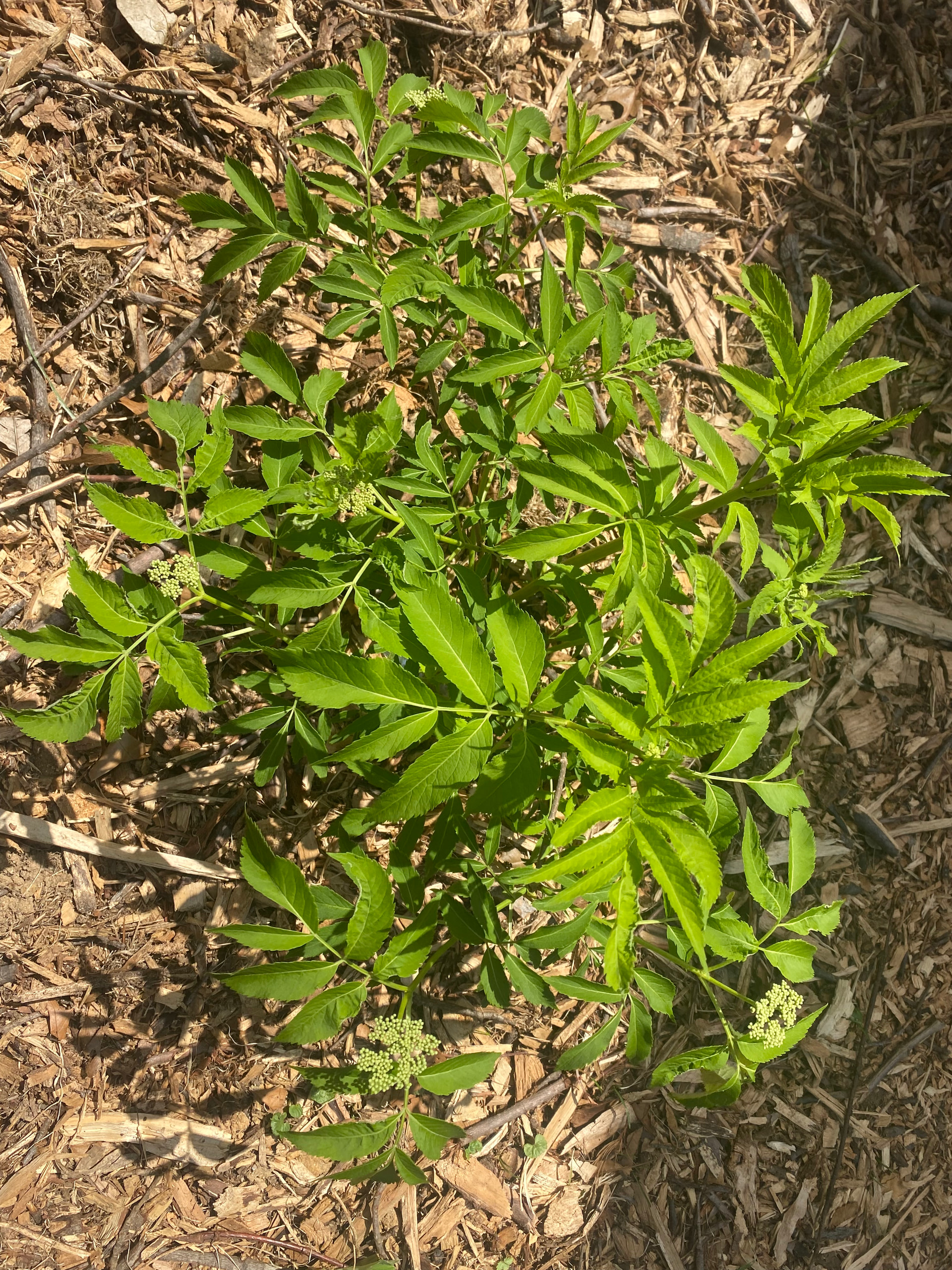
Look at this overachieving little plant! I believe this is Ranch and it was started from cutting last spring. It’s the smallest by far of the 8 cuttings I planted last year yet has all the flowers.
9 Likes
Oh wow, that’s early to get flowers! I don’t think there are any formed yet on mine.
Are the named varieties that much better than the wilds?