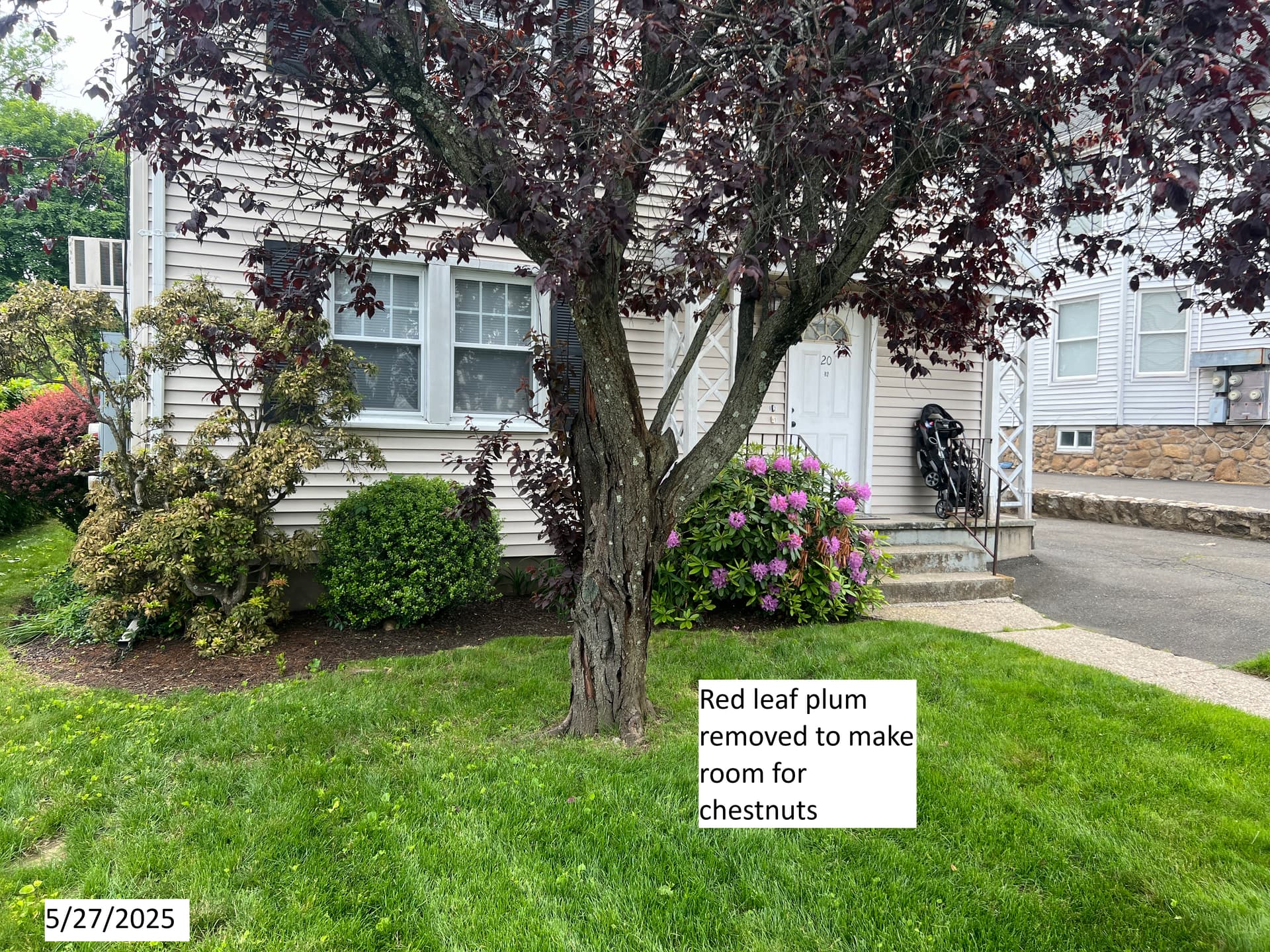
Giant Chestnuts

Here’s a side by side pic of the Prairie Grove chestnuts with some Italian ones from a grocery store ($8/lb, but I cherry-picked the biggest). Both are good. I’d say the Italian ones have a bit milder of a flavor.

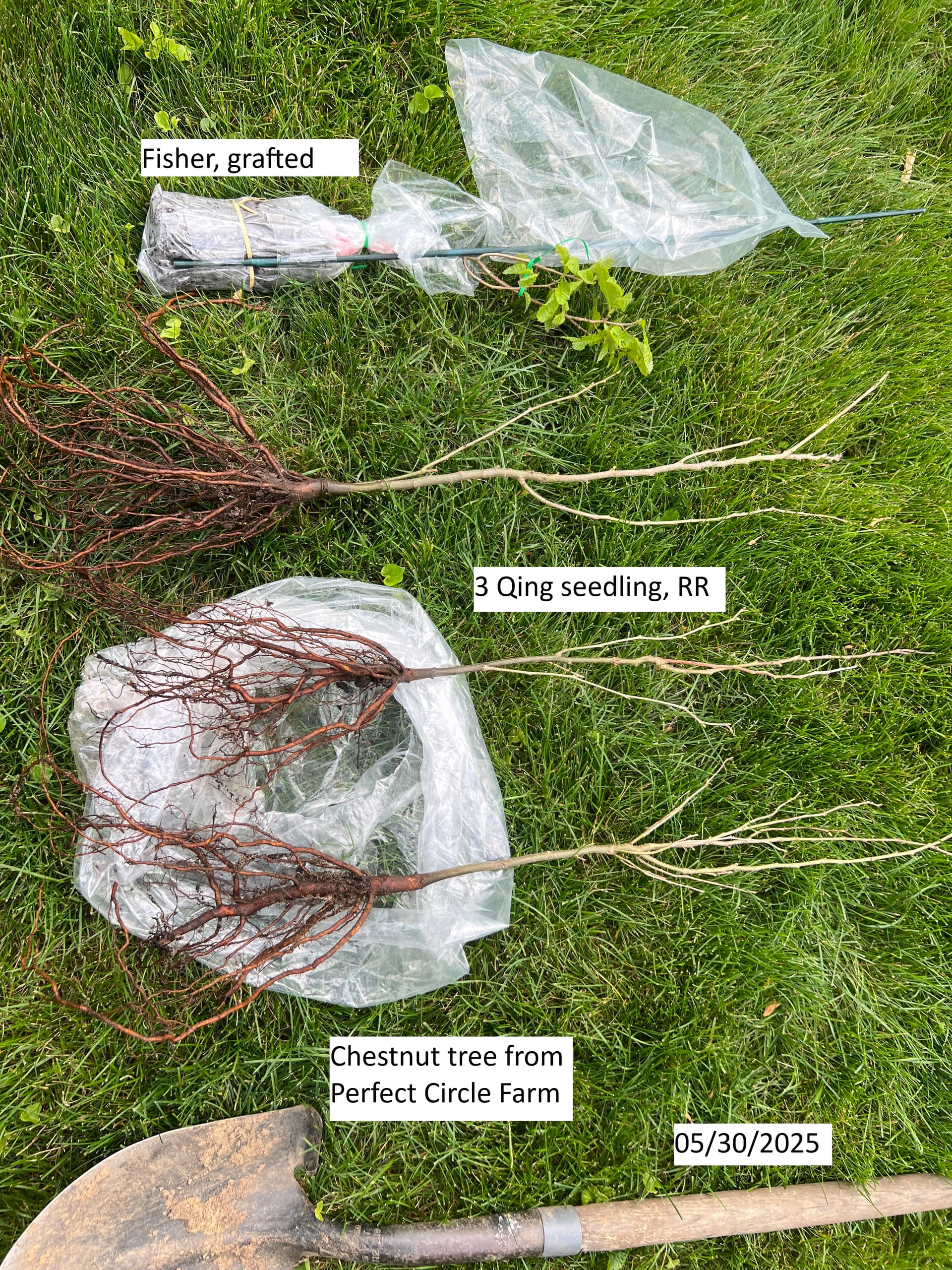
I did end up ordering trees from Perfect Circle. 1 large grafted one of Fisher T1 (not sure what the T1 stands for) and 2 each of the RR and Stehli Qing seedlings. Whichever is smallest will get potted up for later, with the other 4 being planted.

2 Likes

@tonyOmahaz5 what temp do you roast them at and for how long?

1 Like

475 degrees for 25 minutes.

Hi @castanea,

I have read so many of your posts and there is a lot of good information, but I was confused about whether or not I needed to be worried about chestnut blight?

I am in 8A Mediterranean climate at 4200 feet with a short season in Northern California.

So is it that I don’t have to worry about blight because all of the American chestnuts died or do I need to worry about it because all of the American chestnuts died, if that makes sense?

Sounds like I might be able to grow any chestnut type that I want?

I have seen you recommend different varieties and share all kinds of knowledge which is greatly appreciated, but I’m wondering if you could only have 2 to 4 chestnut trees in my area, which ones would you pick if you only went by eating quality that you could peel easily?

I don’t care if it happens to be Chinese or European/Japanese cross, just wondering what your favorites of all time are, that I could grow in my location.

Thank you.

I didn’t even think of looking there!

I’m going to check my local Asian markets and see if they have chestnuts for me to try.

1 Like

An update on my order. Two of the Qing seedlings (from Stehli) were unavailable, so Buzz sent 2 Kalmbach Kintzel seedings. When looking at the descriptions, KK is described as “vigorous tall tree with a very erect growth pattern”. While the rest of the description sounds good (a parent of Jenny), it wouldn’t fit well in the locations I have planned. I wrote to Buzz and asked if he could send 2 of the other Qing (the ones from RR, which still seem to be in stock) and offered to pay for shipping. He very graciously said to not worry about the cost and then sent 3 Qing RR seedlings.

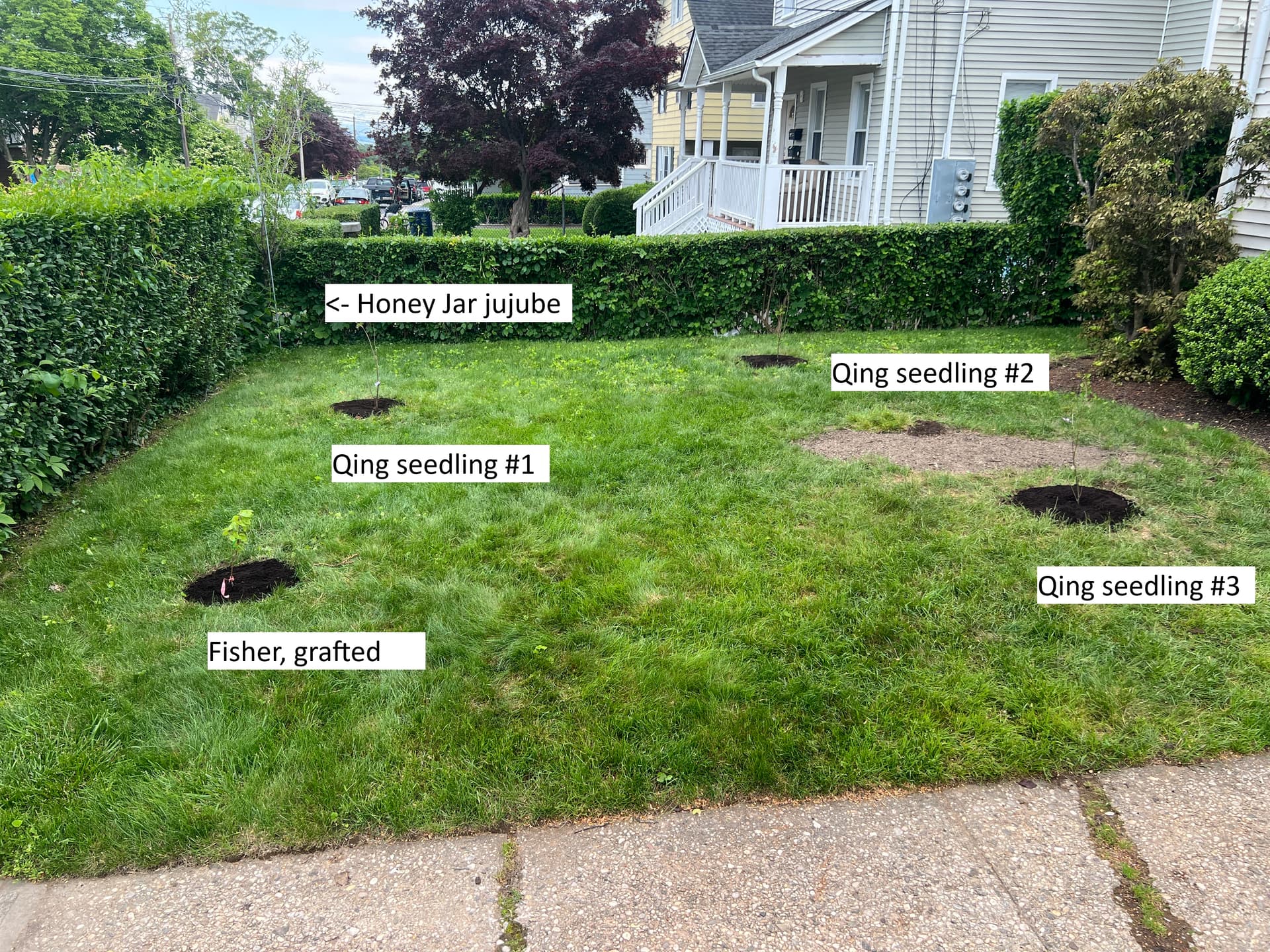
So, now, everything is planted. Here is the primary location I had planned:

I’ll be interested to see how the grafted Fisher does vs the seedlings. The seedlings look to have great root systems, while the Fisher is smaller- maybe from a 4" pot. I am pretty optimistic about the seedlings- it isn’t often you get trees with such well developed root systems. Maybe even more roots, than tops!

You can’t really see the trees in this pic, but it gives you a good idea where I put them. They all have 4-5’ spacing from the hedges and sidewalk and 11-14’ from the each other. They could probably use more space, but there are very few locations where I have any space open, let alone enough for multiple trees.

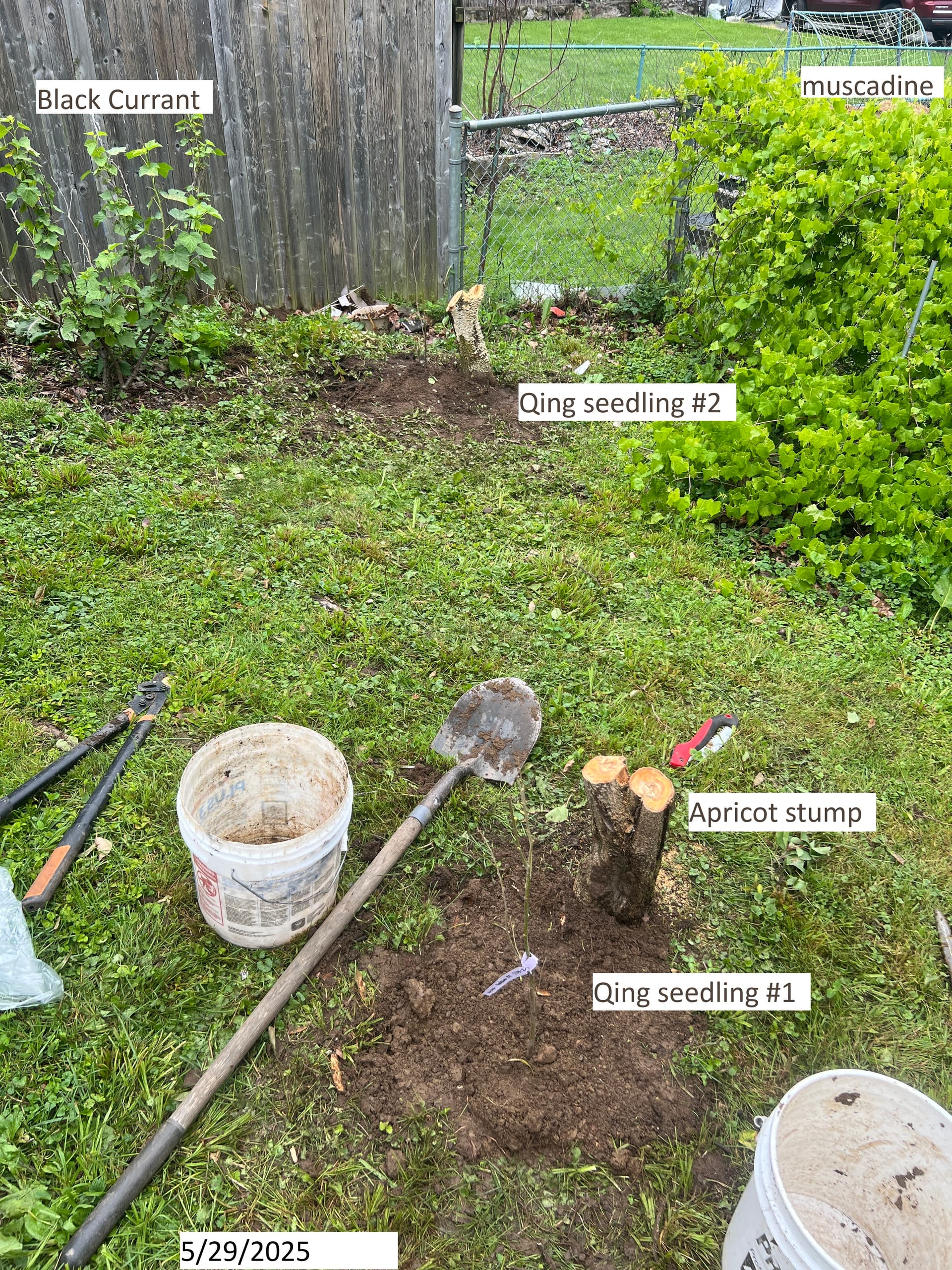
In a bad new but good timing event, I had 2 apricots die (at a different property, about a mile away) over the last week or so. One was in trouble last year and the other has been looking progressively worse. Rather than trying to save it (which generally results in it limping on for another year, then dying, all without any more fruit), I cut both down and planted the last two Qing seedlings. This spot is a bit tighter. 10-11’ spacing, so I may need to keep them pruned a bit more.

When I decided to plant 2 at the new location, I was going to drop down to 3 at the first site, instead of 4. But when Buzz generously sent the extra replacement Qing, I went back to the original plan. So there are now 5 Qing seedlings and 1 Fisher spread across 2 locations.

The 2 Kalmbach Kintzel are going to my father. He’s got a lot more space (2 acres, though a good portion of it is woods), so he thinks he can find a good location for them.

2 Likes

Nice roots!

I wish I had a Qing.

Can’t find anyone shipping Chinese chestnut trees to California.

So I planted 33 Chinese chestnuts on May 13th. I hope I get some trees.

1 Like

I am in zone 7b in the continental part of Croatia (EU) with hot and dry summers. I live in an area with acidic soil (loamy soil with quartz sand) where there are a lot of chestnuts and wild blueberries in the surrounding forests. There are a lot of problems with chestnut bark disease, but recently chestnuts have become a little more tolerant to this disease and many infected ones survive. But the problem is young grafted plants that are not very immune and easily die… Grafted chestnuts of European varieties are particularly sensitive. In addition to root rot disease. Hybrids of European and Japanese chestnuts are more tolerant, but the taste of the fruits is mostly not at the level of European chestnuts. I have several trees that produce a nice crop of the Bouche de Betizac cultivar and less productive trees of Maraval and Marsol. Which cultivars would be good to try for my climate, and to expand the Bouche de Betizac plantation: Bergantz, Gillet, Torakuri (maybe too late to ripen for my climate), Volos (European resistant), Szego and Yolo Grande/Ser (I got the last two as trial ones in Hungary). It is important to me that they are robust and resistant cultivars for my climate, that they do not ripen too late, that they bear fruit regularly and abundantly (like Bouche de Betizac), and that they peel well and have a satisfying flavor similar to forest fruits. Thanks in advance for your help!

2 Likes

I’m from southeastern Poland, zone 6a, with heavy, clayey soil in places. There are no chestnut trees here, only individual chestnuts in parks and private gardens, so there are no problems with tree dieback. My plantation is the first in Poland, and the oldest chestnut trees are now five years old after planting. This year we had an exceptionally cold, dry, and windy summer, but all varieties managed to ripen. In these conditions, the BdB yields quite well, but the Marrone di Chiusa Pesio is slightly better for now and ripens slightly earlier. The Marissard yields very well, but only slightly earlier than the Maraval. The Bergantz ripens at the same time as the Marissard, but so far has yielded slightly less than the Marissard. The Bislta no. 3, which also ripens quite late here, around the time of the Marissard, is also producing well. The Primato ripens very early and produces tasty chestnuts, but it’s probably a bit too cold for it, as it doesn’t grow well. Layeroka ripens very early, with medium-sized chestnuts and yields so far lower than BdB. ACE yielded abundantly this year, ripening slightly before BdB, with medium-sized nuts. Ecker 2, planted in February and later this spring, is showing great promise. The trees are growing very vigorously, and the first nuts were quite large. I also have some of my own open-pollinated Korean Crenata hybrids. Some will be very interesting, with good flavor and early ripening, but we need to keep an eye on them, as they are only three-year-olds that have produced their first nuts.

6 Likes

This is very strange to me that a cultivar (grafted tree), such as Italian Marroni chestnuts, thrives and bears fruit even though it was a cold summer. A nurseryman from the Cuneo region told me that these cultivars (such as Marrone di Chiusa Pesio, Fiorentino, Castel del Rio, Susa, Marradi… & Lovranski maron in Croatia) are low-yielding, unstable in yield and very sensitive if the summer is not warm enough, so they cannot be grown successfully in northern Italy above 650m above sea level.
Disease resistance is one thing (they are very susceptible to bark cancer), but fertility + not constant production in early- to mid-October is the other limiting criterion for me to grow them more.
Regardless of the fact that they are highly valued socially (unlike wild chestnuts, which do not peel well and are even smaller in size and ripen from mid-October) Marroni are peeled whole, not separated by the skin (episperm), which does not penetrate the flesh. Marroni have an excellent flavor and are intended for fresh consumption and processing (marron glacé). The size is medium-large (50-70 fruits/kg).

Hybrids seem like a promising option to me, but there’s a lot to explore… That’s why I’m asking for experiences with other options.

egarding the Pesio variety, the descriptions include the term “sativa hybrid.” The shoots and branches of my Pesio are characteristic of a saiva x crenata hybrid, with more sativa-like nuts. Pure sativas di Susa, Bracalla, and Marron de Lyon also produced a lot of nuts, but they were smaller than they should have been. They clearly didn’t handle the cold summer well. Szego produced very large, high-quality nuts, but there weren’t many of them. They ripened moderately late. The Silverleaf variety’s first fruiting was abundant, with large nuts and an early ripening season. It seems this variety may experience overproduction and small fruit, but that will be revealed in the coming years. Luval’s Monster matured early, with nice nuts, but this variety is more for amateur growers. Cracking of the brown skin on the fruit may be a problem. Gillet was only recently planted, so it hasn’t had a chance to prove itself yet. I graft my chestnut trees onto local, cold-resistant rootstocks whenever possible.

1 Like

Your Pesio tree is then some unknown hybrid to me.
In Italy there is a chestnut center Il Castanetum - link where various cultivars are planted (mostly Italian and French).
All Marroni (which are pure C. sativa) are sterile without pollen (as is the hybrid cultivar Bouche de Betizac). Maraval has a lot of pollen, and Marsol also has pollen.
This week I planted 10 pieces of Bouche de Betizac propagated by cuttings. BdB as the main variety (it only has a problem with fruit rot) and Marval and Marsol as pollinators that ripen a little later (they are not very high yield potential) is a good strategy for my area.
Although BdB is not very tasty, for buyers who mostly do not know quality wild chestnuts, BdB is highly valued for its early ripening large nuts.
But reading this forum, it is obvious that I have room for further improvement after many failed chestnut trees with the introduction of hybrid cultivars or Volos that produce large nuts and have high yields, and also have some satisfactory disease resistance.

I am trying to grow chestnuts near St. Paul in northern Wisconsin, zone 4a. So far most of the trees are surviving after several years, but they haven’t grown much. I rather foolishly ordered four more yesterday. I already had Chinese, Layeroke, Dunstans, maybe another variety or two, and ordered Marsol, Marigoule, Tanzania, and Silverleaf. I read they can get oak wilt, which is rampant here, so I avoid using the free municipal arborist mulch on them, and have added sulfur and peat to the soil when planting them. The five Dunstans have Plantra tubes on them , plus there are deer cages around each tree. One Chinese died after a couple years, probably winter killed. I am getting on in years, so hope someone gets to harvest something some day. Has anyone successfully harvested any nuts from zone 4a before?

2 Likes

I’ve mail-ordered 6 cultivars of nuts and would rank them in approximately this order (ripening time mentioned): Belle Epine (my #1 favorite, but late ripener, probably too late for a portion of zone 4 years), Bisalta #3 (my 2nd favorite, mid-ripener), Maraval (mid-late), Silverleaf (early-mid), Tanzawa (unclear if early or mid), and Marron di Val di Susa (late).

Silverleaf I noticed I was able to eat raw on Jan 02, stored in refrigeration. Most of the others I tried it was November and they had a bitter layer (“Pellicle”) that roasting destroys the bitterness. When cooked mostly just tasted sweet but without flavor notes of my 2 favorites.

Tanzawa were big nuts, and I know it’s resistant to a gall wasp, but I wouldn’t rank the flavor in top of the pack. It’s spelled Tanzawa, BTW, it’s the product of a Japanese breeding program.

I have a grafted Belle Epine in a planter and a layered clone on order, but I worry about what portion of years it will complete nuts in Zone 4. The owner at Burnt Ridge Nursery assures me it will produce up here. It was my favorite. For spring I’m trying to get Precoce Migoule and Bisalta #3 (both as grafts and – as backup against zone 4 winter kill – as seedlings).

Cannot tell you anything about harvesting. My Colossal seedling and Okei layered clone are no bigger after summer #2 than summer #1. I neglected to acidify their soil. Lots of winter dieback on the seedling.

In contrast my Pineapple Quince grew like it’s on steroids, and I don’t even want to keep it now I have an Aromatnya.

Hey you need to remember this: The antifungal Myclobutanil [Immunox] is toxic to chestnuts.

3 Likes

Vizy, Thank you for the link. There’s an interesting article on the website about the health benefits of chestnuts. Trade names Marrone di Chiusa Pesio require two varieties: the original, pure sativa variety and the Pesio x crenata hybrid. Dr. Sandra Anagnostakis lists Pesio as a sativa hybrid in her 2013 list. In 2023, the updated list lists Pesio as a sativa. In any case, the variety I’m growing is a hybrid, with fruits that look identical to the original variety. It’s definitely a saiva x crenata hybrid, as it has the characteristic shoots of such hybrids. The tree is growing healthily, with small leaves and large twigs, and is male sterile. So far, it’s producing very good fruit and ripening quite early. The nuts aren’t as tasty as di Susa, but perhaps a bit better than BdB. Two varieties are also sold under the name Okei. This year, I discovered I have the original Okei and Okei x Collossal. The trees and leaves are virtually identical, but the nuts differ and ripen at different times. Okei x Collossal ripens very early, with large, multi-seeded nuts, and almost all of them cracked.

2 Likes

I am usually a good speller, but my phone changes things on me, like Tanzania for Tanzawa! I also ordered a Precoce Migoule. That one I can’t even pronounce. I hope it is not all wishful thinking. I’ve not heard of anyone actually harvesting any in these parts. I looked for early- ripening, blight-resistant, supposedly tasty varieties.

1 Like

Pronunciation of Prococe Migoule as spoken by Burnt Ridge Nursery:

Say the word “Kosher” with the long O and and the ER. Now just say “Kosh”.

Finally, say this:
Pre Kosh, Me Ghoul.

2 Likes

I’m hopeless. You could help me a lot if you could suggest to me a chestnut tree that ripens right between Precoce Migoule and Bisalta #3. Most likely Marsal, Marigoule, or Silverleaf.

Needs: Zone 4b; Chestnut blight nowadays spreads from our oak trees; must pollinate others.

Preferences: a long keeping time is helpful.

1 Like

I don’t worry about any order of ripening, as long as they ripen by winter. I’ll be plenty happy if anything even ripens and bugs or critters don’t destroy them. I know it’s a gamble this far north and with blight in these parts. I’m not even sure what they taste like. My mother-in-law used to put them in turkey stuffing many years ago, but I don’t remember what it tasted like 50 years later.

2 Likes

Silverleaf ripens earlier than Precoce Migoule, and Layeroka x mollissima ripens earlier than Silverleaf. The ripening order for these varieties is: Layeroka x mollissima, Silverleaf, Precoce Migoule.

4 Likes