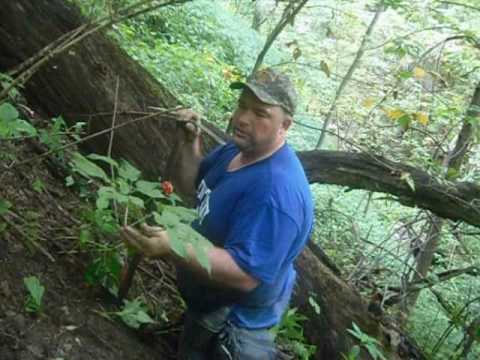
A friend of mine from the wildgrown site… Billy. from the KY State… one of the largest tops and roots I have ever seen and he videoed the root extraction.
It was a multi top root… 3 huge 4 prongs coming off a single root.
Billy is a character… never met anyone that truly loved seng hunting like him. He really enjoys it… like a kid on Christmas every time.
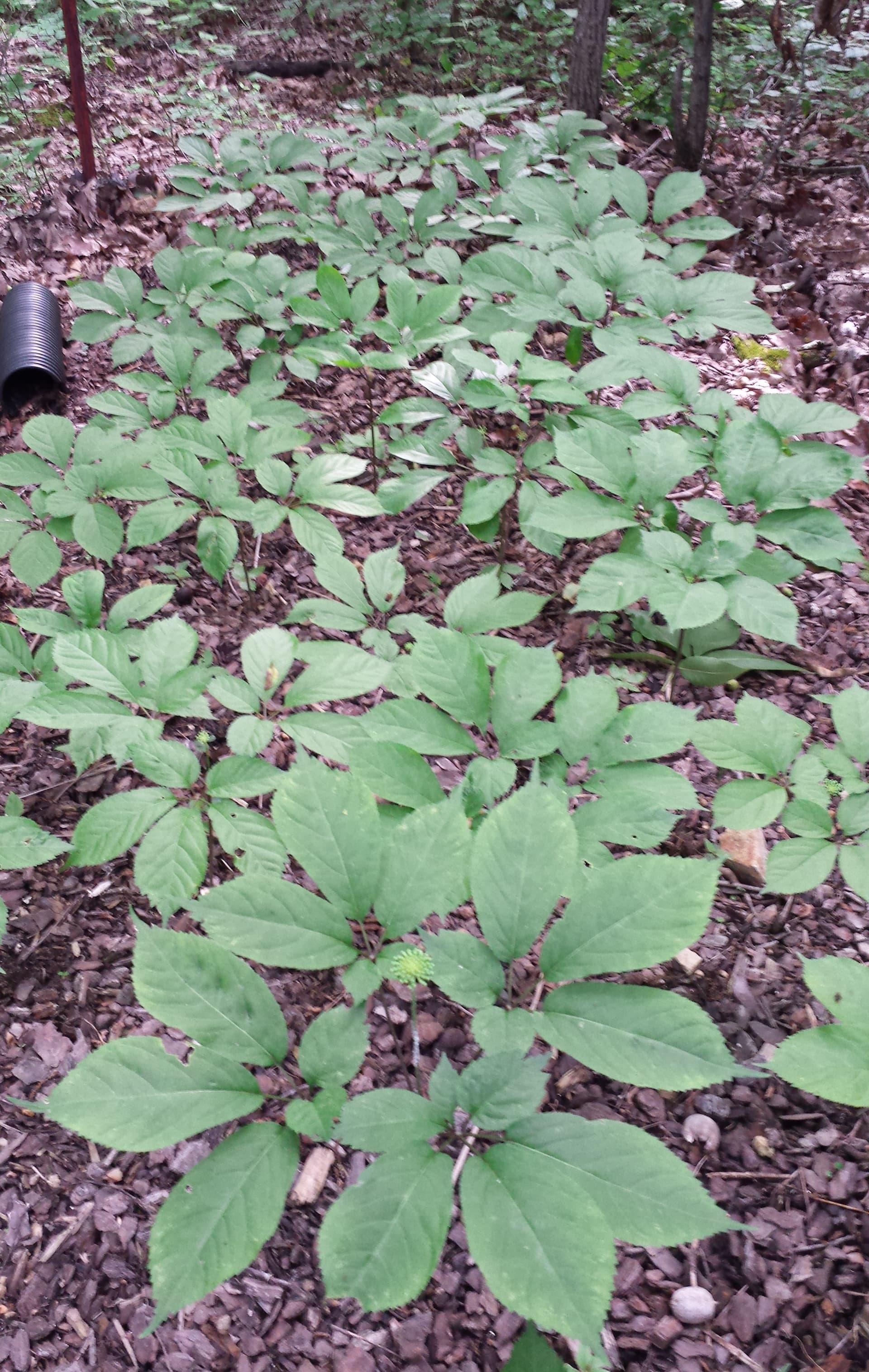
I had some multi top roots in my seed producing bed… two big 3 prongs off one root… had a few of those. Some would change from year to year… 4 prong one year, 3 prong the next… then back to 4 prong the next year.
Is a 6 prong… it was a oddity that happened one year. It has a stem that was double but joined together from the root to the top… sort of like a siamese twin… and at the top… it had two berry stems… and 6 prongs.
It was like it had sort of decided to be a double top with two 3 prongs… but the two ended up being joined together.
Have any of you with ginseng had success growing them wild/unfenced in an location with high deer pressure?
I am considering planting some seed this fall, but concerned it will all be a waste of time if they get mowed down. I’m not willing to fence an area for it.
I grow it… and hunt it… in areas with high deer pressure.
Deer will browse it… but it is like it is not a top 10 plant for for them… they have lots of other favorite foods.
Now in years when you have extreme drought… all bets are off. Many of the deers fav foods are dead or dieing (turning yellow/brown) and in cases like that the deer will eat the heck out of anything that is green.
Back around 2014… I scouted a hollow in early August… found several nice patches and marked them with my GPS. When the season opened Aug 15 (back then)… I hunted that hollow harvesting roots. Most of the plants I found had the top (leaves) browsed by deer… if I had not marked them with GPS… I would not have been able to find those… just a stem left sticking up out of the ground… some had been browsed leaving just a inch or two… others just had all the leaves stripped off.
Note once a ginseng plant is 3 4 5 years old… it is not a major problem if the top gets eaten occasionally during the summer. If it does… the root will form a bud on the neck … that will come up the next spring.
Roots that are big and stout… some age to them… often will skip producing a top… some times for 2 or 3 years… and then send up a top the next spring. I have one like that… a big 60 year old 4 prong… and it was a no show this year.
Thanks for the info Trev, that sounds promising. At least, they probably won’t all perish.
Have you tried planting seed near multiflora rose, or among the branches of recently fallen trees, etc, to help protect them?
Also, any significant difference between buying seed from a shade cloth nursery operation vs seed that somebody harvested from wild or wild simulated plants?
Any need to source then locally, or no real issues with local climate adaption?
Never tried this but heard it described by a neighbor. Someone he knew collected multiple box springs that people were tossing out. Laid them around n a wooded area he owned and planted ginseng within the boundary of each. Said deer didn’t like stepping into the metal so it was somewhat protected.
That does sound like it would be effective and easy!
But, I’m not willing to do it, I know they’d end up out there forever. I’ve already cleaned up hundreds of lbs of miscellaneous scrap out of my woods from the 'ol days when farmers and rural land owners would just haul their junk out to the back 40.
Ginseng grows in a relatively common set of conditions and has relatively little “climate adaptation” meaning plants from the northern range are adaptable in southern climes. That said, I prefer locally sourced seed. I have planted some from Minnesota in the past with less that stellar results. I think it was from the way the seed had been stratified.
@speedengineer … the laws covering ginseng vary some by State… in TN… when you harvest wild ginseng you have to plant any (berries/seed) right near the mother plant.
I think it is within 50 ft.
May be impossible to find anyone actually selling true wild ginseng stratified seed.
There are (or used to be) some places that sell stratified seed from wildgrown plantings. It was very expensive.
The large majority of the 10 lbs of seed I bought came from a guy named Mike… hardwood ginseng. His source was a few artificial shade grown cultuvated operations in Wisconsin.
I treated it with a 10 minute soak in 10% bleach solution. On almost all his seed I had very good germination rates 80-85%.
Disease can and will be a big issue with even wildgrown methods. Planting it in higher concentrations makes that worse… I ended up making smaller beds and putting more space between them… instead of planting 4 or 5 seeds per sq ft… i reduced that to 2.
My disease pressure went way down when I did that.
Smart people love to do this. It means they can harvest the same patch again in a few years.
I know where a wild patch is that has not been touched in 30 years. I could ask the guy who owns it for a chance to see how it is doing. It was over 300 feet across the last time I looked at it and had several thousand plants. It is VERY rare to see a patch that large.
anyone else growing jiaogulan (Gynostemma pentaphyllum)? Reportedly it is hardy to only zones 8 and above, but I’ve had it come back for 4 years in Michigan.
I use some of it in tea. It is marketed as “immortality herb” and is compared favorably to ginseng.