I used a Yates apple graft only for apples because @Auburn had reported success grafting it to callery. It is possible that many apples are compatible with callery. I also tried a couple of Winter Banana grafts but they did not make it.
6 Likes
It’s been a long time since that post but if I remember correctly only the root was Callery. Callery root/Ayers/Yates. Effectively it wasn’t grafted directly to the Callery. I’m assuming that your direct graft to Callery was successful.
3 Likes
So far, the direct Callery Pear-Yates Apple grafts have held up on multiple trees. I think the oldest grafts are 3 years old at this time. I’ll report delayed failures if/when they happen.
5 Likes
Is there significant swelling or other indications of some incompatibility?
1 Like
No swelling that I recall. I’ll check next month. The only potential sign of incompatibility that I recall was when I pruning one of them (pulling branches down to get a cut), it broke at the graft site (1-2 year old graft). However, I ruined a Drippin Honey pear graft the same way, so I am not sure it is an issue of incompatibility. By the way, I am much more gentle with my trees that are not in the “wilds.”
5 Likes
I find that bending pears is really difficult and they seem more likely to break than apples and peaches. I’ve broken non-graft pear branches trying to bend them. Those would have bent easily if they’d been apple. I think @scottfsmith said he’d noticed the same thing once.
I’ve grafted a lot of euro pear onto mystery landscape pear - the ones by me aren’t necessarily true "Bradford, they’re probably some hybrid thing. They still have the really upright branches and really pretty Fall foliage and little round brown fruits.
Most of my euro pear grafts look pretty good and are growing well. A couple of them have done a strange thing where they curl. They look like this picture @clarkinks posted T-budding tutorial - #135 by clarkinks But two years later he said he was getting lots of fruit from that tree, so I guess the weird curvy growth doesn’t really hurt.
Here is mine
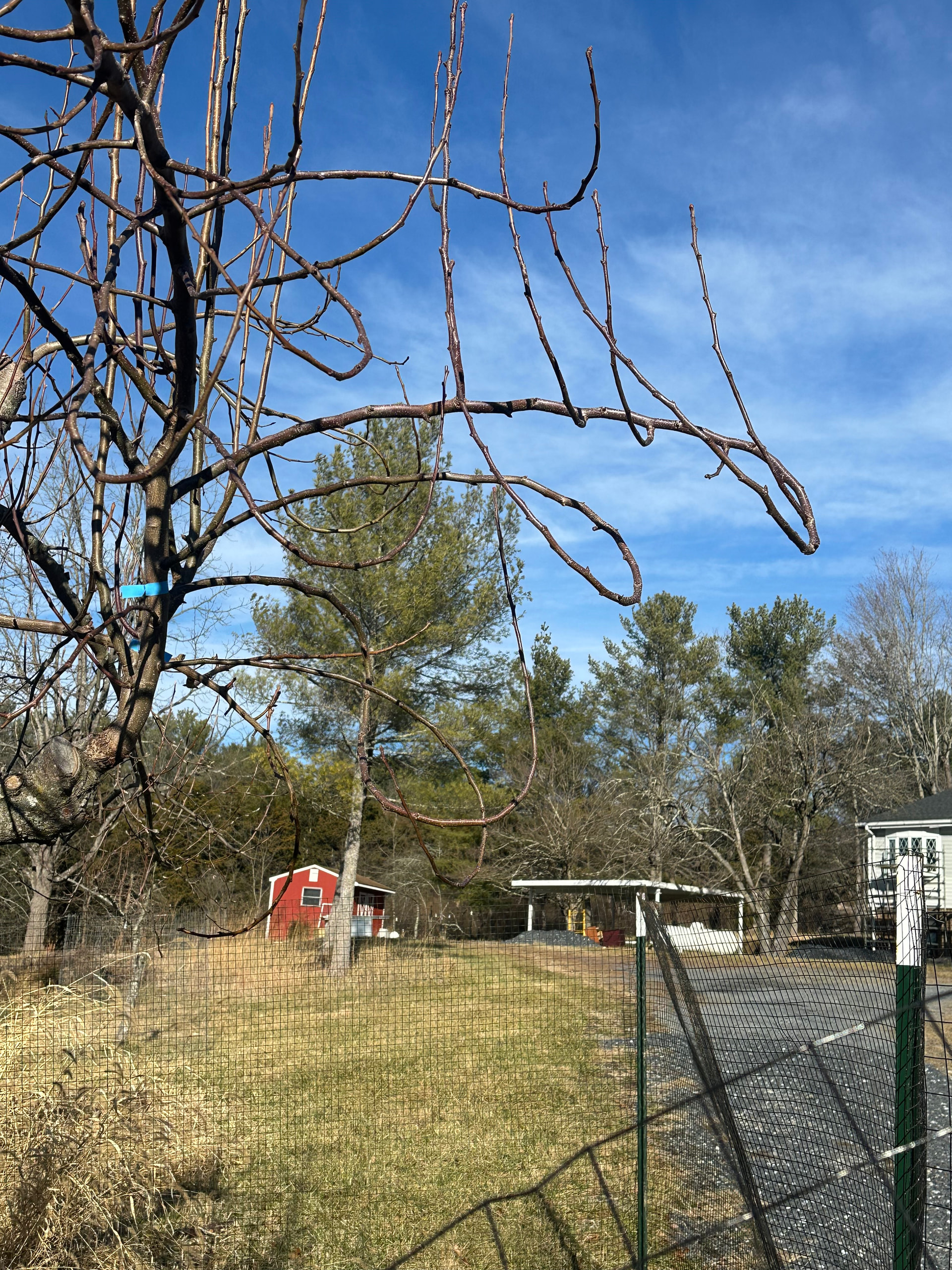
I believe that picture is a sekel graft. There is also a Clara frijs and dutchess graft doing a similar thing.
5 Likes
That tree will produce like crazy. In my opinion that means they are partially incompatible.
1 Like
is there a correlation between the incompatibility and producing like crazy?
I have seen this type growth in one of the asian pear on callery grafts I did in 2024.
1 Like
Incompatibility generally causes earlier and heavier fruiting
3 Likes
Interesting. @clarkinks have you noticed these dying after some period? Is there any other sign of incompatibility? or is it kind of just a lucky thing that these work and fruit early and heavily?
I suppose I thought that incompatibility would be dwarfing (like quince/pear) but these are very strongly growing and the graft union looks very good.
I suppose even if it only makes it a few years and bears fruit, that’s better than what I had before - and of course I can just graft something else on.
1 Like
It won’t fail, over time it will grow more normally.
1 Like
‘Bradford’ is a variety of Callery Pear (Pyrus calleryana, or something like that). If you get fruit, you have multiple Callery Pear around - ‘Bradford’ was originally sold as a “sterile” ornamental, until folks started importing/ selling / planting other Callery.
2 Likes
If the trunk is big (like more than a couple inches), then any kind of graft will never heal over all the way, and the new material will easily break off in the wind.
Why? That doesn’t make sense to me.
Over the last couple of years, I have grafted 15-20+ wild callery with Bartlett, Ayers and Shinko scions. I also top worked a 7-year-old Bradford pear in my yard with a few dozen of these mixed scions. The only care they have gotten is that I tried (poorly) to keep the rootstock growth to a minimum, most have survived and seem to be doing well. The only problem with this is that the trees are scattered over the farm, often at the edge of the woods. While this is good for wildlife, they are not where I want them. Last fall I harvested some fruit, saved and stratified the seeds, now they are germinating. I probably have 50-100 seeds and only want 6-12, so if anyone wants a few PM me. Since they are soft and ready to germinate, I don’t know if they would survive a regular envelope with first class postage in a plastic bag with a little damp moss or paper towel or would need a cushioned envelope. I’ll send a few seeds by first class envelope at no charge, if you want better packaging you may need to cover a couple of dollars postage.
This has been a problem on the Bradford in my yard. Most were bark grafts, they are callousing over but the wind has been rough on my grafts. Some of the grafts grew 4-5 feet and I started pruning them back by half or more to save them. Most of the grafts were on about 2” stock and I put 2 or 3 grafts on each. In the next few days I need to do serious pruning to the multiple grafts and shorten the longer ones that I will keep,.
The Bradford pear was a lark. The year before I had grafted a sucker over to Shinko and was going to cut the tree down. When I was ready to cut it I decided it might be fun to top work instead. I had pruned my pear trees a few weeks prior so I gathered up a handful of mixed prunings that had been laying on the ground, cut them into scions, refrigerated and waited until spring to grafted the tree instead. I still haven’t decided if it will be cut or allowed to grow next to the sucker 2’ away.
Fruit trees fruit under stress to try and reproduce before they die, it’s effectively a stress
I think it is also caused some by an inability of the sugars creates by the scion to travel to the roots unimpeded and this energy is used for flowering and fruiting
I have not had the problem with the big grafts breaking - but perhaps I’ve just gotten lucky? My soil is kind of poor and most things aren’t very vigorous so I’m probably not getting as robust of growth. If @Beeman tries, maybe stake any big growth so it doesn’t break off in the wind.
Those curly branches are really pretty
But it wasn’t really sterile, it just couldn’t pollinate itself and it was rare for any pears to bloom early enough to pollinate it, that was how they claimed that, but even Clapp’s Favorite could occasionally pollinate it and then the seedlings went everywhere.