I am trying 3 varieties. Blue Java ice cream bananas, those are successful all over around here without much intervention (9b south Louisiana). I am also trying grand nain and Double mahoi.
My main goal this year is to protect the roots and as much as the main stem as I can over this winter. I hope we don’t get another “artic blast”, 2 years in a row is enough for me. I do have two grand nain in grow bags, I honestly just haven’t decided where they belong yet, I might keep them in the bags and bring them in the garage, I can see which ones go to fruit faster!
I see talk of tissue culture. I was actually going to practice tissue culture with my grand nain, Tissue culture is a great way to get a bunch of plants from very little, the marketing of tissue cultured bananas claims they fruit faster however I haven’t actually looked into the research…
post pics of your blue java when they are mature, real blue java is rare, most plants sold as blue java are actually tall namwah, because labs have a hard time tissue culturing blue java. also blue java does not taste as good as namwah, i’ve heard this many times over from Florida growers. i’ve compared the tissue culture plants to field dug pups, field dug fruits much faster, even a water sucker will fruit faster than tissue culture. tissue culture is very slow growing, so it’s much better to have a field dug sword pup. what you can do is if you start off with tissue culture is to let a sword pup grow then use that as your main stem and then dig out and discard the tissue culture parent.
Just pulling up a few protocols, tissue culture claims to be faster than field pulps… IDK, I don’t have experience there.
I am guessing there is a zero chance of grabbing blue java over namwah, I have whatever is all over New Orleans, I got three big pups earlier this year. They are all about chest high now, but everyone calls them blue java and I didn’t know the difference until today. I am most looking forward to the grand nain, I have 5 “mother” plants right now, My double Mahoi has 3 good stems in different stages.
I am just tissue culturing these for the experience, I have some other projects I want to try but I want to make sure I have my process down before I move on to the more difficult and expensive plants. I am trying a random dole pineapple top, a muscadine and a banana plant. I guess I can see what grows faster in the next couple of years… same genetic material, same conditions, just different propagation methods.
This picture is great! I want to check my understanding to make sure I have this right. Before frost is expected you remove all of the leaves on the main fruiting stem. That is then wrapped up with some blankets to keep warm. Any pups are left outside of the blankets to help grow through photosynthesis?
I don’t walk around often to check, but my Cavendish is just a tiny bit behind yours.
@MagicMedicine
I’m also 9b, but in Florida. I’ve also tried pineapples from tops, Muscadines, and Bananas. The pineapples fruit well when given enough space. I didn’t do anything special and had them in pots that were likely too small and typically on the 2nd year they’d send up a small fruit. It was very delicious. When I’ve grown them inside they stay very green and get large but don’t fruit. For lack of space I’ve put all mine in the ground in an unused and very shaded area. They don’t seem to fruit there, but I didn’t expect them to. I bought some Muscadine vines and they’ve done well. Apparently they were mislabled so I’m not entirely sure what I have, but I tried to buy Tara and Carlos. They also probably don’t get enough sun where they are but still fruit lightly. Birds have been a problem, but I didn’t have any issue this year.
the pup has to wrapped up as well, in the pic above, there is a fruiting stem and pup underneath all those layers of coverings, you uncover during the day when it’s warm enough so that they can photosynthesize, bananas do still grow in winter when it’s above 60F, but the fruit will be very slow to make any progress until you have consistently warm temps. that’s why it took 6 months for one of the namwah racks to develop (see above) and it didn’t even develop fully because of cold damage, but the majority of the growth was April, May, June. in 9b Florida you shouldn’t really have a problem, you’re much warmer than me, how many nights of freezes do you typically get in winter? i am supposed to be 9a, not a new designation, but i treat my part of town as 8b because every 2 or 3 years it goes into the upper teens. i am 2 miles from the Gulf and i noticed the more densely populated waterfront communities are usually a few degrees warmer than me during winter nights, but i am usually a few degrees warmer than them during the daytime. i think if i were in 9b Florida, i would be zone pushing jackfruit and soursop!
9b Louisiana is not the same as 9b Florida, i think Louisiana gets more freezes and is probably equivalent to a 8b or 9a in Florida. plus 9b in FL is probably like a 10 heat zone. i noticed the cold fronts always come from the north/northwest that’s why the western FL panhandle is the coldest part of FL. if you start in Pensacola and head to east to Tallahassee and on to Jacksonville, it gets progressively warmer and these cities are all 30 degrees N latitude. i’d be having an easier time growing bananas in Jacksonville.
OK, thank you! So basically it’s pressing pause on development of the bananas and preserving them through winter to continue to ripen in the spring?
I’m not sure how many freeze events we have, maybe 1-2 per year, with a few more that are close. Unfortunately we’re expected to have freezing temperatures on Tuesday, so this weekend I’ll need to prepare. That is very early.
We’ve only seen frost twice in the last 5 years, but last year was bad with younger citrus trees in that area dying back below the graft. I don’t think it was much below 30 though. The bananas had their leaves turn yellow but recovered nicely.
In addition to wrapping I’ll use some incandescent Christmas lights to help give a little heat when needed.
i harvested my dwarf namwah today, it has filled out and i’m not waiting any longer because it’s not getting any warmer, and i have other bananas and tropicals i need to protect. i already had 1 freeze on Nov. 11th.
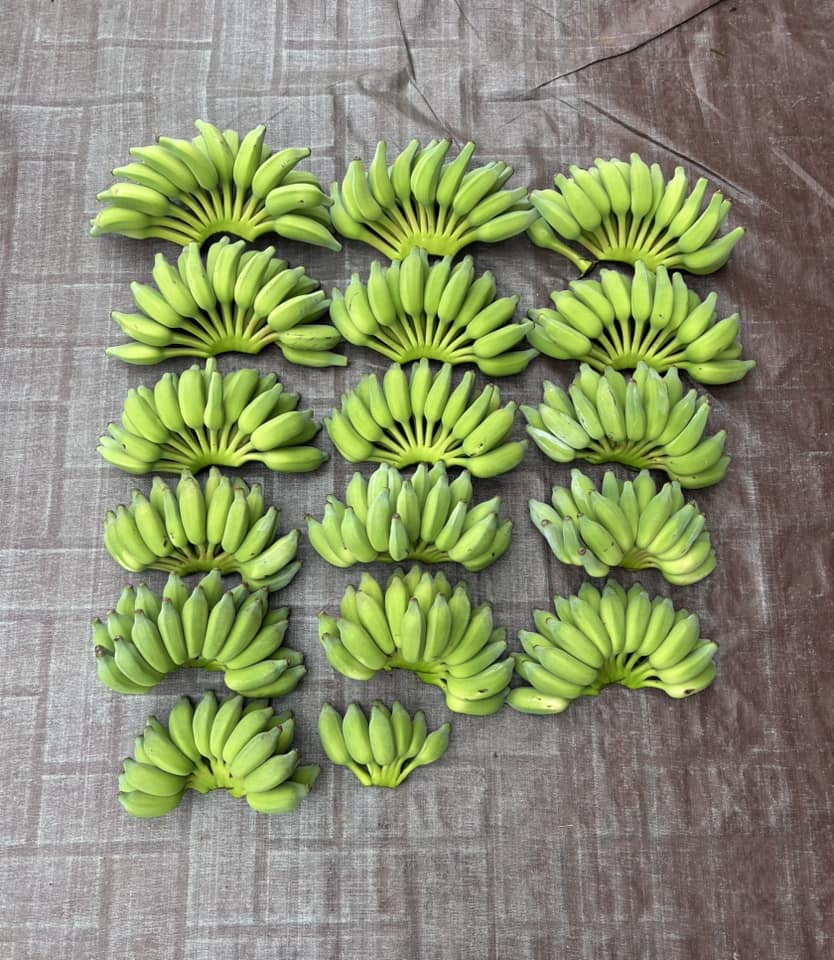
come mister tally man, tally me bananas! 17 hands, 333 bananas. around 105 days from inflorescence to today.
i had a colder than normal November with several nights in the 40s, a few in the 30s and 1 freezing morning. i believe that if i could have had this flower earlier in the year, i could get a harvest in 90 days. i’m excited to try these, they are much bigger and fatter than the ones that had flowered for me in Dec. 2024.
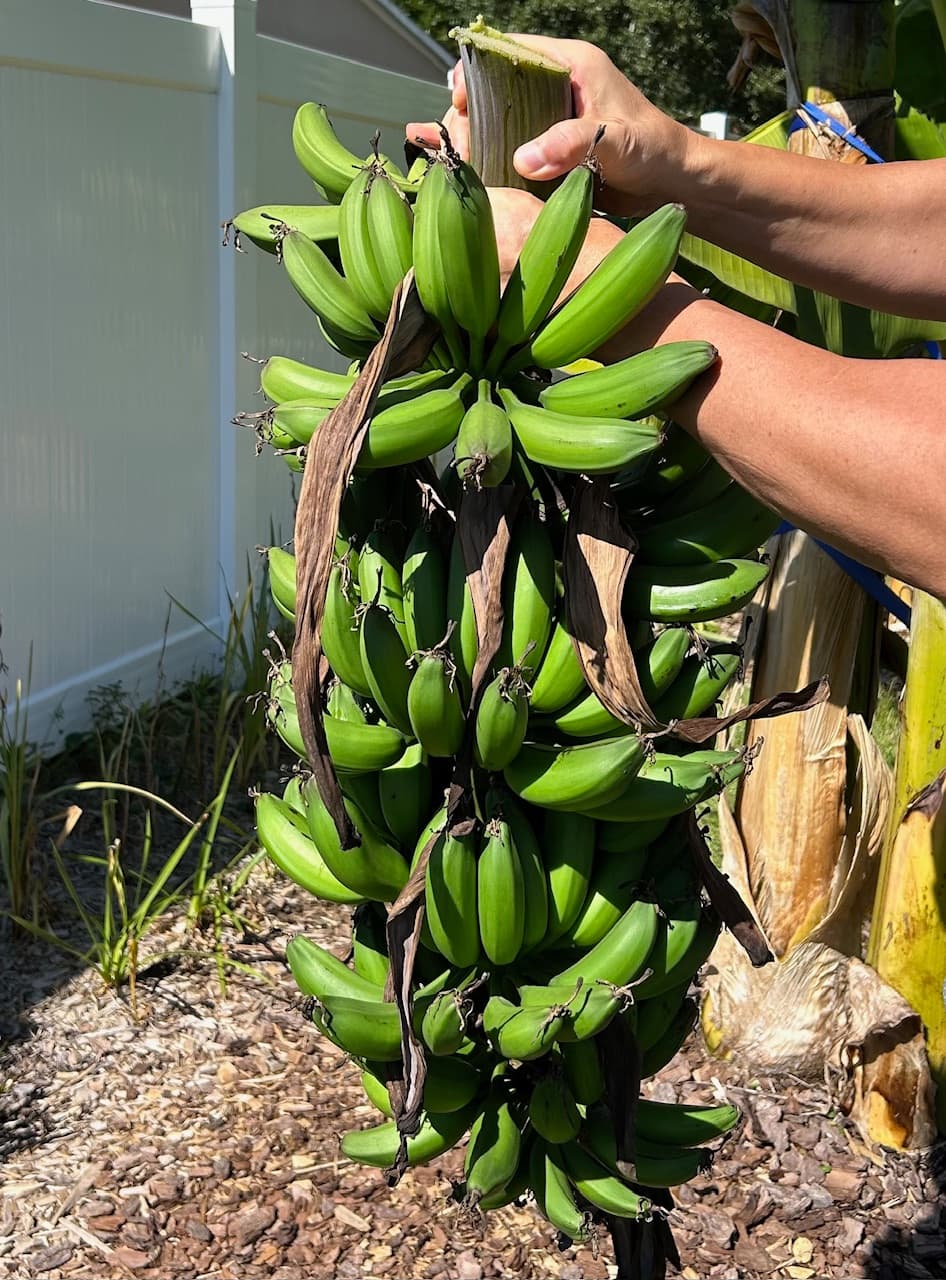
this was the kokopo we harvested in October, (you definitely need 2 people, one to cut and one to catch), i forgot to show the whole rack, definitely bigger than last years and bigger than another kokopo out in the yard.
i have more 10 more racks, different varieties, hanging in the backyard that i will have to decide soon whether i cut some early and/or protect through the winter. i really wish they didn’t bloom so late but that’s my luck…one year i will get the timing right, i keep saying this to myself…
@clarkinks i get too many pups per plant, i have never counted but some varieties like namwah produce more than others, so i’d say a namwah can produce about 10 pups in its life cycle, i thin most of them out and just leave 1 or 2, depending on how fast they grow, because it’s important to get the timing right, you don’t want a pup that’s too big or too small for next season, in winter, i do NOT thin out any pups, i’ll let as many of them grow to provide support for the fruiting stem, i thin those out after harvest, because if the main stem has fruit but no more leaves, at least the pups can continue to photosynthesize and allow the rack to develop.
@Phlogopite it is possible to do it by yourself, you have to cut a v-shaped notch into the stem and let it fall over gently so you can catch the rack
there’s no way to pause development because during the warm days in winter they will grow, that’s guaranteed even in my zone, so i will cut off every new leaf that emerges so it’s easier to wrap the whole thing top to bottom.
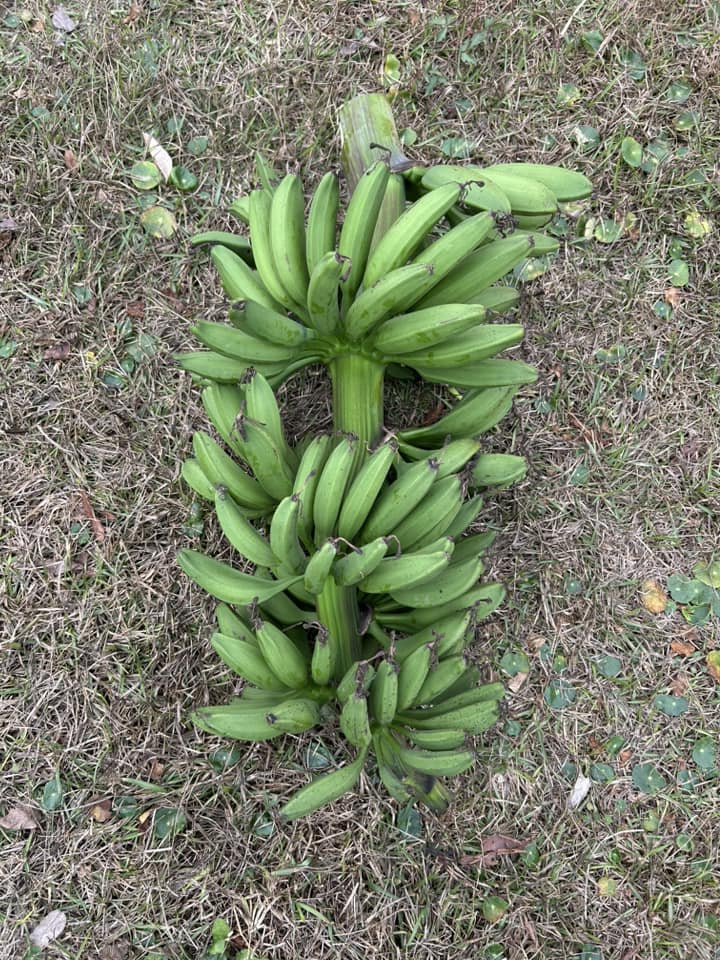
harvested another rack of kokopo, a bit early but i got tired of protecting it, gets cold damage below 50F, one of the most cold sensitive varieties. this bunch has about 150. it will take about a a few weeks to maybe over a month to ripen indoors from this stage.
yesterday, i harvested 3 bunches of dwarf cavendish early as you can see the ridges, but this is a cold sensitive variety and it’s just not going to develop anymore going into winter. i’ll have to report back here when they’re ripe to see if they actually taste better than store bought cavendish.
of the 12 that flowered from late summer to fall, i harvested 6 and there are 6 more, but i am getting tired of protecting the racks, because it is a lot of work and is time consuming. there’s just too may nights where it goes below 40F here. i might let some or all of them go and focus on protecting just the stems that will give me a harvest next year. at least the stems can withstand brief, light freezes. i have to be practical and not let myself get overwhelmed and i don’t want to be miserable worrying about them all winter. i always tell myself, i can’t do this forever, eventually i’m going to have to just grow things that are adapted to the winters here.
You have such a better time with bananas than me. Mine grow at such a snails pace, but I also do not fertilize them like I should. My blue Java didn’t die back from winter but still sits less than 4 ft tall. No hard frost yet, but they just do not seem to be worthwhile here likely due to my poor soil. This will be the last year I put any effort into them.
Bananas are crazy heavy feeders. Mine barely grows even in summer if I don’t feed it, but explodes whenever I fertilize it. I live on land that was considered too poor to put a grove or field on and also too poor to mine for phosphate, so we have pretty nutrient light soil. The best I’ve seen grown are the ones people put in compost.
yeah, bananas need very rich soil, try growing in compost, worm castings, animal manure (that’s not laced with herbicides), fish carcasses and loads of mulch. heavy feeders and drinkers. the amount of water they normally need would kill other plants.