I pollinated it successfully with the pollen from my only incarnata plant, it has 6 fruit on it, most of them pretty large for what I expected, I guess around 100 gr.
1 Like
I can add info for everyone growing Fata Confetto, all my attempts at pollinating it at evening failed, I was successful during the morning around 11 am-13 pm.
2 Likes
Has anyone observed or is there any known evidence of vertical versus horizontal spreading/growth habit having an impact on crop yield in P incarnata?
This year many of my vines just ran along the ground versus climbing my cattle panel trellis.
It seemed like they set more fruit this year.
Obviously this could be due to many factors but growth habit could be one of them…
3 Likes
not sure but generally in vining plants horizontal growth = more flowers = more fruit.
1 Like
Ah I see - I wasn’t aware of that!
The cattle panel of course is kinda vertical and horizontal at the same time but clearly different than running on the ground.
Hmmm
yes its certainly the case with roses (not a traditional vine), honeysuckles, wisteria, and grapes. I dont know for passionfruit. https://theveggielady.com/how-to-grow-passionfruit-2/ it looks like maybe it also just takes a few years to fruit well anyway.
did they happen to root into the ground by chance?
1 Like
I’ve never seen them tip root or put down roots from ground contact. But they do sucker like crazy, especially incarnata.
3 Likes
Right no. what @a_Vivaldi said.
1 Like
I just wanted to update that it appears the very hardy selection of Maypop that I started from seed from Prairie Moon Nursery did not comeback after winter. They looked great last autumn, but I think the growing season is just to short for them to survive. They survived for 2 years here, the first year being the year they started from seed. No sign at the end of June. Oh well, it was fun to try.
2 Likes
I have some maypop I planted this spring in a pot here in zone 6b MA. It’s growing up a fence and flowering happily, but no fruit yet. I thought via OGW it was self fertile; am I wrong?
Also, I’m anticipating it will die back to the ground at frost, so do I just protect the pot and let it grow back next year?
2 Likes
A few selections are apparently self fertile but most are self incompatible. They do tend to become more self compatible towards the end of the blooming season as they get more desperate to set fruit.
6 Likes
interesting, yeah i chose to plant 2 anyway even though mine say self fertile as well, i dont trust it lol, especially since theyre seedlings…
Planted just one maypop / incarnata vine this year in MD zone 7b, and it grew beautifully and has given us flowers and perfume all summer. It set fruit pods, which I was not even thinking about it. I thought, based on a comment somewhere to the thread, that the pods (which feel very light) would be empty since there’s no pollinator.
But I just cut one open and …
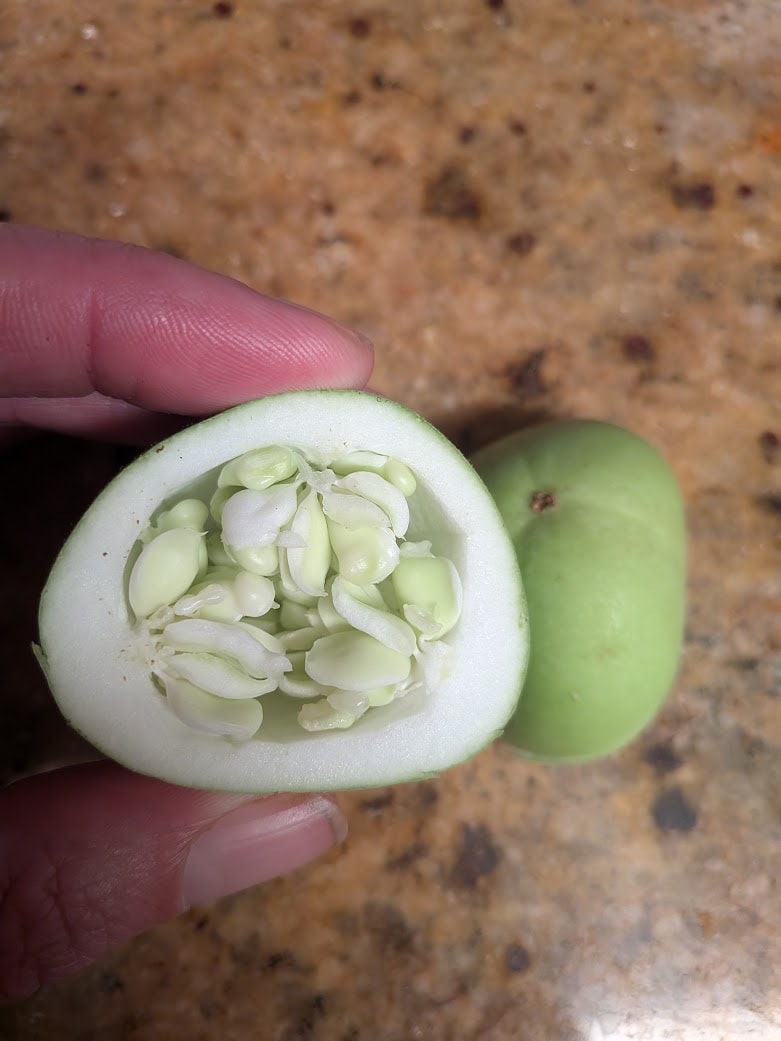
…. These seem to be immature seeds.
Do you all think the fruits will mature?
3 Likes
That’s nowhere near ripe, perhaps six weeks away, and from my experience it would have ripened. Maybe there’s another passionfruit somewhere nearby that pollinated it?
3 Likes
In Maryland, theres a good chance someone else has one or theres some wild ones somewhere. They are popular ornamentals as well as native to some parts of MD. There are also self-fertile and partialy self-fertile varieties.
3 Likes
They should have plenty of time to mature. They will drop off the vine when ripe. I put organza bags over the fruits so they don’t fall on the ground and get eaten immediately by critters.
3 Likes
I definitely have a growing season long enough - what I meant is: does the presence of immature seeds mean that the flowers fertilized and so fruit will fully develop? It doesn’t really matter, but now I am curious to see what it does and to try one, since I’ve never eaten one and don’t know what they are like.
There could be another vine in the neighborhood, but I don’t think the immediately adjacent neighbors have a companion vine. My plant came from a local nursery and was labeled just incarnata so I assume its the usual, wild type. I wonder if it is self-fertile? I am sure pollen has moved well between the flowers because the bumble bees and carpenter bees stay on the flowers for eons, going around and around and even napping. It’s almost as if they are drunk.
I’ll definitely plant another one (or few!) next year, since the first plant was so wildly lush and productive. So even if nothing happens with these pods, there’s the next rodeo.
2 Likes
Yes, immature seeds are only there because it was well pollinated. Without pollination, the ovary typically drops off a few days after the flower blooms.
If there are any wild incarnata in the area, bumble bees will find them and should bring in plenty of pollen. It is interesting how they will sleep inside of the closed flowers at night.
5 Likes
Does anyone have any maypop seeds? Can buy or trade. Thanks.