I’ve been having the hardest time getting any type of persimmon started here in my zone 6 location. I’ve now tried at least 8 times. Every time the plant dies to the ground in spring and I lose the graft. I dont think it’s my winter lows because a couple years ago we had a very mild winter and the low was only about -3F. I’m convinced it’s our fluctuating spring temps. I’ve tried numerous hybrids and a few pure American persimmons. Almost all of them keep sending up new growth from roots. I’ve regrafted onto this but so far it’s the same story every year. A few years ago I tried to plant one I had gotten in the mail pre-grafted in a deeper hole. It came grafted maybe 6 inches up the trunk so I struggled to make the hole deep enough and eventually just had the graft a couple inches below ground. That one is the only one that died completely and never sent up new growth, so it made me paranoid about planting them so deep. Last year I grafted Chuchupaka on some new growth on one of them and the graft took well and grew all summer and fall. It looked great. I attempted to protect it by mounding dirt 6 inches above the graft last fall. This spring the top looked dead but I saw new growth coming out of the ground. I carefully dug out the mounded dirt and found 3 new branches coming out of the trunk… just below the graft. I did a scratch test and the graft seems to be alive at least for several inches above where I grafted, but has no buds. I tore off the 3 new branches in the hope that it will make new ones above graft. We’ll see.
Try planting some seeds, and wait till they get about chest high to graft them. Planting small grafted trees is ok, but field grafting makes a better tree in the same amount of time(or less if trees keep dying)
I’m a believer. Last year, for example, I grafted Chuchupaka to purchased bare root DV trees. Both produced roughly 1’ of growth. They’re in the ground now, still in the whip stage.
I also stuck a scion on a root sucker that was roughly 5’ tall, 1" wide. I cut in to ~2’ then grafted. The scion produced roughly 4’ of growth with lots of branches. This year it’s growing well. I think it’ll flower next year.
So now I’m attempting to grow out rootstock before grafting.
I’ve been trying to convert as many people as possible, but its a bit counter intuitive that by waiting you get faster growth out of the graft. Glad it worked well for you.
Burying graft unions is underrated.
There are lots of reasons to bury graft unions, and only a few reasons for not buying them (although often very good reasons).
Do tell?
Kassandra x open pollination seeds from Cliff England is growing. Hopefully it will be more cold hardy than -17F of its parent.
Tony
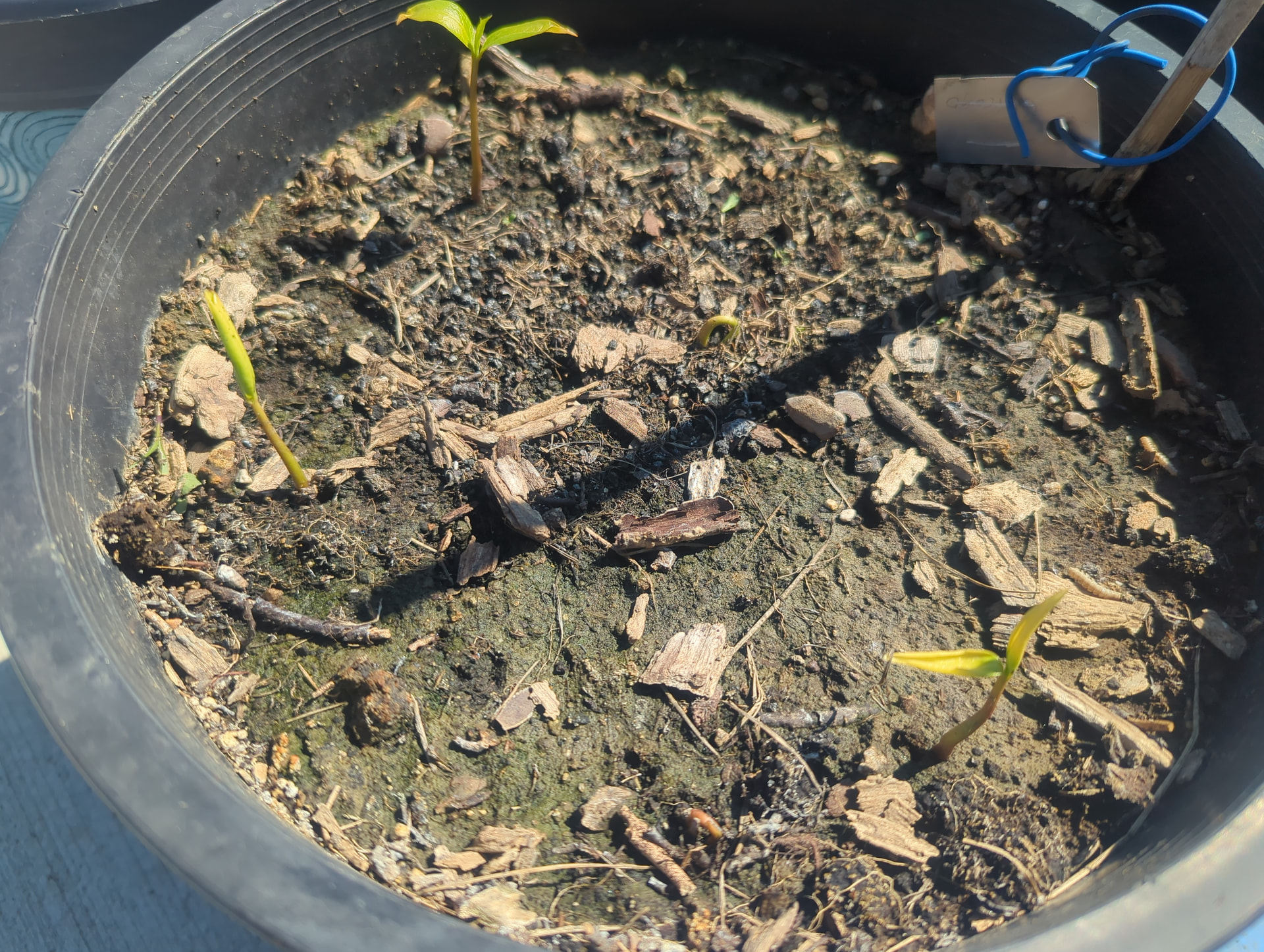
Two real Dar Sofivivky plus the Universal hybrid persimmons with the grafted unions buried 8 inches below ground for insurance for future cross. These trees were grafted a month ago on the large 3 years old rootstocks. Yahoo!
Tony
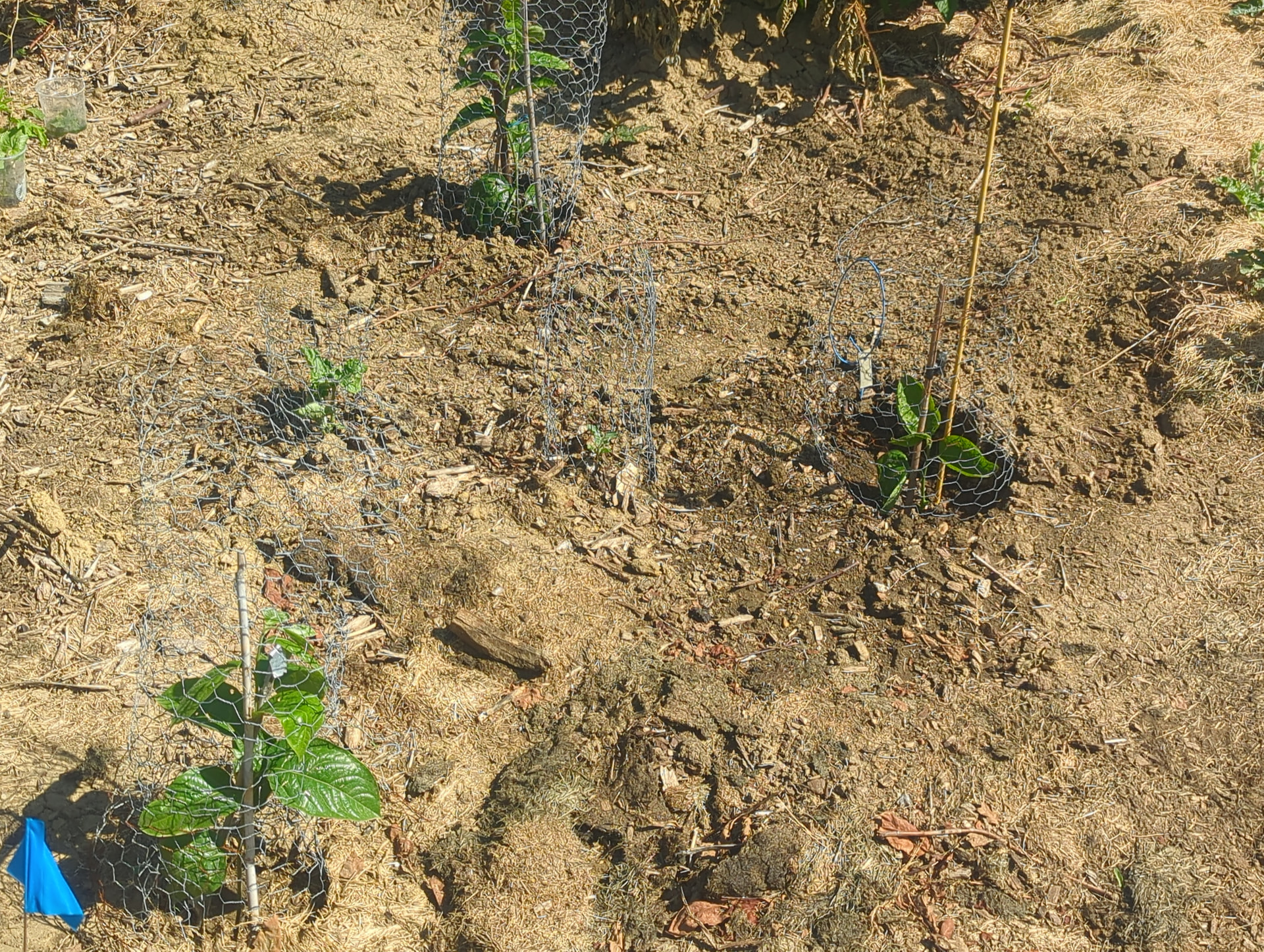
What is your spacing between trees?
I am doing trials for cold hardness for Z5. It could get to -30F once every 10 to 15 years. I grew them 5 feet apart with summer pruning for a high density orchard.
Tony
I was doing some reading of older threads. Do I understand correctly from this thread. List of hybrid persimmon species available in USA - #432 by KYnuttrees that Sestronka is no longer extant in Cliff’ England’s orchard? I had hopes of grafting more scions on my trees. Weird fact. I like to graft the same cultivars from different sources on my trees.
I have a tree of NB-21/Sestronka, grafted 5 yrs or more ago; no fruit yet, so I can’t attest to whether it is true to name, but it is certainly a hybrid, and not a mislabeled D.virginiana like the ‘fake’ Dar Sofyivky. I don’t recall where my scion came from, but it would have been either Clifford or Dax.
Looking for sports or exceptional “individuals”?
I see similar performance for container grown trees just letting the rootstock establish for a year. I think that’s the big difference, not whether the tree is in ground or not.
Climate probably factors in too. In ground established persimmon in z7 grows extremely fast.
Very true. Here in NH, not so much. They are slow growers.
I wonder about your rootstocks. Where are you located, and where did you source your original persimmons/rootstocks from? There’s a known, substantial variation in cold hardiness between northern and southern populations of D virginiana. Many southern nurseries use Southern rootstock because it’s locally available and it grows faster, but it’s not always disclosed when they get sent off to the North.
What do you have success with there?
I only have one and it’s an exceptionally good American cultivar, but it’s like to plant some hybrids and the seedlings of Bull’s Heart which is a very hardy tree, but not able to bear ripe fruit in cold climates, so some male pollinators and female hopefully freak seedlings would be great.
Here’s more info about that, but it’s probably only zone 6a hardy, maybe 5b.
https://isidapark.ru/product/xurma-byche-serdce-bull-s-heart/
It is only -13 F is not cold hardy for my Z5 . The fruit description sounds great for Z6. Maybe someone will cross it with the universal hybrid so it may survive at -17F.
So, I do not pretend to be an expert on this, nor is this list complete (but I’m willing to edit it to add other’s ideas, with credit too)
But let me try to answer. The reasons I know if to bury a graft union include:
Cold hardiness: if the grafted variety entirely dies in a hard winter it won’t sprouting back, burying it deeply enough, could save you from waiting for rootstock suckers to grow and regrafting in following years after dying back to the ground, instead of having 8 inches or more below ground and letting it sprout back by itself.
Bad or unknown rootstocks. So you’ve got your pawpaw on a seedling rootstock and you have no reason to believe that the rootstock is better than the fruiting variety would be, so I bury it deeper and hope the best roots win. Or you ripped up some rootstocks and they’re questionable in terms of survival so maybe the top will root and have a second chance at survival.
You don’t want that rootstock but you have a tree on one and you’d like to get large on a super dwarf rootstock and you want it to get big some day, try.
Incompatibility, I lost a 15 years-old Italian plum on myrobalan rootstock to reverse bottle-necking, the base of the tree and rootstock looked exactly like a beer bottle and almost the same sizes. I wonder if it would have put down its own roots and survived if it were planted “too deep”? Also I buried a couple Chestnut grafts, they’re notorious for delayed graft incompatibility, so hopefully they’ll root.
Stooling, perhaps you have a scion of a variety that you’d like to stool, what can you do? Bury it deep or basically sideways, I guess.
Free standing dwarfs: you have a fruiting variety grafted on to a long dwarfing stem and a full-sized rootstock below that, the full sized rootstock will certainly grow faster than the dwarfing interstem so it likely will not be strangled by the dwarf variety, and now the tree is down lower the entire length of the interstem to make your dwarf a little lower yet.
You live in a windy or otherwise dangerous area and don’t want your unstaked trees getting broken off at the graft union.
Reasons not to:
Your rootstock is a high performer like M111, had a disease resistant rootstock, or you want it to stay a dwarf tree and if you bury it, the tree may prefer it own roots to its own detriment or against your preference.
This species has sensitive roots and will die if buried deep, or you have floods and it kills trees whose roots are not high enough to breathe.
You want to be able to graft directly to the rootstock if the top variety dies off or isn’t any good.
I’d I missed any feel free to comment!
(Sorry for all the typos, I was half asleep writing this, I think I fixed them now.)