I’m not too concerned. If they don’t want to survive, it’s ok. I would like to see what happens to them at that temp.
2 Likes
Yes that is correct.
Rosseyanka 2 is an F2. But daughter Rosseyanka also has the same characteristics as Rossey F2 (while being different).
But Rosseyanka 2 does not produce male flowers.
Another hybrid male pollinator from Michel is the son of Nikita’s gift (male flowers only).
2 Likes
@hobilus … that picture of ZK is impressive to me… nice looking large persimmon… and his comments on the flavor sounds good.
Cant wait to try one.
If it actually ripens for him early Sept… could be mid August for me. That does not jive with his website statement (ripens late season).
Here in southern TN… recently changed to zone 7b doubt I will be testing its cold hardiness and I should have long enough season to ripen them even if they are later.
I will be adding grafts to my wild dv rootstock trees of Journey and Dar Sofiyivky this next spring.
If successful my list of hybrids will include…
JT02/Mikkusu
Kassandra
Nikita’s Gift
Journey
Dar Sofiyivky
Zima Khurma
Thats it… got to stop somewhere.
6 Likes
Good afternoon.
You touched on the question of how far in the north persimmon can grow. I live in Belarus, not far from Minsk. My persimmon trees have not yet produced fruit. But my friend, who lives a little further south in the city of Mozyr, has been producing crops from the Sosnovskaya variety for several years.
This year he told me that Sosnovskaya began to ripen at the end of September. He collected the rest of the hard fruits on October 10 and after 2 weeks they ripened in the box. He also has the Prok variety, which ripens 10-14 days later than Sosnovskaya.
Growing conditions in Mozyr according to our meteorologists:
GDD >10(Celsius) = 2607–2746
duration of the growing season >>10 (Celsius) = 163 days.
There is another variety that may interest you: The firstborn of Podillya. (Pervistok Podillya (in Ukrainian)).
Pervistka (Pervenets, Pervenets Podolia) is a very early variety that ripens in Poddolia around October 10, earlier than Sosnovskaya. The first fruits can be harvested around mid-September. The variety is very productive. The fruits are ovoid, with few seeds, average weight about 80 g, maximum 120 g. Origin: V. Franciszko bought grafted persimmon seedlings from Novaya Kokhanovka. The scions froze, and one of the rootstocks grew into this specimen. The author suggests that the plants were grafted onto hybrid seedlings of V. Derevianko, the bulk of which were destroyed at the Novokakhovskaya research station in 2012[49]. Ripening on September 10, the mother plant begins vegetating 20 days earlier than other varieties, however, this property is not preserved during grafting, because the rootstock wakes up later and thereby retards the growth of the scion. [52]
12 Likes
Thanks @Sergey, glad to have your perspective. It sounds like your site is more marginal than mine for persimmons. For comparison, ‘Prok’ start ripening here in early October. Sounds like Sosnovskaya is a good bet here. I grafted it last year and am looking forward to seeing how it does.
What are the coldest temperatures your trees have endured? How reliable is that 163 days growing season in your experience? Here we probably average about 155 frost free days. Historically this area would have about 135 days and Ive seen as many as 175.
Too bad about the Derevianko hybrids. Id imagine there might have been some promising material amidst what was destroyed
this would be a decided negative here. early wakeup due to changeable weather followed by late frosts is a significant hurdle in much of the US
3 Likes
I’m really interested in the short list of these that can handle -20F. Think after this winter we will have our data. I know @tonyOmahaz5 is getting hit hard with sub -20F now.
1 Like
My Zima Khurma in what is now designated zone 6b ripens in October.
2 Likes
Attached an article about the climate of Belarus. My friend lives in Mozyr (Мозырь). This is the “New” (Новая) climate zone in the article. It should be taken into account that his plants grow near his house and the microclimate there should be a little better.
Климат Беларуси 2018-Оценка-агроклим-ресурсов.pdf (646.8 KB)
As for the persimmons on my site, not everything is so good there.My site is located at the bottom of a former sand quarry. Therefore, the microclimate there is quite harsh. I have Virginia persimmon seedlings growing in open ground. Almost all plants are damaged by frost every year; part of their annual growth is frozen over. Some of them bloomed, but did not ripen. I also have several varieties, but the grafts are only 1-2 years old and these plants grow in an unheated greenhouse. I plan to take scions and grafting in open ground.
I have collected some information on the winter hardiness of hybrid persimmon varieties. Below will be given not my data, but taken from the literature.
- -20 F = -28,9 C.
12/21 - - 29 C. but late ripening variety
Mikkusu kaki Hybrid, JT-02 , Mikkusu - The most frost-resistant hybrid currently known (approximately -30C), grows and bears fruit without shelter in the Belgorod region.
Adolf Lishchuk - Winter hardiness of persimmon variety Sosnovskay [28]
God’s gift (Божий дар) - More winter-hardy than Nikita’s Gift [11]
Dar Sofiyivky - -27C.
Nikita’s Gift - 'not less than -22 °С[11], -24 - -25 °С[45]
Sosnovskay - 'down to -30 °C[11]
Universal (Универсал) -27 - -28С[56]
Chuchupaka - -27 °С[11]
Yubileynaya Kosenko (Юбилейная Косенко) - Winter hardiness is higher than Rossiyanka, close to Sosnovka [58]
9 Likes
I sell a few each year in NH (Nashua). I don’t ship, unfortunately, but feel free to hit me up in the spring if you’re still looking.
4 Likes
Hi All,
New to the forum and to persimmons. We have been growing fig trees, in ground and potted, and have a fairly nice collection.
We have always enjoyed Persimmons astringent and non astringent, a few months ago we started to learn about different cultivars and what is involved in growing them in our climate. It looks like we missed our chance this year to get some trees but still hopeful we may be able to get our hands on a few.
We are interested in Kasandra, JT02, Zima Khurma, Sofia gift, and Journey. Our season is too short with a total GDD of about 2,400.
We are happy we found this forum and look forward to learn from you All.
Thank you,
MFJ.
MA, Zone 6a/b
6 Likes
I am curious if anyone here has fruited Zima Khurma and can comment on ripening time?
All the descriptions I find on the internet describe it as late ripening, including Cliff’s. However, per this screenshot, apparently in 2018 Cliff had at least one ripe fruit on September 8th, which seems quite early to me.
3 Likes
I’m hoping to get ZK fruit in the next few years. I would also like to hear reports from various locations.
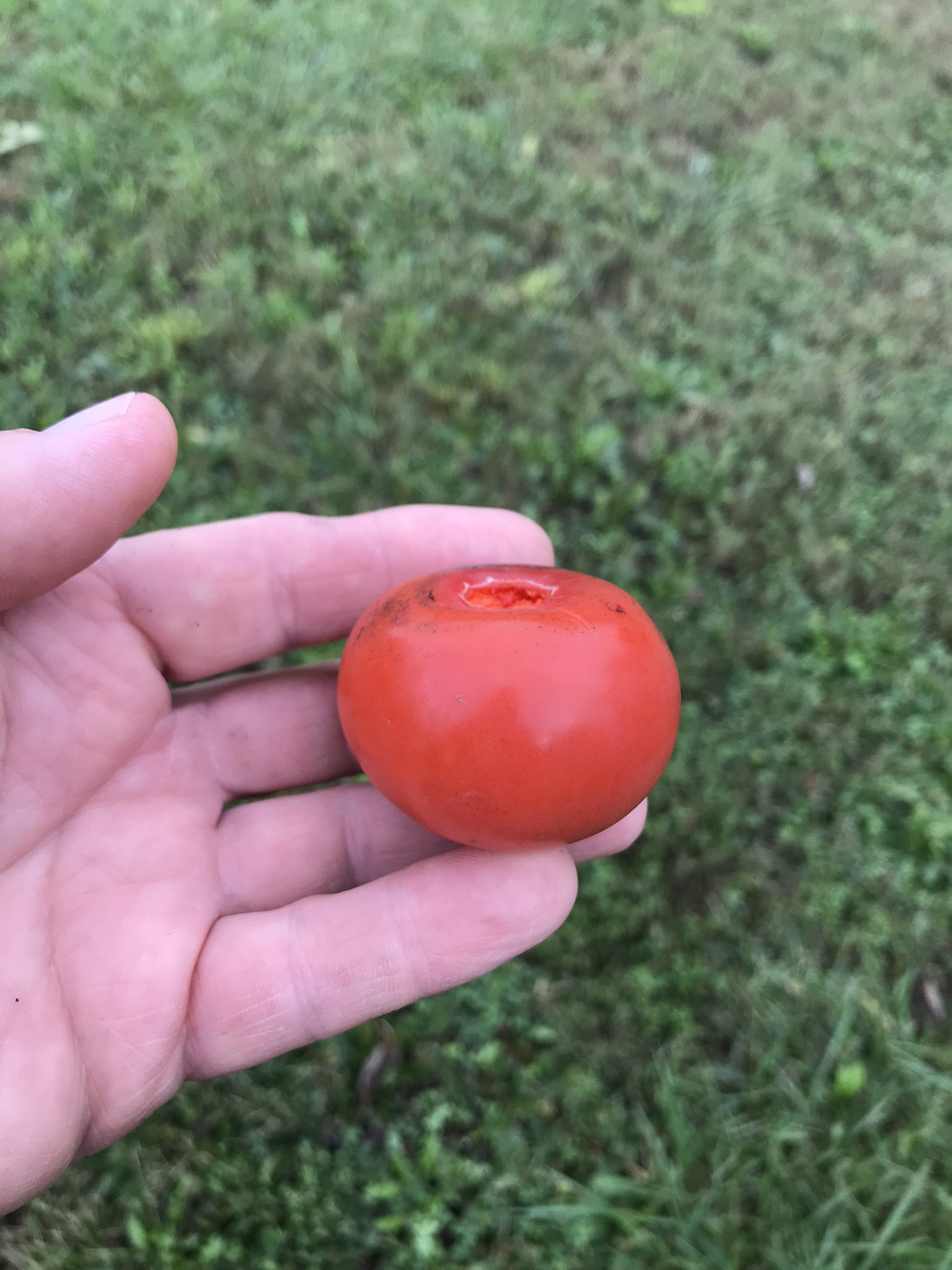
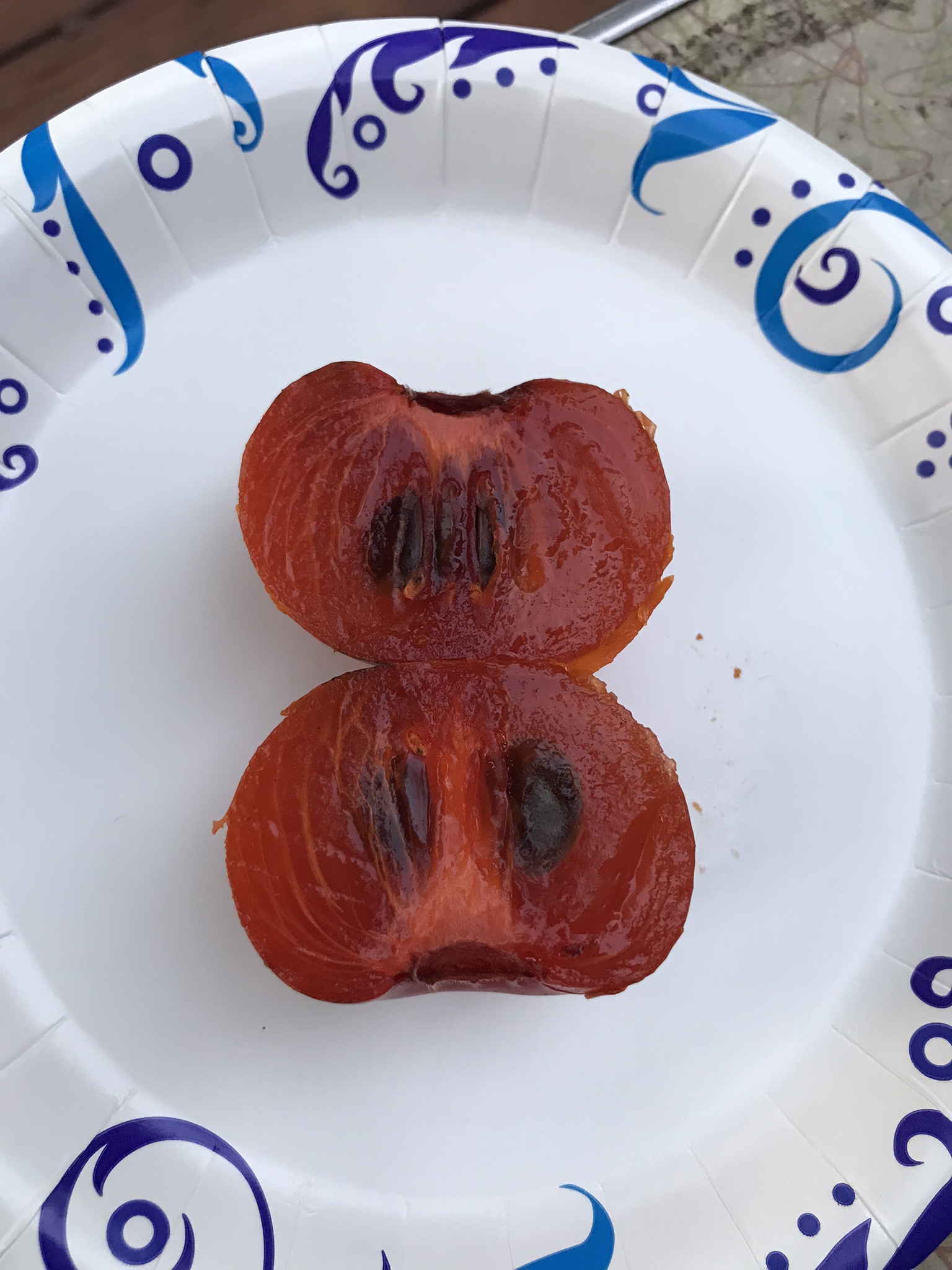
8 Likes
Thanks for the data! That is decent timing. Do you remeber how it ripened compared to other persimmon cultivars that you grow?
I’m unsure exactly where you are, but zip code 62414 got about 3850 Growing degree day (50F) by Oct 1st last year. I’m also unsure how correlated GDD is with fruit ripening, but I’m trying to track it.
2 Likes
From my pictures NB-02,Kassandra, Nakita’s Gift and 450-7 were ripe close to the same time.
Jury’s still out in 450-7 being a hybrid.
NB-02 left 450-7 right.
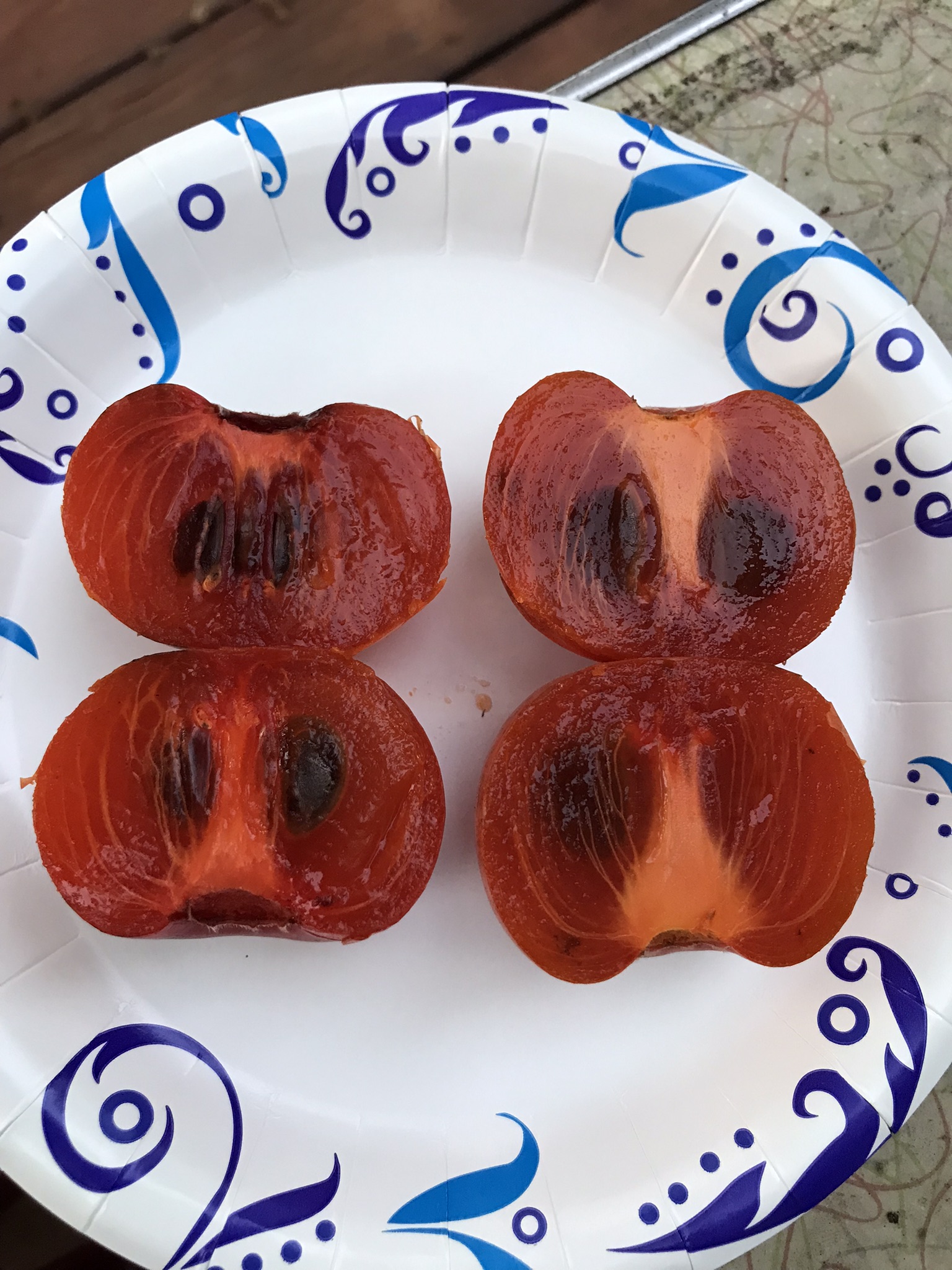
Bozhy Dar 10/11
Rosseyanka 11/14
12-21 end of November
5 Likes
I was happy to see the picture from @JCW; I had assumed that your location in Michigan would be roughly a month later than Cliff’s in KY.
I can’t tell you anything about ZK but I can provide some data on other varieties. I’m in Z7A (borderline 6B) RI, near the coast, which delays the start of the growing season. It’s not reliably warm until May 15.
I have ~3000 GDD between May 1 and early October (15-year average), which is what I would consider my growing season. Early-ripening Americans (H63A, Barbra’s Blush) start to ripen here in late Sept; Dollywood is ~1 week later. Among Kakis, I pick Saijo ripe or very nearly so in mid-October and Ichi Ki Kei Jiro anywhere from mid-Oct to mid-November, orange but not fully ripe, finishing it inside. I pick Kasandra in late Oct, not quite fully ripe, finishing it inside as well. And I pick JT-02 in early November, same deal.
FWIW, you will find that GDD is loosely correlated with ripening, but you could do better by just asking other growers: (1) when does your growing season start (i.e., daytime temps >60-65 F, nighttime temps >50 F); and (2) when do you pick your persimmons? Then count the number of days in between. That day count is a great measuring stick.
The issue with GDD is that it gives too much credit to high heat (> 80 F). A persimmon tree probably grows just as fast at 65 F as at 95 F, but the 95 F day registers 3x as many GDDs. Growth may be optimized at some higher temperature such as 75-80 F, but the incremental benefit is miniscule. Anyway, 80 F registers twice as many GDD as 65 F; but growth at 80 F is certainly nowhere near twice as fast.
5 Likes
I got scion of Sosnovskaya female from Cliff. I let Cliff pick for me. I trust Cliff to make a good pick. Zone 5b.
4 Likes
@tonyOmahaz5 @ramv This question is for anyone with knowledge about Sosnovskaya. Reading this website’s description left me confused:
“The variety itself is an excellent pollinator.
Number of seeds in the pulp 1 - 4 pieces, up to 20% of the fruits are seedless”
When reading that it sounds like it is implying that it has male and female flowers on it? How else is it gaining seeds or becoming a “an excellent pollinator”?
Then this russian website: Морозостойкие сорта гибридной хурмы. (if using Chrome or Brave browser, the entire website can be translated to English using the feature near the url at the top of the browser). There is mentions that Sosnovskaya is seedless but will gain seeds with a pollinator nearby. Then while you’re at it, on the same website, it says that Chuchupaca REQUIRES a pollinator. I haven’t seen that mentioned anywhere else.
Anyone have any details about this? I bought Chuchupaca recently and was considering buying Sosnovskaya.
2 Likes
Sosnivs’ka, forms only female flowers, therefore not a pollinator
6 Likes
So far it has two female flowers on my young tree. No male flower. Female flower is a single flower and male flower has a cluster of three small flowers.
Tony
4 Likes