The article below (which I previously posted) seems the most promising. I need to re-read it carefully. It was published in 2016 and seems fairly up-to-date.
Here are two tentative take-aways. Note that AST is used to describe the dominant allele promoting astringency, ast is used to denote the recessive allele permitting non-astringency:
Dominance of AST.
The AST allele appears 100% dominant. Recall too that the astringency trait in Asians is qualitative / all-or-none.
<< The presence of one dominant AST allele is sufficient to express the non-PCNA phenotype, whereas the PCNA phenotype is expressed only when all alleles are recessive for ast (denoted as aaaaaa) (Akagi et al. 2010). >>
Presence of ast allele in PCA (astringent) Asian varieties.
Some PCA varieties that originated close to the home range of the PCNA varieties bear some ast (non-astringency) alleles. So these PCAs are not homozygous. Varieties with 3-5 ast alleles have a material probability of producing PCNA offspring in the 1st generation of a PCNA x PCA cross.
<< Akagi et al. (2009) showed that an autohexaploid model for inheritance of DNA markers at the AST locus generally fitted the expected ratio, with a few exceptions. These findings confirm that the low probability of obtaining J-PCNA offspring from crossing between J-PCNA cultivars/selections and local non-PCNA cultivars is due to the hexaploid nature of persimmon. Assuming that the theoretical genetic behavior of autopolyploids (Allard 1960), i.e., random chromosome or chromatid assortment, applies to persimmon, in the cross non-PCNA × J-PCNA, non-PCNA parents with less than two ast alleles would not yield any J-PCNA offspring, those with two ast alleles would yield 0–0.2% J-PCNA offspring, those with three ast alleles would yield 5–9% J-PCNA offspring, those with four ast alleles would yield 20–25% J-PCNA offspring, and those with five ast alleles would yield 50–55% J-PCNA offspring (Yamada 2013). >>. p. 65
@Fusion_power – Thank you for pointing me back to this article,. but I think you misremembered the conclusion re genes and astringency. It’s NOT that a persimmon with 5 ast alleles / 1 AST allele is PCNA; it is not. The point is that a PCA persimmon with 4-5 ast alleles has a strong probability of a PCNA offspring in the 1st generation after a PCA x PCNA cross. Make sense?
@westonadams – I think this explains why the observed proportion of PCNA offspring in a PCNA x [PCA x PCNA] backcross is 15% rather than 5%. Some of the PCAs were not homozygous.
Yes, I was thinking along the same lines. If that PCA grandparent had some PCNA alleles, it could cause the rise in PCNA progeny. I think we are on the same page.
And don’t worry about not being a biologist. Since there is no university program for persimmon here in the U.S., it’s up to us "non-biologists.’
Maybe, but I would not want to be the one to release a gene drive into the environment to turn off all dominant AST genes.
Then find out that it had unexpected collateral effects on other species, or resistance to disease of invasive insects, etc.
Once a miss Pandora CRISPR leaves her box, who will put her back?
Seriously? We can’t get Asian persimmons to pollinate American persimmons without embryo rescue, and you’re worried about the anti-AST modifications working its way from persimmons into, what, maple trees? [It might be worth it if the persimmons ended up tasting like maple sugar!]
The most discussed case presenting remotely similar risks is GMO (BT) corn. The best and latest meta-analysis of related research shows no impact on non-target species.
BT corn is not a very good example. It may have no effect on non-target species, but it has a major effect on target species such as European Corn Borer which rapidly develops resistance to BT.
Zinhead is incorrect in supposing a gene drive would be used for something like disabling the persimmon astringency gene. It would be done with gene knockout techniques which disable the target gene. It is kind of like someone proposing to use a shotgun to swat flies.
Huh? Of course BT impacts the European Corn Borer. That’s it’s purpose, right? You say it like it’s a bad thing.
I think the larger point of the opposition to GMO is that there may be unexpected, unintended adverse consequences. BT corn appears to be a case where those unexpected adverse consequences never showed up.
Development of resistance would seem to be entirely expected, given how evolution works. If that were a compelling argument, we’d never use antibiotics.
I think the concern is that insect pest resistance develops more quickly when GMO BT corn is grown on a wide scale, and every part of the GMO plant is producing the BT protein that kills insects. When BT is used as a pesticide on non-GMO crops, the pest population has a more limited exposure to BT and thus take significantly longer to develop resistance.
It’s a parallel to the concern with indiscriminate use of antibiotics in livestock production. The odds of germs developing resistance increases dramatically and undermines the longer term effectiveness of the drug.
We need to be careful how we think about “resistance.” Resistance does not develop in an individual organism over time. It’s not like resistance training with weights. The individual organism either lives (and reproduces) or dies (and doesn’t reproduce). Resistance develops over time in a population when genetics impact survival. If a gene confers some protection, then individuals with that gene will tend to survive. The gene will become more widespread. And so on.
This implies to me that the function relating dosage to resistance is an inverted U. With no / small doses, most of the target population will survive and the genome won’t really change – No resistance. With very large doses, most of the target population will die and the genome of those who are left – who never got the exposure – won’t really change. So again, no resistance. But with modest, inconsistent, variable doses, some of the target population will die but some will live. Who lives? – The individuals with some advantageous genes. Resistance.
This is why doctors caution us (1) not to take antibiotics unsystematically, and (2) always to take the full dose for the prescribed duration. It’s not too much antibiotic that encourages resistance, it’s too little / too inconsistent to ensure that the target organisms all die.
If GMO corn produces enough BT to ensure that resident corn borers all die, there can be no evolution. That sounds safer to me than occasional or haphazard application of a BT spray.
p.s. We’ve gotten way off topic. Let’s continue this, if at all, by PM.
There are two paths to failure. You stated one path with inconsistent exposure. High doses just mean more of the population die leaving a very few truly resistant individuals. Those individuals reproduce and in 2 or 3 generations the only ECB’s remaining are highly resistant to BT. They gleefully eat BT corn and thrive. Meanwhile, organic farmers who rely on BT sprays to control ECB on their crops are left with a formerly reliable organic pest control that no longer works. Two minutes of searching the web will turn up the very real data that European Corn Borer has already developed significant resistance to BT products as a result of exposure via BT corn.
This brings up one of my pet peeves with gene modification for pest/disease tolerance. So far, it has been based on a single gene that conveys resistance. Overcoming single gene resistance is almost trivial for insects that develop populations in the multiple billions each year. For the same reason, single gene resistance to late blight on potatoes has been a bust. Give trillions of late blight spores a few years and every single gene has been compromised while late blight goes right on destroying.
@westonadams – I assume we’d have to rely on research by others. The article linked earlier states:
<< Non-PCNA cultivars, ‘Yoshino’, ‘Egosho’, and ‘Busshi- gano’, all of which have a high ast allele dosage, originated near the area of origin of ‘Gosho’ or other major PCNA cultivars, suggesting that the accumulation of ast alleles and the resultant generation of the PCNA phenotype occurred around the region where ‘Gosho’ arose (Akagi et al. 2010). In addition, the ast allele was widely found not only in Japa- nese local non-PCNA cultivars but also in astringent culti- vars of Chinese and Korean origin (Akagi et al. 2010). >>
I haven’t checked but maybe the Akagi paper gives more names.
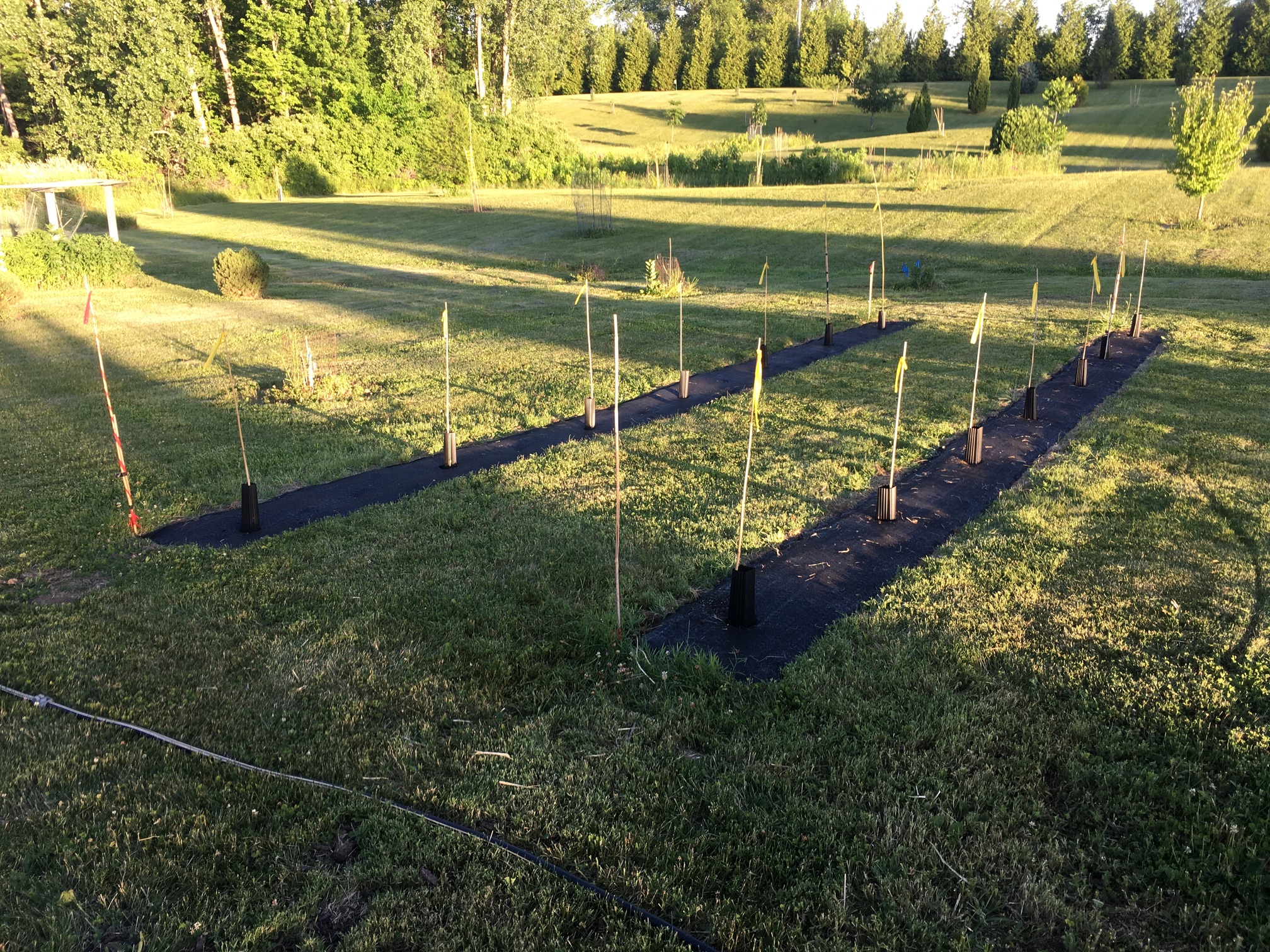
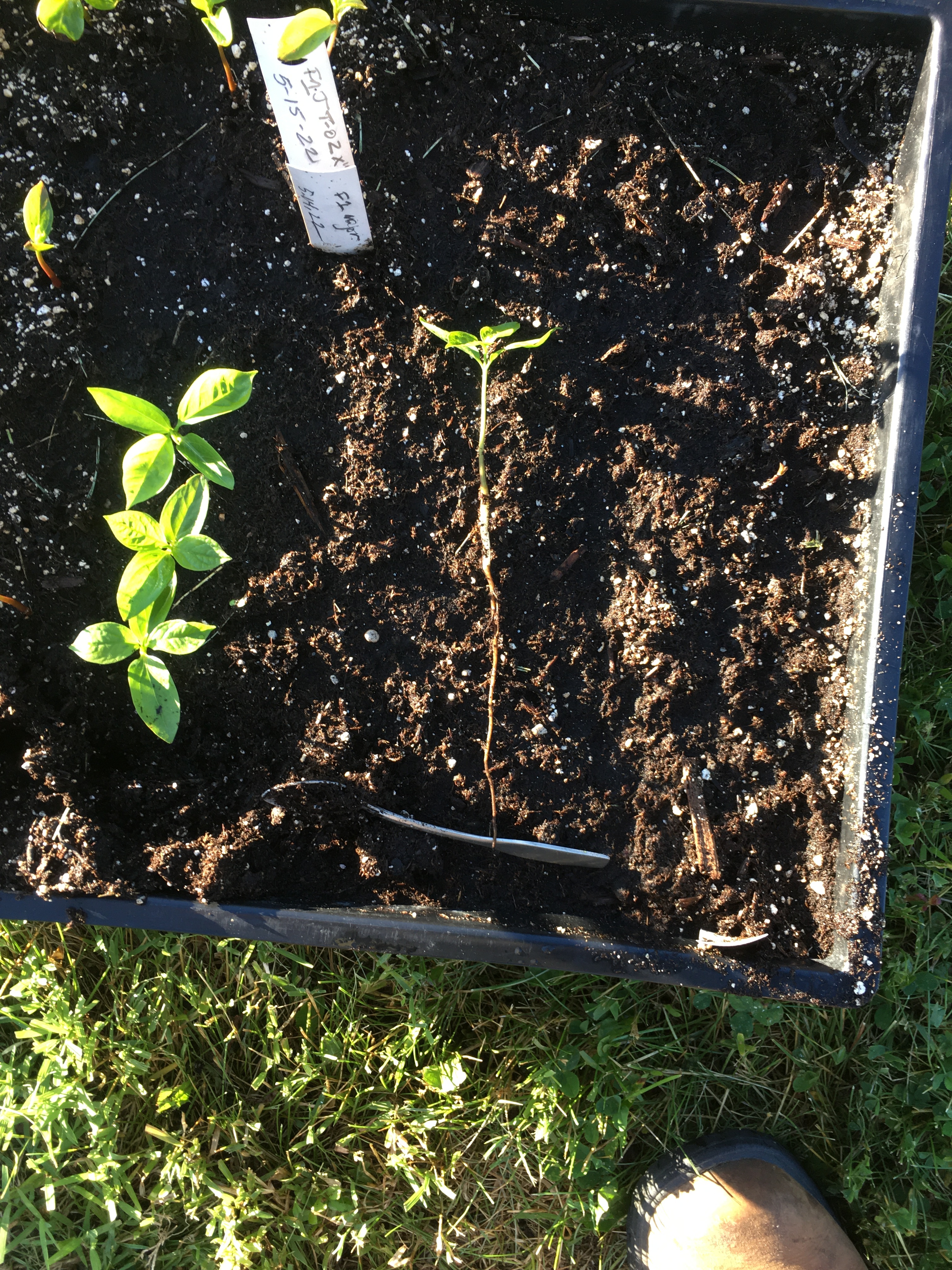
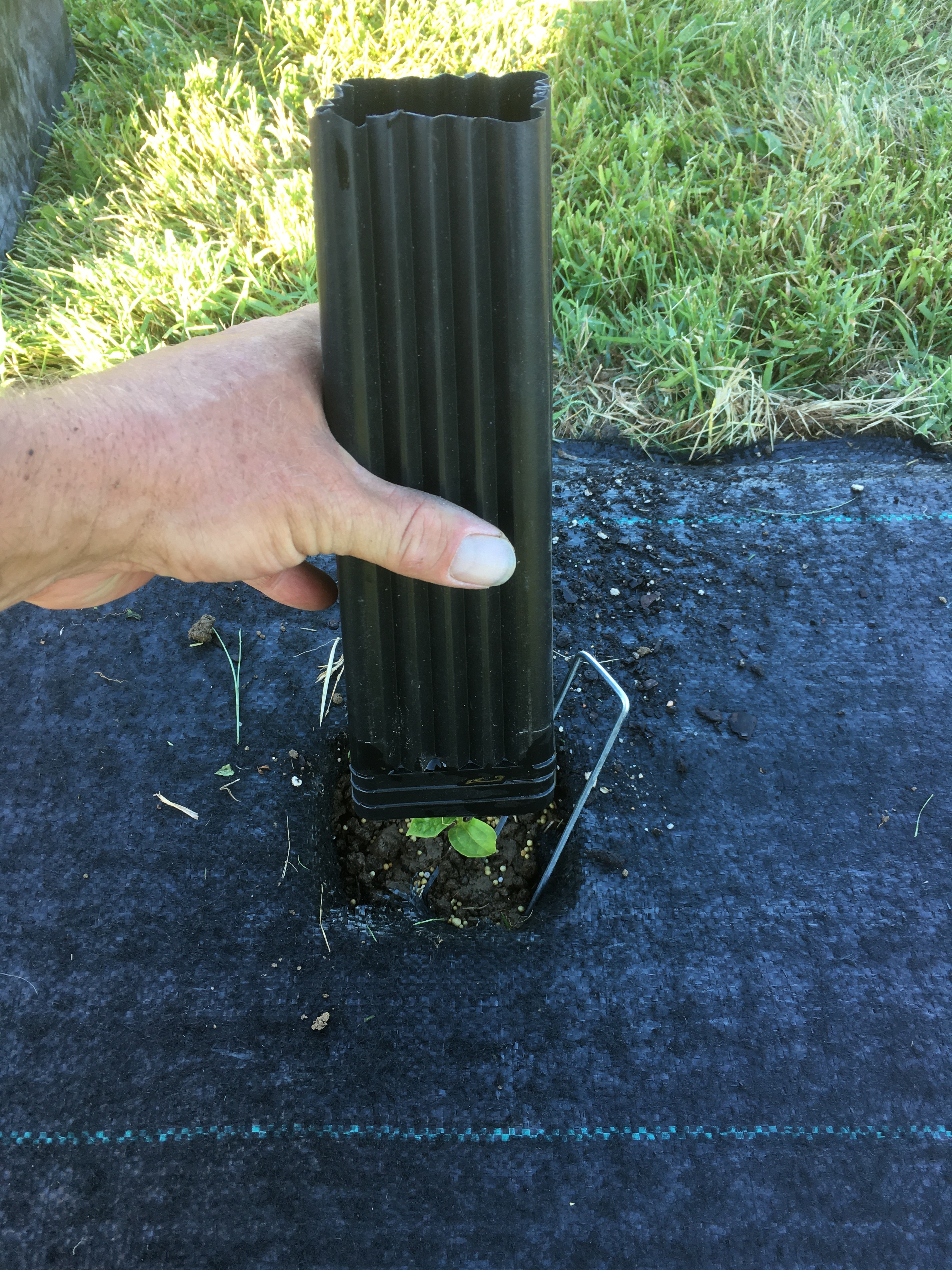
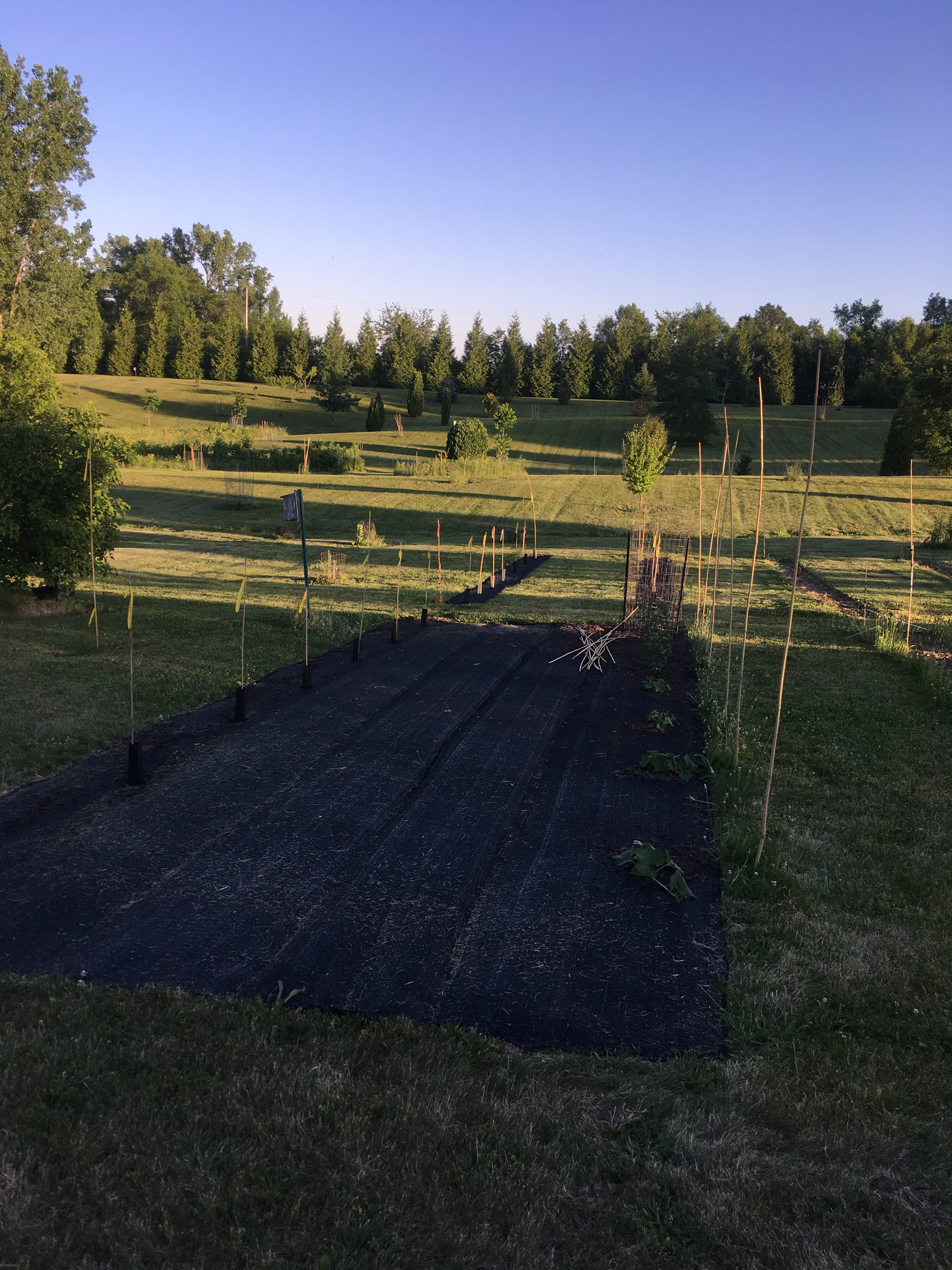
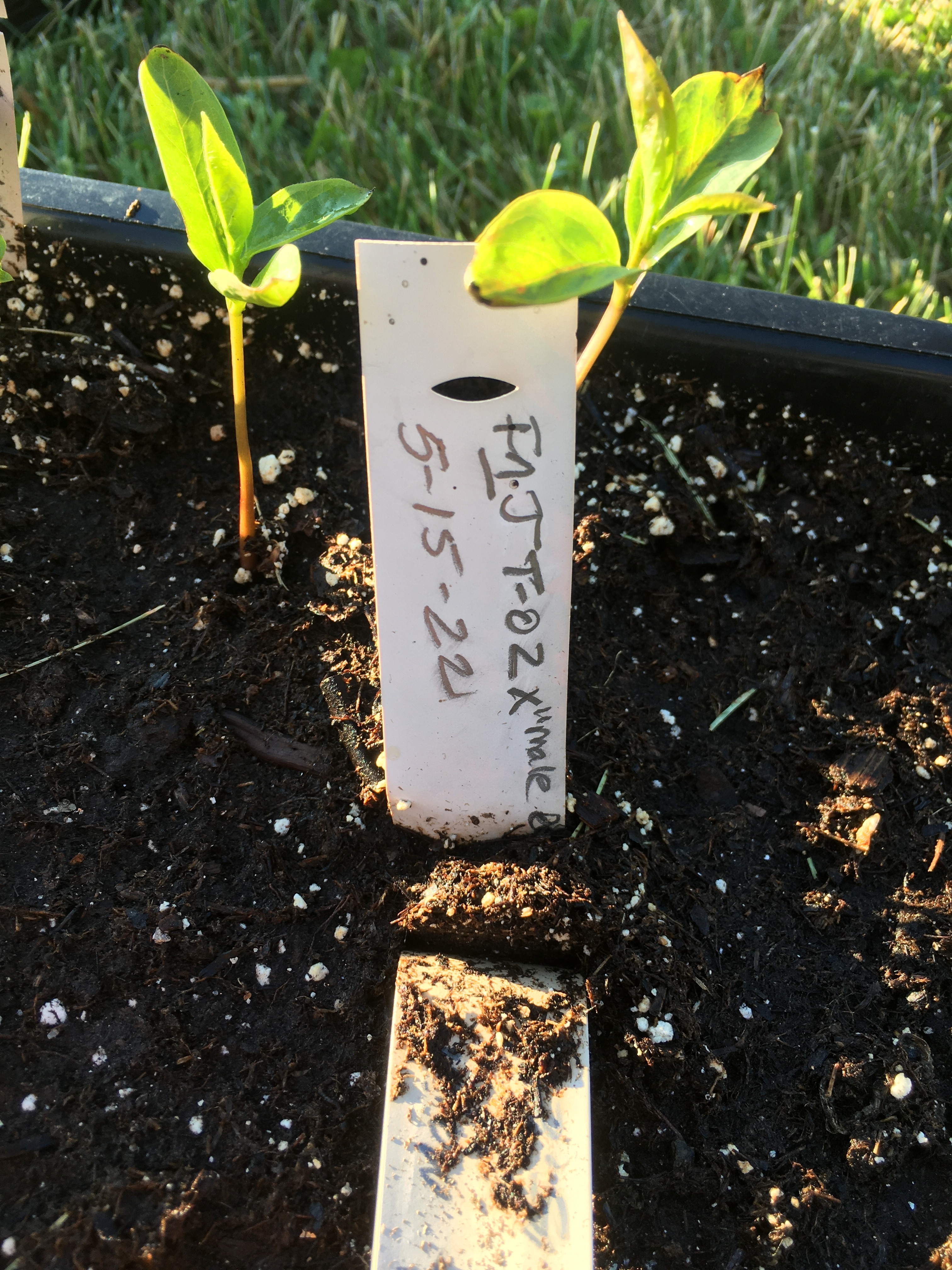
(7) JT-02 xRosseymale I planted tonite and I have two rows of an American persimmon seed source that makes really big fruit and wonderful taste to evaluate. All males (unless I keep something for breeding) will be eliminated.
Left Row Beardstown American persimmon Right Row JT-02 xRosseymale