
I mean sky writing works, its just not somethign thats done at scale.
Yeah, I don’t think it’s done at scale. Russia is pretty open about doing it during major events though.
Trees grow off of CO2, trees turn sunlight into growth, not heat, and increase humidity levels, holding more heat (energy) in the atmosphere even at the same temperature , so burning fossil fuels is not expected to be a reliable way to raise temperatures of Earth, humidity, perhaps.
But HAARP, check it out.
But thanks for your comment and explaining your thoughts well, I’m happy to understand where others are coming from.
Ha- yes I know trees don’t photosynthesize heat- that would be cool though. I was saying that large actions require large amounts of energy which is expensive. HAARP, I’m doubtful that would impact weather, how would that even work? I just looked it up, and ya they spent a suspiciously large amount of money on the project. It must have been a bust for the military because it is run by a public school now, you don’t need any security clearance to work on it and I guess you can work on it as a summer school student, but enrollment for was due by April 30, 2026 for the 2026 summer program, so there is always next year  .
.
When sunlight strikes a leaf what happens?
When sunlight strikes a rock what happens?
Nailed it. We’re soft, and a culture of people that once took courage in their grit have become weak and full of complaints about things unchangeable by them like the weather, because of the affluence we’ve lived in since 1940. It only takes one generation to lose the grit, we’re going on three. I appreciate the heat. The corn absolutely loves it, the peppers too, the Southern peas, the pumpkins. And it makes the cold of winter more welcome when it arrives. We built our home without central heat and AC in Kentucky. I pay pretty close attention to the heat and cold. The last 3 or four years its been like clockwork. 3 total hot weeks in July, 3 total bitter cold in January, not necessarily in a row, usually separate cold/hot snaps. The rest is mild.
Btw I’m not saying that remarking on the heat or cold makes you soft or a complainer. But to say we’re doomed because of the relatively predictable heat waves, speak for yourself. We’ll be alright here I’m sure. The world has survived worse
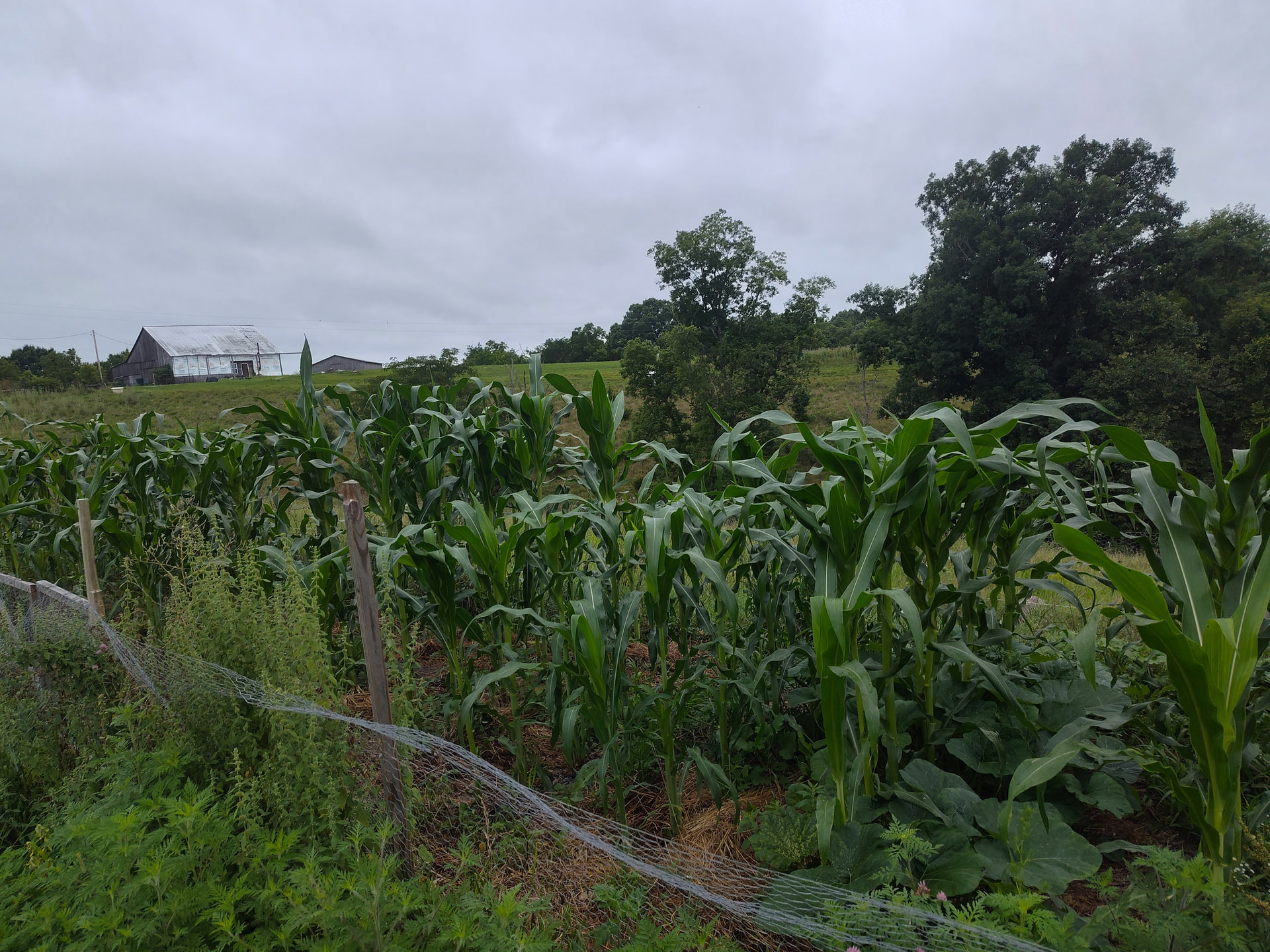
I say all that on the most pleasant morning I can remember in the last two months. Weather is lovely today
“Hard times create strong men. Strong men create good times. Good times create weak men. And, weak men create hard times.”
- G. Michael Hopf, Those Who Remain
I’m not sure what your getting at here - but I’ll bite. It has been a few decades since I’ve had to do this kina math so I’m going over simplify. When light hits something it generally drops some energy into the object and bounces off the rest. In the case of a leaf that energy (when the light hits a chlorophyll molecule anyway) goes into hydrolysis to split water and start a long chain of chemistry to store that energy as a carbohydrate. If the bounced off light doesn’t hit something it will head back into space. Residual energy left in the object hit eventually radiates as IR. So I’m going to go with light hits a leaf the energy is stored, light hits a rock it heats up… but it is way more complicated. lol- that is a C+ answer from a lazy C- student.
Exactly.
If light hits a rock it makes the Earth hotter.
If light hits a leaf, it makes the tree grow.
So trees prevent the sun from heating the Earth, and trees grow much much faster with every tiny increase in CO2 or NOx.
This goes against virtually all available scientific evidence. The increase in atmospheric CO₂ has been large, rapid, and is one of the best-measured changes in Earth’s atmosphere. As CO₂ concentrations increase, less infrared heat escapes directly to space, causing the Earth to warm.
That is a function of CO2. True. But the problem is that the current emissions of NOx are 13x more power a greenhouse gas than CO2, so it makes you wonder, why are they focused on CO2.
Another function of CO2 is increasing vegetative growth. And on this forum we (all?) know that greenhouses intentionally inject CO2 into them to their atmosphere to speed vegetative growth, the same happens on Earth, and I guarantee you that standing under a tree that’s twice as big, preventing all that soil from being dried out by the sun while having all that heat converted into growth as opposed to heat on the dry soil and rocks, and then all this small plants dying off because of the springs drying up is going to make a hotter Earth, and that’s exactly what the researchers have found.
Not here they’re even saying the Earth greening more, might be a bad thing! They’re in an antibiotic CO2 cult and I don’t understand how it got so bad:
Any time infrared light bounces off of objects on earth’s surface, that light heads back out towards space. CO₂ is considered a greenhouse gas because, instead of allowing the infrared light through the atmosphere back into space, it traps it. Therefore, CO₂ and other greenhouse gases like methane trap heat in our atmosphere. This is the entire basis of the greenhouse effect.
I don’t expect I’ll convince you, though. I’m just hoping that other people reading this gain a better understanding for how CO₂, lots of which comes from burning fossil fuels, causes climate change.
CO₂ can do two things at once: it can stimulate plant growth and act as a greenhouse gas. Those effects aren’t mutually exclusive.
It’s like adding fertilizer to the plants inside a greenhouse while also making the glass better at trapping heat. The plants may grow larger and provide more shade, but the greenhouse still retains more heat.
Additional vegetation does cool local areas and absorbs some CO₂, but it doesn’t offset the fact that higher atmospheric CO₂ reduces the amount of infrared heat that escapes to space, causing the Earth to warm.
Nitrous oxide (N₂O) is a much more potent greenhouse gas than CO₂ on a per-mass basis. However, CO₂ receives more attention because humans emit vastly larger amounts of it, it persists in the climate system for much longer, and it contributes the largest share of long-term human-caused warming.
Also the amount injected into greenhouses is like 3 times the amount we have in the air. That amount in the air would make parts of the planet too hot to photosynthesize.
I might be misreading this but it looks like the diagram shows the opposite of the title, that the wet areas are getting wetter and greener. I can’t get at the actual research, but it would make more sense that hotter temps mean more severe weather and greener jungles.
Found the study Elevated CO2 as a driver of global dryland greening | Scientific Reports
Basically it says more CO2 means the plants can close thier stomata and use less water thus the soil stays moister, but not enough to survive the increased temperatures cause by increased co2 in some areas.
- In the near-infrared (0.7–1.4 µm), healthy vegetation reflects up to 50-60%, but bare rock reflectance can range from <10% for dark basalts to >40-50% for light-colored granites or limestones, depending heavily on the specific wavelength chosen.
Healthy plants reflect more than stone too, more cooling effects of more greenery.
I didn’t even ask for that I was just looking for the percentage of infrared that was reflected and I found that gem.
elevated carbon dioxide significantly enhanced soil water levels in drylands more so than it did in non-drylands, with soil water content increasing by 9 percent in non-drylands compared to 17 percent in drylands
This happens because the canopies protect the soil and then the water slows its evaporation.
The Earth is more covered in greenery than ever in recorded history, despite all the cutting.