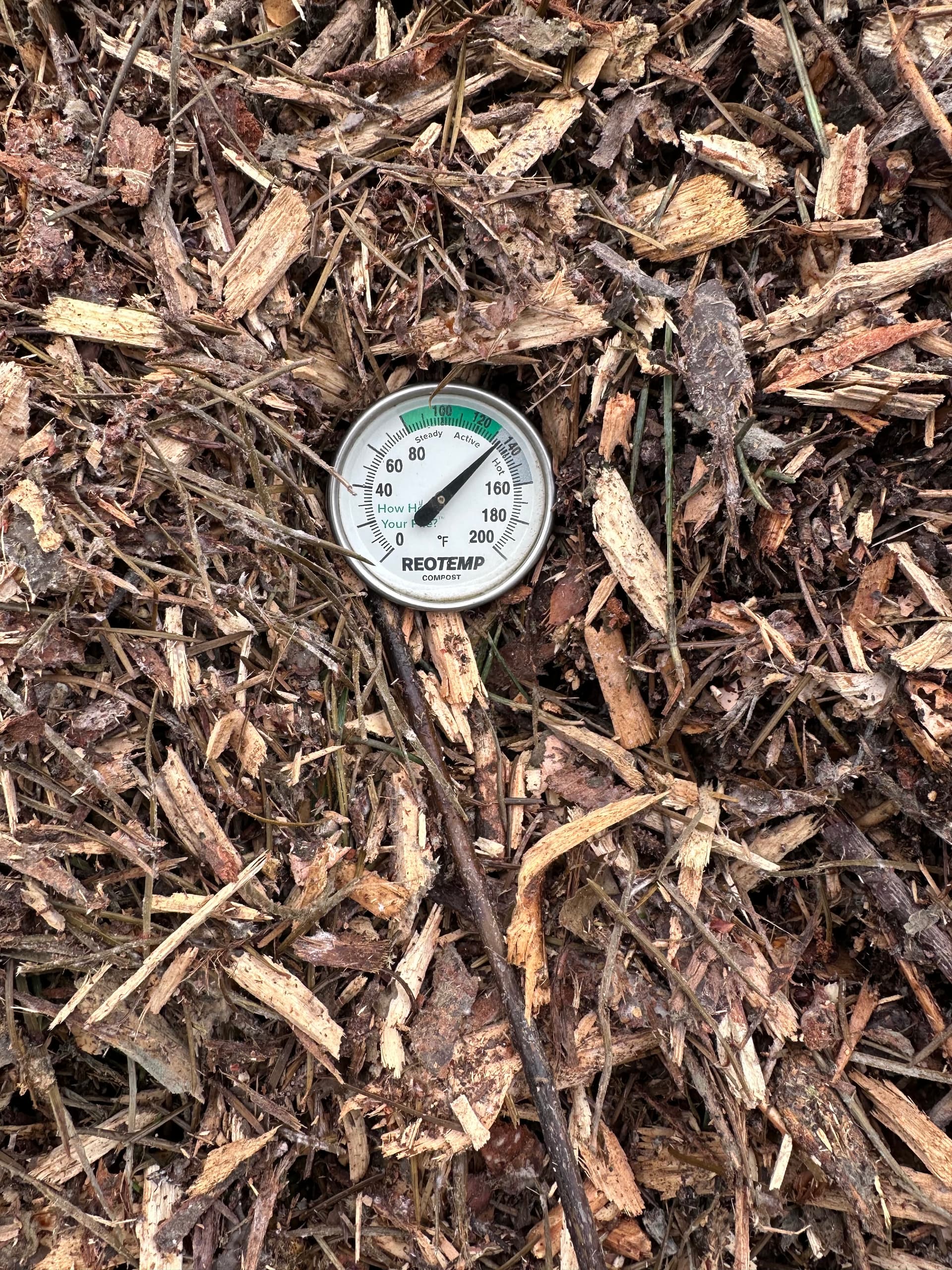
That’s interesting about cowpeas, and it sounds like it is working well.
Thanks for the information on bacteria and nitrogens too, I haven’t visited that subject in over a decade. Out here water-soluble urea salts are in good supply with factories just north of us in L.A. county.
1 Like
Honestly this is useful when you are doing it by the acre. You get a cover crop and a significant amount of nitrogen because one acre is 43560 square feet. A compost pile that is what, 25 square feet? The amount would be quite insignificant. You could piss on the pile for a day and end up adding more nitrogen.
I actually did the math; a heavy crop of alfalfa, one of the highest nitrogen fixers, would take an entire grow season to deposit 1.34 grams of nitrogen per square foot. Most others would be less than half of that. The average daily load of nitrogen in a person’s urine is 12~20 grams.
Heck a mixed gallon of Miracle-gro contains a measly 1.512 grams of nitrogen. The average daily urine is about 1 liter (800~1,200ml), diluted 5:1 with water is more than a gallon, and still contains 12~20 grams of nitrogen.
3 Likes
Actually it is both Nitrogen & fungi.
Abd the process doesn’t require roots.
Just require sugar or starch.
Bacteria use FeMo-Cofactor enzyme primarily.
There is multiple different variations of FeMo-Cofactor.
The primarily enzyme has Iron, Sulfur & Molybdenum.
There is a version with only Iron & Sulfur, no Molybdenum.
A version with Vanadium substitution for the Molybdenum.
A version with Cobalt substitution for 1 Iron.
One with both substitutions.
In fungi & yeast it is Nickel enzymes which fix nitrogen & alter Nitrogen States creating Urea & other Nitrogen chemicals.
I got a dump of Woodchips from the utility company who were trimming trees in my neighborhood, its a mix of conifer and whatever deciduous trees people grow in front of their house.
It was sitting for a week heating up on its own. I spread anywhere between 4 to 6 inches of it around my yard. Would applying some urea or fish emulsion to speedup the decomposition significantly?
I’m not proud. I use Urea. Fires right up into a hot pile.
A pile of wood chips like that continues to be an N sink for quite a while after it cools down. I’ve taken to pouring a bucket of water and urea diluted to animal urine strength on it every week or two until use.
1 Like
Manure, grass clippings…
I have a 2 year old pile of roadside brush chip… that has had nothing added to it…but rain… and it is over 50% compost now.
If you can just wait 3 or 4 years should get there on its on.
1 Like
It’s not in a pile anymore, I spread it on the ground under the trees. I am thinking to water in some fish emulsion if that doesn’t work, I will go with Urea.
I spread it in yesterday it was sitting on our front lawn and cooking slowly.
Sure. Then you play it by ear as you almost always can with N. You might be surprised at how much gets diverted to the wood chips.
1 Like
that’s my worry, where the trees are deficient at the peak of growing season, never done Woodchips mulch.
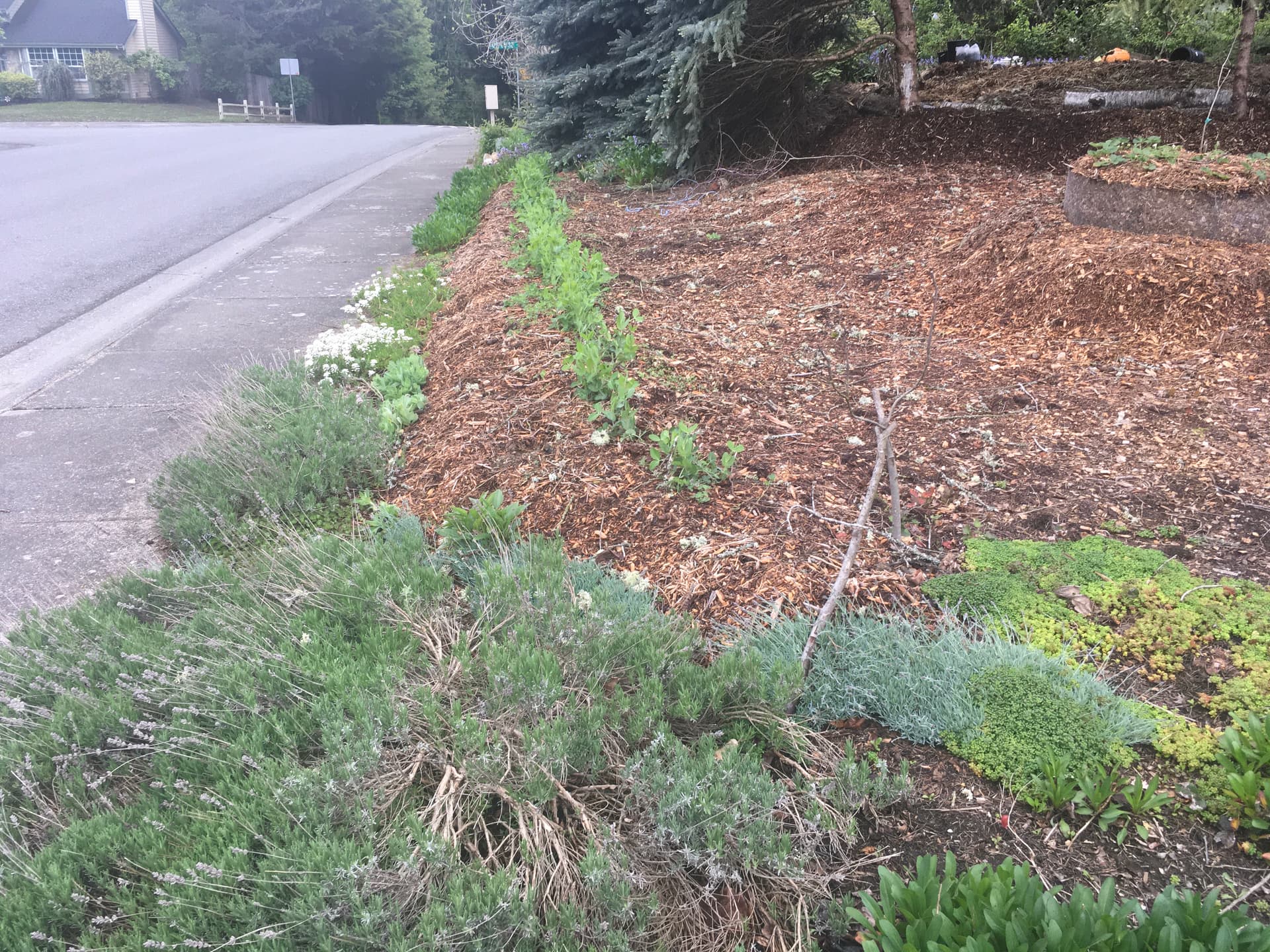
Maybe consider creating Hugel kulture piles, and planting legume plants around the pile to pull in free nitrogen to feed the bacteria that are busy breaking down the woodchips. From your statement I assume you have a good source of woodchips, so burying them each year in a windrow fashion and seeding down the area above the Hugel pile is a way of accelerating the woodchip breakdown process. The process works faster if you provide the N2 and sufficient moisture. Burying the woodchips helps prevent desiccation and keeps the pile moist enough for Bacteria to work efficiently. Below is a pic of my recently created Hugel pile.
You may be able to tell in my pic that the elevation of the soil is no longer the same as the sidewalk. That’s because last year I cut down several dead hardwood trees, and buried them adjacent to to the sidewalk. The logs were about 10-12” diameter, so I imported some aged woodchips that were virtually white with micorrhizae to fill in all the void spaces between the larger pieces of wood. I then pulled a very thin layer of the soil from the pit back to cover the pile. This February I sowed the snow peas and red clover over the soil, raked it in and covered that with about 2-3” of woodchips. So this pile of decaying wood has collected the winter moisture and is prime for bacterial action. This growing season the legumes will provide the Nitrogen to fuel the process. This fall I will plant a row of plum trees about 4’ away from the sidewalk at the uphill edge of the Hugel pile so the pile will become the source of nutrients for my trees. As I plant each tree I will innoculate the roots with the same micorrhizae to speed up the formation of a symbiotic relationship with my Hugel pile.
Dennis
Kent, Wa
2 Likes
i always hit up the arborist for a load in late June so the trees have fresh full leaf growth. that helps the pile break down much quicker than when there isnt any leaves in there.
Dennis, looks like a great idea. Those chips were dropped by the utility company trimming trees on my street, a mix of conifer and other yard trees. I can’t do a full scale hugelkulture bed, for now I have spread them 4" to 6".
Is the aged Woodchips mean partially composted?
My main source piles are road crew chips which tend to accumulate during winter months primarily due to storm cleanup. I always go to the aged pile for several reasons:
- It has the longest contact with the native soil where micorrhizae already exist due to nearby cottonwood trees that have a symbiotic relationship with the older pile.
- Due to aging the micorrhizae have already penetrated most of the pile so when I collect it the chips near the soil are already turning white with white strands coursing into all directions, much like you would see in the middle of a forrest.
So yes age does make a difference, but if I bring in the new chips to cover the aged ones, then the older ones innoculate the new ones. These are fairly mixed hardwood and conifer chips, but there is enough of the smaller branches mixed in that the tannins are not too objectionable. Each year I call the city and county road departments near me to discover any new piles they may be starting.
Dennis
2 Likes
With frequent turning to help with aeration, plenty of rain, and a good dose of N fertilizer every now and then, I suspect it wouldn’t take nearly as long.
In that case, it will take a while to degrade. Spread over the soil like that the chips will mostly remain dry. No amount of urea or other fertilizer will help with that. Additionally, the sunlight will severely restrict fungi from growing.
Mixed into the soil it would rot faster, but then your trees would be robbed of nitrogen. Woodchip mulch on top of the soil won’t cause that problem, but it also don’t rot very quickly.
My impression is that hugelkulture stuff is primarily suited to a very specific climate and soil range. Heavy soils and cool, wet climates specifically. I don’t know where the OP is, but in my area, hugelkulture is usually a really, really bad idea. The kinds of trees common in the region also matter. If your trees are mostly white pines, spruce, fir, poplar, aspen, alder, and other highly degradable woods low in heartwood extractives, then you are pretty safe. But areas with lots of oaks, cypress, redcedars, old southern yellow pine, black walnut, and similar woods run a much higher risk of the buried wood either not degrading within any reasonable timeframe, leeching chemicals that burn the plants growing in the bed, or both. And for some species, such as sweetgum, there’s the risk of the logs simply sprouting and growing a new tree. Ask me how I know…
isn’t it the chips at the bottom touching the soil will decompose and probably the top an inch or so will stay intact because they are exposed to the sun.
Yes. It’s just slower than if they were in a pile where most of the chips would stay moist.
But that might be just what you want. Depends on your goals.
I would rather have it decomposed, but I can’t leave the pile sitting on the front lawn. I was thinking about spraying fish emulsion and inoculating with some sort of mushrooms on the chips that have been already spread.
1 Like
Hard to say if the fish emulsion would help if the woodchips are not in a pile. Maybe? But I feel like if they’re only a few inches thick, the fertilizer will wash out pretty quick.
Mushrooms would probably speed it up. I’ve seen people talk about winecaps in particular making short work of woodchip mulch.
1 Like
i keep my compost piles covered with a old black tarp that has some small holes in it. it keeps in moisture well and allows some to come it. i pull it back to wet it with urine occasionally then cover it back. i find its the fastest way to I’ve found to compost in the north.
1 Like
I do urea on the piled chips - but I use winecap spores on the spread chips. they’re about 6 to 9 inches deep round about, I lay the winecap spawn underneath on the dirt then load the chips on top. I got about 10 or 15 lbs of mushrooms last year and the chips are broke down mostly. I’ll probably get another bigger chip drop next year, and scavenge from other people’s “too much” drops this year.
2 Likes