I’ve seen meyer lemons endure temps down to 17 F with absolutely no damage. In Sonoma County about 10 years ago we had back to back nights at 17 for several hours and the citrus were, by and large, not damaged. In the area we mostly grow navel, kumquat, oro blanco grapefruit, satsuma mandarin, and meyer lemon. In all the years with many nights below 25 and a handful of nights in the teens these trees all did well all over the county with almost no damage. Avocados were a different story. While the trees all survived those nights into the high teens, they had significant leaf burn on the top of the canopy. But they all rebounded quite nicely and fruited that same year.
2 Likes
Prague can root but not easily, air layers seem to work way better! I stuck a prague cutting in coir and it never put roots out after a whole year, but it also didn’t dry up. It had calloused so I think the callous part was acting as a root and taking up moisture. I ended up grafting the stick to my outdoor TaiTri and it started to grow after the graft took
3 Likes
You grow your Prague outside fully unprotected in zone 7a? That’s quite impressive for a citrus. Are there any other citrus cultivars you grow outside unprotected in your zone? Do you
Get any fruit from the citrus trees that grow unprotected? I’ve found that all the citrus fruit I grow can endure freezing temps down to 25 for many hours before any risk.
1 Like
I am growing in zone 7a unprotected Standard poncirus, Fast Flowering Poncirus, Poncirus+ (“improved” poncirus without bitter notes), Prague Chimera, Taitri (Taiwanica x Poncirus), Swingle Citrumelo, Morton Citrange (least hardy), Thomasville Citrangequat (borderline hardy), and Bishop Citrandarin. All have survived. Only the Fast Flowering Poncirus has fruited. The Prague has flowered so far, no fruit yet.
2 Likes
Do you have a YT channel?
1 Like
I do, video of the plants I mentioned:

1 Like
First time I’ve heard of poncirus +. Is it supposed to be less nasty tasting than regular poncirus? I’ve tried eating flying dragon and it just wasn’t happening for me. Though I keep it for its gorgeous habit and endless supply of seeds to grow rootstock.
Have you ever tried any of the citrange like Morton or Carrizo?
Is the Morton citrumelo similar to the dunstan grapefruit? A hybrid of trifoliata and a commercial grapefruit?
1 Like
Yeah Ive seen your videos, kinda sounded familiar. Good job keep it up!
1 Like
Yes exactly, poncirus+ lacks the bitter resins. I have yet to try the fruit but others have confirmed. I don’t mind the taste of flying dragon or pure poncirus, it could be my tongue doesn’t detect the off flavors, to me they both taste like very acidic lemons I don’t notice the bitter either, though I have not tried to eat the membranes or the rind.
My containerized Morton is holding a fruit which I hope to get to maturity and try it for the first time. My outdoor graft has not yet flowered, it’s said the fruit is closer in taste to an unripe orange and “almost edible” than it is to a grapefruit
2 Likes
I haven’t tasted poncirus+ yet as I only recently started growing it, but I will say it’s a vigorous one, easy to start from cuttings too, for a citrus anyway.
Everything I’ve seen about Prague indicates that the fruit is great, the plant hardy, and the ripening time ok if you’re in the South, but that the plant is anemic, ragged looking, and unproductive. So it’s a great curiosity and novelty plant, but not something you’d count on for a great harvest. My own “Trifoliate Satsuma” from Madison Citrus Nursery, which I believe is what some people call the Leningrad citsuma, may be a chimera (though I kinda suspect it’s a hybrid), has also been extremely slow growing and is just as ugly as they come. Compared to poncirus+ (to say nothing of Dunstan, Taiwanica, or US-802, my fastest growers) it’s absolutely glacial and hideous.
7 Likes
@a_Vivaldi @vnomonee poncerous+ and trifolate satsuma sound interesting! I might would be interested in a scion trade one day! And for sure fruut taste and ripening time reports/comparrison.
My prague plants have done better if i start out with bigger trifoliate rootstock. I have not done a fair test, since mine are potted. And kansas is not Carolina.
It is slower growing than trifoliate, or satsuma, or Thomasville, or kumquat. And is ragged and sometimes shoots s groe limb straight down, instead of up, sort of like it is confused.
But, compared to meyer lemon, it is not that bad. Meyer also is thinner and slower.
I imagine a bigger pot and some chicken manure, would help. I just have too much stuff…
5 Likes
Yeah, if my poncirus+ keeps getting like it has, I’ll have some scion wood to spare next year. I’m on the lookout in particular for US-1279 and either US-1281 or 82 but I’m open to other cool stuff (I’ve actually got some US-1279, but the two tiny pieces that I grafted six months ago still haven’t done anything. Still green, but no growth whatsoever).
That’s interesting about Meyer. Mine did absolutely nothing last year after I planted it. In spring it bloomed a decent amount and grew a little. The two fruits it set were dropped during our drought in June. But then in July it simply exploded with growth.


2 Likes
My grafts of Prague from earlier this summer seem to have finished growing for the season. It’s funny how all three grafts have this kinda tortured looking, weeping form. I can see what people mean about it not having the most attractive growth habit. Now, to hope such young grafts make it through their first winter OK.

9 Likes
How did your Prague do over winter?
1 Like
Unfortunately this dude left the forum. I think he’s still active on Tropical Fruit Forum.
4 Likes
Any news on prague citsuma ?
This information is worth while watching. See 2:22 on the second video.
https://youtu.be/bAVid6H5ZLc?si=cnlWzDWH12YK9qXg
Some things worth noting . The fruit looks excellent
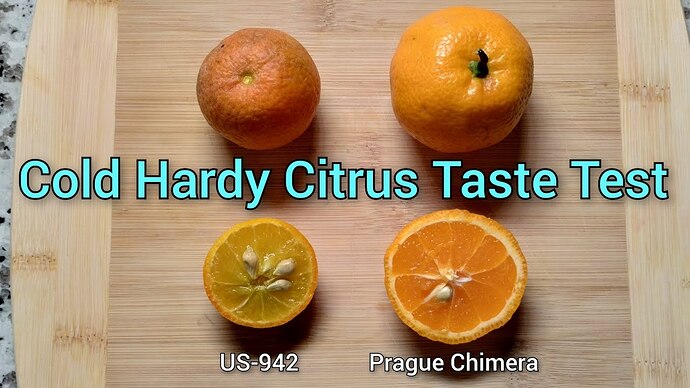
The tree does have a bad habit of dropping fruit. That means at least up until the last we knew it was a shy producer.
2 Likes
US 1281 is available now at Madison.
Five_New_Citrus_Rootstocks_with_Improved_Tolerance.pdf (60.3 KB)
'“UNITED STATES DEPARTMENT OF AGRICULTURE
Agricultural Research Service
Washington, D.C.
RELEASE OF US-1281, Citrus Rootstock
The Agricultural Research Service, U.S. Department of Agriculture hereby releases to
nurserymen and growers the US-1281 citrus rootstock. This rootstock selection originated from
a 1995 cross of Cleopatra mandarin (Citrus reticulata) x Gotha Road #6 Trifoliate Orange
(Poncirustrifoliata) made at the A.H. Whitmore Foundation Farm by Dr. Kim D. Bowman of the
USDA, ARS, USHRL, Florida. Field testing ofUS-1281 was planned and conducted by Dr.
Kim Bowman, in collaboration with or support from industry partners, including Florida Citrus
Research Foundation, Florida Citrus Production Research Advisory Council, Florida Citrus
Research and Development Foundation, and Mid-Florida Citrus Foundation. Dr. Greg
McCollum (also of USDA, ARS, USHRL) collaborated in the evaluation of fruit quality from
field trials. During field testing, this hybrid rootstock was identified by code numbers BS95-V5-
10 or US-1281. The major positive attributes of this new rootstock are induction of superior fruit
productivity and fruit quality on sweet orange trees grown in the Florida flatwoods and infected
with Candidatus Liberibacter asiaticus (Las), the causal agent of huanglongbing (HLB). This
rootstock is being released for commercial use in Florida because of the urgent need for new
citrus rootstocksthat have improved tolerance to HLB.
Field testing of the US-1281 rootstock has been primarily at two locations and with ‘Hamlin’
sweet orange scion. The longest field test involving this rootstock is a replicated trial in St.
Lucie County Florida at the USHRL research farm in Ft. Pierce. The site is typical Florida
flatwoods with a soil characterized as Riviera fine sand, and trees were planted in double row
beds at 3.0 m x 7.6 m spacing and irrigated by microjet. In this trial, seven ‘Hamlin’ sweet
orange trees on US-1281 were compared with a similar number of trees on 25 other rootstocks
planted in 2000 and using a randomized complete block statistical design. Trees in this trial
were damaged by hurricanes Frances and Jeanne in 2004, and both HLB and citrus canker
(Xanthomonas citri subsp. citri) began to affect the trees in 2007-8. Fruit production of ‘Hamlin’
on US-1281 in this trial was first measured in the 2006 and 2007 harvest seasons, before HLB
symptoms were widespread. During the 2006 and 2007 seasons, fruit production on US-1281
was numerically higher than production of trees on Swingle, the most common rootstock used in
Florida, but the difference was not statistically significant. In the following years, Las spread
rapidly throughout the trial, and overall tree health declined. From 2008 to 2012, cropping on all
rootstocks declined from the pre-Hl.B yields, but cropping on Swingle rootstock suffered more
dramatically than cropping on US-1281 and some other rootstocks. The average fruit production
during this period on US-1281 was measured at 2.2 times the fruit production on Swingle. As a
result of increased application of plant nutrients, overall tree health in the trial improved during
2012-14. In the 2013 harvest season, trees on US-1281 produced 52 kg fruit per tree, or about 66
percent of the annual crop produced on those trees during the 2006 and 2007 seasons (before
HLB impact). In comparison, trees on Swingle rootstock in the 2013 harvest season continued a
very low fruit production, yielding 19 kg fruit per tree, or about 17 percent the annual crop
produced on those trees during the 2006 and 2007 seasons. The significantly higher fruit
P.0079.14 Page 1 of3”
“Origin and Development
-
Parentage: Cleopatra mandarin (Citrus reticulata) × Gotha Road #6 trifoliate orange (Poncirus trifoliata).
-
Cross Year: Made in 1995 at the A.H. Whitmore Foundation Farm in Florida by Dr. Kim D. Bowman.
-
Field Codes: Tested originally under selection codes BS95-V5-10 or US-1281. [1]
Key Horticultural Traits
-
Disease Tolerance: Shows superior fruit production and quality after infection with Candidatus Liberibacter asiaticus, the causal agent of huanglongbing (HLB or citrus greening disease).
-
Growth Habit: Produces a medium-sized tree when grafted with commercial scions like sweet orange.
-
Soil Adaptation: Well-suited for the flatwoods soils found in regions like the Florida east coast.
-
Propagation: Readily propagated via semi-hardwood cuttings on a mist bench rather than standard seed. [1]”
2 Likes
Here’s a video on the Prague chimera that is interesting.
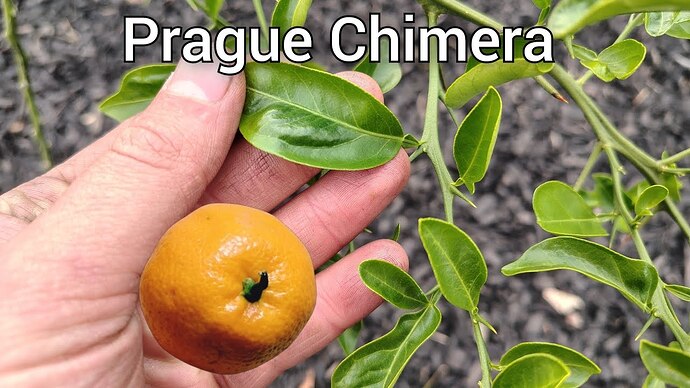
It’s a bummer that the fact that if it gets too cold it won’t produce a crop, which that means regardless if I could make a trifoliate chimera that could ripen fruit before it gets too cold, the average winter here would still damage the mandarin part of the chimera where there wouldn’t be any crop even if it can survive the winters here.
3 Likes
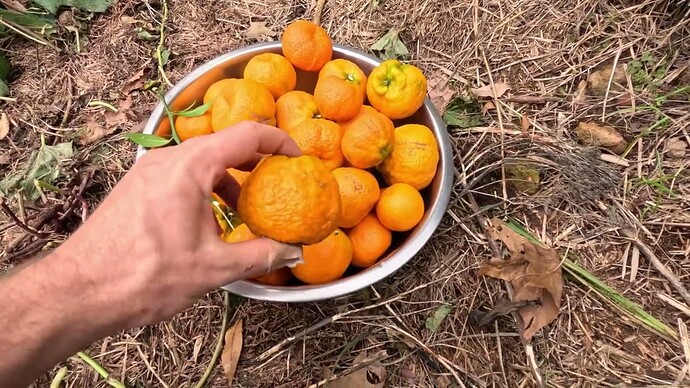
We will have to continue to try to determine what the situation is. I think it’s possible the exact opposite could happen with the next generation. One more video of Prague.
1 Like
Well, it’s a chimera, so it’s not really useful for breeding, because the seeds from the fruit would be full mandarin or full trifoliate.
If I remember correctly, I think the prague has been reported to be able to take -10°f, and at about 8 minutes in the the video he mentions that when it get down to zero and below the tree has the tendency to start reverting back to the trifoliate at increasing levels corresponding to how cold it gets.
3 Likes