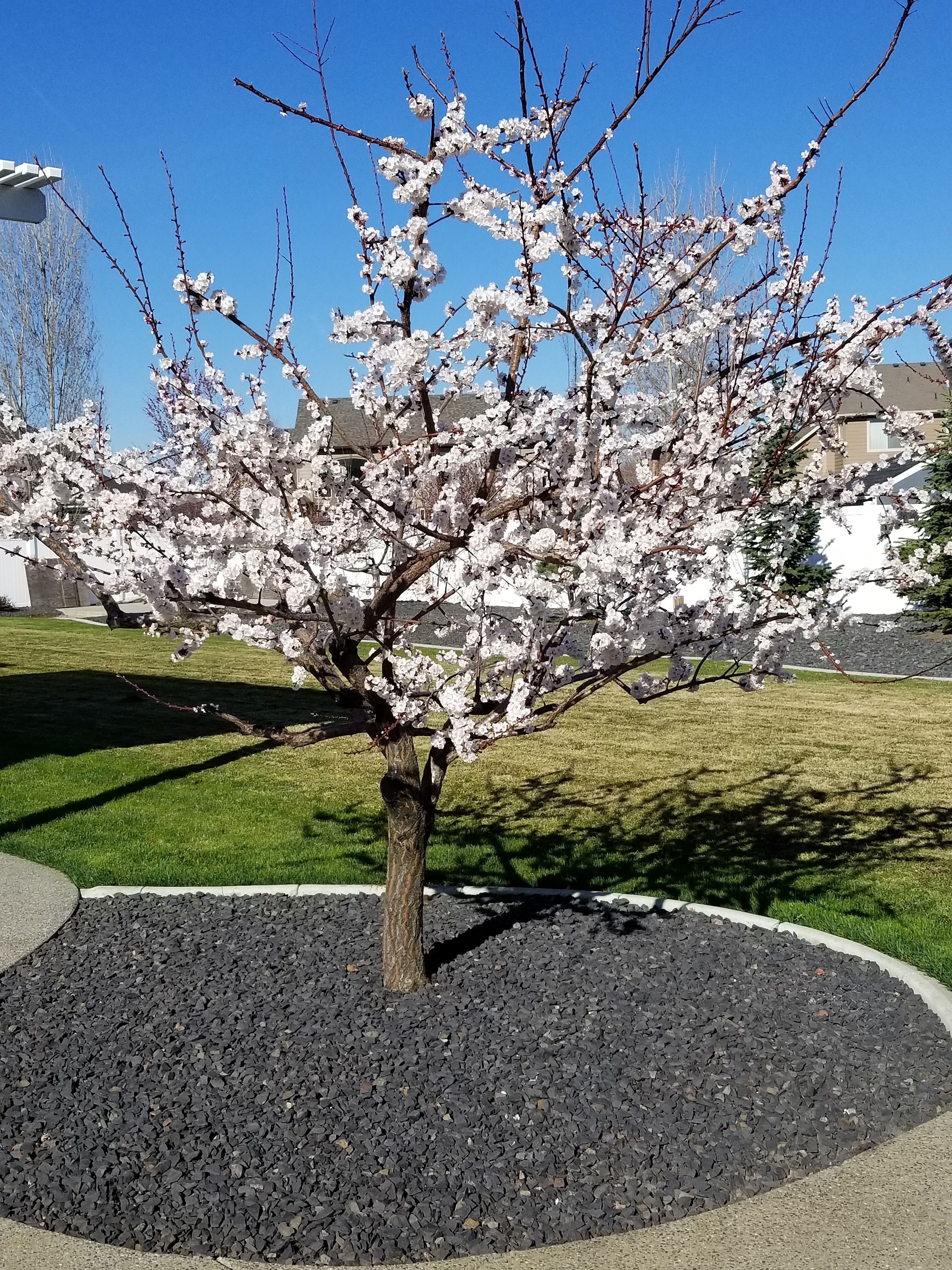
I too have been pruning my apricots in summer after fruit harvest for the same reason Ahmad cites above. Canker can be really rough here and summer pruning is way less risky. Additionally I hit them with fertilizer after harvest and pruning. The cots are done so early, I can give them a boost after harvest unlike the late ripening fruit. Like Ahmad, I get a lot of bud rich growth this way and typically get a lot of blossoms. Here’s a pic from a few years ago:
4 Likes
I’m curious Sean, do you have another apricot for pollination of your CWB?
1 Like
Thank you Ahmad. If you were correct in the relative seriousness of this disease, I’m guessing that a search of it with Cornell at the end would bring up several articles about it, and it doesn’t.
There is research and there is professorial advice gathered from that research. A lot can happen in the translation. Especially when the professor lives in New Zealand. The info of the first link was copied from an article written there. How it ended up in a UMass publication to advise growers in the NE is an interesting question. The answer might support your view on the disease and it might not.
There was some of what I read as recs in that first link (as far as I’ve gotten) that seem strange to me and not something I’m aware of any commercial grower doing, including the suggestion of using “pruning paste” for each pruning cut… huh? As if pruning isn’t already expensive enough for commercial growers- and also suggesting that late summer-autumn nitrogen can cause rank growth, which it certainly doesn’t after Aug. You can’t stimulate growth with N once the sun recedes to a certain point- trees store it in the buds for the following year. I have read this but also know it from years of experience- I give trees a dose of quick release N before the first predicted rain in Sept. I would imagine that N growth response could have different timing in New Zealand.
So I still am not sure how serious this disease is in the northeast, but I strongly suspect you have an exaggerated sense of it’s seriousness in our region.
Incidentally, most of the information used by commercial growers in the NE comes from Cornell. I believe NYS grows a lot more fruit commercially than the rest of New England combined. Only Rutgers works from a similar budget in this region and Rutgers is considered a source primarily for mid-Atlantic growers. Not that there isn’t plenty of overlap.
Much of what U.Mass publishes for commercial growers comes straight from Cornell, but not the article you linked.
The main canker problem in NY appears to be fungal. Scaffolds 5/21/01| disease
1 Like
I have already suffered loss from canker (don’t know whether it was bacterial or fungal) which makes it serious enough for me. Whether it is bacterial or fungal, infections can happen from open pruning wounds, specially in wet weather, and hence summer pruning makes perfect sense to me, specially that it stimulates fruit bud formation and I am not getting any significant winter die back from it.
As you mentioned earlier, apricots are very insignificant commercially in the NE, and actually all over the US except California. Hence the lack of information from Cornell and Rutgers on them. Even plums and cherries are dwarfed by apples, peaches, berries and pears in most of USA, so I would not expect too much research or publications on them.
1 Like
The canker issues of importance that I witness come directly from freezer injury to the trunk, not from pruning wounds on branches. Most apricot death is weather related in the NE and not at all related to pruning, IMO.
Of course, it is impossible to know what conditions render apricots vulnerable to winter or spring cambium kill. What we do know is that they tend to be tougher in the west where it is drier, including in the high deserts of New Mexico, where rapid dips in temps are common and rather extreme at times.
I’m guessing that when the cambium cells are bloated with water they are more likely to burst from freezing and in the east coast the cells have more difficulty in hardening off- that is shuttling water from vulnerable cells.
2 Likes
Beautiful! That’s the kind of flowering I’d like to get going  Yes, it’s actually quite helpful. Thanks! From looking at your leafed out CWB and comparing to mine, I can see there is quite a bit more sunlight and space between the main scaffolds in your tree. So it’s confirming to me that I think I’m trying to get away with too much tree - and not enough space between branches.
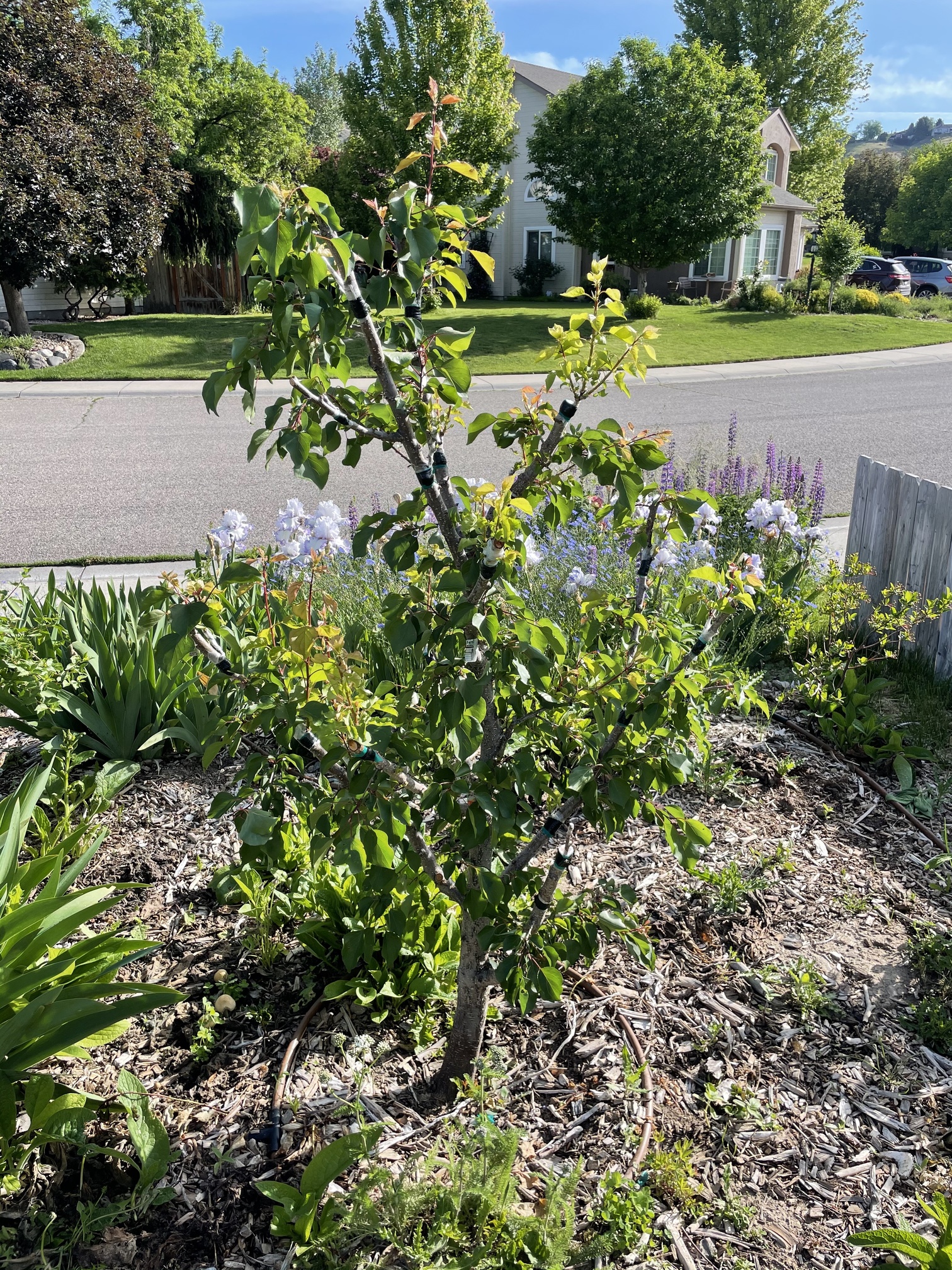
This is my pollinator - cut back to stubs as I grafted it over this year from Chinese to Hoyt Montrose/Zard/Tomcot/Hunza. I don’t know if the grafts will grow enough this year to make flowers next year though. Through omission of first year cuts I ended up training it to a delayed open center, also called the Western Whisk in our house, which I thought I would hate but I actually have been pretty happy with. Growing it with 4 different varieties grafted may be a different story and maybe a total sacrifice of aesthetics - we will see.
2 Likes
Fantastic!
1 Like
That does seem logical. I do back off on water in the fall which seems to help encourage dormancy. I still battle canker though…
1 Like
But which kind… this has actually been fun now that I’m not worried that bacterial canker has become a big threat in the northeast.
1 Like
Honestly, I don’t know enough to determine which type of canker I am dealing with. The peaches show mild signs from time to time, but seem to shrug it off with no ill effects. My Sugar Pearls apricot is old and well established and hasn’t had an issue in many years. My younger CWB apricot seems pretty susceptible to canker. I lost a scaffold branch to it last spring and have another scaffold with signs of it this year.
Based on the descriptions. bacterial canker seems to often be fatal and is very contagious. I’m guessing your issue is fungal, but how can you tell canker from death by freezing? Freeze damage is considered an entry point, but how can you separate the consequences of the two?
The old saying is that a pathologist always finds their pathogen. It isn’t always clear if the pathogen is the real cause of a problem.
1 Like
Ahmad when you are suggesting heading these whips back 40-50% do you mean approximately cut
1 or 2 in this photo. Cut 1 would be into last years growth but I think that’s what you meant, and I can see how that makes sense. Thanks for your input.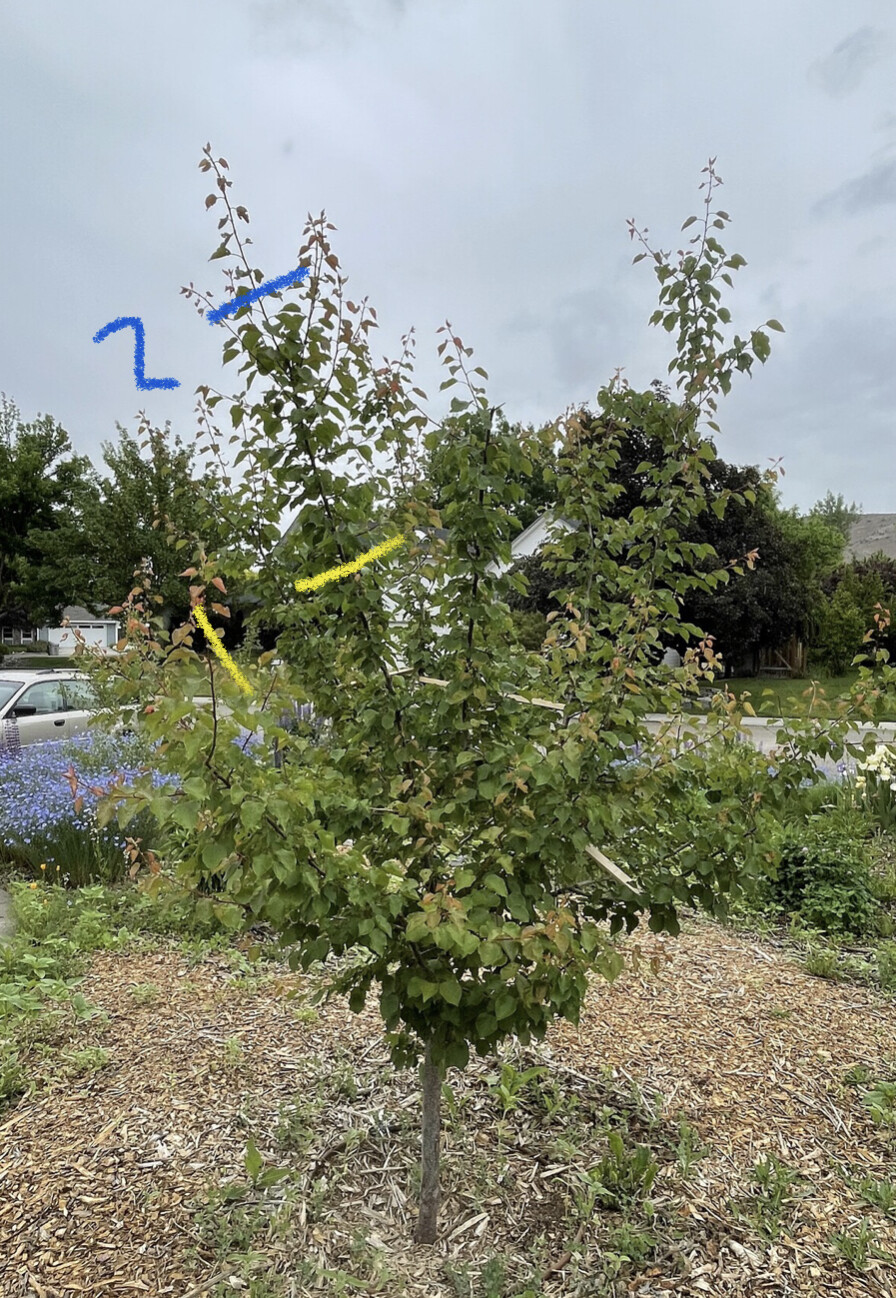
1 Like
I don’t usually cut in last year’s growth unless I am correcting a mistake, e.g. leaving branches to grow too long so they are not strong enough. The other reason could be renewing an older tree that’s getting to tall or two big. What I originally meant is to cut 50-60% (these numbers are not set in stone, it is a judgment based on how long the branches are and how you want to train your tree, so it can be more or less) of this year’s growth, but I would say you can try it on a couple of last year’s branches since they look quite lengthy to me.
3 Likes
Do you just head the current year growth?
Edit: Nvm, saw your latest reply. I wonder if this will work on Apriumns too.
It should work on Apriums, they are essentially apricots. I’d like to add that some trees/some years my approach didn’t produce a lot of fruiting buds. I am lately inclined to minimize summer pruning (and winter heading cuts) of cots and some other fruit types as pruning sometimes stimulate trees to get into vegetative growth and not produce enough fruit buds. I virtually left my fourth leaf Lasgerdi Mashhad cot with no pruning last year and this spring it has a ton of fruit buds/flowers. I will prune it immediately after harvest (except for a few thinning cuts earlier, to allow good sun), and that will be it for the season. I am taking this approach because the tree has already been well trained into open center, and have strong scaffolds.
Thanks.
I think Apricots are complicated because of varying fruiting habits. I was reading this paper and it seems like pruning has to be specific to a variety and knowledge of fruiting habit is essential.
this is the safest approach assuming the tree structure is in place. If you check FruitNut’s K1 experiment, left alone to grow the tree does its thing.
There isn’t much info on Aprium fruiting habits one has to just experiment for couple of years and see what will work which is time consuming because of overall Apricot challenges of growing outside California.
2 Likes