Yep, old gas burners could have starting problems too. Here most diesels (I’m talking tractors and heavy equipment) will start w/out assistance down to about 30F (or 25F if you crank them a while). Colder than that and they need some assistance (i.e. glow plugs, cold weather manifold heater, a small shot of ether, etc.) That’s my experience anyway, but I expect there is some variability in diesel engines. BTW, for the record, don’t use ether if the diesel has glow plugs, or a manifold heater, which can ignite the highly volatile ether at the wrong time and screw up the engine. In that case one can use WD-40 instead of ether (Just don’t spray it on the filter. Take the air filter out and spray it directly into the air chamber.)
I do remember the cars and tractors w/o injectors or automatic chokes (I’m really feeling old now- and not even that old.) Some were a pain to start in the cold and some not so bad. Generally, most of them would start down to 0F or a little colder w/out much problem w/ a pull of the choke and some cranking. But then they would flood easily too.
I remember the first time I rode in a car w/ fuel injection. A friend in the 80s had a Saab which had fuel injection and that thing would fire right up no matter how cold it was. I was amazed at the time. We don’t know how good we’ve got it, regarding our automobiles.
The other option for cold weather diesel starting is a block heater that you plug in. Many trucks come with one these days, and there are quite a few after market options for adding them. Some folks put them on a timer, so that they come on a few ours before you will be starting it. Another advantage to the heaters is that you’ll have heat right from the start.
Are you sure about this Olpea? I know it’s almost a universally held truth, but as a guy who earns his living involved with diesel repair and service I have to say, you couldn’t prove this by me. I think a lot of this belief stems from older, longer stroke, lower compression and lower rpm engines. Those have been extinct for years now. I think too, that folks hear about “over the road” trucks or locomotives with millions of miles on them and conclude that they last forever. Nothing could be further from the truth, because while it’s true they achieve this mileage, they have generally received boat loads of repair work in the interim.
For one thing, for a diesel engine to provide any real power it must be turbocharged, and turbos don’t last…they just don’t. They are also very expensive, in fact, diesel engines are monumentally more expensive than gasoline engines to maintain in every single way.
When diesel engines fail, they often break things internally, and while gasoline engines do that also they, do it FAR less often thanks to their usually much lower compression ratio.
Another common belief is that diesel engines have vastly greater torque than their gasoline counterparts, and while this IS generally true, it’s not true in all cases, especially with smaller, more modern diesels.
It IS true that diesels lend themselves well to heavy equipment and tractors. The typically heavier weight of a diesel is a benefit in this equipment, as is the lower rpm and usually higher torque.
What hasn’t been mentioned (unless I missed it) is fuel storage. Diesel is WAY easier to store safely than is gasoline. It also won’t go bad as quickly, though it too does go bad thanks to algae.
If I were buying a tractor, I wouldn’t be dissuaded from a diesel, but I wouldn’t be drawn that way in thinking it lasts longer or is easier to maintain. For the most part, a typical diesel tractor owner will not see or realize any benefit in this area imo. Diesel fuel also costs more, and depending on your location it can be significantly more.
Diesel engines, while very useful, most definitely are not all they’re cracked up to be.
Yeah…I heard about that. For the next few years new diesels will likely be a nightmare. Trying to achieve higher tier emission standards has proven to be very difficult. All the new diesels are having LOADS of trouble, regardless of who is building them. Our new diesels are pure junk.
When they are running though they are indeed clean as a whistle.
For some reason I thought you were an electrician. Not the first time I’ve found memory undependable.
I don’t think we have much disagreement. I have little experience w/ small diesel motors (i.e. automobles).
Like you, I do have some experience w/ diesels in tractors and heavy equipment (both personal and folks w/ diesel equipment).
I used to own a couple Oliver tractors (one diesel and one gas) and the diesel used much less fuel than the gas powered tractor, when running fixed PTO equipment (i.e. irrigation pump). As you point out, diesel costs more, but the cheaper cost in no way offset the efficiency gained in fuel efficiency from diesel. It wasn’t even close.
When I lived in AR, I knew a logger who ran both gas and diesel trucks. He said on very short runs, the gas burners could compete, but if the runs were very long at all, the diesels were much cheaper to run.
Again, this is probably things we agree on (big trucks/tractors).
In terms of longevity of engines, you mention turbos. I do know turbos have more problems. My understanding is turbos are much less forgiving when turning up the injectors (pumping more fuel through the engine). A trucker once told me putting too much fuel through a turboed engine will make the turbo hiss and eventually shell it.
I’ve never owned a turboed diesel. I prefer naturally aspirated diesels. They seem to go forever. I once owned a blown (i.e. supercharged) detroit diesel, and those things would, like a typical truck diesel, apparently last a million miles before rebuild. I’m not talking about the newer low emission engines, which won’t last as long. (As an aside, as you know, GM developed a blower for their 2 cycle diesel engine and drag racing gearheads adopted this technology to their gas burners. To this day, they still use the old Detroit (GM) terminology (i.e. 4-71; 6-71, or 8-71 super charger). All from the original Detroit engines.)
Again I’m not sure we have any disagreement. My point is for tractors, a diesel will last a lot longer than a gas burner. The diesel Oliver tractor I owned clocked more than 5000 hrs. and was nowhere near needing a rebuild.
To put that in perspective, 5000 hrs (at PTO speed, which is how old tractors gauged hours) is roughly the equivalent of a vehicle traveling 250,000 miles at 50 mph.
Appleseed, I can’t say about the newer diesel engines (car or tractor), but the older ones seem pretty bullet-proof, as long as they had their oil and coolant kept at proper levels and changed every so often. I’m speaking of the older Japanese tractors (Kubota, Satoh/Mitsubishi, Yanmar and the others). Plenty of those around still running strong. Although admittedly none of those are turbo’d, have electronic injection control, or make any attempt to meet auto pollution standards.
One nice thing about tractors is they are not held to the same air standards as autos. I suspect though that the newer tractors have adopted much of the auto diesel technology (electronic injection control, turbos, etc) and that longevity has declined along with those newer “gadgets”.
If one can find an older (80-90’s) Kubota or Yanmar that was well cared for, it will likely last another 3 to 4 decades with minimal maintenance. Won’t be as fancy as the new stuff out there, but will get the job done and keep running.
Olpea…I am an electrician, but now in this new life, a diesel electrician. You might find it hard to believe, but often times (nearly all the time in newer stuff) the electrician obviously must know the mechanical workings of the engine as well. The good mechanic would most definitely agree with this statement. Your memory is great.
Few tractors have engines larger than those found in the typical automobile and if we were to rate size by bhp, almost none of them would…and I’m just talking small automobiles here, not passenger trucks.
Naturally aspirated diesels are more efficient than a naturally aspirated gasoline engine, but not by the margin you might think. Keep in mind too, that a naturally aspirated gasoline engine doesn’t suffer much in terms of net power produced, but a diesel suffers terribly when naturally aspirated…horrifically in fact . That’s why even old diesels were turbocharged or blown commonly before it ever appeared in typical gasoline engines. Yes, gearheads adopted it, but for gasoline engines, and only as a low cost thing that worked. I’m guessing Ferrari and Porsche and others had their own better suited designs already. Toyota for sure did. BTW…big Detroit diesels would be tough to define as they were gear driven from the engine to the point that exhaust pressure was sufficient to bring them “off the clutch”.
I’m glad you mentioned GM and the Detroit diesel…I know a tiny bit about them . They are great engines and probably some of the best ever built in terms of reliability. They are however now on life support, and wholly owned, I think, by Caterpillar. They do not, as of now even have a single 4000+ hp engine that is tier 4 compliant. I do realize 4000 hp is more than the typical orchard tractor, but smaller size typically results in even less efficiency and even poorer emissions per given hp .
That isn’t honestly putting anything in perspective Olpea. That is cheating the gasoline engine in every single way. That may very well be the way “old tractors are gauged” but that gives every single advantage to the diesel and capitalizes on the few areas where a gasoline counterpart falls short. I don’t know about old tractors (which BTW I think are super cool), but the hour meters I’ve installed clocked hours when the electrical system was active, regardless of rpm or anything else.
Diesels are really good when at operating temperature, and up on step in terms of rpm and held there, and also in situations where their larger size (needed to achieve the hp of a gasoline variant) is not a disadvantage (and again, instead often an advantage).
Please Olpea, don’t think for a second I’m trying to prove you wrong in any way, because you aren’t wrong. You are a smart guy who is also knowledgeable even in non-smart guy (non-collegiate stuff ) and I like that. I like bsing with you on things.
I would love to see a photo of this Oliver, if you have one. What year was this tractor? Even very large naturally aspirated diesels make very little power per given size and weight (and production cost), and would not likely match a modern gasoline engine in terms of thermal efficiency. A modern diesel can, but it’s not a free lunch, it comes with costs.
There is so much more to this and we’ve only scratched the very simple surface. Just ask yourself this: if diesels were so efficient and so long lived, and cheaper, why isn’t every ICE diesel? The answer is, they only are those things some of the time. Diesels are expensive to build, expensive to maintain, and are problematic, including the old 2 stroke Detroits, which can’t function in a modern world much longer for a number of reasons.
Take a peek on youtube at a 7hp Lister diesel, even one running on K-1…that will pretty much tell the story (btw, I love these things too, but they aren’t the future and for good reason).
You and Steve both have mentioned the term “modern”. Perhaps we need to define that. Kubota has had turbos on all it’s small diesels for decades now, unless maybe were talking lawn mowers…and even those too (at least the ones I’ve seen) are also turbocharged).
Diesels (other than Lister types) will most definitely not outlast (without significant input) a equally designed gasoline engine by a factor of three. Impossible.
Plenty more of the older gasoline powered variants, in fact, a LOT more of them.
Which means they are very underpowered, in other words, they would be found lacking in todays power hungry market. Normally aspirated diesels are incredibly underpowered for their given size / cost…
For now, but emission standards are and have been for some time getting stricter for all ICE engines in all countries. This really doesn’t relate to the original reply, the most environmentally friendly tractor is the old tractor that is still doing work, regardless of whether that old tractor is diesel or gasoline powered.
My goodness…turbocharging diesel engines has been around and well understood longer than any of has been alive. Fuel injection in various forms for nearly as long. Both have been in widespread use for decades. The newer stuff goes way, way beyond this.
BTW…fuel injection never decreased reliability or longevity. High compression, and again turbos, that diesels require still remains the Achilles heel, at least in terms of catastrophic damage.
Ok…I won’t deny that, but are you saying that a 80’s - 90’s gasoline powered version cannot do the same? How about a 1940’s model? Scores of them still out there working. Again, many magnitudes more of those than diesel variants. Admittedly, this is because more gasoline were built, but the number remaining doesn’t mean much.
Diesel has it’s place, and tractors just so happen to be one of them. What I’m trying to say is that they break and the engines are most definitely NOT bullet proof…they aren’t now and never were.
I don’t know a lot about the technical aspects of gas compared with diesel. I purchased a used 25 engine HP Kubota diesel tractor in 1982. When I bought the tractor, most of my neighbors who farm for a living laughed at my Japanese tractor. After of 30 years of use, I sold the tractor for the same price I paid for it. During that time I had one major mechanical problem which I caused. Mowing with the bush hog late in the evening I hit a very big rock I was pulling a 5 foot rotary mower rather than a 4 foot as suggested. The shear bolt did not shear when I hit the big rock - but the transmission did. Cost $700 bucks to get it fixed. Otherwise the tractor was flawless. About 5 years ago I bought a slightly larger Kubota (35 HP. I use the tractor about 150 hours/year .Mostly to pull a 7 foot finishing mower between the rows of about 5 acres of small fruit and tree fruit or to pull a 50 gallon Rears airblast sprayer. Also, some of the normal plow, disk, till type stuff - but nothing too demanding, and nothing on a big scale. So far, the tractor has been flawless. I expect it will outlast me.
Well, I’m glad I got that right Btw, I totally agree anyone who works on the electrical effectively must understand exactly how those electrical controls operate the mechanical functions. I’ve wired more than you would suspect from a person w/out formal training or apprenticeship (lots of buildings, whole boxes full of contactors, timers, momentary switches fed back into relays, etc.). I hope I’m not sounding self-aggrandizing, but just want you to know I’m on your page.
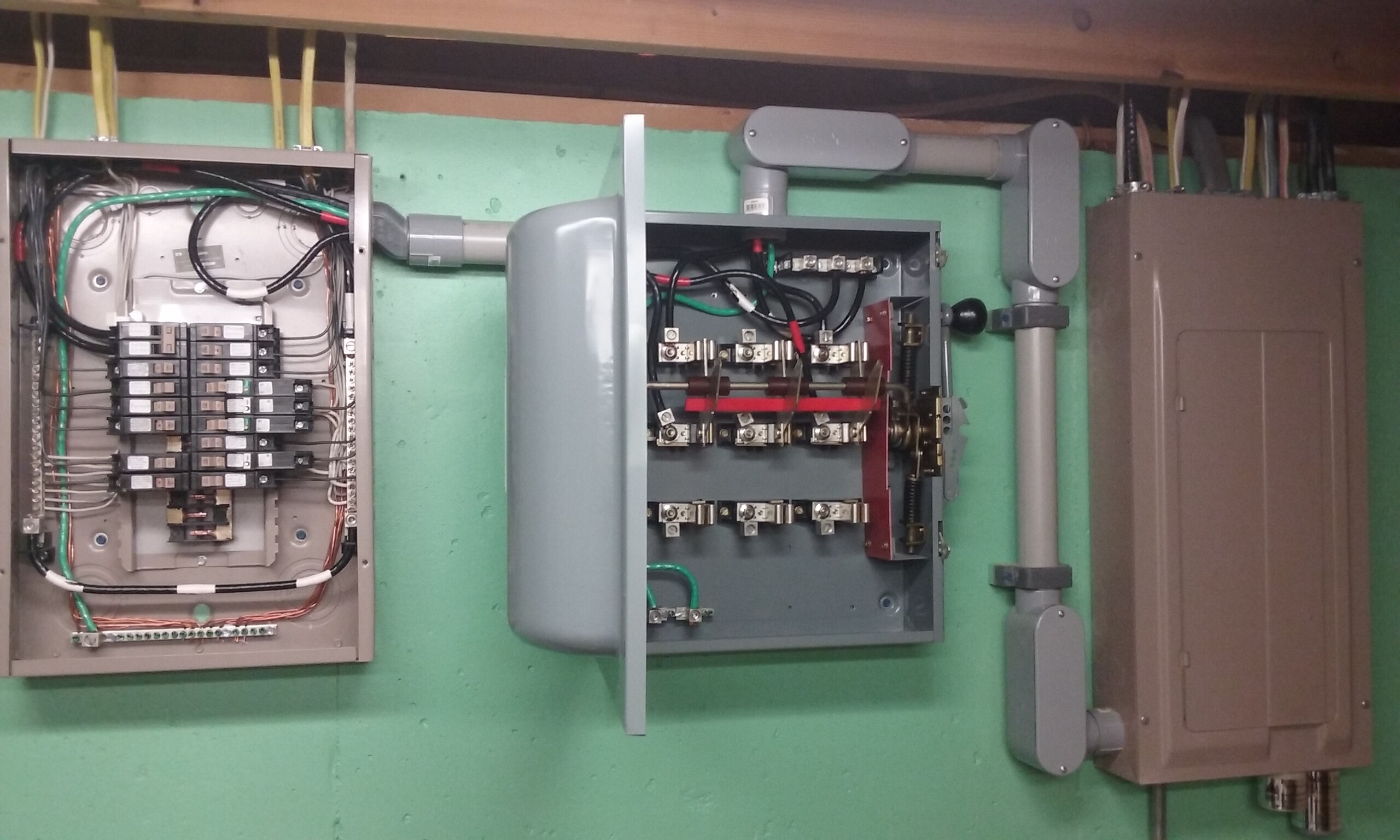
Here’s a double throw transfer switch and sub-panel I installed in my house. Eventually plan to hook up the bottom end of the transfer switch to run an emergency generator.
Don’t be too hard on my install. Professionals are the worst critics!
Back to the diesel discussion. Again I don’t think we have much disagreement at all. I think you would still agree the reason big trucks run diesel ICE is because they are more efficient. My guess is that part of the reason for this is that diesel fuel contains more calories than gasoline, but this is speculation on my part. I don’t really know the reason.
My own experience is that my gas powered Oliver used about 5-6 gal/hr. to run equipment that my diesel used 2-3 gal/hr. This was a naturally aspirated diesel. I don’t own either one anymore, so unfortunately I can’t provide pics. But they were nothing special anyway. Just common old Oliver tractors (one was even a tricycle).
Diesels tractor engines do last longer than gas burners (with the qualification that again I’m not referring to the newer “green” engines. Honestly, I’ve not kept up w/ which tier is currently mandated (for emmissions (I think my current tractor is tier IV) but I just know the older tractor diesels lasted a lot longer than the gas burner counterparts). I’ve seen many examples demonstrating this. Old John Deere diesels would run 8000 hrs. before a rebuild. I’m not sure why diesels last so much longer (you are right the compression is more on a diesel than a gas burner which should be harder on the engine) but I suspect it has something to do with the “oily” properties of diesel fuel. As you know diesel is basically an oil, whereas gasoline is more like a solvent, which tends to wash the oil out of the cylinder walls. Plus I’ve noticed the manifolds of gasoline tractors are considerably hotter than diesels. Putting an old gasoline tractor to really hard work will cause the exhaust manifold to glow red (hot enough to light a cigarette). I’ve seen this on a gas burner, but not on a diesel. Again this is just an educated guess on my part.
Re: hour meters on tractors.
Old tractors had hour meters which were run off a cable measuring engine speed. One hour of time equaled one hour at PTO rated speed, so (for older tractors, which is what I referred to) I think my perspective that 5000 hrs = 250,000 miles is probably a fair assumption (not perfect but fair).
You’re right new tractors have electronic hour meters which measure engine idling time (in other words time which the engine is running, regardless of engine speed). My current MF tractor has two meters, one of the old style mechanical meter clocking one hour at PTO speed, and one electronic meter measuring time the engine is running.
As an aside, on this tractor, the electronic meter, which measures actual time the engine is running, regardless of engine speed is about 3400 hours. As I recall, the mechanical meter is around 2200 hrs.
It contains more btu’s than gasoline, and diesel costs more because less diesel can be made from a given amount of crude than gasoline. Bet most find that hard to believe right? It’s true.
Diesels ARE more efficient, I said that. The reasons they are used in heavier equipment goes beyond efficiency, but no doubt, it’s a prime reason. The more than double efficiency numbers you posted concerning your old tractors may be true, but we don’t know enough data here to draw any conclusion from that. I hope you are not implying that diesel engines are more than twice as efficient as gasoline. They aren’t, not now and never were.
Search thermal efficiency of gasoline vs. diesel and you may be surprised. Diesels are more thermally efficient though, I’ve said that all along.
The higher compression is much harder on the engine, which is why the engines must be built much heavier. It’s the reason diesels aren’t used on aircraft, otherwise diesels would be an ideal choice.
Both are solvents in regards to crankcase oil. That’s why fuel dilution in the crankcase of a diesel is such a big deal, but I get what you are saying.
I’d love for you to see a 20 cylinder exhaust stack after a 30 minute load test. Oh…it glows…it glows real good. But yeah…exhaust temperatures are lower than gasoline. I don’t think this has much to do with longevity though, but maybe.
Yeah…but so then a diesel running an irrigation pump via PTO (as in your example) has one start in 1000 hours, versus the vehicle in your example that may have hundreds. Hundreds of times where for that split second there was no oil on the bearings etc? That is most definitely not a fair comparison at all.
I didn’t know this at all. That is a good way for measuring tractor hours for sure, but a poor method of comparing to a gasoline vehicle mileage…for a ton of reasons.
NOW…about your electrical work.
I won’t criticize anything somebody does for themselves unless they really want me to.
I applaud you for not doing what most folks want to do by backfeeding using a double ending jumper to a welding receptacle.
I’m assuming the panel on the right is your main and the panel to the left is the loads to be served by the EG.
Tell me about your grounding and neutral bonding in the Emer. panel.
Who told you to do it that way…and why was it done that way?
Does the emergency generator have it’s own panel with overcurrent protection, and how is the neutral handdled there? Is this is the basement of your house or a garage or workshop? When you purchased that panel to be used as the emergency panel, you had to buy those two neutral bars separately. In fact, anymore, you likely had to buy all three, including the one for the grounds. You also went out of your way to bond these two neutral bars and isolate them from ground. Tell me…why was that done? BTW…I’m not saying it’s wrong either…just curious if you know why you did it that way. How did you handle the neutral in the main panelboard? I’m not nitpicking, but this is precisely where everyone screws up these installations and you’ve done some studying, but I’m curious what you know about it. Was this install inspected?
Your work looks good, neat and workman like. I’m not a fan of plastic pipe except for underground, but it’s fine there.
I think we’ve beat the diesel discussion fairly, so I’ll leave it unless you, or anyone else has anything more to discuss.
This thread seems to be pretty much played out, so we can discuss my electrical if you want. I doubt anyone but you or I are interested.
No, you’re right that is a very bad deal. As you know, a way to get a lineman electrocuted. My old farming partner’s father was the manager of the local REA. He used to be a lineman and gave me my initial introduction into electrical wiring. Many lineman have died because of backfeeding a portable generator.
Yes, during a service interrupt, the idea is to throw the transfer switch to serve the “critical” circuits in the subpanel by way of EG.
As you know bonding the neutral in the sub panel violates code (i.e. parallel ground circuit - at least against code for residential in my area) so the neutral is unbonded there.
The neutral floats on the portable generator. Because it is not defined as a “separately derived system” per code, the neutral must be unbonded on the generator. The generator does have its own overcurrent protection.
Yes,this is the system for my house, located in the basement.
Very sharp observation. Actually, the two vertical neutral bars on the Emer. panel came w/ it. One was a designated case/safety ground bar, and the other neutral. I wanted a neutral bar on either side of the panel, partly for convenience, partly because I didn’t want to run out of neutral lugs (which has happened before. Likewise I’m sure you’ve run across double tapped neutrals which are a “no-no”, so I wanted plenty of lugs.)
I did add the case/safety ground bar on the bottom. I did this because the newest upgrades suggest separating the neutral bar from the ground bar. But before you lecture me on adding components to a panel (I know the added component hasn’t been UL tested (from the perspective as a panel as a whole) so from that perspective (i.e. the extreme letter of the law, they aren’t approved) But the logic is sound, as new boxes generally isolate the neutral bars from the ground bars and have been UL approved. When I added the bar on the bottom, I removed the paint for good contact, carefully added a small amount of dialectic grease to the contact points. I don’t know if you’ve ever added anything to a box in your career (which would by the letter of the law, nullify UL testing) but I suspect at some point you have, so you know what I’m talking about here.
In the end, my addition brought the box closer to code, not further.
The neutral in the main is bonded (per code).
I used PVC (plastic) for the conduit because I’m more familiar w/ that. I’ve run quite a lot of that and like the way it goes in and the protection it offers. As you know, it’s required for wet environments. That’s what I’m used to, so that’s what I ran.
When I added the subpanel, I took the opportunity to add AFCI and GFCI on circuits which were required per updated codes. I also took the opportunity to get rid of shared neutrals, which as I understand are not against code currently, but as codes continue to update, will probably be eventually be against code for residential.
This could probably be a very long discussion, which would probably cause most folks eyes to glaze, but I wanted to answer your initial questions anyway. Questions I would expect from a competent electrician.
Exactly! Every time I try to explain this to people, they want to argue the point that it’s safe because they manually open the main. Not only that, but poor / improper wiring on the load side can cause problems and fires because it is now, no longer protected by a main capable of opening all ungounded phase or line conductors. Doesn’t surprise me at all that you did it right.
Right, but this isn’t always the case, but you kind of touch on that later when you mention separately derived systems. I’m impressed!
You did it entirely right. There is absolutely no preclusion to adding the neutral bar and UL listing is never required. Many items are not UL listed btw, and even then, they aren’t the only ones doing such testing. This is addressed by the NEC. UL is an independent laboratory used for testing and has no governmental authority, but it’s listing may be accepted as a performance proof.
PVC actually isn’t required in wet locations, and in some jurisdictions, would actually be a violation. This was originally due to to fumes emitted if the building were to catch fire. So some local jurisdictions prohibited the use of plastic conduit in a dwelling, while at the same time permitting it’s use for plumbing purposes. Made no sense really.
You did a real nice job and avoided all the common mistakes and more impressive still is that you actually know why you did everything. Knowing about and using the code terminology (separately derived systems) is really over the top.
I figure you approach everything you do in this way. Now that the word is out all your friends and neighbors will be wanting you to wire this and wire that. They will want to skirt the rules and do everything as simply and cheaply as possible…they won’t listen to reason either…lol

 Btw, I totally agree anyone who works on the electrical effectively must understand exactly how those electrical controls operate the mechanical functions. I’ve wired more than you would suspect from a person w/out formal training or apprenticeship (lots of buildings, whole boxes full of contactors, timers, momentary switches fed back into relays, etc.). I hope I’m not sounding self-aggrandizing, but just want you to know I’m on your page.