Our electrician is coming out today to look at what we’ve got and solidify the plan. When he checked it out last year he suggested a new pole with separate meter to future proof since I want to put in a barn and outbuilding at some point.
Biggest points of discussion: putting the panel on the north wall vs south. Somehow everyone wants to put everything on the south wall, and since I had to orient this north-south instead of east-west I’m a bit reluctant to give up any square foot of polycarbonate space to solid objects that will block light. At the end of the day it’s probably not a huge deal, but if I’m going to insulate the north wall it makes more sense to put any panels or equipment on that end. It’s bad enough that the gas line and water line come in the south side, so the boiler will take up southern real estate as well…
We’ve had a few unreasonably cold nights and I had to shuffle plants into our garage…I did not expect to need greenhouse heating in August or early September!
I wouldn’t compromise on the southern exposure, that defeats the purpose of the greenhouse!
All of my infrastructure I’m planning to put on the north side of the structure.
I just had an epiphany this evening that I have probably a couple thousand feet of pipe I can use not only for an underdrain/ air circulation loop, but also possibly as the structure for my greenhouse roof instead of 2x4s, or possibly in addition to.
Painting the piping black and filling it with anti-freeze would make for just about the best multi-level loop system I can think of for a temporal and physical stacking greenhouse system, incorporating the heat gained into a sand (or similar) battery below the greenhouse floor. By circulating the heat during the day from the black pipes I may significantly reduce energy needs as the heat would rise at night from the floor. I’m going to run it by the engineers I worked with and see how crazy they think I am.
If anyone has thoughts or comments on the topic, please chime in!
I’m still currently (stubbornly) planning to remain off grid for the cost savings and limited recurring monthly fees. I’d rather spend a few thousand down the road on additional batteries than cable to grid tie, especially on principle and relying on my own updated systems over the aging grid in PA.
That sounds like (to my ears that know nothing lol) a great idea and good use of what you have on hand.
I had mentioned that we insulated the foundation deeply to create a large thermal mass, and I’ve noticed that during the cold snap we’ve had, the floor radiates a lot of heat and is keeping the structure warmer than ambient. Of course it will be different when it’s -15°F out, but it’s nice to see that creating a heat sink was worth it. Hopefully that will increase the efficiency of the radiant floor heat as well.
Being off grid is a great thing. Energy cost and availability are so unpredictable. What do you plan on keeping in the greenhouse?
I got the permit for my greenhouse, but since winter starts any day now, im going to wait till spring i think… probably start clearing the site. I’m doing the climate battery. Will put a propane heater to keep it warm enough to grow…well something that dosent grow in northern Wisconsin.
I’m hoping for ideal temperature conditions when it’s all said and done. I’d like to do citrus, figs, miracle fruit, and a few tropical things if I can swing it. Might add LED lights to the energy equation for higher grow quality in the winter. Still lots to learn and research.
Are people really growing tropical fruits using the geothermal loop system? My mango aren’t happy with winter minimums of 42F and lots of sun. Relying on the geo loop will put you well below 42 in winter. The trouble with that system is you get what you get. There’s little control. If it runs low 30s all night in winter and you want warmer the only recourse is adding heat. If you have to run a heater does the cost of the loop really make sense?
I’m planning on putting in a wood burner that will heat a hot tub, sauna, or some sort of mass… really hoping hot tub because that would be awesome. Then every weekend I’ll stoke the fire and let the climate battery soak up that heat. The additional mass (i.e. hot tub) will radiate heat for a day or 2. I’ll need a propane heater to set a minimum temperature because a few sunless days of -30f would be a disaster.
In my case, I have a couple thousand feet of schedule 40 pipe sitting at the farm and I can borrow heavy equipment to excavate. I think typically on a build like this, labor and machine use would be a primary cost. Pipe is over $3/ft for something similar to what I have.
My costs are the blower, solar/battery/inverter etc, switches, walls, and roofing. I’ve been researching ways to source all of that within my budget.
I have a decent amount of electrical and other materials left over from other projects I plan to use. Plus, marketplace has given me a lot of free and low cost stuff.
The electrician/electric co and plumber should be out this *coming week. It has dipped into the 30s at night so I moved my sensitive plants in and was able to keep the minimum temp at 60°F using a little 1500w space heater for now. Luckily we had caulked and sealed everything up, and the daytime temps are decent so there isn’t sustained cold. Even though the permanent heating systems aren’t in place, it was nice to have plants cozy and warm somewhere without needing to shuffle them into the house.
We backfilled around the foundation. I’m planning to casually install a bunch of native bushes around the structure so that I won’t need to contribute as much formal maintenance. Viburnums, spice bush, ninebark, bayberry are high on the list. If I get really ambitious I’ll try to source some before it freezes.
The electric is run, and the rest of the install will be tomorrow. The plumber is finally here today to connect the gas line and finish setting up the radiant heat system. I’m having a lot of anxiety over our discussion of the height of mounting things such as the boiler on the south wall…I feel we may not be on the same page. They also need to vent the boiler via a cut in the triple wall polycarbonate and I fear it will crack. I gave them a waste piece to practice on.
I’ll be glad to have heat since it’s supposed to drop into the 20s this weekend.
The boiler and external piping is installed. It doesn’t block as much on the south wall as I thought, so that’s good. I’ve got an indoor and outdoor spigot as well - very exciting and convenient for running irrigation to our annual gardens next season.
Had a bit of a disagreement with the plumbers over mixing the fluid for the system. We have a bucket of 95% propylene glycol and need 40% concentration in the system. I want to measure and premix to 40% and then add to the system until full. The calculation was very simple. They seem to want to dump most of the 5 gallon pail of 95% in and add water, then use a hydrometer repeatedly to see if more water is needed and then adjust.
I bought some clean 5 gallon pails, an accurate imperial/metric measuring pitcher, and some bucket lids with pour spouts and plan to take the choice away by preparing the fluid before they arrive again. I guess this makes me a bad client, but I want things to be correct.
We set the timer for bright lights to come on 1 hour earlier than dawn, then go off. Back before LEDs, halides then high pressure sodiums.
Tricked plants to bloom early, anticipating spring.
The system is up and running! We ran an extension cord from the garage to get the boiler going since we’re still waiting for the electric co to come out and approve things. That will ideally be tomorrow, but who knows since we’re getting a bit of a snowstorm.
The floor heat is very nice. I’m going to have to play with settings because it’s kicking it up pretty high right now despite being set at 60 degrees. I’d like to set it at 50, but didn’t want to take a chance of it being too low tonight with outdoor temps in the low 20s. I’m very glad we insulated the slab. I moved my citrus inside now that it’s getting a bit colder. The mandevillas I have already have a bunch of aphids and have been isolated so I can hit them with some insecticidal soap once the crews clear out. I may also just prune them down to expedite things.
It’s all very real now stepping inside a 70 degree greenhouse while I needed my parka outside.
Once the construction debris is cleaned up I’ll have to post a few pictures.
Still waiting for final electric work. The work has been inspected and approved by the electric company; the electricians just need to wrap up on their end. I have tweaked the settings so it’s 55°F minimum and that seems to be working out pretty well. On a sunny day the inside temp will get into the 70s even when it’s freezing outside.
Moved a pomegranate inside and will move our kakis and figs in soon now that they’ve defoliated. I’m curious to see what the growth cycle will be like.
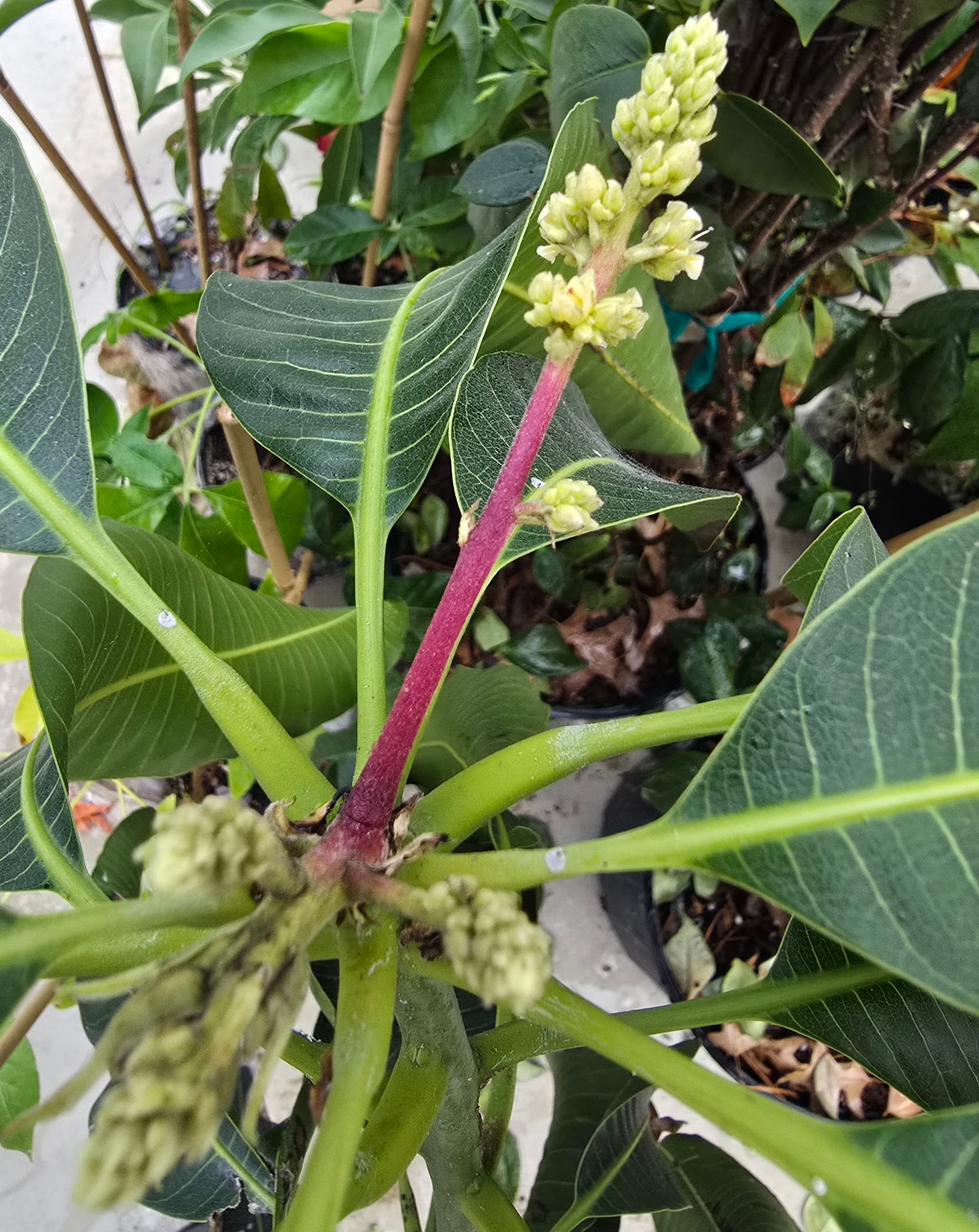
Ice Cream mango decided to bloom…it really needs potted up from its nursery pot, but it’s nice to see and will be fun to watch bloom.
I do feel like I’m at a standstill because of all the wiring work and equipment. Once that is gone I’ll be able to clean up all the debris and transform it into a pretty greenhouse instead of a construction site.
This thread needs photos of the greenhouses and the construction details. My greenhouse (in my dreams) is just going to be dirt floor. Not interested in growing tropical fruit or pots, just figs and maybe a persimmon tree in the greenhouse, in-ground. But if I could not do that, then maybe a concrete floor with potted figs.
If I was rich and had lots of time, then maybe tropical fruit. I wonder if any cold climate greenhouses in Z5 grow mangosteen, sapote or cherimoya? Those are my favorites. I always look towards colder zones than mine. I figure if they can do it, maybe I can too.
Here are some collections related to greenhouse growing.
I’ll definitely post some pictures once it’s no longer a construction zone. I can’t wait to have the last crew out of here. I just sneak in to water my plants, but with all of their equipment and debris around it feels like a jobsite.
The plans… were in my father’s head, beyond the basic structure. It’s a roughly 14x30 kit greenhouse with triple wall polycarbonate built on an insulated 20" block stem wall/foundation. The main heating system was designed by the company that sold us the radiant heat components, so he sized it to the dimensions and desired minimum temperature. It’s a gas boiler with in slab heat. We caulked and sealed every part that we could. The kit came with a ventilation system consistenting of roof windows with auto openers and a linked exhaust fan/shutter system to pull air through on hot days. We added lighting (just basic LED shop ceiling lights), water service, and electrical outlets. Honestly couldn’t have done a thing without my father helping us.
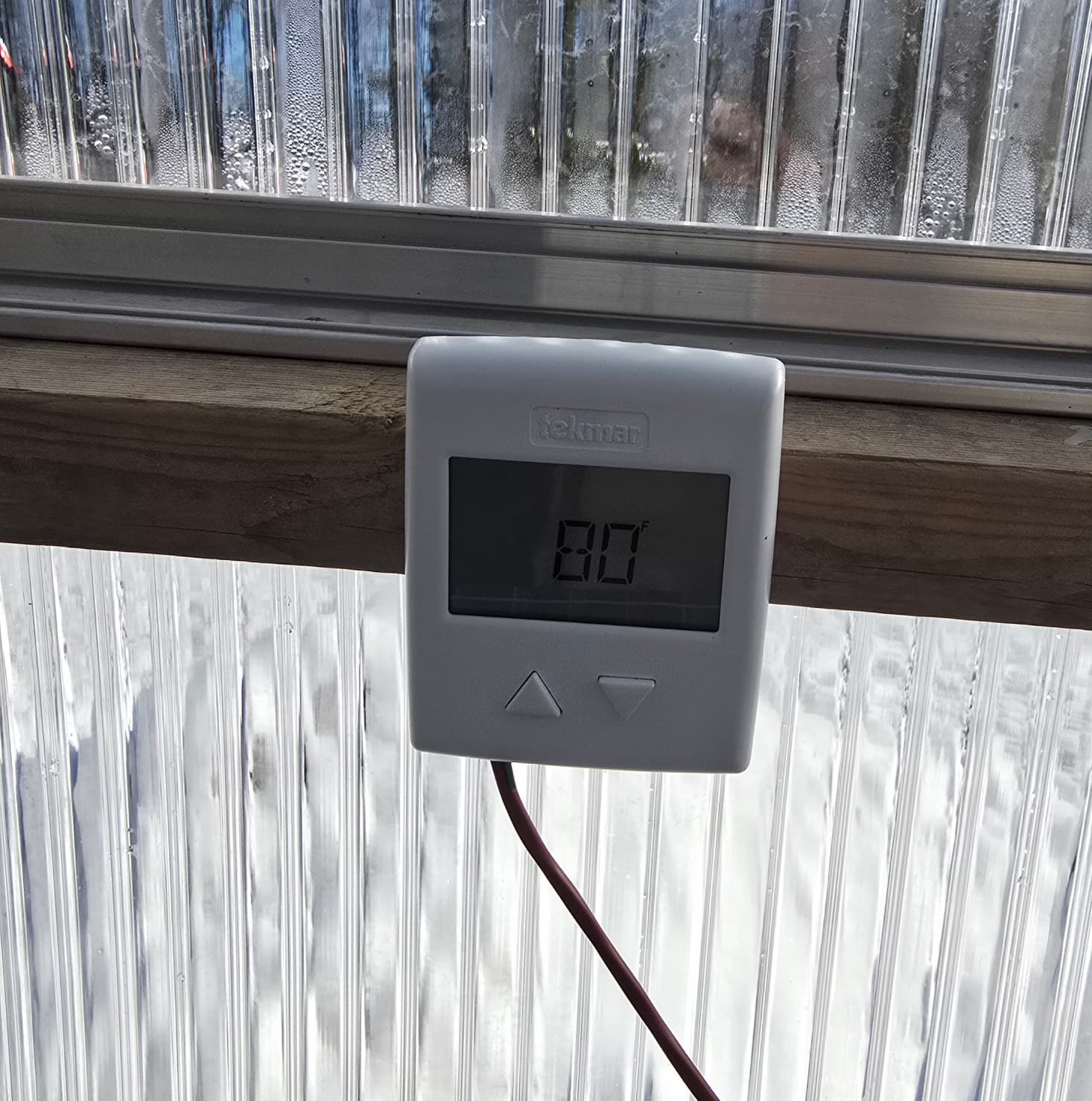
It’s currently 22°F outside. The thermostat is set to 55°, but as you can see this sunny day has warmed it up a lot. My husband is going to climb up and adjust the auto openers because they’re starting to pop at 70°, which made sense when it was summer to get ahead of the ambient heat, but makes little sense right now.
We had a record cold temp last night, dropping from ~30° nights to a 6° night plus windchill bringing it closer to 0°. We moved everything that was moderately sensitive inside, so the figs and kakis, as well as some herbs that I’d like to keep going.