Hello Sir, I see you have a lot of information about Monrepos and Adara. I search all the internet and i don’t find anything If one of those rootstock’s are compatible with Kordia and Regina cherry’s. I got a list with some variety’s but I don’t find something relevant.
Ivan, let’s select the best varieties from the Drigen nursery.
- Narana, a German variety developed at the Julius Kühn Institute in Germany.
It belongs to the group of very early ripening varieties (8 or 10 days before Burlat, 29 days before the American Bing standard).
It offers good size (28-30 mm), good flavor, and texture for its early harvest dates and has a great advantage over its main competitors at that time (SMS-280 and Sweet Dave), which is that these two are extremely susceptible to cracking.
Second interesting variety:
- Grace Star
Developed by the University of Bologna, within the Star cherry program.
From my point of view, it is the best variety of the entire series.
It offers a 30-32 mm diameter, but its best characteristic is its flavor and texture, and it’s very resistant to cracking.
If I remember correctly, in 2007 it received the award for the best-tasting cherry in Italy; it’s a highly recommended variety.
Third variety
- Justyna
A Czech variety developed at the Holovousy Institute, it offers a 28-30 mm diameter, high firmness (it’s very crisp), and is very resistant to cracking, but most importantly, it’s flavorful. It stands out for its powerful, very sweet taste (over 25° Brix), and is one of the tastiest cherry varieties.
Fourth variety
- Irena (only if you like cherries with high acidity).
This Czech variety, developed at the Holovousy Institute, produces 28-30 mm cherries with good firmness and high resistance to cracking. One important note: this variety must be harvested at full ripeness to avoid excessive acidity.
Fifth Variety
- Sandra
A Czech variety from the Holovousy Institute, this is a very good cherry. It produces very large cherries (30-32 mm), with excellent flavor, a crisp texture, and very high resistance to cracking (it is one of the best Czech cherries).
Sixth Variety
- Tamara
Another Czech variety from the Holovousy Institute, widely used commercially due to its excellent characteristics. It offers a 30-32 mm diameter, with excellent flavor and a crisp texture. It’s a magnificent variety, but with medium resistance to cracking.
Seventh variety
- Felicita
A Czech variety from the Holovousy Institute (I love this variety along with the Horka variety). It offers a large 30-32 mm diameter, with a delicious flavor and crisp texture. It’s a very good cherry, but quite susceptible to cracking.
Eighth variety
- Carmen
A Hungarian variety from the breeding program carried out by Apostol János in Budapest. It has excellent characteristics, as it is enormous in size (34-36 mm and more), has a very good flavor, and medium resistance to cracking. However, it has medium firmness and isn’t crisp in the mouth. Even so, I love the Carmen variety.
Ninth variety
- Sumburst
A variety obtained at the Pico Summerland Station in Canada.
It’s a variety that offers large fruit (30-32 mm). The flavor of Sumburst is exceptionally good, but like Carmen, it lacks a crisp texture. I love Sumburst, just like Carmen.
These are the most important cherry varieties from the Drijen nursery.
Best regards
Jose
2 Likes
Hi Cosmin.
I’ve tested Adara and Monrepos rootstocks in my orchard, and I can’t say one is bad and the other good, because that would be completely foolish of me.
Rootstocks are chosen taking into account several parameters:
- Adaptation to our soil type
- Desired vigor in the trees
- Resistance to different problems
In my particular case, my soil is extremely calcareous, heavy, and has a high pH, and I’m looking for a very vigorous rootstock.
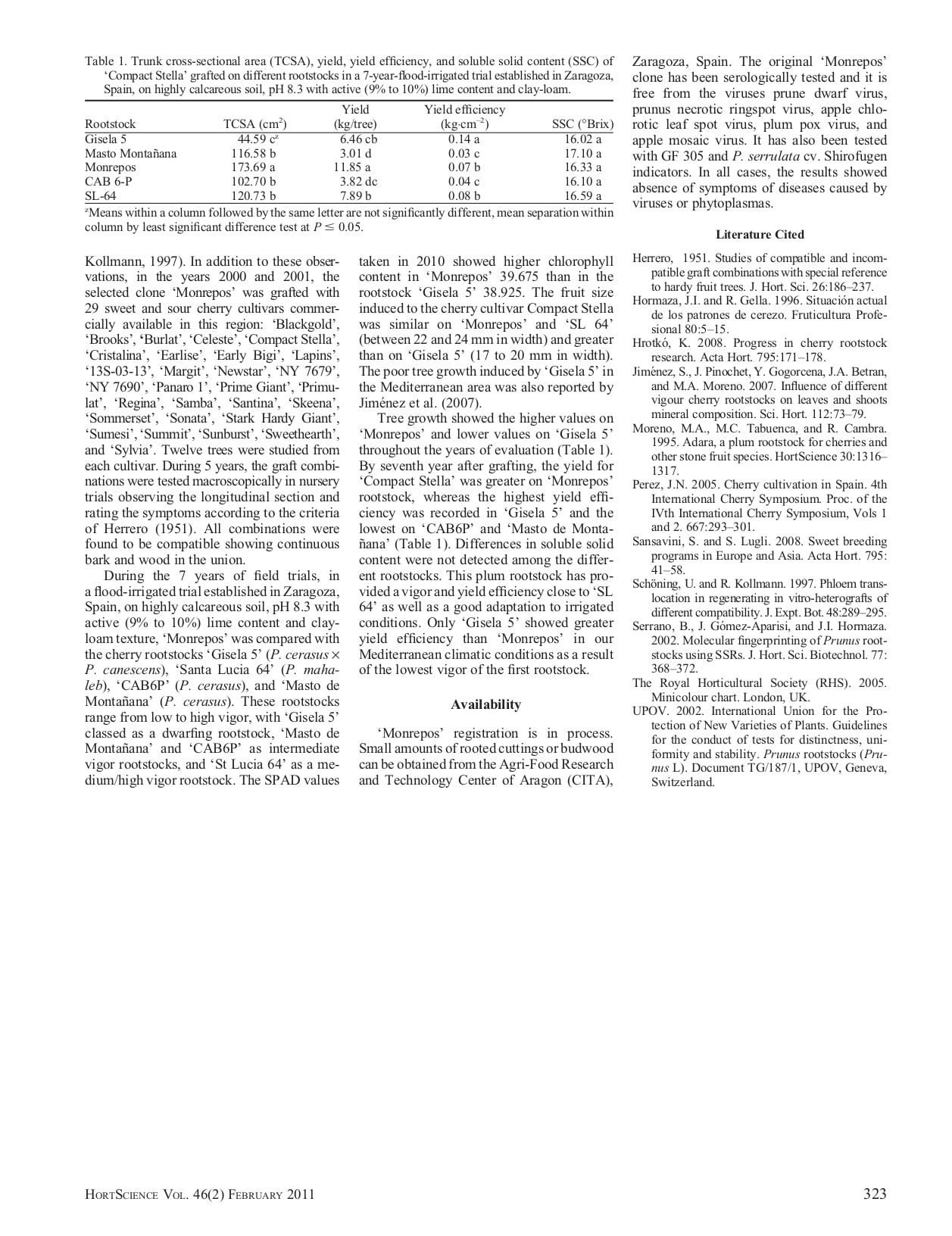
Obviously, Adara doesn’t offer this, and yet Monrepos is a true marvel in my soil.
Therefore, it’s not a question of good or bad, but of adaptation.
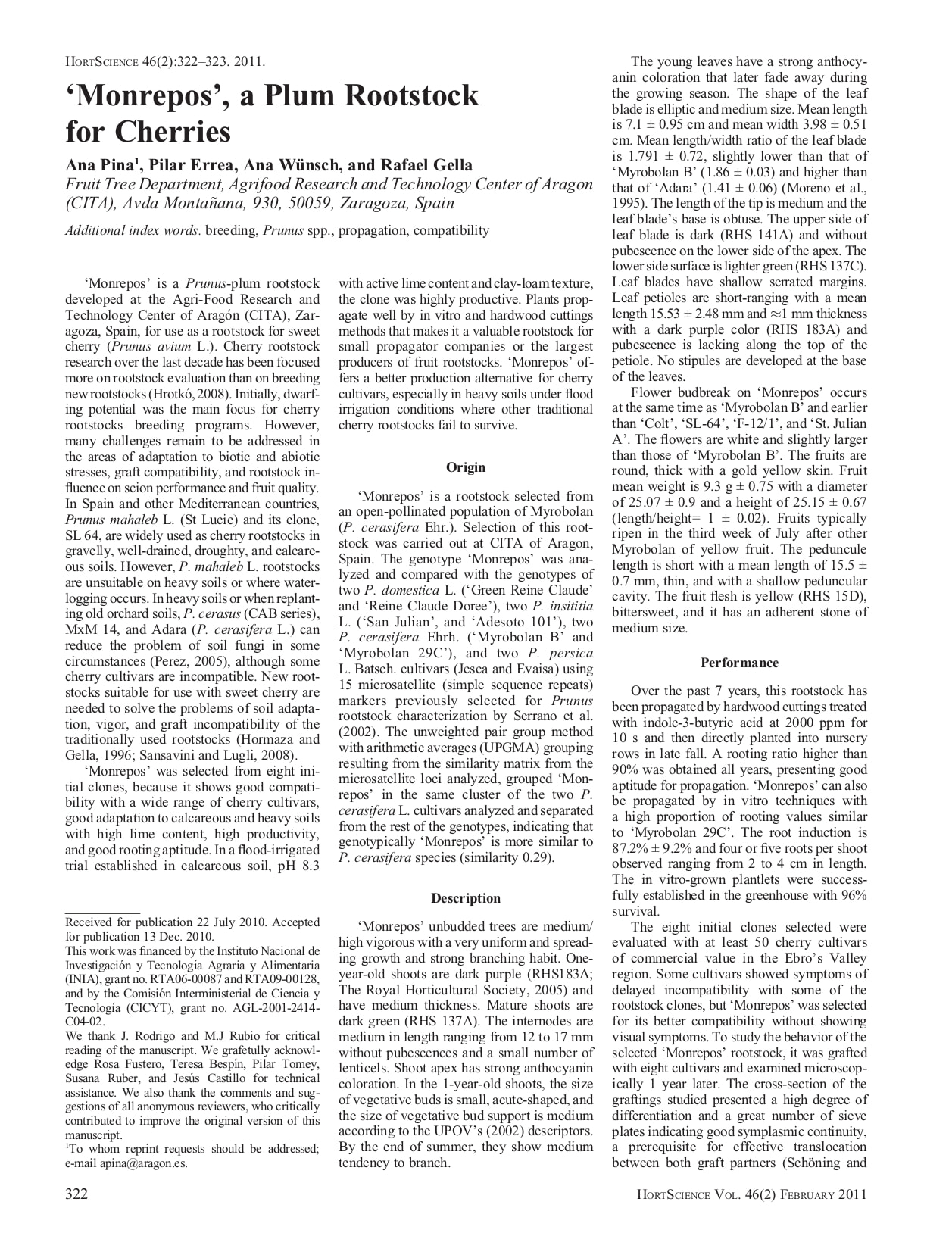
Regarding the compatibility of Monrepos, it is absolutely perfect with any cherry variety, but when used as an intermediate (puente plum ), the scion of both Adara and Monrepos should have a minimum length of 30 centimeters (some sources recommend a longer length, but 30 centimeters is sufficient) to avoid incompatibilities.
Furthermore, it is necessary to know the vigor of the rootstock used as the base, in order to use an intermediate ( puente plum ) with Adara (less vigorous) or Monrepos (very vigorous), to avoid discrepancies in caliber, at the grafting point.
Example:
I use the GxN 15 Garnem hybrid (similar to the American rootstock Titan II or SG1), which is very vigorous. If Adara is used as an intermediate graft ( puente plum ), since Adara is much less vigorous, I would have problems in the future , for this reason, I use Monrepos, which has similar vigor to the lower rootstock (GxN 15 Garnem) and similar vigor to any cherry variety grafted onto Monrepos.
I’m very busy, but I’ll try to post some photos of cherry trees grafted in spring tomorrow; they’re very illustrative.
There are many publications on both rootstocks, but since we’re on an American forum, I’ll post an article about the Monrepos rootstock, published in HortScience magazine (I hope you consider it prestigious enough).
Best regards
Jose
3 Likes
Hi Ivan.
Well observed.
Adesoto 101 is the king of rootstocks in excessively moist soils or even where the ground suffers long periods of waterlogging.
Adesoto enjoy in water.
Adesoto comes from a selection of Pollizo plum from the Murcia region of Spain, It is fast-growing but not very vigorous, producing medium-sized trees.
Using Monrepos (very vigorous) as an intermediate graft (puente plum ) on Adesoto (not very vigorous) makes no sense.
On the contrary, Adara has very similar vigor to Adesoto and is ideal for use as an intermediate graft (puente plum ) on Adesoto.
Best regards
Jose
1 Like
Hello,
These pruning schemes are very well made and very intuitive, thanks for sharing. I am sorry to ask this in this topic, maybe there are information already in the forum, but are there any books you recommend or can share some parts with these similar organized information and figures for other species /other pruning system, for instance open vase or other reccomended system for plums or peachs or central vase or solaxe for apples or pears?
Thank you in advance
Hi Jose
Thanks for the nice description of the varieties in the Drijen store 
In Croatia we have a cherry nursery OPG Trešnja.
Link.
Is there any interesting variety that has not been mentioned that would be good for hobbyists who love growing cherries?
Ivan
Hi Ivan.
At the Croatian nursery OPG Trešnja, there are some interesting (classic) varieties that are essential for a good cherry orchard.
Here’s a list of the interesting ones:
- Sweet Ariana: An Italian variety from the Sweet program at the Alma Mater of the University of Bologna. It’s a good cherry, but the two outstanding varieties in this series are:
- Sweet Saretta
- Sweet Stephany
Don’t buy it because I’ll send you cuttings of the four best varieties in that series.
-
Prime Giant: A very good Canadian variety from the Pico Summerland station. It’s excellent, but it has a problem: when the variety was selected, a viral problem was not eliminated (Crinkle Leaf) but in 2007, Californian breeder Marvin Nies freed this variety from viruses and patented it under the name:
-
Early Red Maraly
It’s a really good variety (I’ll send it to you).
- Brooks (I love it)
A variety developed by the University of California, Davis.
It’s not a giant cherry (28-30 mm), but it has all the best qualities of a good cherry tree: adequate fruit production every year, texture, and incredible flavor.
It’s one of my favorite varieties; don’t buy it, I’ll send you grafting material.
-
Carmen and Grace Star, both very good.
-
Summit
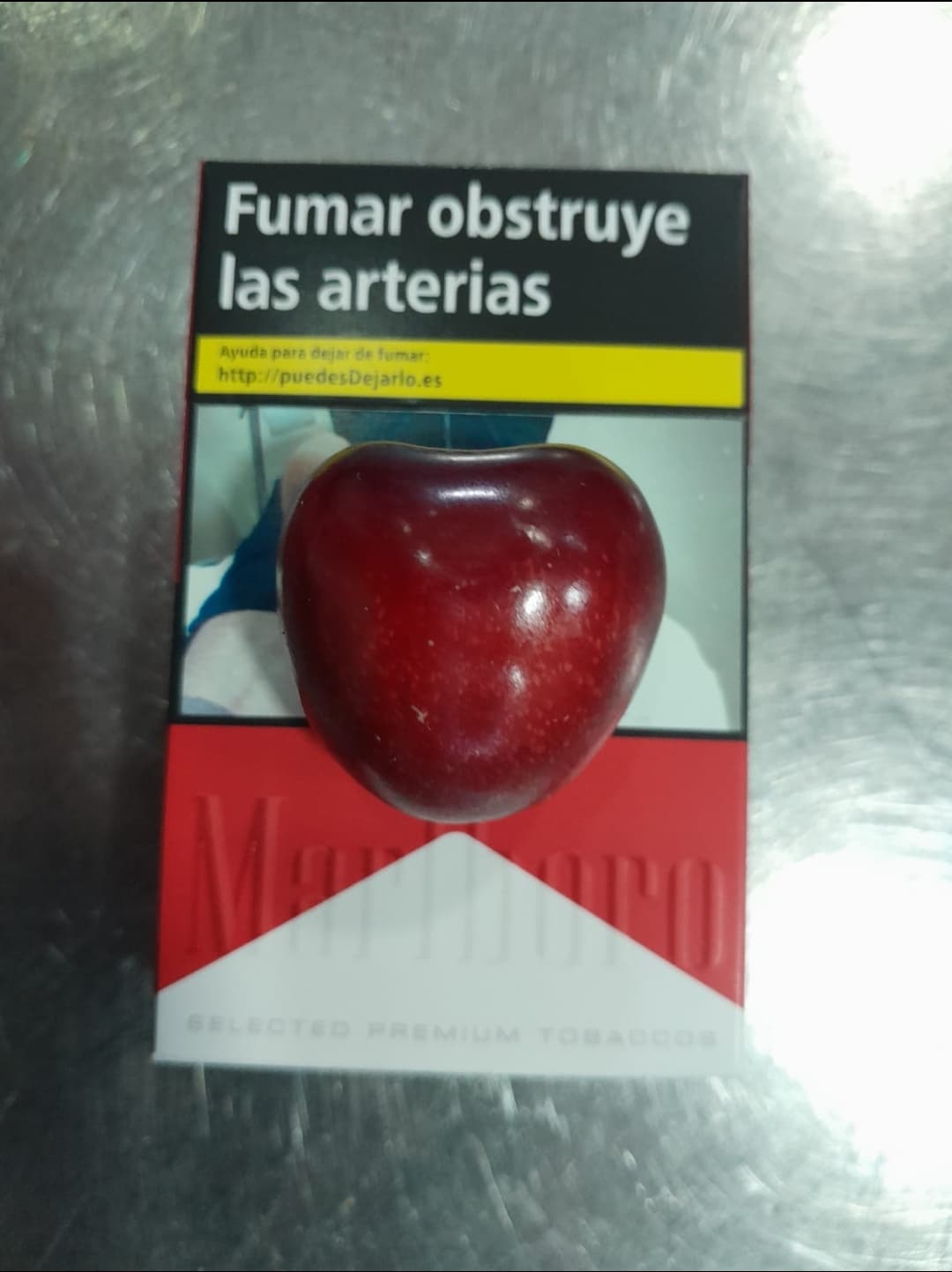
A Canadian variety from Pico Summerland, despite being a very classic variety (1973), it is one of the most perfect varieties of all cherries , but It needs a pollinator with a very late flowering period for Summit to pollinate well (Sweet Stephanie is ideal).
I’m going to buy a couple of Summit cherry trees in Spain, because rabbits have killed my huge tree of this variety.
A photos of Summit


- Sumburst
Very good, although somewhat soft on the palate, but its flavor is spectacular.
Of the late-maturing varieties from this nursery, Kordia is the best; it is a variety with very good flavor and texture.
Best regards
Jose
2 Likes
Of course, there are many truly excellent varieties that we haven’t discussed in this treat , but sometimes I feel a little embarrassed for two reasons.
-
They are very recently developed varieties, and I get them because I have professional friends, but some members might think I’m bragging, so I often prefer not to mention them.
-
They are very recent varieties that won’t bear fruit for me for another 3 or 4 years, so I can only provide the information offered by the breeders and not empirical information from cherries harvested in my orchard.
To name a few of these varieties:
-
Cot 12-09 Sun Pop
-
Petronila
-
Royal Apache
-
Epik-16 (SMS-16), it’s possible I’ll see my first fruits this year
-
SPC-342
-
Nipama
-
All varieties in the Meda series
- Almost all varieties in the German Cerasina cherry series
-
All cherry varieties in the German LFP program (Kir series)
-
Kir Lamour
-
Kir Rio
-
Kir Vulcano
-
Kir Rosso
-
Cherries from the IFG Cheery program (I have the Cheery Grand and Cheery Treat varieties from this series), but after testing in Spain, this series has a reputation for being very low-yielding.
https://www.ifg.world/index.php/cherries
There’s a new series of cherries from the Californian breeder Zaiger, which have been selected in Europe for professional cultivation in Formula Club.
I prefer not to talk about these varieties, as I already have them, but it’s too early to discuss them.
-
Bradford Genetics has some extraordinarily good new selections.
-
The University of Washington has selected two extraordinarily good new varieties (still unnamed, only known by their program code):
-
R-3
-
R-19
In Spain, two new series developed here will be released very soon:
-
The Cherryx series, from the Spanish breeder VIF International
-
The cherry series developed by the Spanish breeder Juan Negueroles
My coveted variety, Skylar Rae (Tip Top)
And many more. The development of new cherry varieties is overwhelming, as there are a lot of new ones every year.
Best regards,
Jose
3 Likes
I’ve been reading this post for a long time, thanks to the helpful information @Jose-Albacete and the other participants in this interesting discussion have provided, this year I think I’ll plant Nimba, Red Pacific, and Rocket. Now I have only Durone 1 and some local varieties. I have planted Burlat and New Star but them have not yet borne fruit.
Then in the coming years I hope to add other varieties if I can find them and have enough space to plant them.
I’m trying to focus on early varieties because the cherry fly causes the most damage to the later varieties, at least in my area of Italy, because I don’t want to treat them.
1 Like
Hi Pierpaolo.
Before focusing on specific varieties, since you’re starting your cherry orchard, I recommend beginning by planting the best self-fertile and universally pollinating varieties for their flowering season. This way, you’ll ensure good pollination for all the cherry trees you plant later.
There are three groups based on flowering time, and here are the varieties I consider most interesting:
EARLY BLOSSOMING SEASON
- Lapins
- Pacific Red
- Royal Tioga
- Royal Helen
- Royal Edie
- Sweet Aryana
MID-BLOSSOMING SEASON
- Frisco
- Grace Star
- Santina
- Selah
- Sunburst
- Sweet Saretta
LATE BLOSSOMING SEASON
- Black Gold
- Sweet Stephany
If you plant one cherry tree from each flowering season group, you’ll guarantee good pollination in the future.
Pierpaolo, planting only early cherry varieties is a bad idea. One cherry tree produces many kilos of cherries, and all the trees will fruit very close together, meaning you won’t be able to eat them all and you’ll have to give some away to your friends. That’s why I’m going to ask you this question:
Have you noticed if the cherry fruit fly, Drosophila suzukii, attacks every year, or was it just a one-off year?
It’s spreading in Mediterranean countries. Fortunately, it’s not present in my orchard at the moment, but in Spain it’s already attacking even in colder areas.
I have some good news: the wasp, " Ganaspis kimorum " , is already being bred for release as a biological control agent against the cherry fruit fly. This wasp is a small parasitic insect that infests the cherry fly . Releases of these wasps began in Spain last year.
I’m going to show you a nice photo of my friend Raul, who has his orchard in the town of Burgo de Osma in Soria (a very cold region). Previously, there was no cherry fruit fly in his orchard, but he’s been having problems with it for two years now.
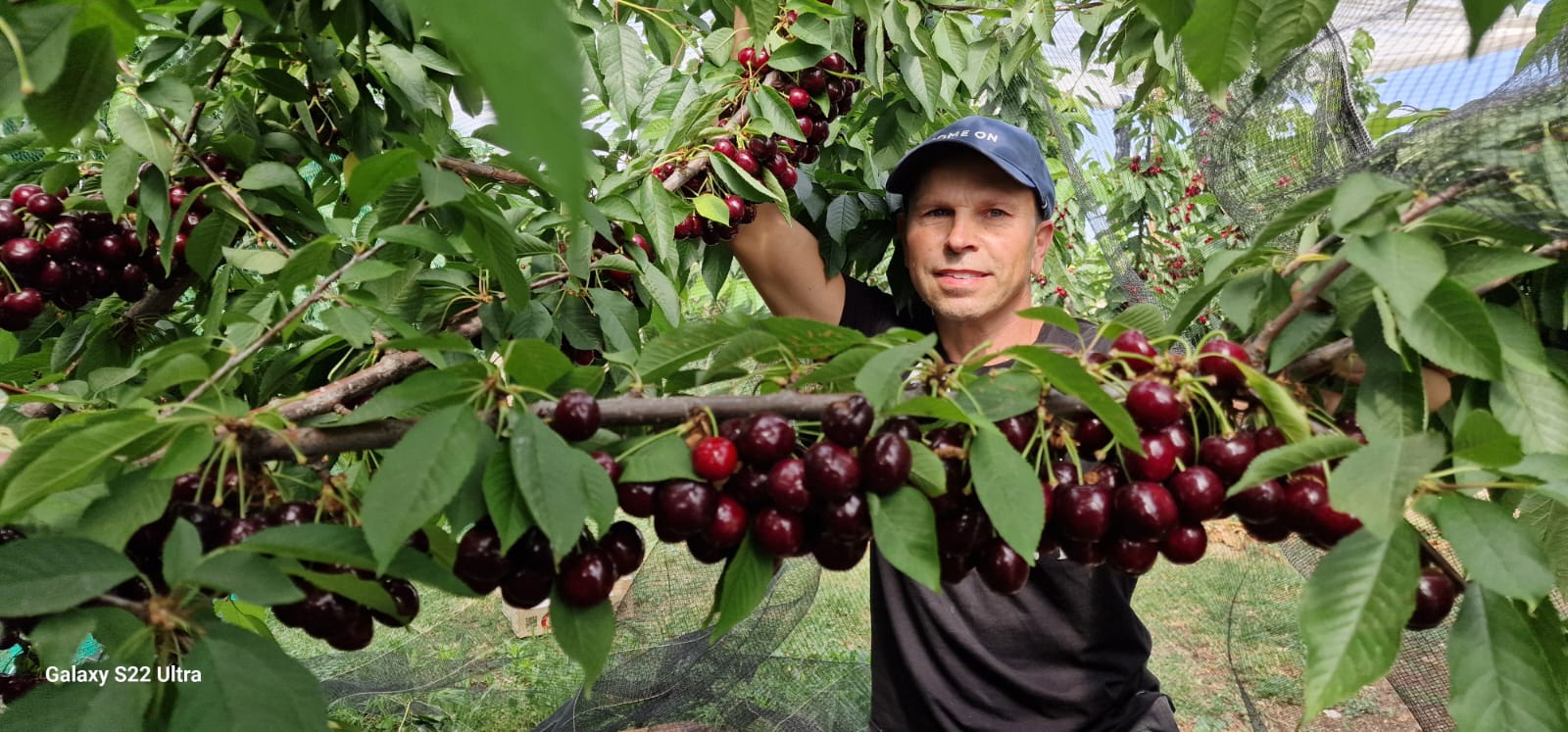
This is my friend Raul, and the cherry variety is Sweet Saretta.
Of the cherry trees you bought this year:
-
Nimba is a perfect variety in every way.
-
Pacific Red is very good, but it suffers from excessive fruit production each year, resulting in smaller fruit size (you should control the fruit load with heavier pruning).
-
Rocket tends to have some good harvests in some years and some with low fruit production in others, but it’s an excellent variety.
You won’t have any trouble finding the best varieties at Italian nurseries.
Best regards
Jose
2 Likes
Thank for the reply and advice.
It doesn’t attack every year but recently more frequently.
This wouldn’t be a problem. I’d turn them into canned fruit, jam or sell them. In the end there are only 3/4 trees. The important thing is that they produce! 
I also already have other old local varieties that are later.
I forgot, I also have Royal Tioga, but it hasn’t flowered yet after 4 years. Is it normal? I don’t know the rootstock, but it’s vigorous and has grown a lot.
1 Like
Pierpaolo, Royal Tioga is an excellent early-ripening cherry, and it’s also a magnificent universal pollinator for all early-blooming cherry varieties.
Royal Tioga is characterized by its extremely rapid fruiting, so it should have already started to produce some blossoms.
Give it another year of “trust” before considering re-graft.
The good news is that it’s a very widespread variety in Spanish and Italian nurseries , the bad news is that some nurseries sell “fake” Royal Tioga. I’m telling you this from experience, as a somewhat prestigious Italian nursery sold me three fake varieties:
- Royal Tioga
- Pacific Red
- Nimba
I won’t publicly name the Italian nursery, but if you ask me privately, I’ll tell you who the crooks are.
I thought it might have been a mistake, but they have a reputation as “pirates” in the professional sector.
Best regards
Jose
1 Like
Hi Jose,
In the book of sweet cherries - link is written:
Suggestions for suitable rootstocks are generally inversely proportional to the productivity of the cultivar, i.e. high-yielding cultivars are usually combined with moderately productive rootstocks, and low-yielding cultivars are usually combined with highly productive rootstocks.
This means that Kordia/Attica and Regina can be more difficult to grow on, for example, Adesoto-Adara rootstocks?
However, some varieties are recommended for cultivation on low or moderately productivity rootstocks with Spanish bush (SB) or Kym Green bush (KGB) training system.
Did I understand that correctly and how did it turn out in practice?
best regards
Ivan
Iván , that’s not just a book, it’s “the cherry bible.” No one in the world knows more about cherries than Professor Lynn Long.
Yes, you understood perfectly, but if you’re going to use a different rootstock depending on the cherry variety’s productivity, it can be a real headache. The important thing is to select the rootstock that’s well-suited to your soil and climate conditions.
The yield per tree isn’t so important for amateur growers, as it can be regulated through pruning or with the application of Paclobutrazol.
With Adesoto you have one well-studied certainty, and it’s this:
Adesoto 101 advances ripening and improves size and Brix compared to other rootstocks.
If Adesoto is well-suited to your soil, then you have the right rootstock.
Adesoto is perfectly suited to training systems like Spanish Bush or KGB, I personally prefer the Spanish Bush system, as it’s a bit slower to develop the tree’s structure initially, but once the trees are established and mature, winter pruning will be minimal.
There are no studies, but I believe that Adesoto with an Adara puente will produce excellent quality cherries.
Best regards, Jose
2 Likes
I just discovered this interesting thread.
Of the cherries I have and have already tried, some of my favorites are Sweet Lorenz, Sweet Saretta, and Royal Helen.
Pacific Red is my favorite of the early varieties I have tried.
2 years ago, I grafted Meda Dragon, Meda Tiger, and Meda Taurus cherries from a test farm here in my region (Aragon, Spain). According to the technical data sheets, they seem very interesting. Hopefully, I will be able to try them this year.
1 Like
Just an FYI. The frustration of someone who is interested in what he buys and eats.
Went to the grocery this weekend and saw some cherries from Peru. Apparently they are a variety called “red cherries”! 
Just in case the consumer is color blind.
Usually I see the usual Bing, labeled as such, and the occasional Rainier, also labeled as such.
1 Like
Hi Phil.
That information about the variety name is impressive.
Essential for colorblind people .
Best regards
Jose
1 Like
Hi Phil.
Chile, Argentina, and Peru (the latter to a lesser extent) focus their production on export, but in recent years they have experienced significant problems with the Chinese market.
The Chinese market is very demanding, and the cherries must arrive in perfect condition.
Obviously, there are very few varieties with the necessary firmness to withstand long journeys. Therefore, Chileans apply large quantities of gibberellic acid (GA3) to their cherries, as it increases size and firmness. However, this has a disadvantage, since gibberellic acid considerably increases acidity and alters the flavor of the cherries.
That’s why, when we buy South American cherries in supermarkets, we find them less flavorful than the cherries from our countries.
Chile has the advantage of producing cherries during seasons impossible for our countries, but they pay the price of a lack of flavor.
For the past two years, the Santina cherry variety, thanks to its excellent characteristics, has saved them from losing multimillion-dollar contracts.
In 2024, due to an engine problem on the Maersk Saltoro, Chileans lost $120 million worth of cherries, and increasingly, the Chinese are rejecting containers of Chilean cherries because they don’t meet their standards.
I have a huge collection of cherry varieties, but I just bought two Bing cherry trees (a variety planted many years ago in Spain and replaced by newer varieties) because, as an enthusiast, I greatly value the flavor of the Bing. While the Bing fruit isn’t huge (30-32 mm in diameter), few varieties surpass its flavor.
Last year, the same thing happened with traditional Italian varieties like these:
- Adriana
- Gemelle
- Grossa di Pistoia
- Cilegione
- Durone nero I, II, and III
Newly developed varieties are always interesting, but traditional varieties are usually a safe bet in terms of flavor.
A fact: To obtain the Sweet cherry series from the Alma Mater of the University of Bologna (Italy), two main parent varieties were used:
- Sunburst (Pico Summerland, Canada, 1984)
- Giant Red (Marvin Nies, California, 1995)
Today I woke up feeling nostalgic for traditional varieties 
Best regards
Jose
1 Like
Very interesting, my friend.
Considering where I live along the Gulf coast in the southern US, we never get straight to market stone fruit of any kind, so our palates are not familiar with how good a fruit is supposed to taste.
Once we travel somewhere and get to, it’s a shock…then we go home and are depressed knowing we can’t get it fresh anymore!
Do all types of fruits need all seasons oil during the dormant period? It’s very expensive to use on my entire orchard, do I need it for all stonefruit or just cherries? Can I skip the dormant oil on apples and pears, and just use copper on pomme fruits?