OK…so I left one or two per tree. Most of these units have to be at least 4 years old by now…second leaf for me but, dang, they were over three feet tall when I got’em. And I don’t really want them to be all that big anyway, ha ha. And it would be cruel to me to not get at least one!
1 Like
Seedy, unlike the really good growers here, I sorta follow my instincts about these things, rather than some rigid set of rules. There are simply far too many variables in play for rigid rules to be of much consequence imo. My instincts are still developing (and changing) and have proven wrong more than once, or maybe a hundred times.
I look at a young tree and by far the biggest criteria for me for it’s ability to carry fruit is it’s trunk diameter and meatiness of it’s primary scaffolds. That’s not very scientific, but it does ensure that, at the very least, the necessary delivery system is in place. That is to say, for me, a whole lot of vigorous upright growth doesn’t mean so much (actually to me, it means nothing) as a heavy base.
I let a young tree fruit in it’s first year and posted photos of it here. Everyone said it was too young, too small, lacked adequate foliage etc. I let it fruit anyway…I think it carried maybe 15 apples that year. It was on a dwarfing stock. It has never since missed a beat, fruits heavily every year and is getting bigger and this year has tons more foliage. That’s not to say they were wrong…they most definitely were not. Everything they said was right and I knew it…I let it go anyway. So, I cheated a bit and clearly won…it didn’t even come close to meeting my own criteria, much less the commonly ascribed to rules.
I never suffered a bit from it…but that’s apples. Peaches are no doubt an entirely different story.
3 Likes
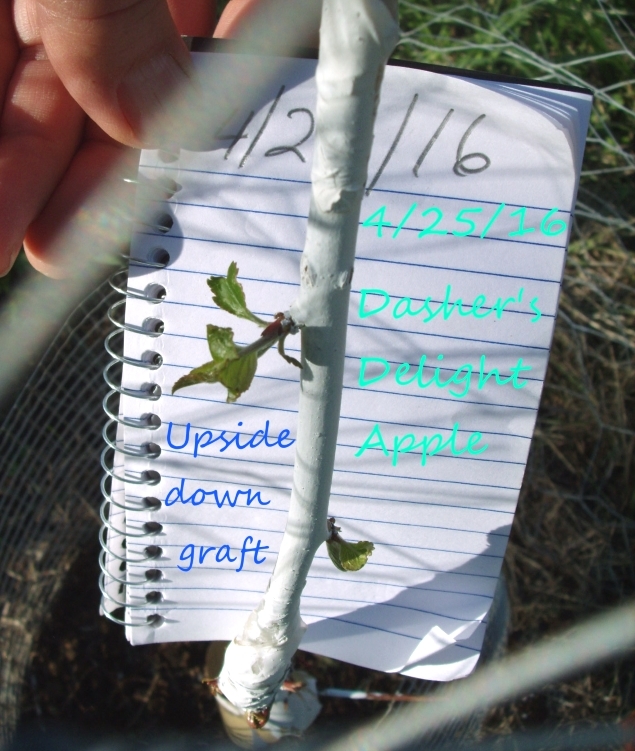
My very first experience here (forum) just a few weeks ago led me to ‘just go for it’ when I was nervous about my first time grafting. I still ended up grafting one scion upside down…it’s still growing…along with the 5 right-side-up (outta 6); not too bad. Every so often I need to be reminded of my tendency to ‘over-analyze’ the situation. Thanks.
Keep us (or me, at least) posted about the outcome of the upside down graft. Is it apple? I’ve always thought about doing this on purpose just to see what would happen. I’m curious to know if it will reorient itself and if new growth will push buds in the correct direction.
I know of no reason that it shouldn’t continue to live, but I must admit, I’m dubious of a positive outcome. Will be cool to hear what it does.
I do know that Forsythia cuttings rooted upside down will (or at least, can) grow out normally. I’ve done it by accident and without intention of it’s growing using them (cuttings) as row markers in my garden. I have a nice bush in my yard from that cutting.
Yes, apple…
The vigor of the upside down unit is weak compared to the other scions, which are growing very well. I put a sun guard up to block the most intense sun/heat of the day because the scion appeared to be wilting a bit. It did help to do that. The leaves came out pointing down and are curving up toward the light. That sums it up, but I’ll definitely be posting more about it…'cuz, why not?
This is from over three weeks ago (25th), but they haven’t change a lot since.
2 Likes
oh…ok, I thought this was a scion you grafted to an established tree? Looks like a scion you put on a dedicated rootstock? Nice and neat paint work…you must be like me and care little for your time.
I always held the opinion that I didn’t care how long something took, as long as I’m happy with it when I’m finished (when working for myself at home).
Everything I do at work is timed for performance, so I get enough of that. I often like to purposely “diddle around” when gardening, solely because I can and I’m allowed to.
I’m really curious as to what that scion is going to do.
I got four Geneva 222 rootstocks with varying amounts of roots, I think this one had way more than the others. I think this was my first graft attempt, and I somehow managed to do it upside down. There are too many factors to say what exactly is contributing to the weak growth, but I’m pretty sure I’m going to be trying it again, on purpose, largely because of this writing which describes it as being a method to control (dwarf) growth:
http://arnoldia.arboretum.harvard.edu/pdf/articles/1950-10--dwarf-trees.pdf
There is information that says USD grafting is on the list of why a graft might fail. Once a person has enough material produced in the orchard to experiment with, ya might as well do it.
Yeah…I’ve seen that exact write-up. 63chevyimpala’s youtube channel documents the rework of a pear orchard where Old Home pear was used as an interstem (upside down) to reduce tree size and control vigor. That must have been a seemingly wacky idea once thought to hold promise. In that case it had slowed growth to the point of requiring removal. I don’t think it’s used much if at all anymore.
BTW…the YT channel I mentioned is in your neck of the woods…well sort of I guess.
Here’s the video…he starts talking about it around 3:30 min in I think.
Great stuff! Well, if this graft continues to live I might designate the tree as Experimental and try all sorts of stuff on it. I was fortunate in that 5 out of my other 6 first grafts are really healthy, and the old tree whose genome I’m trying to save is responding well to the TLC that it’s receiving…so far, so good! I think I know why the one graft failed but I want to look into and see what I can discover.
Would like some advice and a check on my plans.
Is there a benefit to removing the blossom from a young peach or apricot tree rather than waiting and removing any fruit that sets?
I have been removing flowers (during bloom) on my young or newly grafted pears by just manually pulling the blooms off. Mostly I did it to reduce fireblight risk (and that is a real problem for me but it doesn’t seem to kill the older pear trees as much). So there is an obvious benefit to removing the bloom for my young apples and pears.
Now I have some one year old (planted last spring) peach and apricot trees. Due to some mistakes I made, they grew less vigorously than I would like. I am assuming they won’t set fruit (my young peach trees from 3 years ago did bloom but did not set fruit in their second summer) but if they did, I would remove it.
Assuming I have the time, should I be removing the blooms? Should I just wait and remove any fruit if it sets? Is there a benefit to removing the flower from a peach or apricot tree rather than waiting and removing any fruit that sets (or vice versa)?
Well, one advantage of waiting for fruit to set before removing it is that it is it is much less work than removing the blossoms. I have had young trees blossom heavily, but hardly set a fruit, especially in the first years. I also learned the hard way to wait until June drop to thin fruit.
3 Likes
The bees would rather you kept the flowers.
3 Likes
If any of my second leaf apples bloom, I have learned to leave them for the bees to visit and pass around pollen. Then if any fruits set on something very young or small, it is an easier matter to remove the applets.
For instance, I grafted Clark’s Crabapple to Bud118 in '24. It bloomed while the graft was healing over. No fruit & grew to four feet tall. Spring of '25 it bloomed heavily for something so young. I allowed one apple to grow. Full size (thought it was a crab only) fruit that was a treat to try with my Better Half. This coming season I must cut and dig the root away from the rest of the stooling area and re-plant it. I already know it will be allowed to grow just one apple this season. If all goes well, I will try that apple later - Valentine day, maybe.
The sooner you remove the buds the less energy will be spent on them, but the research suggests is will not affect shoot growth, at least on the year it is done, apparently the energy investment at that stage is very small and increases as the fruit develops.
Where blossom removal can have significant benefit is when attempting to correct a pattern of biennial bearing of an established tree. I used to think this was an energy sink issue, but your question brought me to CHAT which explained that the issue was hormonal signaling not specifically energy related.
That is the kind of info that is not available from anecdotal observation which drew me to the wrong theory but right practice in the first place. I have helped establish annual bearing on trees that trend biennial using this method, or at least my observations strongly suggested its efficacy, now I know of research that backs up the use of this method, and better yet, I believe I now understand the why to go with the how.
This is CHAT’s explanation: Removing flowers prevents the establishment of the hormonal and carbohydrate signals that suppress flower-bud initiation. Once fruit set occurs—even briefly—some of those inhibitory signals are perceived by the spur and cannot be fully reversed by later thinning. This explains why blossom removal is often more effective at breaking biennial bearing than thinning after petal fall, even when total crop exposure is short.
5 Likes
Happy to here you back this up. Blossom thinning is well known amongst commercial growers as the most effective way to correct biennial bearing. And before I catch hell from someone, yes appropriate timing of heavy pruning can be helpful too.
1 Like
The old adage of prune the tree open enough to be able to throw a cat through it is highly instructive. That way, spring shoot growth will never shade spur and other leaves near fruit to the point of dysfunction that cannot be adequately reestablished by summer pruning. If such leaves are excessively shaded for even 3 or 4 weeks, summer pruning needs to be done in a way that doesn’t deprive the fruit of leaves further away that have become the fruit’s primary energy source.
This is why I advocate spring pruning of excessive shoots in apple and even plum trees- then it is early enough to assure leaves in close proximity of fruit are still functional. They are the most efficient deliverers of energy to the fruit and reducing shade strategically caries other benefits, particularly in the humid regions where fungal issues rule.
These issues are no longer very important to commercial fruit growers that rely on dwarfing rootstocks to eliminate the need for a lot of thoughtful pruning. Therefore, such an explanation will be hard to find in the general literature if it is in there at all.
I would be very interested in a study of the affects of judicious spring pruning. It is a logical theory that you could elevate productivity of trees on vigorous rootstocks this way over the traditional approach of managing trees with very aggressive dormant pruning.