Thanks Tony- this is just one side of the tree. I left the So in the middle, under the theory that it will be more dwarfing and create a somewhat open center. Then on the other side (to the right of the pic), there are more grafts.
Bob, when you bought the scion wood from Rodger, did he tell you if they are primary shoots, or secondary?
Nope- I’m not sure how to tell the difference either. The scions Roger sent were relatively small, but most weren’t tiny. Most were thinner than a pencil, but thicker than an electric cord. It is worth noting that a majority of the grafts I made came from other sources (27 varieties total). Even with the disappointing benchgrafting results, I’m up to 16 varieties with growing grafts. I think I’ll be able to get to the low 20’s. Some cultivars, like Ant Admire, were used up by the time I finished bench grafting. Others, I had only enough for a single shot at it and saved to graft on an established rootstock.
If the scion woods are just sticks, then it is hard to tell, but some are still able to tell.
My trees are still young. But try to get prepared to graft…
I’ve got to say my scion wood from roger was just as you describe. My bench graft results with Jujube have been even worse than yours. The sample size was small (2) but both field grafts I tried succeeded last year (one W&T and one Bark). I’m wondering if I wouldn’t be better off field planting my propagated Tigertooth in the field and grafting them after they are well established.
I’m glad to hear someone has so many varieties going. So far, I have Tigertooth, Silverhilll (which I’m told is similar but not the same as tigertooth), and Redlands #4 in the field. I was only able to add one more to my tigertooth via bench grafting this spring, Admiral Wilkes and I’ll be planting it in the field this dormant season.
I don’t think your bench grafting can be much worse than mine. Only 1 of more than 30 bench grafts took. A minority of the rootstocks have even leafed out- only 9 of the ~30 I’ve observed.
The rest of the 17 successes (2 grafts of 1 variety took) are on already established trees. I’ve got 2 small trees that are now 3 varieties (Sherwood has Redland and Shihong, Sugarcane has Winter Delight and hopefully Honey Jar). There are another dozen varieties on my So (4th year), with more which haven’t taken yet.
Maybe you are right. Of 3 tries on TIgertooth I had one take (the admiral wilkes). Eight of the 10 wild rootstock leafed out and only of the 8 graft attempts on it leafed out.
I assumed it was by poor grafting technique, but maybe Jujube bench grafting is just hard.
The good news is that most of the 7 wild rootstalk grafts that didn’t take are putting up new growth that I’ll be able to try to graft to next year.
Bob & Jack,
The 10 rootstocks I bought from Roger two years ago, I planted them in the ground and let them leafed out before I bark grafted them. They all took I have not try to bench graft them so I can’t help you there.
Tony.
1 Like
So the success rate with field grafting is much better than bench grafting? This way, you take out the odd of the rootstock not making it.
Seems like it. My field-grafts (excluding those done in the last two weeks whose results are too preliminary) are at about 2/3 success. Far below apple/pear, but not so bad.
I received a piece of root cutting last fall. I kept it in garage over winter. Now I’m still waiting. Maybe time to dump it.
But my sour jujube seedlings are coming up. It is going to take some time for them to take graft. It is going to be field graft only, in pots…
I wouldn’t dump it just yet. I took root cuttings from my Tigertooth in December one year and give up on them by early June. The container happened to be sitting next to other plants and they got watered purely by chance of the placement. It was early July when I finally saw top growth.
I will do. It was protected from cold and watered, still no growth. We will see.
This winter I extracted 9 tigertooth root cuttings (some not prime size). Three of them have produced top growth so far. The last one just broke through about a week or so ago. While the odds are low, I’ll probably keep that container watered until the end of July just in case.
I may have been a bit quick to declare such poor bench grafting success. While still not great, I may have another take. Of the 3 tigertooth rootstock I tried to bench graft this winter only the Admiral Wilkes took. One of the two that failed produced a stem below the graft. I let it grow for a while to recharge the root system and then tried a regraft. I believe I was close to the mix and ended up using a cleft graft because I didn’t have room for a whilp and tongue for the regrafting attempt.
When I checked the trees today, I noticed the regraft which is a Redlands #4 I got from Bob on that tigertooth has started producing some top growth. It took quite a while, and it is still too early to call it success, but I’m hopeful.
That would put me at 2 out of 3 that made it on the tigertooth container grown rootstock. The third was still undersized for grafting.
From watching some video from China, it appears the workers graft the tree in the field. Not sure exactly the success rate, it appears to be about 70% or so. They did really fast, pretty much the same way as Prof. Yao does.
It is really hard to tell if you have a small sample…
for thorny varieties, if the scion wood has straight thorns, then it is definitely a secondary shoot.
if with hooked thorns, it could be either primary or secondary. If you see a pair of hooked thorns at same level as the node, it is likely a primary shoot.
if the scionwood looks like a chicken leg bone with a node under the ‘epiphyses’ then it is automatically a primary shoot.
i will post pictures tomorrow to better illustrate.
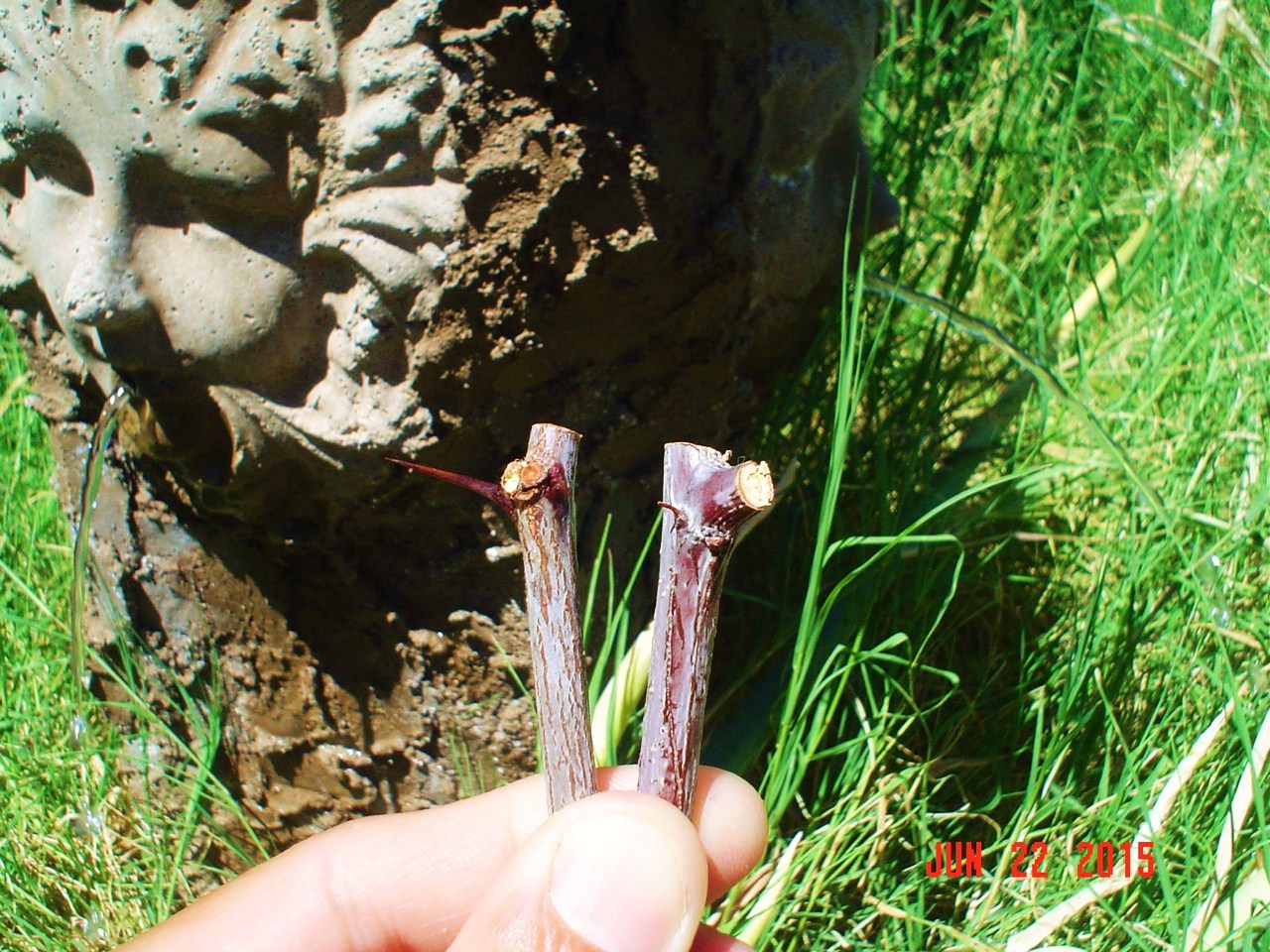
below is a pic of two sticks of identical caliper, which has subtle but tell-tale characteristics. The left one is a secondary shoot, while the one on the right is a primary shoot. Left one has a really thick fruiting spur/node, scarred by deciduous fruiting branchlets, and the node spans almost the entire thickness of the budwood. Also note that with secondary shoots of thorny varieties, the bigger thorns are proportionally longer, more straight, and thicker, relative to caliper of budwood. Secondary shoots could also have pairs of short and hooked thorns, so using thorns as a guide isn’t reliable.
the right one looks like a chicken bone, and the node beneath the stumps is quite tiny relative to the overall thickness of the budwood. Noticeable as well is that the two stumps above the node are quite thick, as one is the continuity to the primary shoot which was cut off, and the other is that of the secondary shoot which was also cut off. Hardly visible is one of the tiny hooked spines of the pair i mentioned earlier.
i guess the quickest way to tell primary from secondary is that the primary shoot has two prominent thick-caliper stumps, whereas the secondary ones only have one thick stump, and one thick fruiting spur(or node)
1 Like
I just wish I could actually order from roger. I have emailed multiple times for multiple seasons but never managed to get a response.
For the grafting, I’m not sure why people bother with bench grafting jujubes? Planting the rootstock and grafting after it starts growing is basically 100% successful. I have had grafts that were terrible cambium matches that I thought had no chance to take and even those do well on jujubes. The budwood seems to be fine even after 6 months in the fridge.
he’s a busy guy. Am sure he gets plenty of email from all over america, as the popularity of this fruit is accelerating… You need to call him.
he’s certainly a good guy who does his business via honor system. Each time i order from him, the jujus arrive at my doorstep before i could even mail the checks!
http://www.jujubesales.com/Contact-Us.php