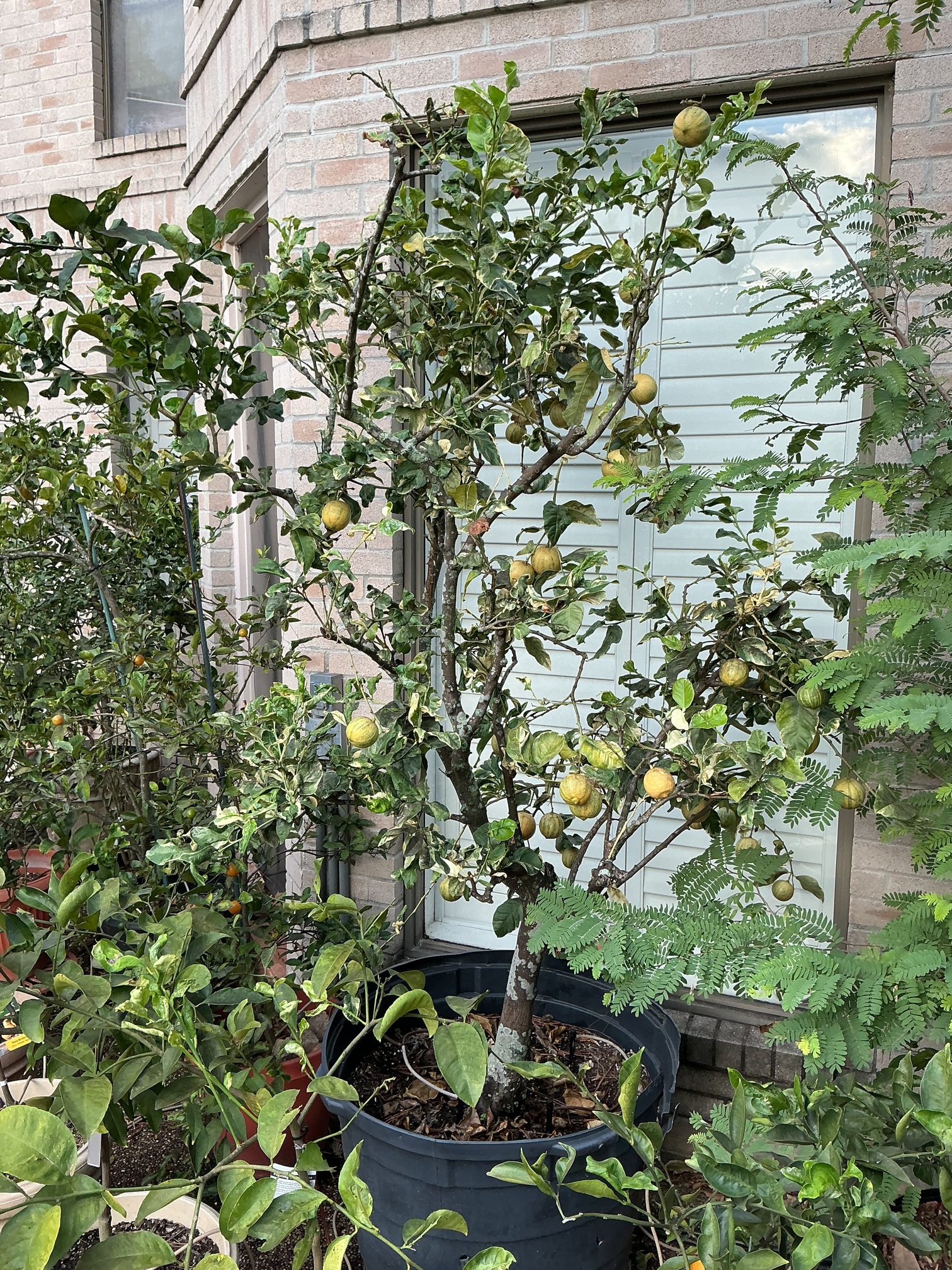
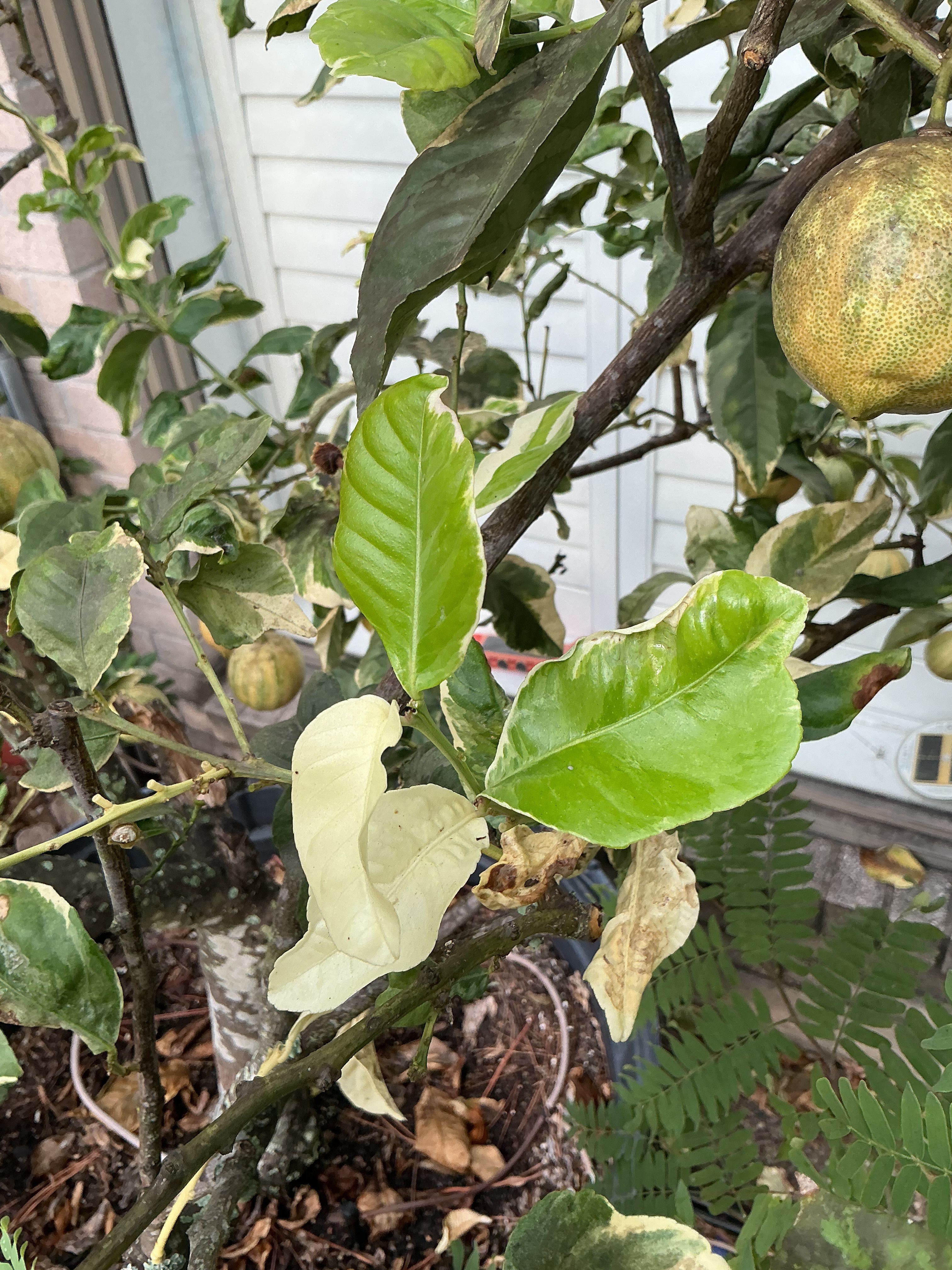
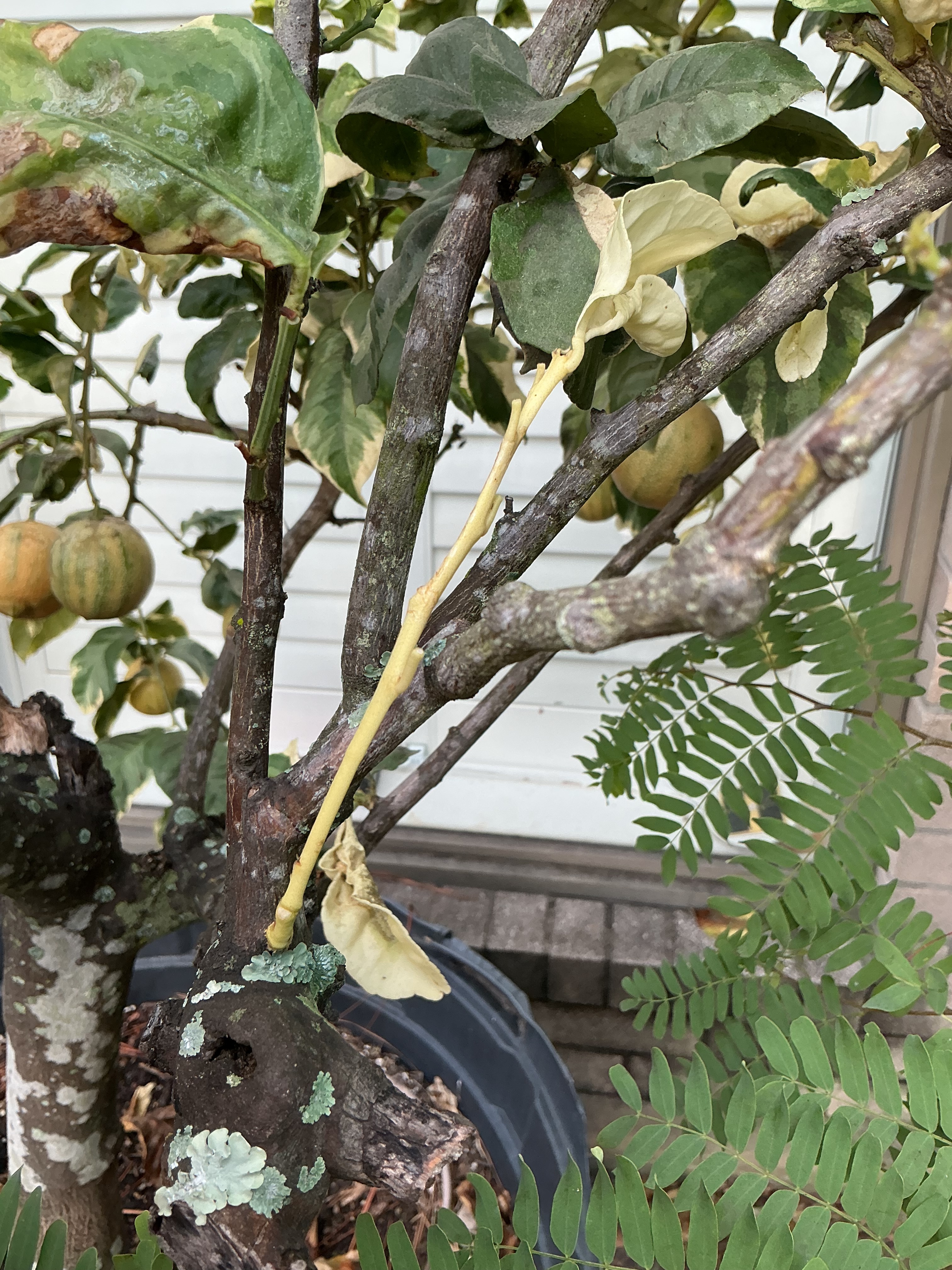
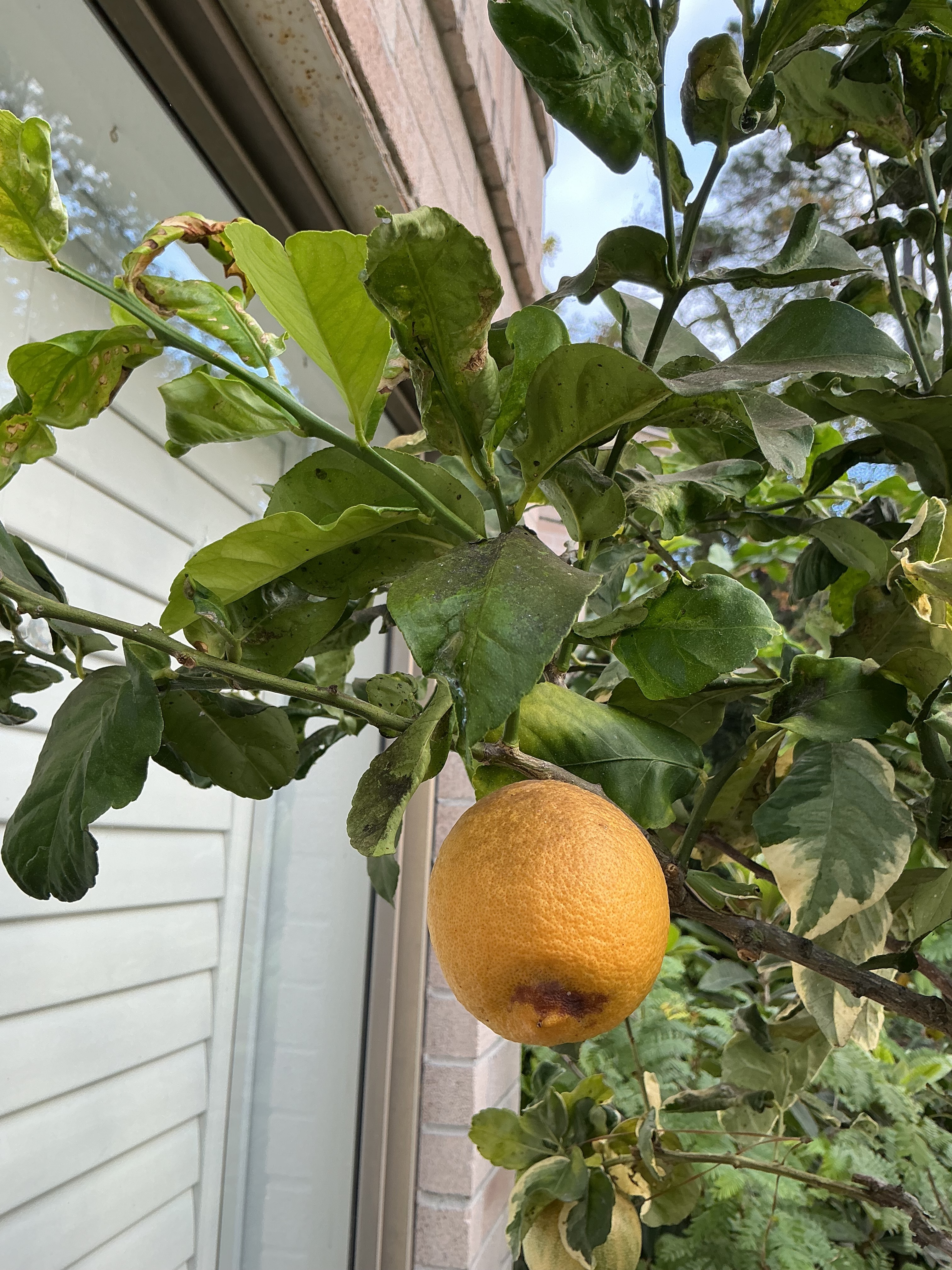
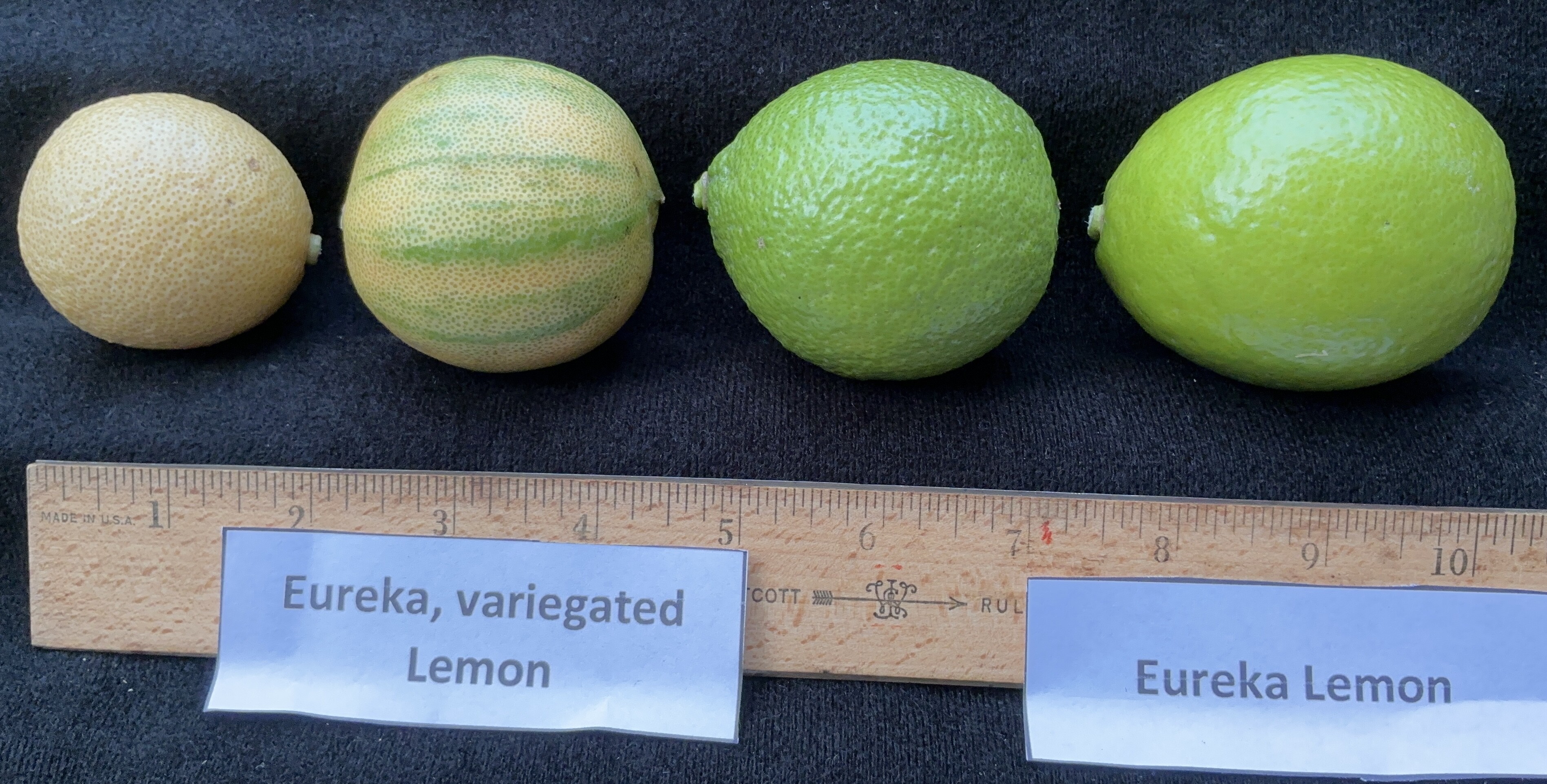
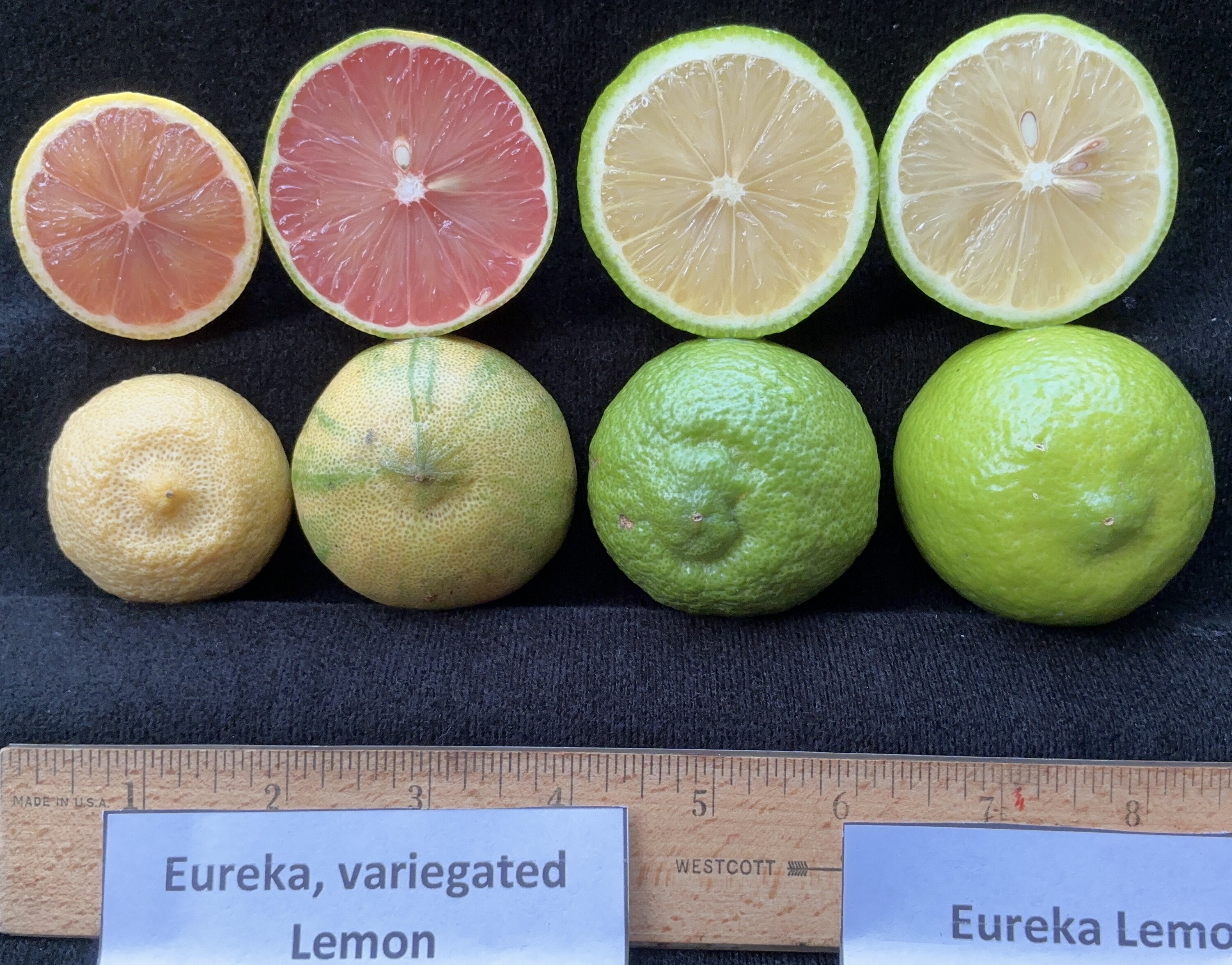
Here is a photo of 4 fruits from left-to-right: an all-white non-striped fruit from an “albino” branch (note the smaller size), a regular variegated Eureka fruit, a non-striped fruit green fruit from a reverted branch on the same tree, and a fruit from a regular Eureka cultivar for comparison:
An update: of the two Harumi seeds, one was too disintegrated when I received it to even germinate. The other seed was intact and pushed out two taproots and two sprouts (clearly polyembryonic! a very good sign for true-to-type cloning). I did not try to separate the two seedlings, so my “double” seedling is now approaching a foot in height. I will grow it/them out for another year, then if any buds reach T-budding or chip-budding size, I will top work it onto a vigorous rootstock or foster tree to hopefully speed it to maturity. Fingers crossed!
Exciting!
I also have one germinated at the same time, producing two seedlings. Growth in pot so far seems vigorous. Plan to put inground as one bush next year.
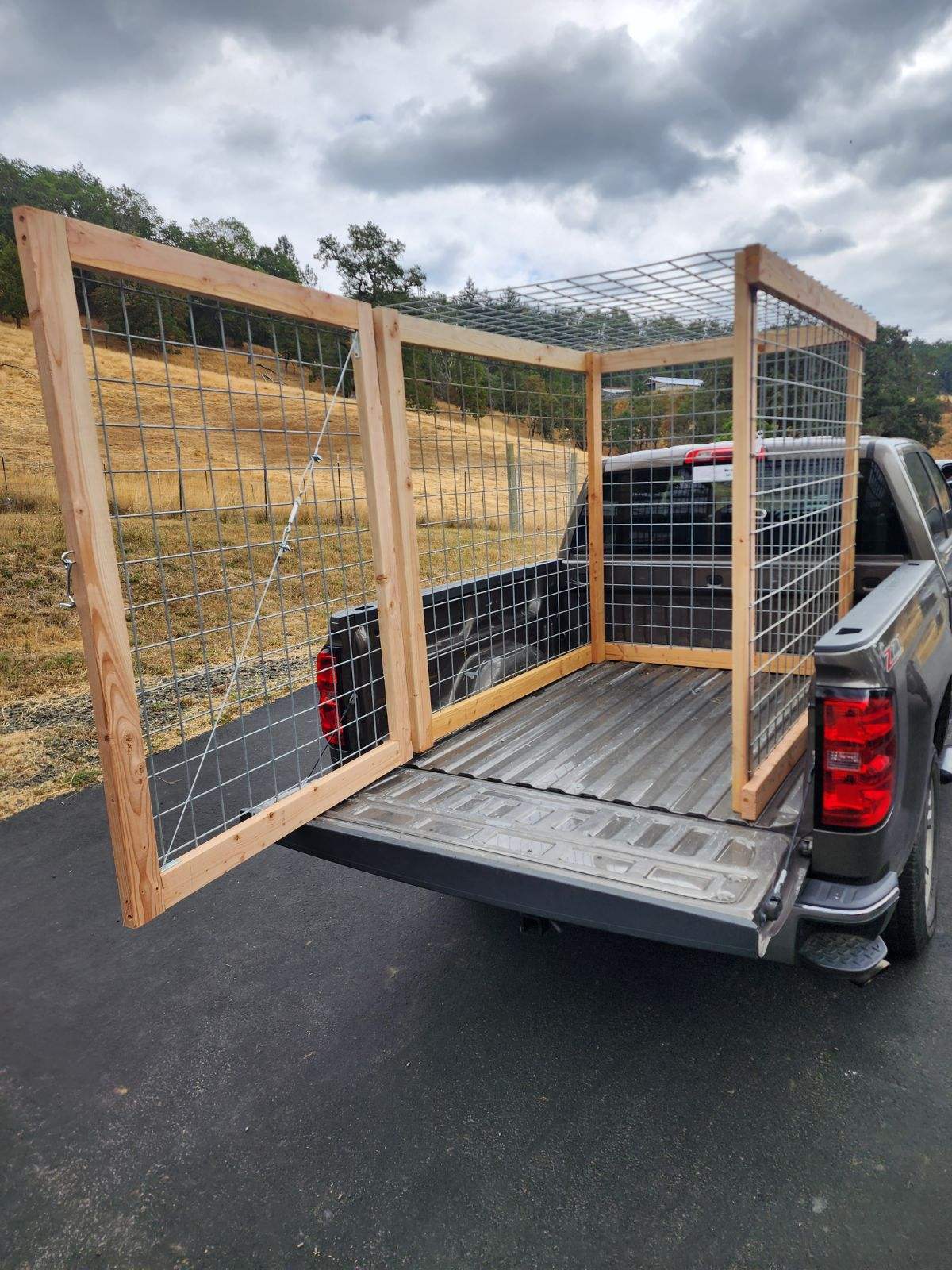
Thank you. I will have to look at the tree more closely when I rotate the trees around and see if any of the leaves/ fruit still have the variegation right now. I have them in a pen I built to haul a couple goats at a time if we had to evacuate due to a fire. It’s pretty small for 4 citrus trees. I have to pull one out to look at or move the others. At the far end is a thorny one, which I think is all flying dragon after too much winter exposure several years ago, when they all died back to stubs. After that I got some perforated plastic from Territorial Seeds and it keeps them about 10 degrees above ambient temperature, and even lets just enough rain through. I crack the door open on a warm day.
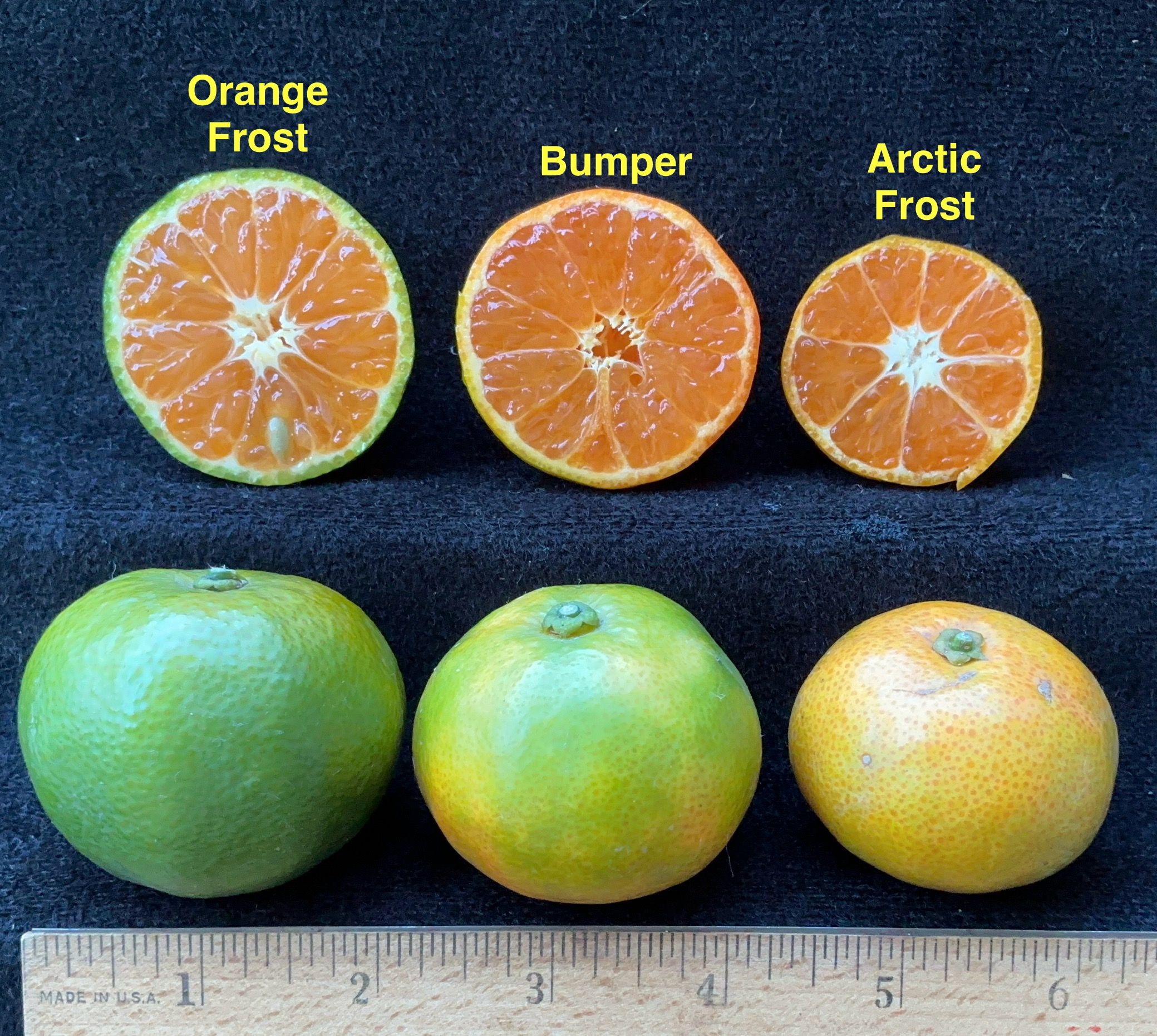
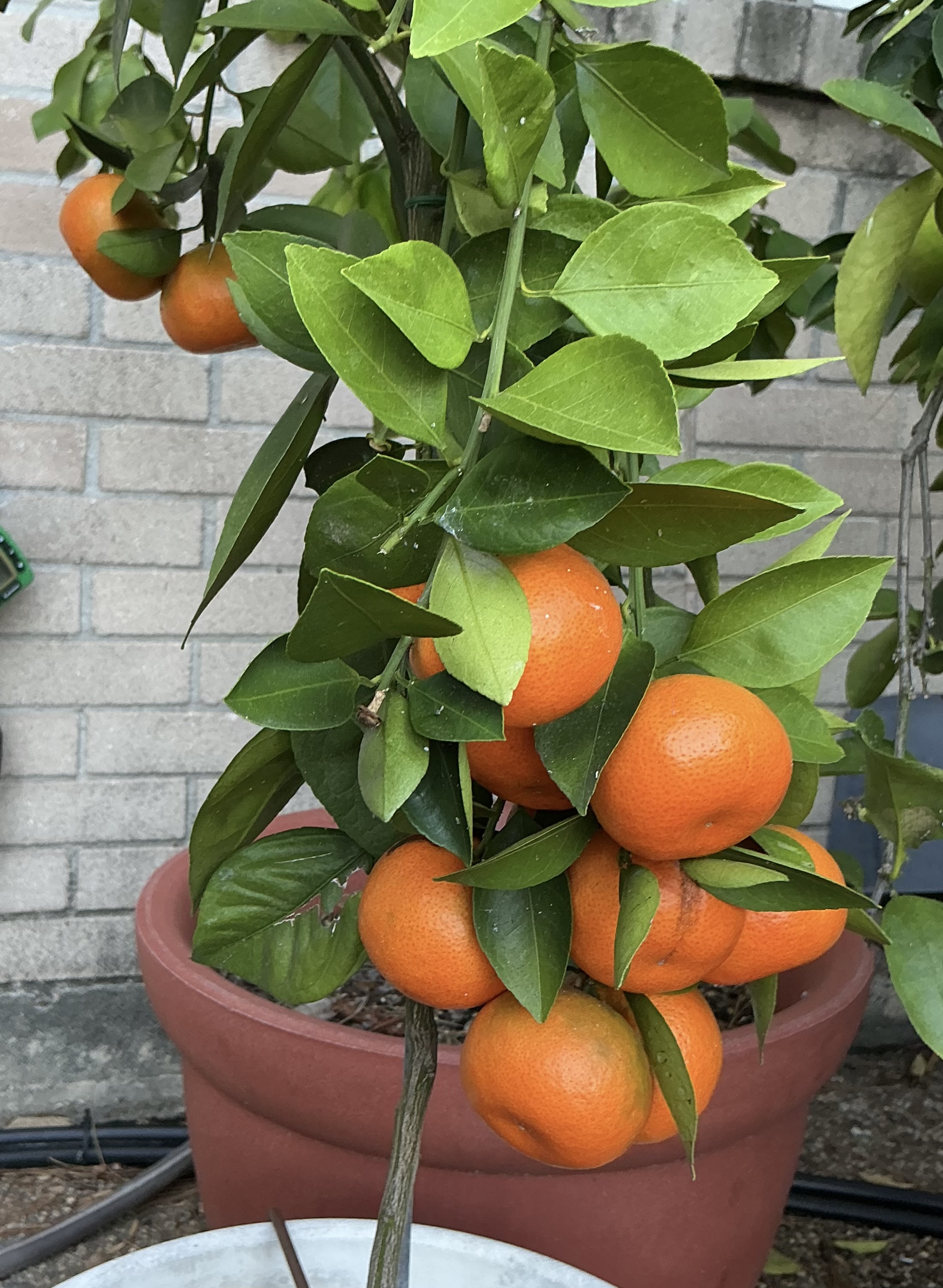
In the 1990s a Chinese plant scientist, Dr. Ying Doon Moy, working on hybridizing hibiscuses, papayas, and other plants at the San Antonio Botanical Gardens was approached by horticulturalist Dr. Jerry Parsons of Texas A&M University with the idea of crossing the seedy, but cold hardy “Changsha” tangerine (winter hardy to the Dallas area) with a legally-seedless Satsuma in an attempt to create a very cold tolerant seedless mandarin hybrid (technically a “changsat”). Because Satsuma is strongly polyembryonic (essentially all the embryos in its seeds are clones of only the “mother” plants genes), Dr. Moy had to perform “embryo rescue,” carefully dissecting each resultant seed under a microscope to identify and extract and grow only the very smallest embryo in each one (the only zygotic embryo present). Dr. Moy’s painstaking efforts resulted in three “sister” hybrids initially designated: “Gremoy 79,” “Gremoy 47,” and “Gremoy 8.” After extensive field testing here in Texas, these hybrids were subsequently plant-patented and renamed “Arctic Frost,” “Orange Frost,” and “Bumper,” (respectively) and released as licensed cultivars through the Texas Citrus Budwood Program in Weslaco. To-date, Saxon Becnel and Sons holds the exclusive right to propagate these 3 trees commercially for sale to the public in Texas. Early field testing by Texas A&M has shown the “Arctic Frost” is cold hardy down to about 10 F degrees under ideal conditions. Here is a photo of the late Dr. Moy’s three “sister” hybrids and a second photo of the aptly named “Bumper” in our orchard in The Woodlands north of Houston. Seek them out wherever Saxon plants are sold.
I think I never added the feedback here from the “official fruit taster” of the family of my six Satsuma taste challenge (see above). She favored Arctic Frost (as did I), then Brown’s Select, then Miho Wase, then my seed-grown Satsuma (possibly Okitsu Wase, but could have been many others), then Bumper, then in last place Orange Frost. The first three (Arctic Frost, Brown’s Select, Miho) have been on my “Best Citrus Varieties for Southeastern Texas” for several years, generally beating out the other 11 Satsuma cultivars I grow here in SE Texas for both taste and reliability. Your mileage may vary, so let me know if your favorite Satsuma might beat out these 3.
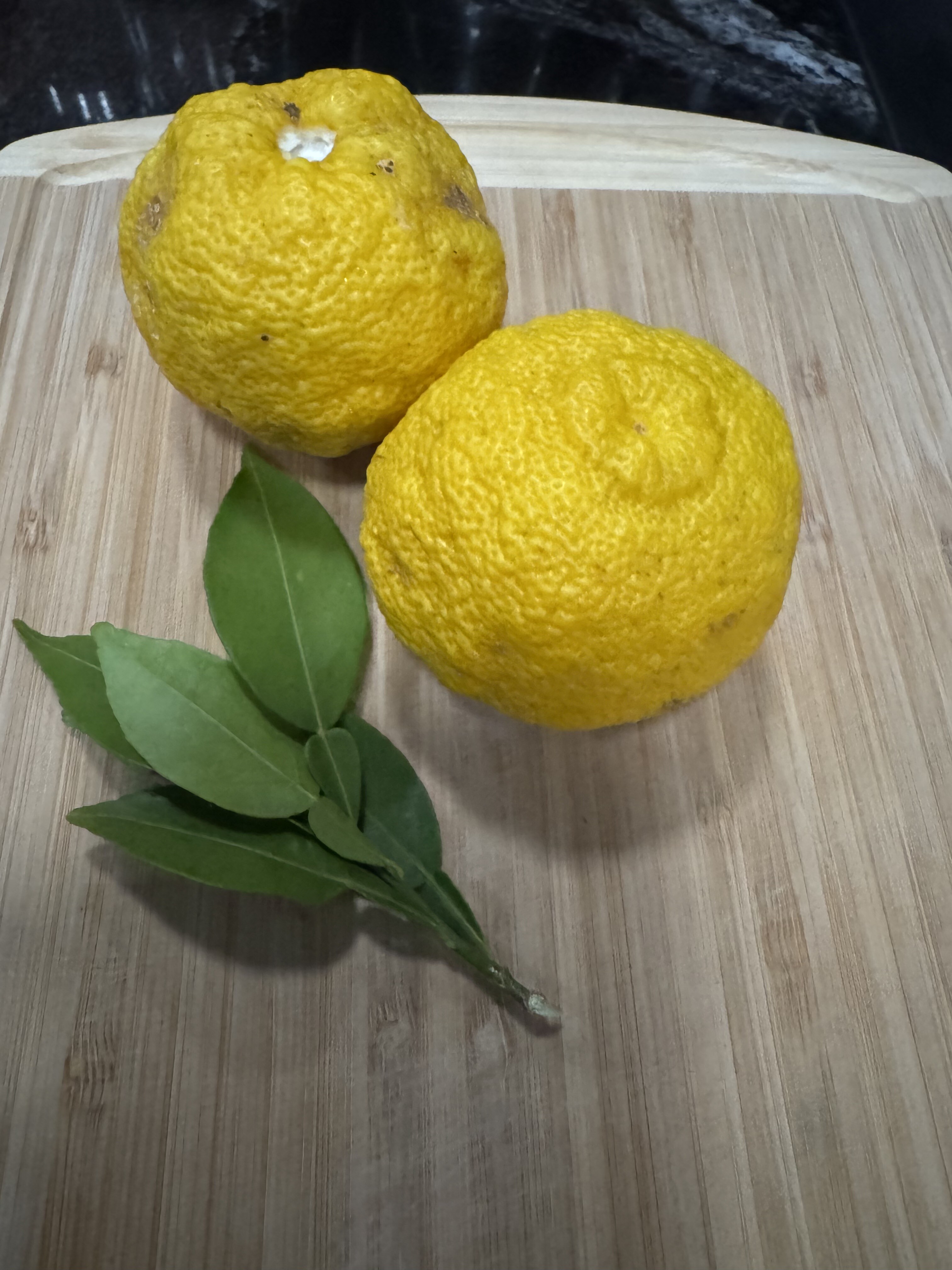
I am surprised that your Thomasville has so much color already. My Thomasville fruits (SE Texas) are still very green. They usually become pretty good to eat (relatively speaking!) by January, but begin drying out internally soon there after. They are really best regarded as a lime substitute, I think, while still very juicy. Rarely do I find someone who likes to eat them whole (like a kumquat), although at a couple of public citrus tastings I have had 2 different women rave about the flavor. Maybe their taste buds were destroyed by COVID?
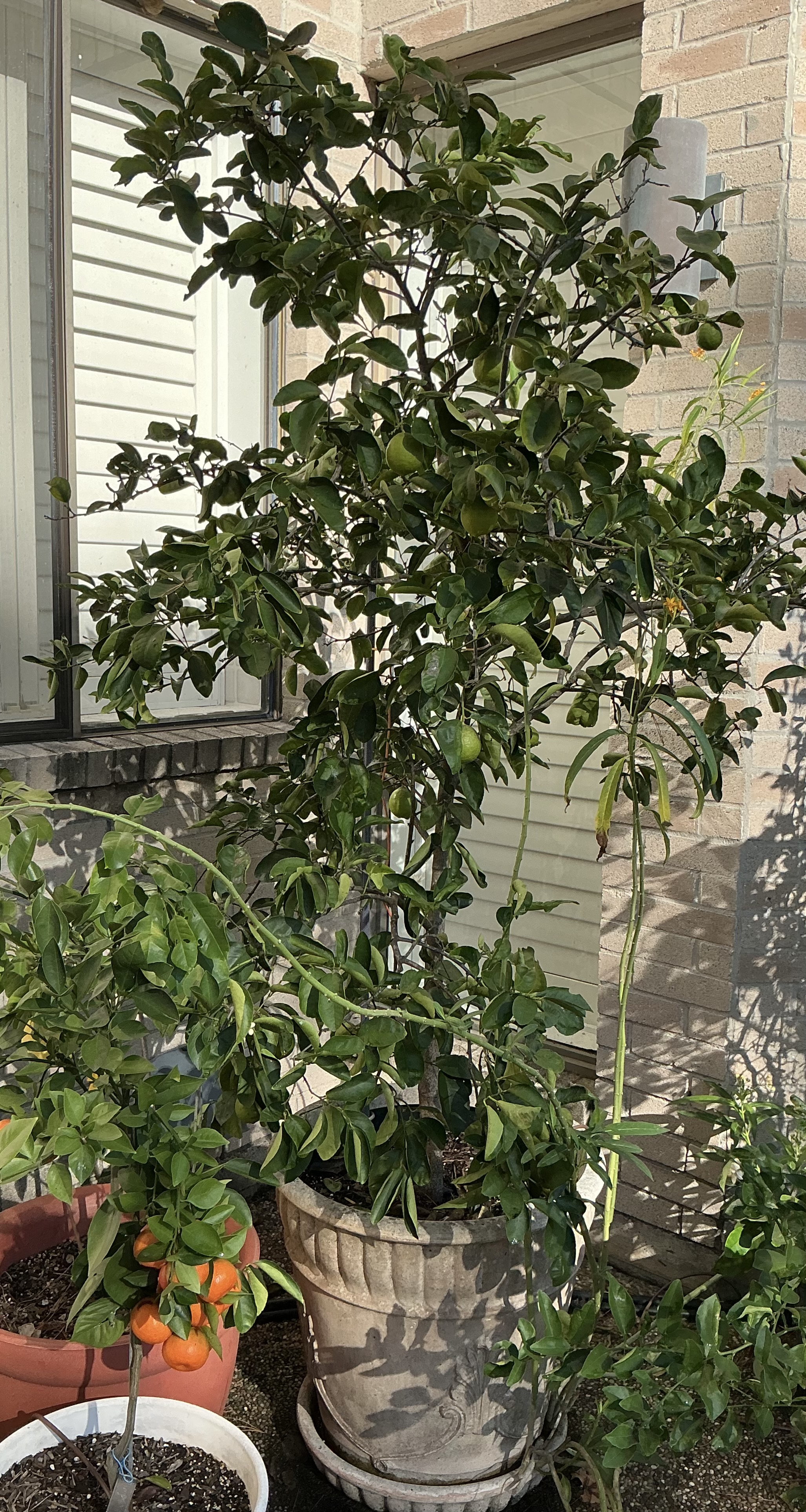
Among the over 110 cultivars of Citrus we grow, primarily in the ground, in The Woodlands, TX (about 30 miles north of Houston, supposedly USDA Zone 9b) is a roughly 10-year-old Persian Lime in a large container.
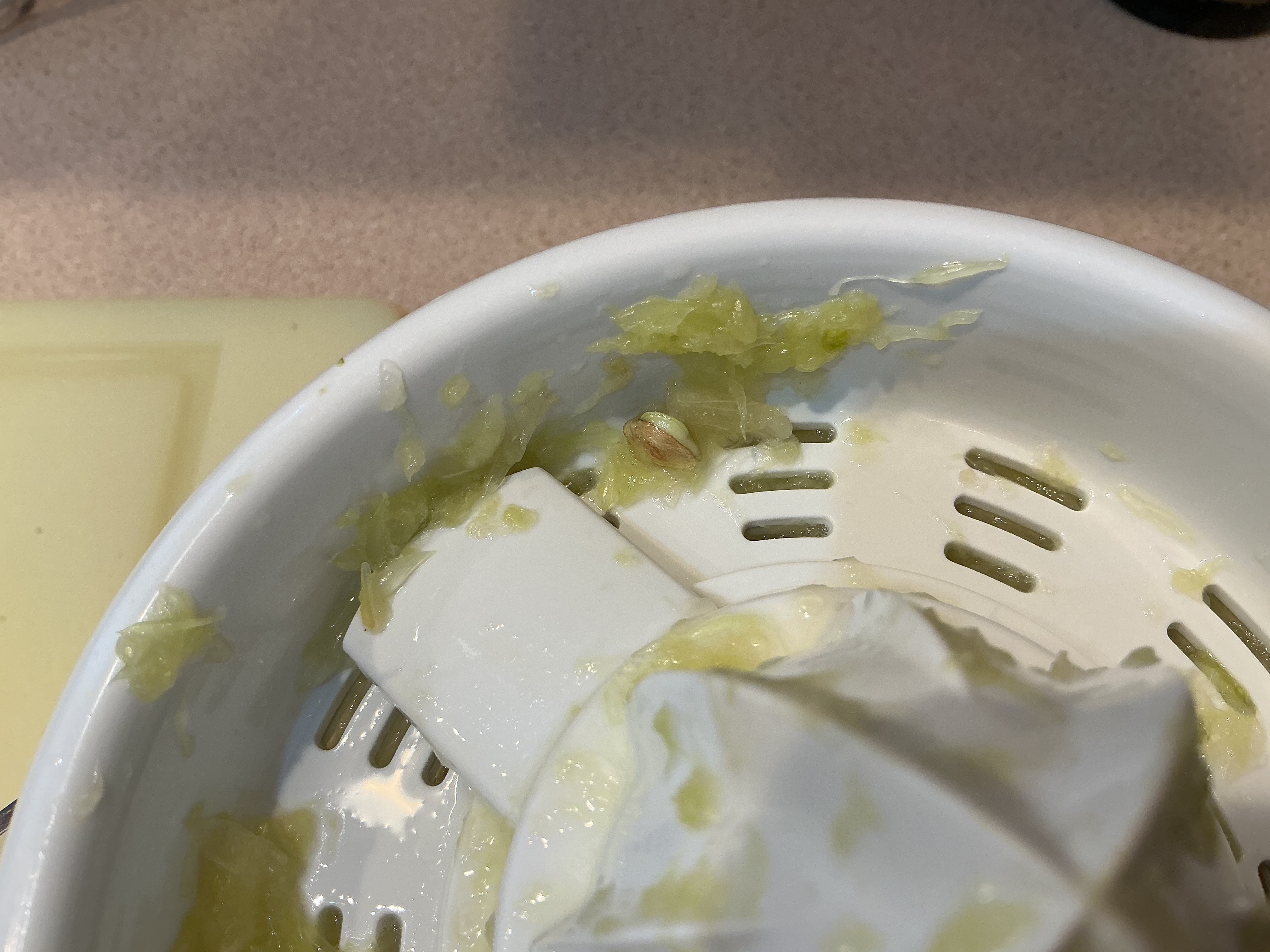
Although still subject to freeze damage in the upper 20s F or lower, Persian lime trees are slightly more winter hardy than Key/Mexican lime, and they produce larger fruit in much greater quantities. Unlike seedy Key/Mexican limes, Persian limes are a naturally occurring triploid, so in theory they cannot produce any viable seeds. In practice, I typically find 1-2 seeds for every 50 or so homegrown Persian limes I juice. (As the great Yogi Berra once said, “In theory there is no difference between practice and theory, but in practice there is.”).
Here is the only viable seed I found in a batch of 50 home-grown Persian limes:
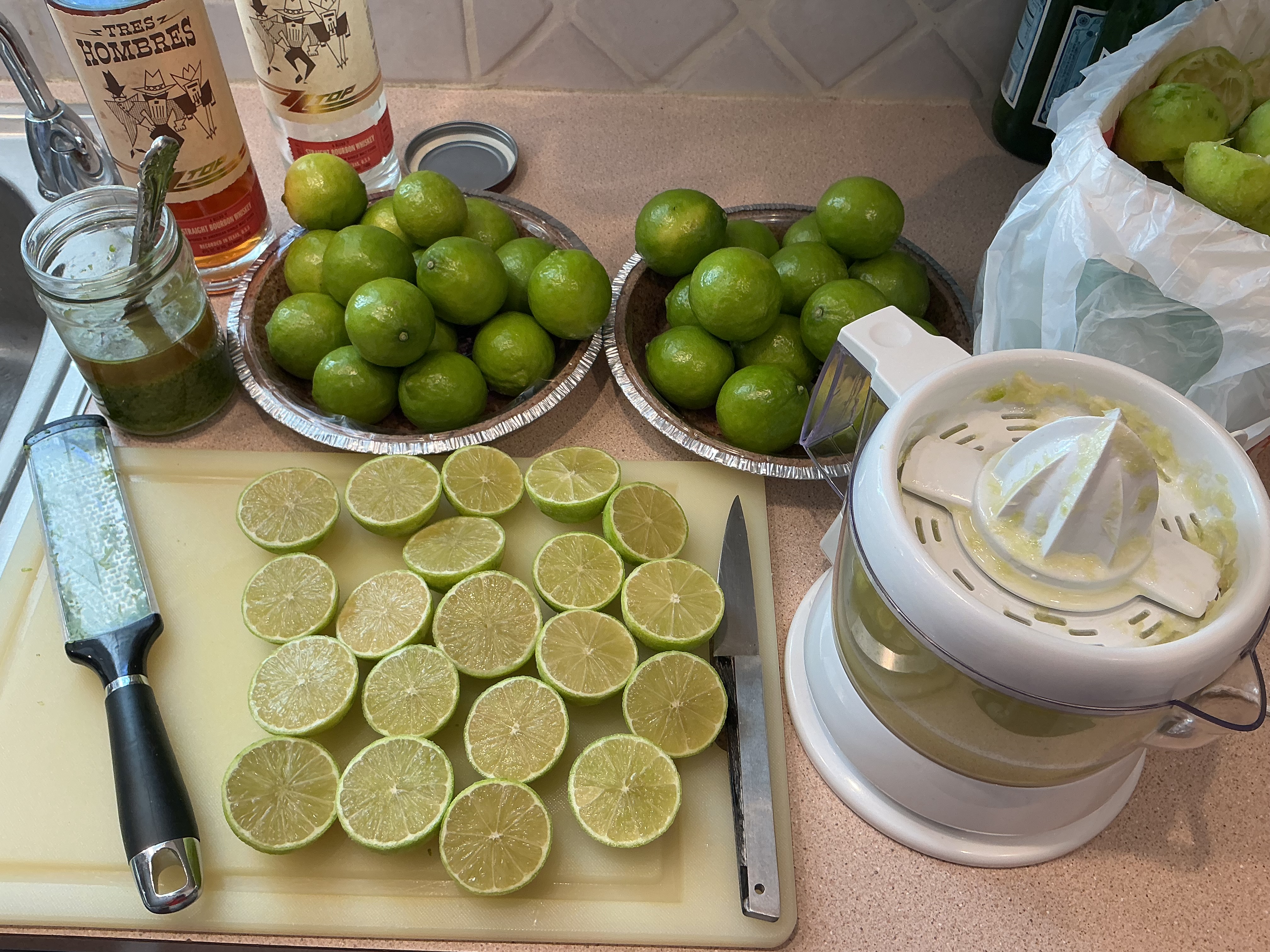
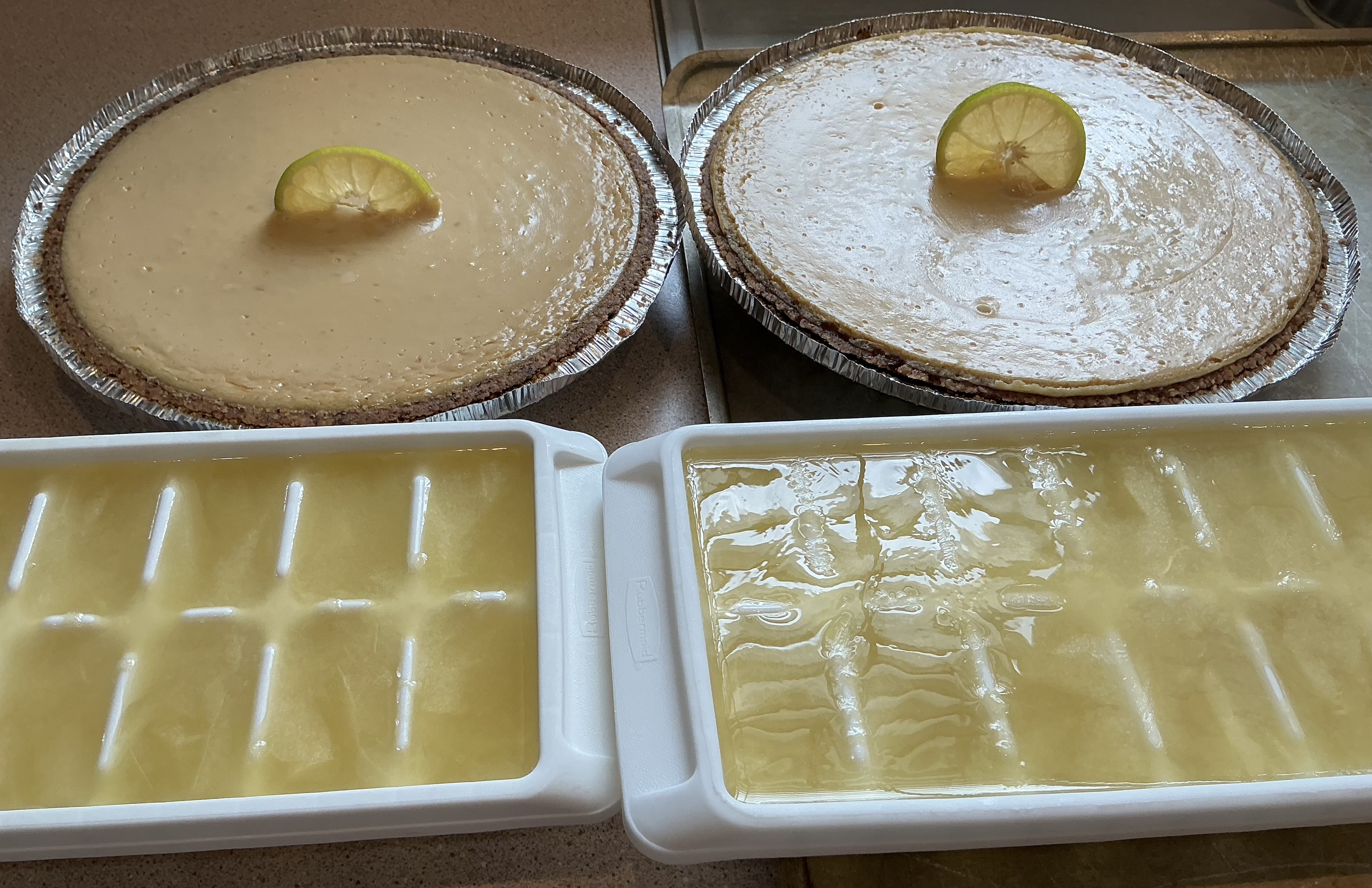
I washed them and started a batch of “Lime-cello” from their zest, made 2 lime pies for Thanksgiving, and froze 32 oz of juice as cubes for future use. FYI, although I typically use home-grown Finger lime juice vesicles, these 2 pies are each topped with a home-grown Lemondrop (lemonquat) slice “twist”.
Like to use limes for cooking or drinks? Do consider growing a Persian Lime tree, but keep it in a pot to move indoors temporarily if a freeze threatens!
I didn’t get any Xie Shan fruit this year (probably due to back-to-back 20 F freezes in Jan. and Feb.), but usually Xie Shan ranks at/near top too. Thanks for the reminder.
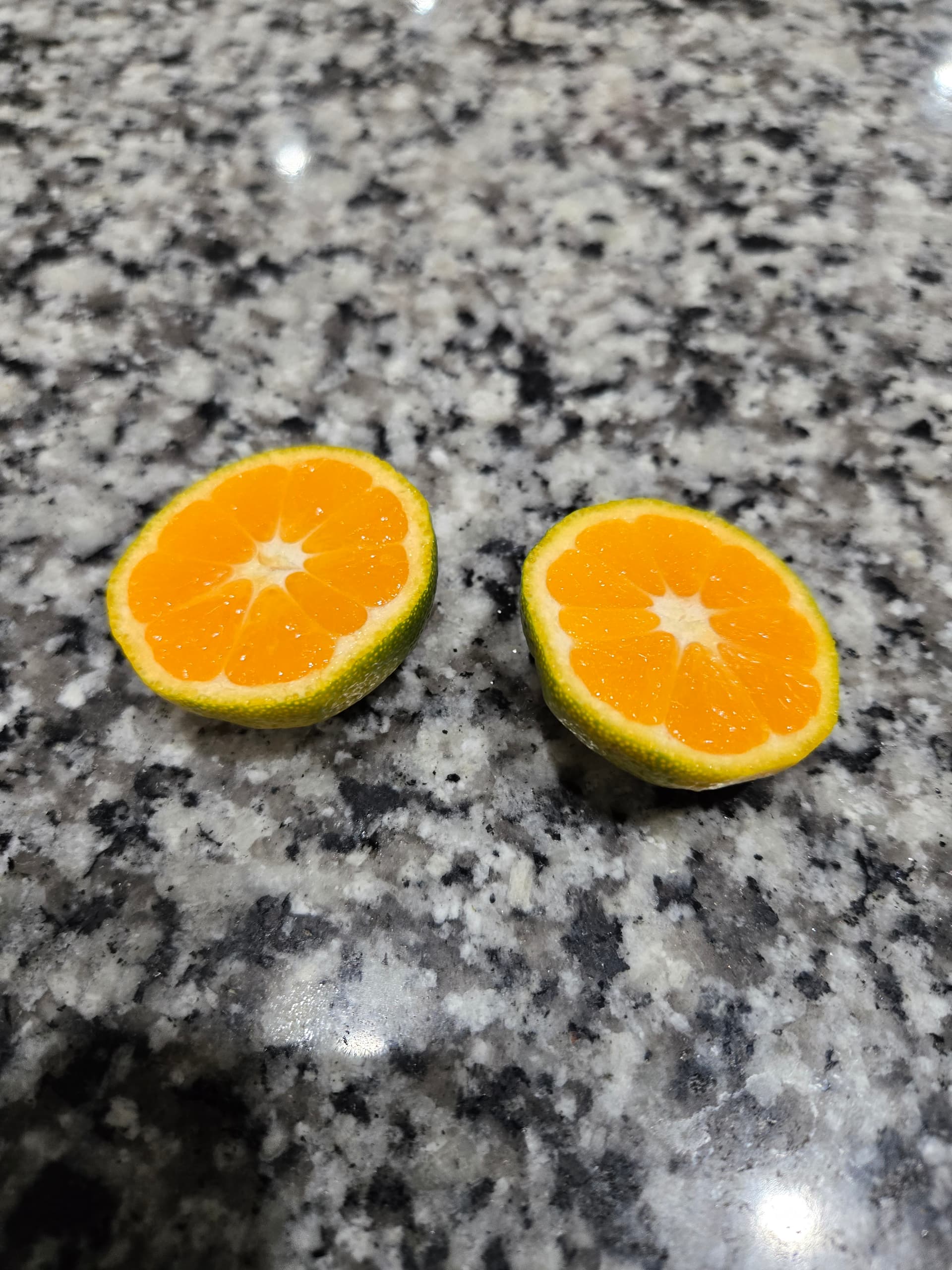
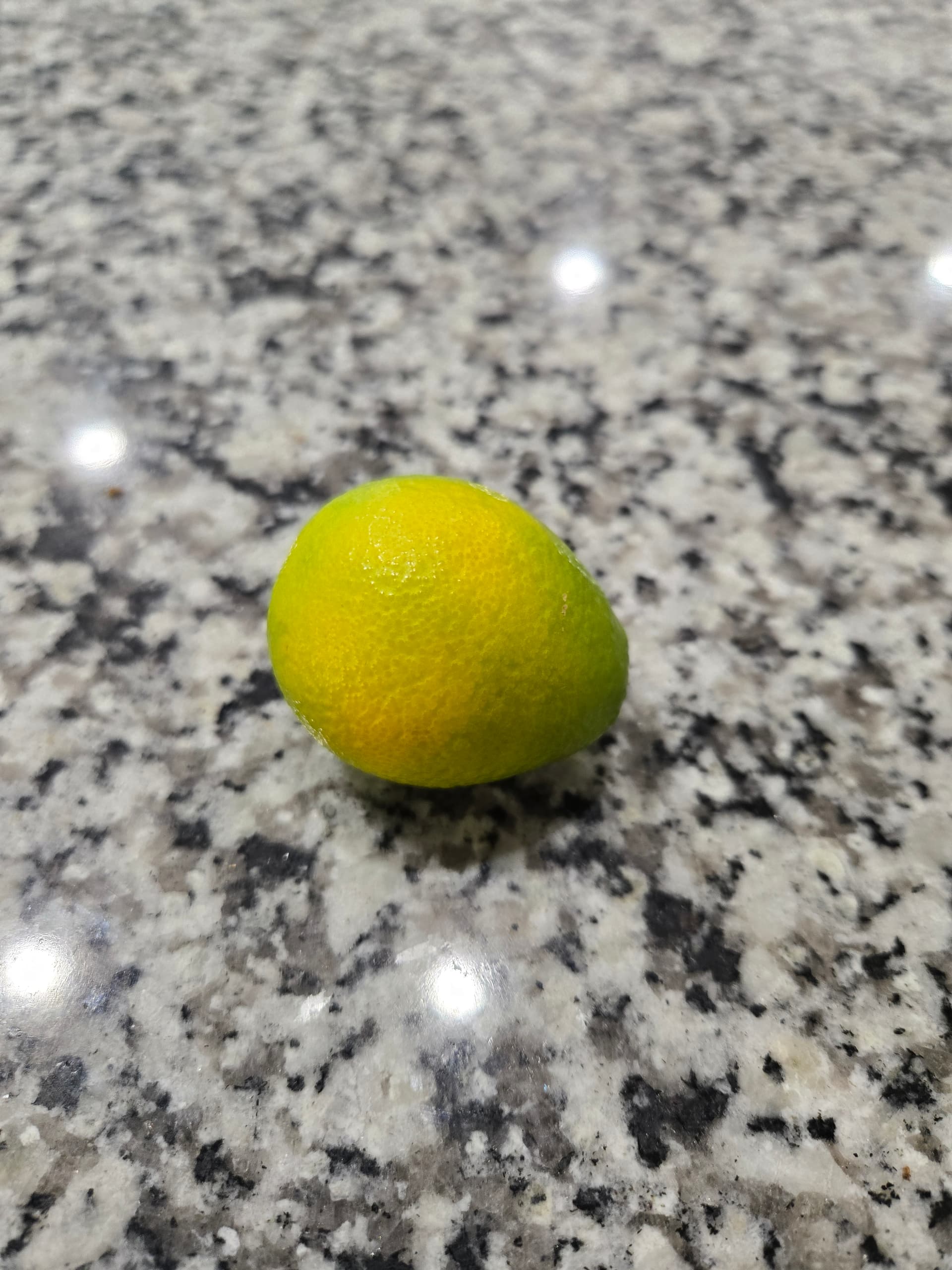
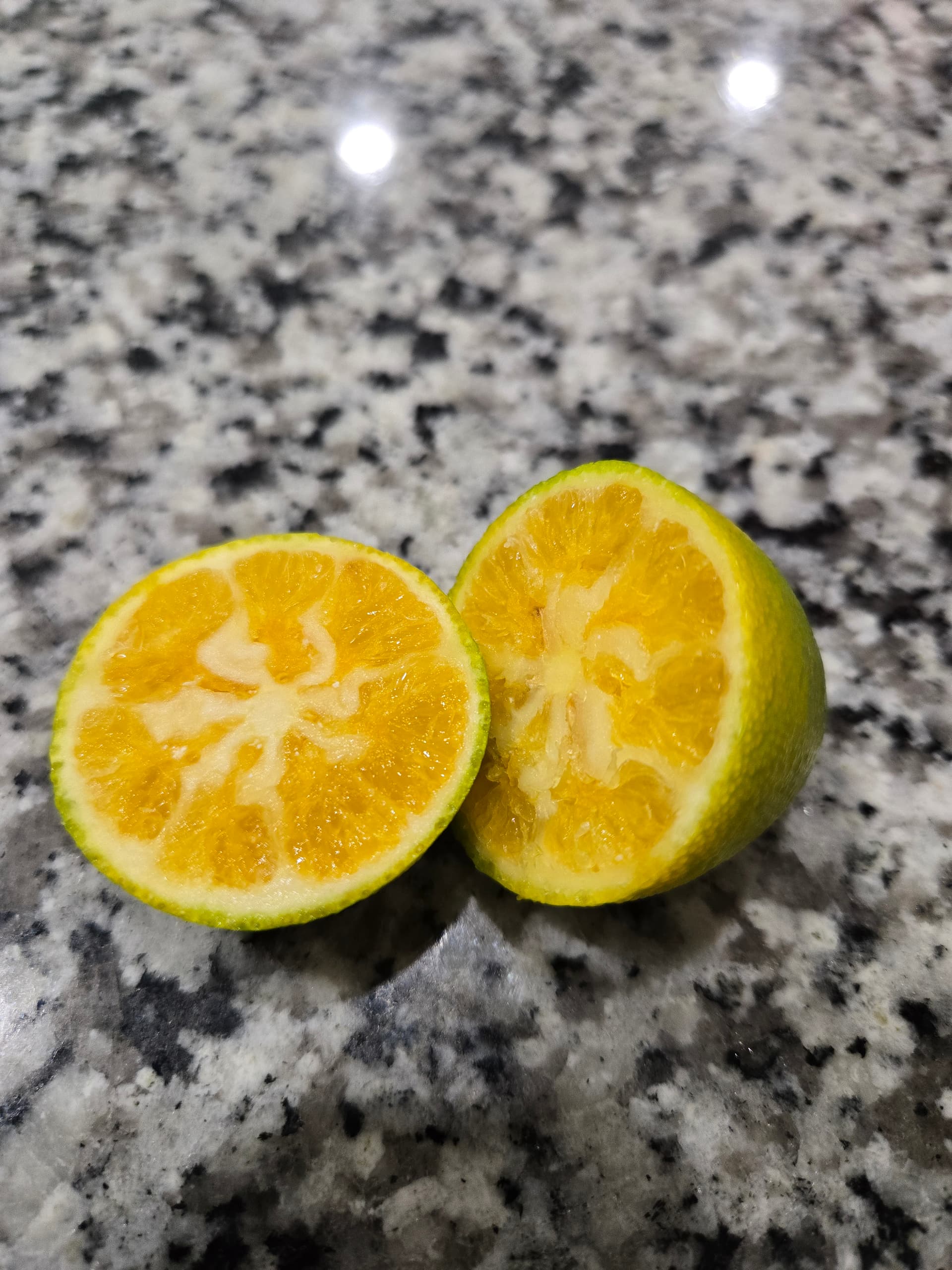
I dont know about eating Thomasville out of hand. This one even though it was mostly orange didnt have much sweetness. I did notice that the flavor was pleasant so i cut a few that were more green and those were great to use as lemon or lime substitute.
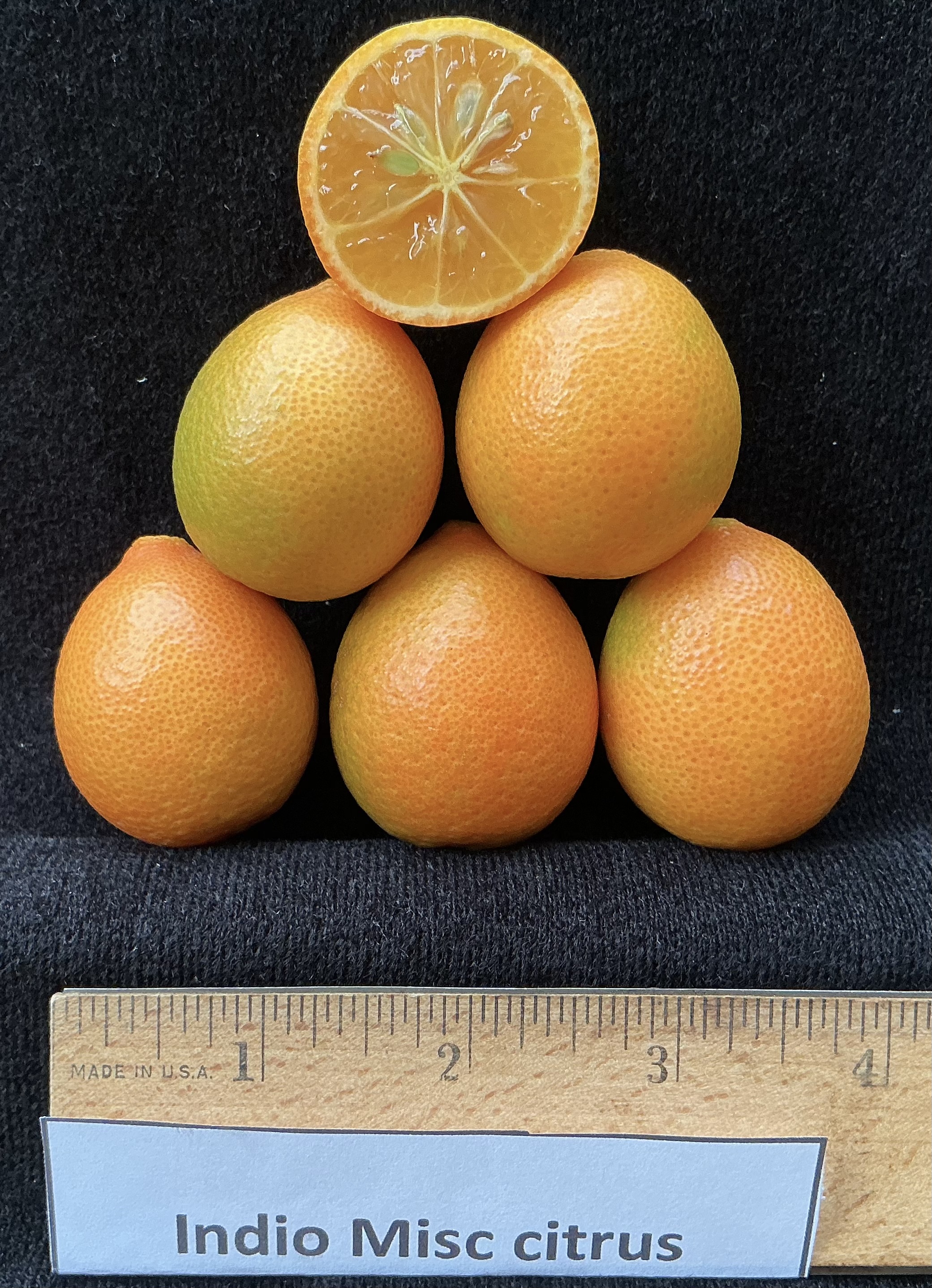
In the 1960s a seedling citrus was discovered growing underneath a Nagami kumquat tree in Orlando Florida that produced an unusual kumquat-like hybrid fruit. Budwood from that seedling was sent to USDA citrus researchers in Indio California for further evaluation and they eventually decided to release the new hybrid commercially under the name “Indio Mandarinquat.” For many years now Indio has been available in Texas through the certified citrus budwood program in Weslaco (along with the very similar “Nippon Orangequat”) and budded Indio trees were offered for wholesale by Brazos Citrus Nursery. Prior to the recent Texas citrus quarantine restrictions, Greenleaf Nursery also grew and sold rooted cuttings of Indio. In the past few years Indio budwood from Weslaco has become available in only limited quantities and sadly commercial growers are longer offering Indio trees to retail sellers.
The plant itself is probably about as winter hardy as kumquats. Our cutting-grown in-ground Greenleaf Indio tree (in The Woodlands north of Houston) is about 10 years old, around 7 feet tall, and reliably produces about 15-20 pounds of fruit each year, in 2-3 flowering flushes each year. It gets protected by only a large tarp for sub-20s F freezes. Here it is a couple days ago:
The fruits are about golf ball sized and the main (first flush) crop ripens in late November and throughout December. The thin peel is sweet (like a kumquat), but the very juicy and seedy interior is quite tart (about like a calamondin):
Dead-ripe I can eat only a few of these out-of-hand before I start to worry about my teeth enamel dissolving. They do, however, make amazing marmalade and stewed sauce (with lots of sugar!), and I have made several wonderful “lime” pies with the tart, but very flavorful juice. Martha Stewart and other chefs have a large number of Indio desert recipes online and I have sometimes seen the fruit for sale at our local grocery store in winter. If you live in the greater Houston area, I will have samples of our home-grown Indio fruit available for tasting (if you dare) at the free TRFG citrus tasting event in Houston on Saturday, Dec. 6.
Arctic Frost, Orange Frost, and Bumper are all patented varieties that are liscensed exclusively to Saxon Becnel & Sons Nursery (growing facilities located in Texas and Louisiana). Saxon does wholesale millions of citrus trees annually into the nursery trade (especially big box chains like Home Depot and Lowe’s, but also to mom & pop nurseries). I have seen Saxon-grown Meyer lemon trees for sale at a Home Depot in Omaha Nebraska, and have been told their citrus trees are sold in Home Depot stores in Georgia. Look around locally, you might just find a tree.
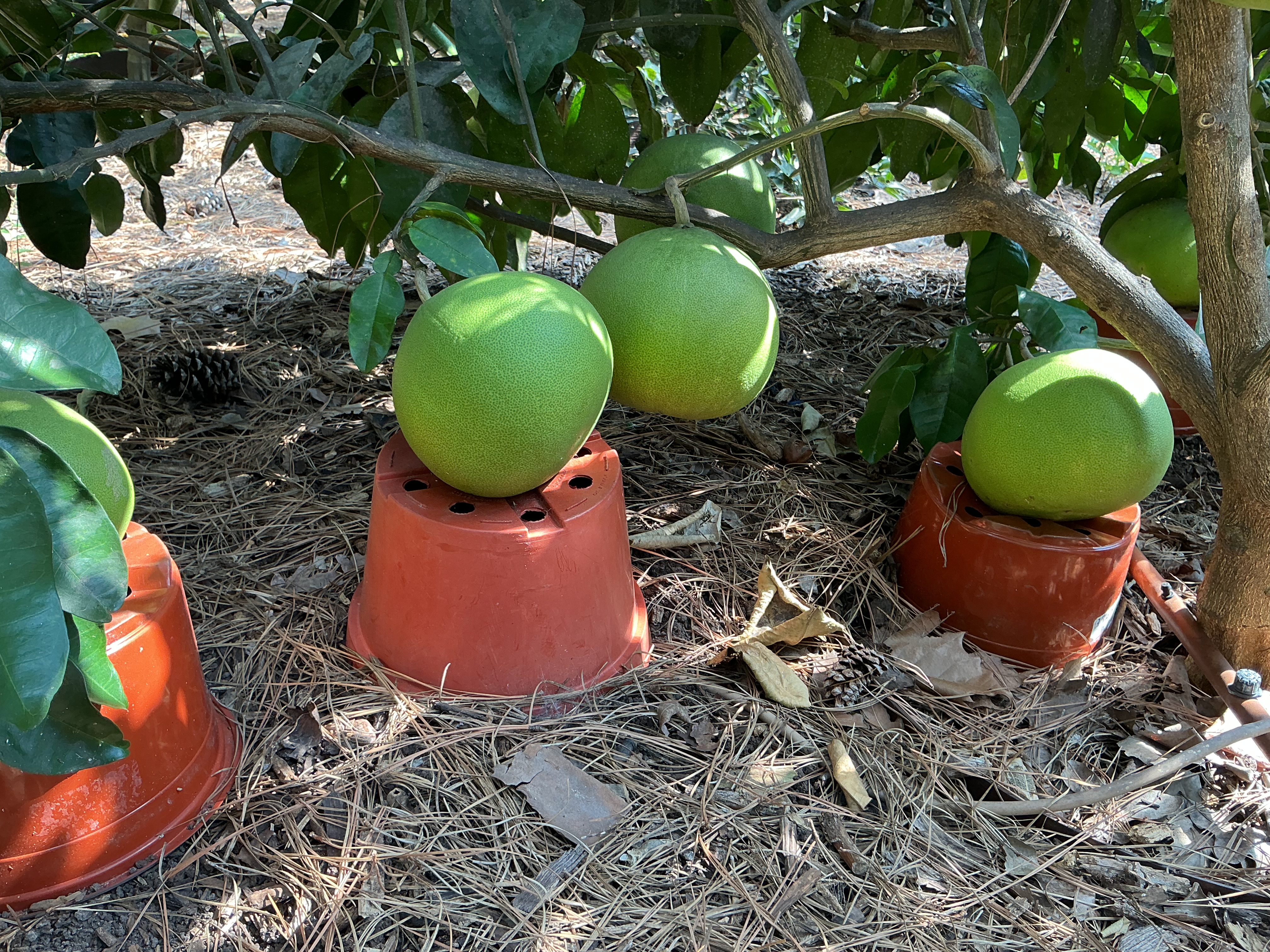
We grow the following 8 pomelos and pomelo hybrids (mostly in-ground) in our orchard in The Woodlands TX (30 miles north of Houston): Bien Hoa, Chandler, Hirado, Nam Roi, Oroblanco, Sarawak, Thong Dee, and Valentine. Of these, Hirado is consistently our favorite for great flavor, sweetness, fruit size, and reliable fruiting. After significant freeze damage from successive sub-20 F freezes, essentially every year since 2020, we have had poor success with fruiting pomelos, but do have one or more fruits on Bien Hoa, Hirado, Oroblanco, and Sarawak this year. About a month ago I picked a Sarawak fruit, and it was still quite tart. Yesterday I discovered another Sarawak fruit had a small split in the peel and it was just starting to ooze juice. I picked it and we ate it last night. It had a lemon-lime flavor, was soft and very juicy (unlike most pomelos, which are more firm-fleshed or almost crunchy), and still moderately tart. Here is our in-ground Sarawak tree a few weeks ago, with inverted pots to keep the fruit from contacting the ground:
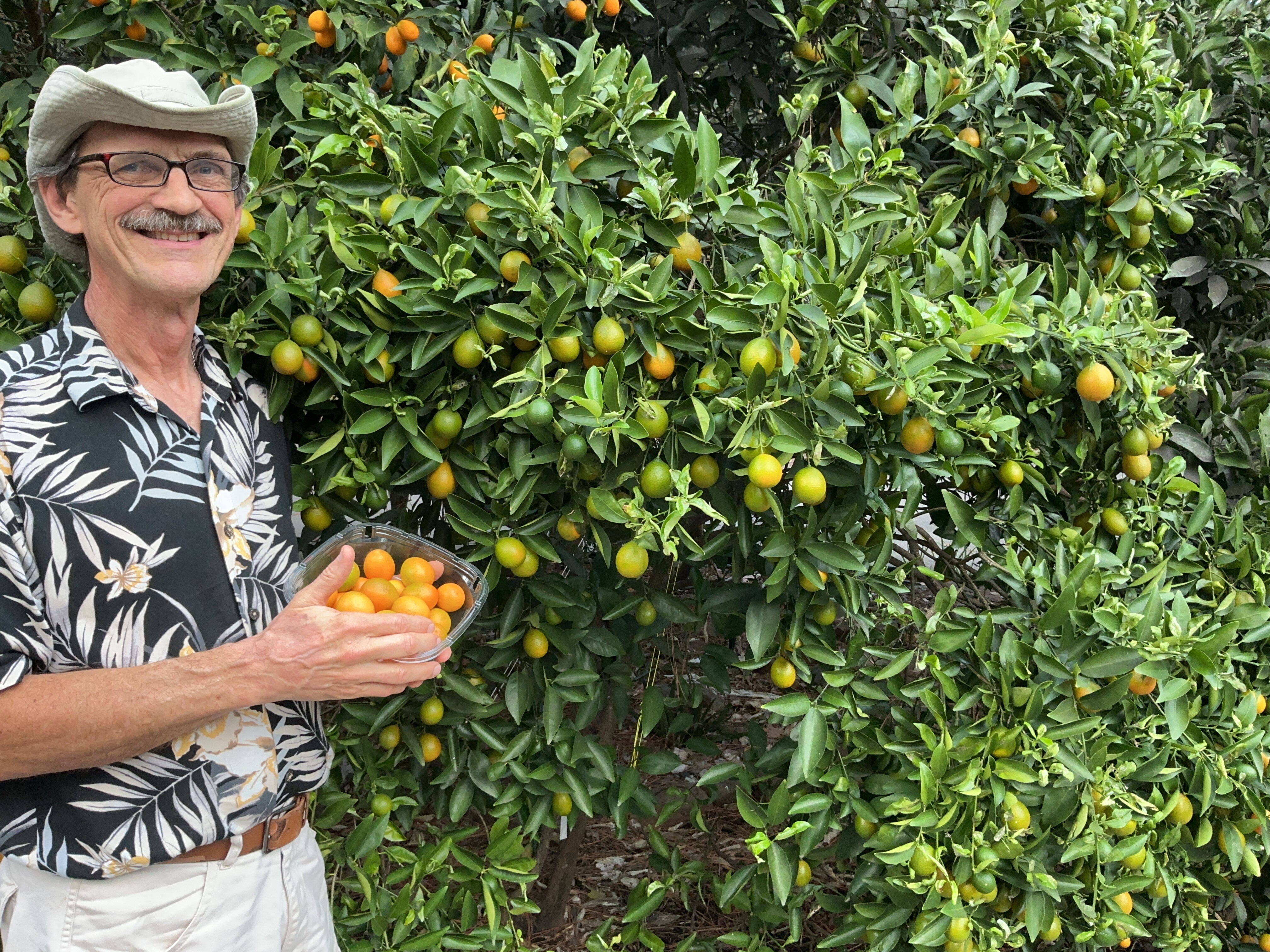
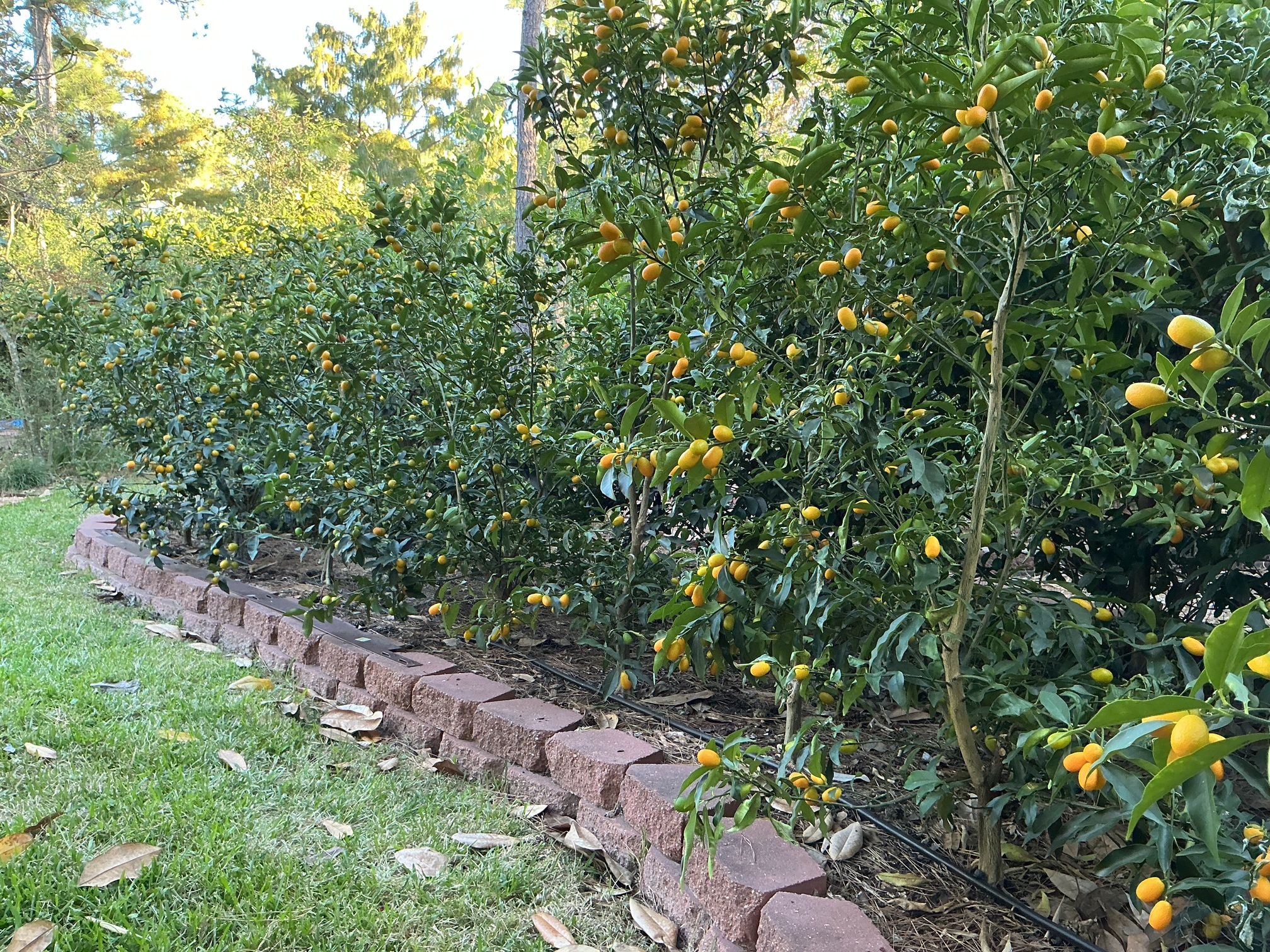
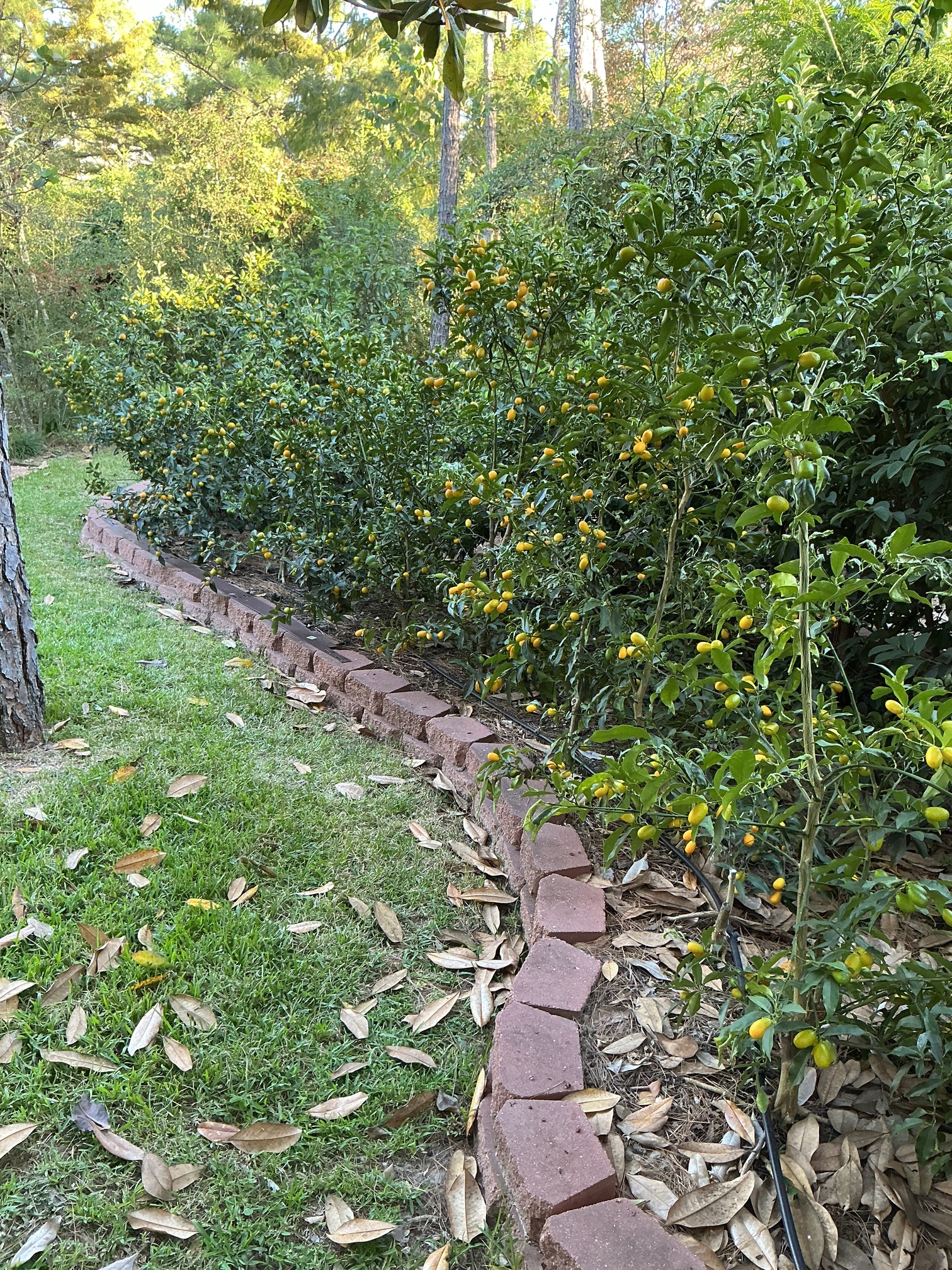
About 6 years ago I planted a hedge/border planting of in-ground kumquats (5 Nagami, 8 Meiwa) in a raised bed in our orchard (The Woodlands, about 30 miles north of Houston, TX). In February of 2021 we dropped down to 10 F degrees and stayed below freezing for 72 continuous hours. The kumquat trees were mounded with fresh damp hardwood mulch to about 4-6 inches above the graft line. All of them died back to the mulch, but none died down to rootstock. In December 2022 we dropped to 12 F degrees, and again I lost the entire canopy on all the trees down to the mounded hardwood mulch. One kumquat tree wasn’t adequately mounded, and it died down to the citrange rootstock (I have since re-grafted it). In January 2024 we dropped to 17 F. Our kumquats had only a medium-duty tarp for protection (no mulch) and there was only some minor limb dieback. Both Meiwa and Nagami suffered about the same amount of damage. In January of this year we dropped to 20 F, and to 22 F a few weeks later. These kumquats had absolutely no protection whatsoever. They showed no freeze damage and are now loaded with many pounds of ripening fruit. Kumquats are a winner in my book. Depending on freeze timing and duration (and rootstock type, cultural practices, tree health, etc), they are easily hardy to about 20 F and possibly lower in SE Texas without any protection. Here are a couple photos of that kumquat hedge (now about 6-7’ tall) a few days ago:
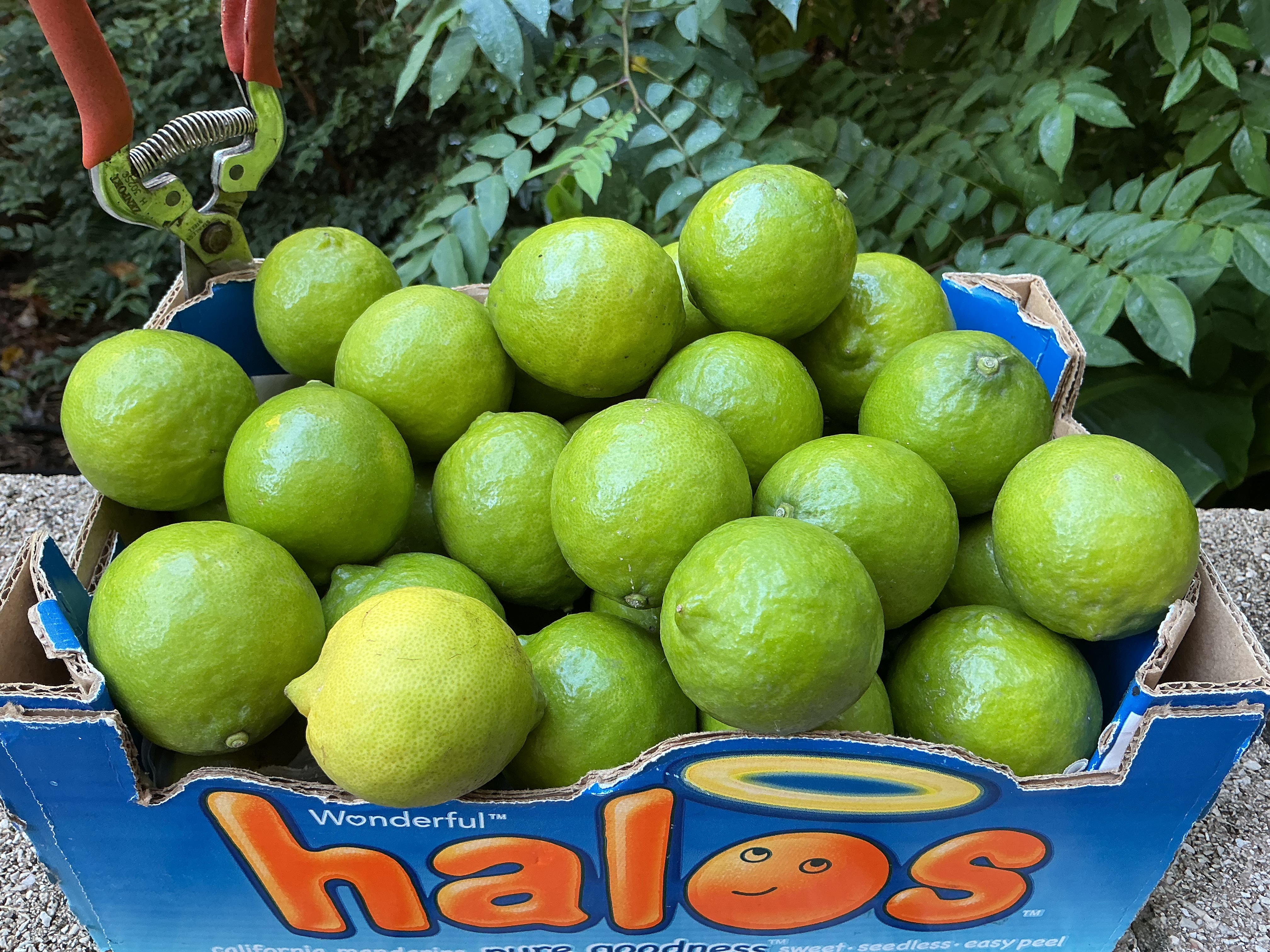
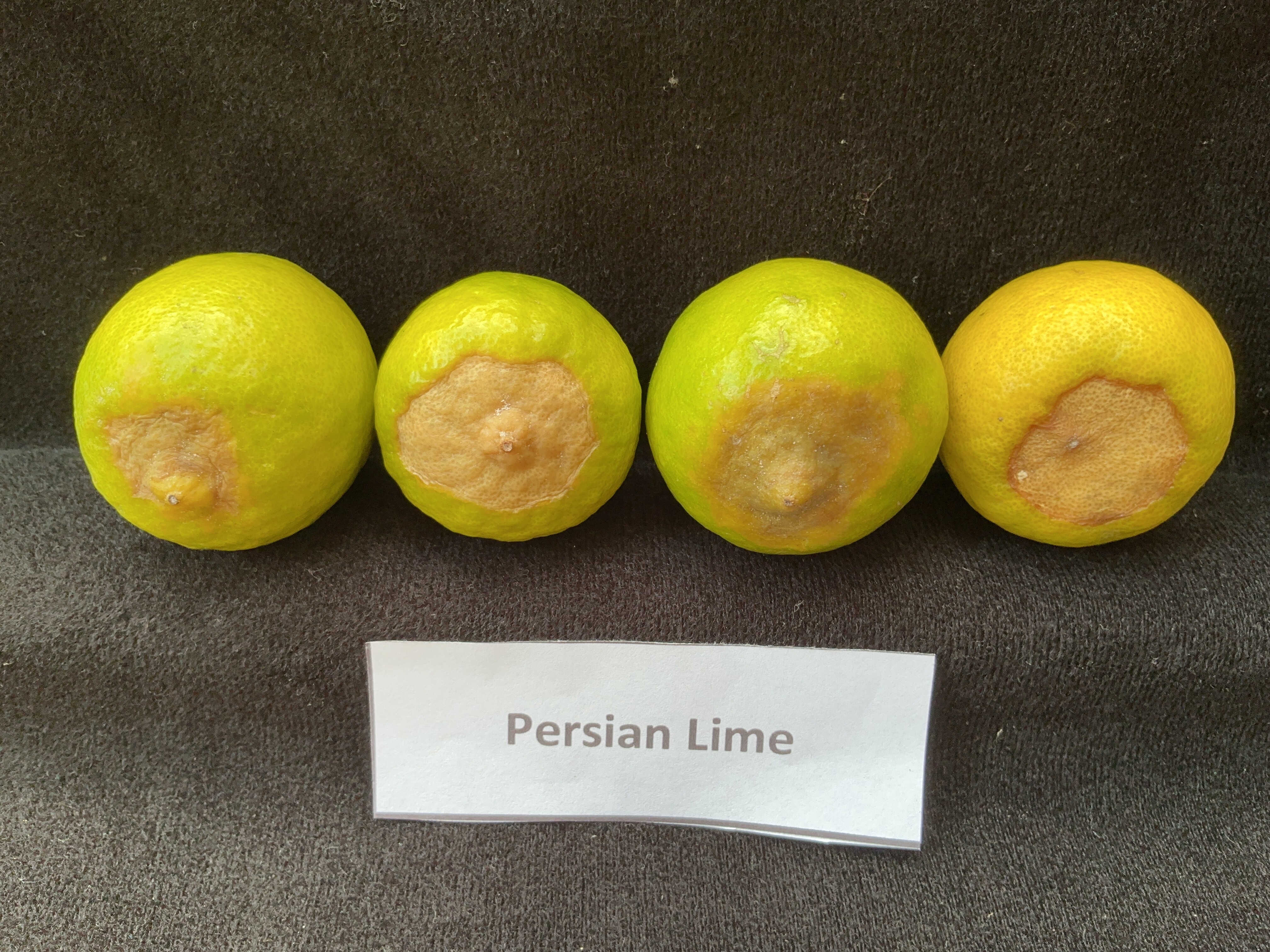
Note that the yellowish one at lower left was just starting to suffer from Stylar-end breakdown (SEB). SEB is a well-known disorder of Citrus fruits. It is initially caused by the rupture of juice vesicles at the stylar end due to high turgor pressure and stress from hot, humid conditions. This breakage allows juice to enter the rind, leading to localized breakdown and eventual rot. Fungal species like Geotrichum citri-aurantii are the common pathogens. Our Houston area limes (Persian and Key), Lemons (Meyer, Eureka) and other thin-skinned Citrus seem most susceptible. There is little to be done to prevent it besides harvesting fruit as soon as they are ripe. Here are some of my 50+ Persian Limes with advanced SEB (I.e. starting to spoil internally):