…man,
Now… THERE’S A PROJECT TO WARM THE HEART WITH ANTICIPATION.
Whatever you do please take timeline photos so we can see the progress and final SUCCESS.
Mike
…man,
Now… THERE’S A PROJECT TO WARM THE HEART WITH ANTICIPATION.
Whatever you do please take timeline photos so we can see the progress and final SUCCESS.
Mike
I was going to give someone else a chance, but this project looks like too much fun to not comment on. Though I hope Alan gives us his thoughts on it as well.
After seeing the pic, my thinking changed a bit:
1.) The tree looks healthy enough that I don’t think you need to graft to the suckers (unless you want to dig them up and transplant).
2.) This tree looks big enough that you could put 10-20 varieties on it without them being too crowded.
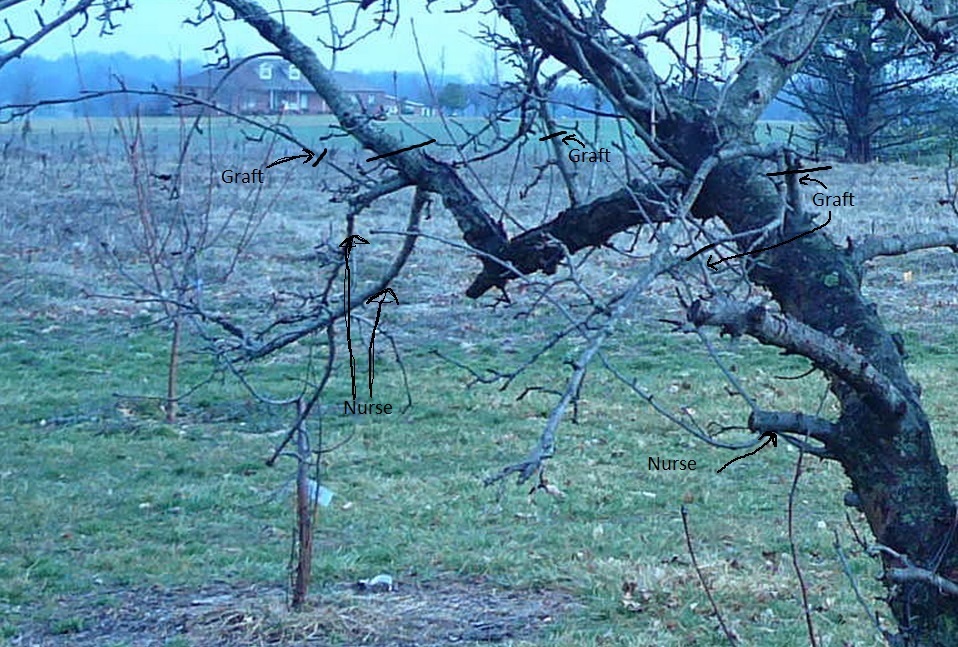
I zoomed in on part of the tree and (crudely) drew a few examples of places I would look to graft (at least 4 grafts in this area along). I think that the easiest part to graft to will be the small wood which is coming off the big wood. The ones going up get the graft, with a few pointing down left as nurse branches. Keep in mind that I’ve never renovated such a mature tree like this. But it looks like fun. I bet you’ll get great growth out of the grafts.
As always, thanks bob. I’m glad you and mes111 can see why I’m looking so forward to this project. I, too, hope Alan will chime in too. I really am lucky to have such a mature apple tree right smack in the middle of my brand new orchard.
The way you (Bob) illustrated your suggestions make it much easier to understand what you described. On question I have about it is: if I do graft to some of the upwards growing shoots/small limbs, do I immediately cut off everything else on the big limb (except nurse limbs) or do I wait a while?
The only down side to this project and this thread is that I got a little excited and posted too soon. We are probably a month away from grafting season here, so I hope everyone doesn’t loose interest. I’ll certainly repost when I do the work. Meanwhile, I’m open to all comments and suggestions.
The other good thing about this tree besides it age and size is that I really does have a LOT of limbs and spouts that are spread some distance apart, so I think its true that I should be able to attempt several grafts with several varieties. I’d love to do 20 but I’ve only got about 4-5 scion varieties! But that should be plenty for me! I definitely do want to make it a cocktail tree if I can, though.
Thanks, all.
There isn’t any single way to change over a tree. The most common way is to use cleft grafts or bark grafts onto big wood that has been stubbed back, perhaps leaving a nurse branch.
I’m someone who prunes 7 months of the year or so, so I could straighten out a tree like your photo in about 30 minutes- turning it into a beautiful open tree, probably reducing the height by at least 10’ the first year.
After doing that I might graft on some pencil thick wood the first season, or I could wait until the next when I’d have lots of smooth and vigorous one year wood to work with.
The important thing is that the grafts get good light. If you leave the tree intact you will have something to tie the graft to as it takes over the space you want to give it.
If you butcher the tree I actually don’t think the conversion is accelerated although I’ve never compared methods. By leaving most of the original tree you are providing the root system support, especially if you remove most of the spur wood (that small knotty wood that flowers and carries fruit) from the original tree. Fruit and flowers are first in the pecking order for access to a trees energy.
If you hack most of the leaf bearing part of the tree, by the time your grafts pick of the slack much of the root system is bound to be dead. It is a different equation with a small peach tree where leaf area can be replaced very quickly. Not that the big roots won’t survive and eventually replace what’s lost.
If you cut to wood with a scoring cut above your grafts- just a couple of inches- the graft will likely get some extra juice from the roots as it functions like a road block giving your graft all the water, nitrogen, etc that would have run upstream.
As expected, your comments were most helpful and appreciated. I’m not sure if I made this clear, but I need to rework this tree not just to straighten it out and shape it up properly, but to turn it into something that will produce decent fruit. The apples it makes are small, hard, knotty, and so sour and bitter that (to me) they are just not good to eat at all. But because of the old tree’s location, historic significance (the first tree in my orchard and cornerstone for it), and large size/root base, I really want to use it. Based on what you’ve all said, I think I’ll try a few methods and hope to have success with at least some of them. I collected scion wood today, wrapped it in damp newspaper, put in a bag, and refrigerated it so I should be ready in a month or so to get started on this very important (to me) project. THanks for all your help and encouragement…I’ll certainly keep everyone posted and give photos.
I got that the apples of the original tree are worthless. I think of a tree like that as a frame for the new branches, more or less a trellis. If you make sure the existing tree is not blocking light from the new tree its branches can function as a place to string tie your grafts to. I usually wait a couple years before pulling grafts to maybe 20 degrees above horizontal and it is easier to tie them to a lower branch than staking them to the ground.
When adding multiple varieties to a tree, is it possible to leave a branch of the original? I still want some fruit from the original, just don’t need a whole trees worth of it. I’m concerned that leaving a branch of the original variety will divert all the energy to the remaining branch instead of my grafts.
Of course you can, in fact it’s recommended to leave a nurse limb.
With old apple trees I always leave the original tree at first and train my new varieties over existing branches, eventually removing all the branches from the original tree I don’t want. It is so much more elegant than butchering a tree and leaving ugly cleft grafts. I suspect it may even speed up the transition by keeping the root system fully nourished.
On the estates I work, elegance pays.
They are usually cut off after the graft is calloused and buds open. I wasn’t sure what the consequences would be if they are left on.
OK, that is what I like to hear. I guess I’m expecting the tree to resist my efforts in favor of self-preservation. It seems like everything else does.
Thanks
I believe I’ve saved trees by grafting on a more vigorous variety to a declining tree.
When taking the multi-year route of changing over a tree, is it best to start at the bottom and work up or start at the top and work down? I’ve always wondered where the growth priority is.
The strongest growth priority is always in the top. You can do all at once by cutting off everything except maybe a nurse limb.
If multi yr you are going to have lots of growth in later yrs you can’t cut off. So the only place you are assured of good vigor is in the top.
I’d start low cutting off all but a nurse limb. Then put later varieties onto the earlier scions.
I assume this is due to hormone concentrations. I wonder if this changes for mature trees. I’m currently working on old full size trees in 20’-30’ height range. One in particular has a wye about half way up. I know the tree has been at max size for years. It has water sprouts in random places all along the trunk. If I cut one of the wye branches off, it seems like growth would be direct somewhere other than the remaining wye branch because it is already filed out as much as it can. I’m thinking that grafts to where the wye branch was removed will get priority because it is already established growth path and it is the highest place that has room for growth. Else, the growth will be direct to water sprouts on the trunk or a combination of both…
Strongest growth is always, or nearly so, from very near the largest cut. AS you say that has established plumbing and the tree wants to utilize what’s already in place.
The hormonal affect is only shoot by shoot, I believe. Greater growth at the top is due to more sunlight, not only for photosynthesis, but higher levels of transpiration bringing more nitrogen from the soil. That’s my opinion, anyway.
More growth in the top of tree is mainly a hormonal effect involving axuin and apical dominace. Yes there is more light there and that’s why the tree pushes growth up top. Grow higher than the competition. We could discuss cause and effect. I’d say cause is axuin and effect is more growth up high.
The auxin affects the buds below not the tips of other shoots below on separate scaffolds.