DMOR 26, Oscars. Pedigree: M. nigra x M. rubra
DMOR 68, Oscar. Re-Identification: 19 Jun 2013, Morus hybr.
DMOR 76, Oscars. Re-Identification: 01 Jun 2012, Morus hybr.
I’d like to see a ploidy equation from a cytology report.
DMOR 26, Oscars. Pedigree: M. nigra x M. rubra
DMOR 68, Oscar. Re-Identification: 19 Jun 2013, Morus hybr.
DMOR 76, Oscars. Re-Identification: 01 Jun 2012, Morus hybr.
I’d like to see a ploidy equation from a cytology report.
I think they meant it was likely alba x rubra. I actually think it may be straight alba, or very nearly so. It resembles mill run albas in every respect except that it has great flavor with pronounced acidity- a rare thing in alba it seems
I noticed that some years back a number of Morus accessions were listed as x nigra hybrids. Its pretty clear they didnt do much dilligence at that point. They seem to be correcting that now.
Im curious what youre take on Morus bombycis is @Richard . Just another alba? I have a sizeable tree. Its morphology seems pretty unique
@hobilus
When Howard Frost left UCR, Oscar moved into his house on a culdesac at the university, which was later named Frost street. Small world.
There’s no doubt that Oscar crossed something to create that plant, but it’s unknown if it was true M. nigra. He was an excellent caretaker of plants and the university gardens but I’ve no idea about his horticultural knowledge. Given his address, you’d think he was an expert. A $25 ploidy test would solve this query.
There’s a lot of contention about Morus bombycis. GRIN declares it a synonym of Morus australis. There’s a paper describing it as an important browsing food for elephants in Africa. Other overseas authors describe it as M. alba. Kew declares it as a synonym of Morus indica which GRIN also states is a synonym of Morus australis.
interesting to hear some of the backstory. I had no idea of its origins. Id love to know if you come up with any more details- gossip or otherwise. Was the variety bred during his (Oscar’s) tenure there? What year might that have been?
Now that I think about it, the leaves are distinctive in shape. I know this isn’t necessarily all that telling in Morus, but Oscar makes only 3 lobed palmate leaves IME.
The fruit is excellent. The first few years i wasnt as smitten with it but now that the trees have sized up, the size and intensity of flavor have greatly increased.
Amazing if thats true, since its such a hardy and rugged tree. I grew some cuttings of it (‘contorted’ that is) in a nurse bed and had an impossible time digging them out the second year. The roots had gone at least 8 ft in all directions- like perfect 1/4” diameter yellow ropes! The sex is very unstable, which isnt that odd in itself, but someone here on the forum (as you probably saw) says that the fruit suddenly went from pea sized to over 1” long. That almost strikes me as polygama dioecious territory there.
Yes, sometime before 1995.
Yes.
I’ll rate it “very good” – far above many cultivars.
you have to give it a few years. lucille whitman describes it as perhaps her favorite I believe, and she grows some true nigras. I didnt agree until a couple of years ago. Pot culture might limit it somewhat too, though I was able to grow some respectable DMOR9 fruit size and flavor-wise in a 15 gallon container.
Yes, like most cultivars. For the black cultivars, to date I’ve only rated M. macroura as excellent in taste. My favorite cultivar here is I.E. for the length of harvest.
Oscar so far is my favorite too. Mostly because it grows well in a 6a marine environment ( hot-cold and wet-dry with nothing in between). Even many so called hybrids with rubra have dieback in the winter but Oscar has none so far. Rubra grows all over around here
Most are not that good but I did find a couple trees with decent tasting fruit. One I would rate as excellent. But that tree is dying. I should try to save it via grafting. The mother tree was damaged from prolonged flooding.
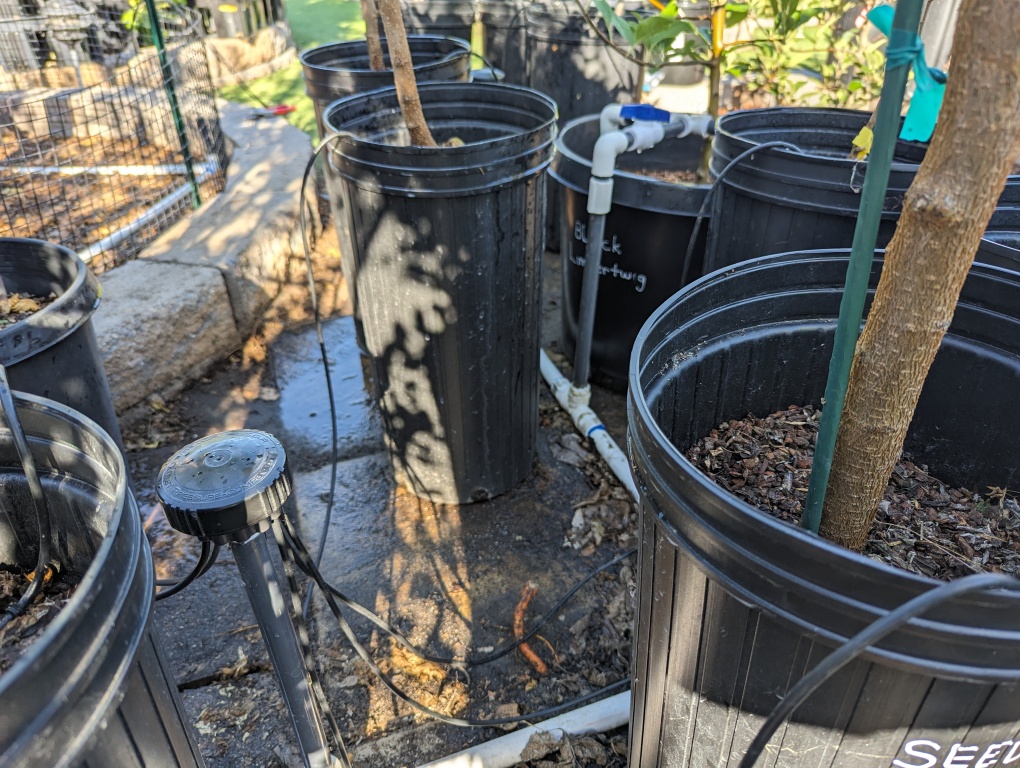
Today I got the “keepers” plus a potted Black Limbertwig apple hooked back up to the irrigation system.
I picked up and just planted a Honeydrops mulberry based on your observations. I got mine from peaceful heritage as well. hoping the fruit comes out similar to your experience.
Is it practically impossible to cross alba or rubra with nigra mulberries? I was tossing the idea around in my mind of crossing some extra large fruited variety like siam jumbo with a wild one from around here and back crossing again to a wild to try getting larger berries that are cold hardy around here, but siam jumbo is evidently nigra.
Look up the chromosome differences between black mulberry and white/rubra. It will blow your mind. In a nutshell, it is remotely possible to make a hybrid but the result will probably have an in-between chromosome count that won’t readily cross with either parent.
I find the entire thread fascinating. I know osage orange , che , mulberry, jack fruit , bread fruit etc. Are all close relatives. It sounds ridiculous, but osage orange is not edible while the others are. Interestingly, figs have that same white glue like sap found in unedible parts of jack fruit. I know osage orange was a preferred food of the wooly mammoth. If someone was going to gmo anything it should be to make osage orange produce the fruit of the tropical cousins jackfruit and breadfruit. Many might wonder why they dont gmo silk worms to survive well in Kansas on our plethora of mulberries. Imagine a booming USA silk market. What about jack fruit the size of watermelons that we could easily graft to osage orange populations. @tonyOmahaz5 and I tried many experiments amongst this family of fruit.
Nope! It is a derivative of M. macroura, possibly an auxin-induced hyperploid.
Would it be even possibly compatible?
I sense you are a victim of M. nigra hype. As evidence I take your perception that siam jumbo could be M. nigra – indicating that you’ve never seen (in person) or tasted M. nigra fruits. I recommend you hold off on acquiring M. nigra or dreaming about crosses until you’ve had that opportunity.
Speaking of crosses, Illinois Everbearing is an M. alba x rubra cultivar with an excellent track record. I recommend you try it.
I looked up info on mulberry ploidy levels and on named species. Mulberry is literally all over the map. One source states over 150 species which suggests a lot of isolation and ploidy change events have shaped the genetics. Chromosome counts range from 2N=14 for M. notabilis to 2N=343 for M. nigra. Base chromosome number for all species appears to be 7 which would be consistent with an origin more than 70 mya followed by multiple ploidy doubling events over the intervening years. A study in China found that even within a species chromosome numbers are highly variable and sometimes vary even within the same tree. MGCPdb, a collective resource for mulberry genome size, chromosome number, and ploidy - PMC Chromosome restructuring and number change during the evolution of Morus notabilis and Morus alba - PMC
For a “WHOA” moment, picture an osage orange that ripens and is flavored like a mulberry. Genetically, they are just barely close enough that it might be done some day.
I guess I haven’t ever tried them, but the huge fruit greatly appeals to me if I can breed the size into to albas cold hardiness and flavor.
If I’m not mistaken, the biggest issue with edibility for osage orange is their prohibitively firm texture. Since they’re quite closely related to che which ripens soft, that seems a more readily achievable route for hybridizing something with some level of edibility assuming you can get a female offspring which still sets fruit despite the high likelihood of being seed sterile.