I ordered a few G.11 for potted patio trees. We’ll see how that works out for me…
1 Like
You could be fine. We had a very bad fire blight year then. Trees tend to get fireblight younger and often age out to stronger resistance.
Ordering couple Krymsk1 roots - experimenting with Redhaven interstem and further peach grafting. Not sure yet what variety will be grafted on top of Redhaven.
2 Likes
What does the redhaven interstem do?
I believe there were some incompatibility reports about Krymsk1 and some prunus persica verities. Redhaven is proven to be compatible with Krymsk1.
2 Likes
G890 and OHxF87
I have a guardian rootstock that I’ll attempt to bud graft Contender to later in the season.
I’ve ordered g890, Siberian crabapple, ohxf 97, and American plum rootstocks. I will also order Sargent crabapple, swamp crabapple, and select Siberian crabapple seeds from sheffields.com
2 Likes
Mostly G214. I have a lot of Bud9, and they are runty little trees that need a lot of water during a hot summer. I mentioned this to Tonya at Home Orchard Education Center, and she had heard the same… and @dannytoro1 also said it, so it must be true, right?
I like M111 a lot for dealing well with my water extremes, but I am getting too old for the wait and the ladders.
Last year’s G214 grafts in pots haven’t grown as much as I hoped yet, so I may be sorry I bought 50 more G214 rootstock. However, the Bud9 I potted after grafting didn’t grow a ton until their second year, either. I planted them out the second fall and winter. Hope the G214s will be big enough by then. 
1 Like
Do you think emla.111 is superior to mm.111?
What are the preferred sweet cherry rootstocks in the mid Atlantic?
And since I have them popping up various places is it possible that Juliet Cherry, a sour “Romance series” bush cherry might work at least long enough for seeing if I can get reasonable fruit without too much rot. If I find a couple varieties I like and are reasonably easy to keep without too many sprays I’m happy to put in full trees, but I was wondering if the Juliet suckers might work for some testing first.
1 Like
That is fairly academic. All M.111 grown as commercial rootstock is the ELMA version as far as I know. Since decades ago. When virus indexing was done.
1 Like
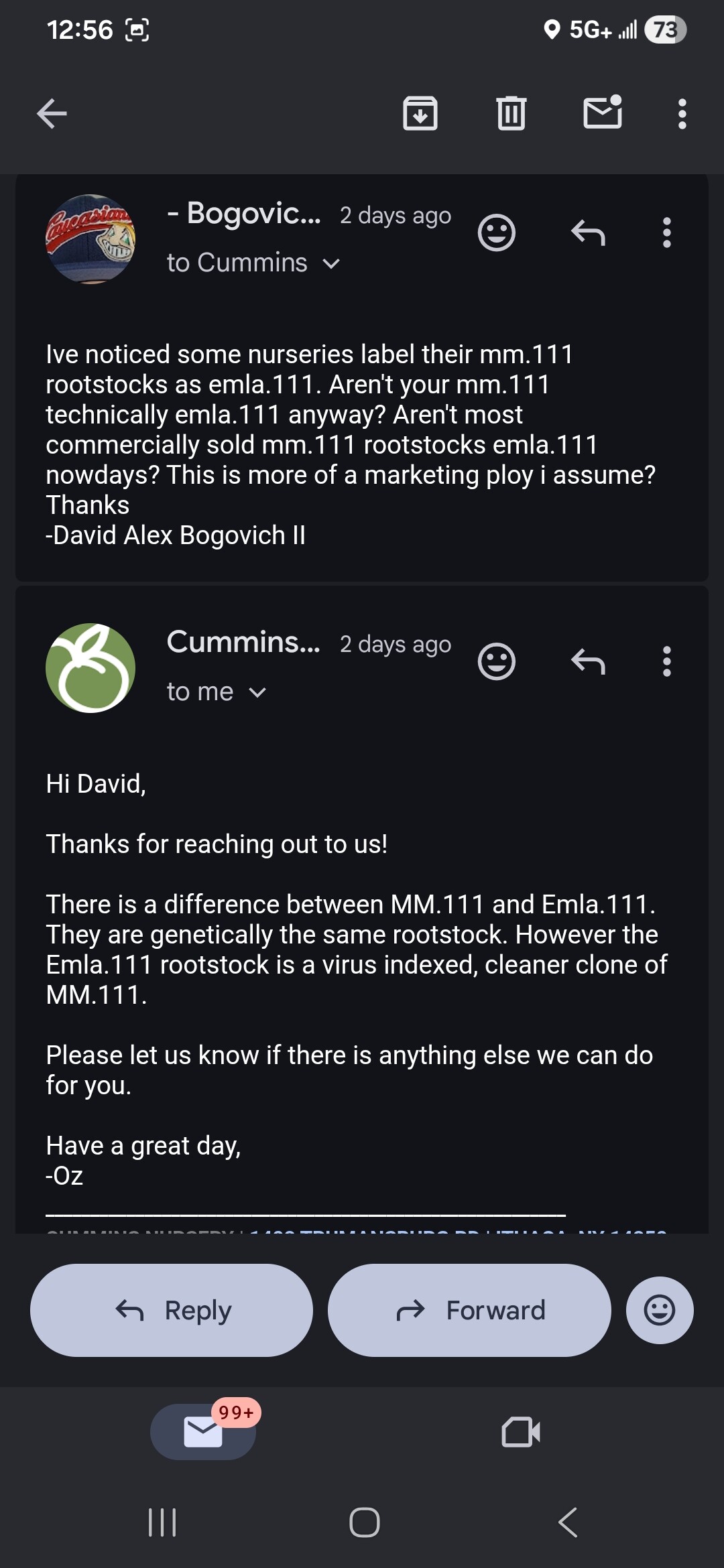
This is what i was intially told but when i asked cummins if vendors lableing mm.111 rootstock as emla.111 was a marketing… because they are the same. They stated that there was a difference between the two rootstocks. I appreciate their transparency because they dont even sell emla.111… but this created confusion for me to be honest.
Last year was 100 3/8” caliper G214 rootstocks from Treco and 20 smaller caliper (I assume 1/4”) G41 from Mehrabyan. These dwarf trees are destined for the trellis, and all but 3 keener seedling grafts took.
This year is 100 3/8” caliper G969 from Treco. Intending these to be free-standing someday.
1 Like
They are not the same. They were painstakingly cleansed of virus issues for many years. Williamette, CopenHaven and Treco only sell M.111 ELMA. Not the old Malling Merton 111.
I’d wager that represents 85-95% of M.111 sold annually every year.
Now yes; perhaps some small operation may still stool old MM.111. Maybe the USDA still stocks old MM.111 as a relic of it’s inventory. But ELMA versions of UK rootstock has been with us since the 1970’s.
3 Likes
So cummins nursery most likely technically sells emla.111 even though its advertied mm.111?
Did they say that?
Their website description says:
Also known as Malling-Merton 111, MM.111 EMLA, EMLA 111.
It is not exactly clear. Though I am positive they will say they sell the Virus Indexed ELMA modern version if asked. Who wants rootstock incompatible to a scion because of viruses?
Wow so the description creates even more confusion lmao. Well mehrabyan had crabapple seedlings and cummins did not so i added 2 emla.111 to the mehrabyan order. So i didnt cheat on cummins too much lol
3 Likes
My G.210 arrived on 2/20 and indeed they had barely any root at all. I also got B.9 and EMLA.111 from the same nursery and they had much more root mass so I guess it’s a G.210 thing.
Instead of bench grafting, I planted the G.210 outside on 2/21. It’s 2/24 today and they’re already pushing little leaves. It is very tempting to spring bud them…
1 Like
I would venture to guess that budding would be successful, I think that’s a great idea!
1 Like
My G41s were near rootless as well.
1 Like