This isn’t just about trees. Last summer I made up a bunch of hanging tomato baskets with 2 plants per basket, using ceramic plant waterers in the center. They’re a ceramic cone that attaches to either a wine bottle or threaded soda bottle and automagically water through the pores in the ceramic. I noticed that in every basket, one of the tomato plants just didn’t do so well.
In the fall, I took apart the baskets. In every basket, one of the tomato plants had reached the ceramic first, and the encircled it completely with it’s roots. Basically, the other plant got starved out!
Because I tend orchards on estates for a living I also get to see a lot of “kitchen gardens” which are planted and tended by companies that have sprouted up that specialize in this. I’ve yet to see one of these gardens that allowed adequate space between plants that require it- like indeterminate tomatoes.
The yield provided by these tightly spaced plants never seems to equal the potential of the space. I get more tomatoes from a single plant than these gardens get from 6.
I’m not sure that quite explains it. I throw the snow much further than the probable extent of the rise in soil temp provided by my not huge driveway. Just speculating here.
It may actually be a disadvantage to delay bloom by a few days!
Most fruit trees are more sensitive to 30-32 after bloom than before bloom and more sensitive during bloom than pre-bloom.
I did not understand this until I just experienced it. My freeze just occurred post bloom rather during bloom which resulted in more damage than expected.
Blueberry,
I’m not sure I understand your thinking.
Why would it be a disadvantage to delay bloom? As flower bud development advances from pre-bloom to bloom, to post bloom, each successive stage is more sensitive to frosts. By delaying bloom, there is more chance for warmer weather during those stages, and less chance for damaging freezes (as the season advances).
I think if we could have delayed bloom a week here this year, we would have been sitting pretty good.
1 Like
In the past, I have tried to delay bloom by pruning as late as possible and fertilizing as late as possible. This year the freeze hit post bloom at the worst time. The peaches may have been mature enough to handle it. If the plants would have been a lot more mature I would have been OK. More mature or less mature, just not where I was.
1 Like
This study’s most important point seems to be how much the wood chip mulch pulled nitrogen from the soil and stunted plants. This may be a more important issue in colder soils where access to N is very close to the surface of the soil, because I believe for trees in warmer areas, wood chips are not so capable of hording available N in their decomposition- except from young annual plants.
This may also explain why this research showed such a strong affect on bud break timing- In Alaska most of the root activity is closer to the surface than further south so a reduction in soil temps near the surface would likely have much more of an affect.
Not that anyone is still paying attention, but I’m still trying to figure out the meaning of this research that is contrary to what I learned back when I was a hort student.
I will experiment with this in my own orchard next fall and let people know the results.
4 Likes
Alan,
The books I read said the wood did steal nitrogen from the plants in the short run. I read that about 20 years ago and was keeping chickens at the time. I dug out a 15 foot area about 2 feet down and filled it with wood chips and applied 3 inches of chicken manure on top and some mixed in the chips. It took several years until it broke down into thick rich beautiful red colored soil then it changed to pure black later. The earthworms were a big part of the break down so that could be variable. Fast forward its the richest moistest soil on my property. Did the same thing with ragweed and sunflower sticks and the soil is fine and rich and again took several years to break down. My point is with the chicken manure I wanted the nitrogen locked up for awhile but in the end you get it all back which you already know but someone reading this may not.
http://naldc.nal.usda.gov/download/50068/PDF
I was surprised by the quick positive response, showing some interest. Here’s something I just found that supplies more info on the affects of soil temps and N. uptake.
Of particular interest to me (although I was aware of it previously) is how trees generally rely on stored nitrogen for spring growth (except foliarly applied N). Apple trees get their biggest burst of growth at this time and this is also when the nourishment of spur leaves is crucial. For peaches, I believe it is important to maintain equal vigor well into summer, but for mature apple trees, excess summer vigor can be detrimental to fruit quality and even annual bearing (I believe).
The reason fresh wood mulch suppresses growth of vegetables much more than trees may be that trees store N for their first spring growth. Now I wonder how much of this suppression may be the result of cooler soil temps as opposed to bacterial N hording.
1 Like
Would love to see more details about it and what your findings are from your research. Thanks for posting. By the way I tilled the chicken manure in several times with a shovel the full depth. At the time I meant to use it as a test sheet compost method.
Yes, I often read that in the past but have since read that the affect on established trees in decent soil, even very young ones is not significant unless it is incorporated into the soil.
Now I’m beginning to think the entire issue is more complicated than bacterial influence and includes the mulch affect on soil temps. Roots need a certain level of warmth to begin full activity, including absorbing N. Every species has its own optimum temp and I’ve read apples function in cooler soil than peaches.
1 Like
I’ve read that to but see a lot of people bury chips in the hole when they plant their tree or add a log of wood. Not sure why they are doing that with a new tree because it takes nitrogen from the new tree which would delay growth unless they are using the wood like a sponge to hold water. They may have some purpose I don’t understand. I use wood chips around my trees with very positive results on top of the soil.
2 Likes
I have some personal experience with wood chips robbing N from plants. Some years back when I was building my garden soil, I got several loads of aged horse manure mixed with quite a lot of wood chips. It wasn’t that aged, but I used it on my soil anyway. The vegies grown on those beds did poorly until I realized that the wood was depriving them of N and I added some.
These were all annual vegies, so perhaps not directly applicable to perennial fruits (except their first year), but the effect was noticeable.
3 Likes
I’ve had a problem with wood in a vegetable garden as well when used as mulch. I was never sure if it was an N issue or something in the chips because simply adding N did not adequately solve the problem.
Sometimes cause and affect are hard to pin down- even if you do something and it seems to work. Of course, your problem was probably N depletion and I’d assume the same thing, but if you applied it to all the suffering vegetables instead of leaving some unfertilized to compare, the improvement may possibly have been just the soil warming up or some compound in the wood leaching out adequately at the same time you added N.
Almost all my gardening anecdotes are devoid of the use of a control so I’m not saying this as a critique, just a suggestion.
I actually have seen what appeared to be N deficiency in young trees mulched with fresh wood- but it was in a wet, shallow soil where feeding roots were all close to the surface. Anecdotally, I think fresh wood’s negative affect is based mostly on how shallow the root system is- trees are able to get nutrients wherever their roots are active and grow towards N as well as water, apparently. That is, when a piece of root finds either and the tree needs more the tree grows more root at that location.
1 Like
While I had read this b4, I was a bit dubious. Then last year in an attempt to get a Red Rome Apple Tree to spread out a little I tied one limb out and down. I got a little carried away thinking that over time it would come back up so I tied it pretty much horizontal. This year the only limb on that tree that is blooming (absolutely covered in blooms!) is the one I tied down! Its an amazing contrast for anyone who wonders of tying limbs really does promote fruiting!
3 Likes
The first year I only pulled down a few limbs and was amazed at the difference. I’m tempted to pull all of the limbs down now but I want some to grow longer before giving them the miracle pull. Someone smarter than me will have to explain why it works. I’m satisfied with just knowing that it promotes earlier fruiting.
1 Like
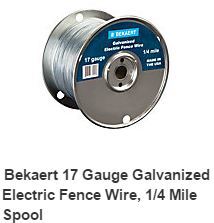
The 17 gauge electrical fence wire has become my go to product in my small orchard. At a nearby supply store I can purchase a 1/4 mile roll for $15. One roll might last a person for several years or a lifetime. Most all my limb bending is completed with a section of this wire. It is manuverable enough to use on small limbs and strong enough for some of the larger ones as well. Sometime you also need to pull a limb upward or just give it a little extra support and it does this well. If you remove the wire in a reasonable time frame it typically does almoet no damage to the tree. I also use it to attach my many graft labels. I’m sure you will think of many other uses for it. Bill
2 Likes
Bill- Do you find that the thin wire damages the trees in any way? I have aluminum underground dog fence wire that I really like but wondered if it would end up cutting the trees.
1 Like
I’m careful not to let it stay on any longer than it is needed. For longer periods I apply a double layer of electrical tape between the wire and tape. I think any wire has the potential to damage growing wood if left on to long.
2 Likes
Speedster,
I use the sticky traps for pests that hang on the tree with a wire and I had a couple that I hung on a fast growing branch that had to be removed because they grew around the wire. Same thing with string so some people add a price of rubber that’s larger to prevent that from happening between the wire and the tree.
2 Likes