Thanks Barry. Sounds like you are somewhere south of Anniston. What rootstock are you using? Were you by chance acquainted with David Griffith who lived near Dadeville? He had about 300 pear trees with nearly that many varieties.
1 Like
My experience is Tyson take 10+ years to flower. They are not fast growers!
Beierschmitt (per USDA) is Bartlett x Beurre Clairgeau
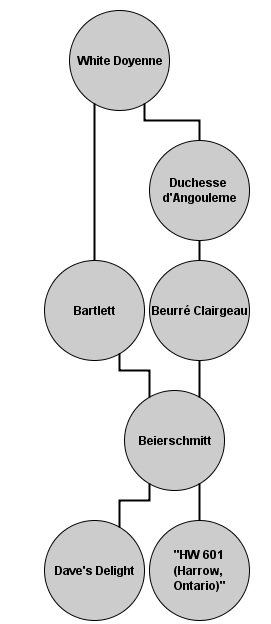
Any potential FB resistance is not coming from Bartlett, and Beurre Clairgeau is a child of Duchess, which does have some resistance
How are late ones like JdM with FB? Pears of New York (Hedrick) says JdM is blight resistant

Pears of NY also says Winter Nelis is “nearly immune to blight”

Thanks
1 Like
My winter Nellis is not immune but also does not grow much.
1 Like
There are tons of old home places we run across with Bartlett, Sand Pear, Ayers, Kieffer, LeConte, Reliance, Dixie and June Sugar pears. All very hardy canning pears basically. All getting quite old in a disease ridden area.
1 Like
Winter Nelis gets some fireblight here but grows reasonably fast. I suspect rootstock has a lot to do with how fast a pear grows. I have it on callery. It is strictly a winter pear that requires storage. I won’t suggest it for commercial use mostly because I already have a couple of varieties that fit that category. The objective is not to grow more varieties, rather, to grow just enough varieties to fill 4 or 5 months of having fruit available to sell.
In the “grows very fast” category, Ayers put on 8 feet of growth last year on an established callery rootstock and has added 6 more feet this year. I’ll be on a ladder this winter pruning the laterals. It may have small fruit, but with rapid growth and reportedly very good flavor, I will keep it in the list.
Mine are on callery. Some are branches on a bradford pear that I cut back and grafted over. I don’t know David Griffin. I’d love to know which pears worked for him and how he handles blight.
1 Like
David passed nearly 15 years ago. His property was sold but still has the pear trees growing. I don’t know much other than that his son currently lives in California. I walked through the pears with him in fall 2003 and sampled some of the best pears I’ve had. I’m not 100% certain, but think this is the pear orchard. 32.860392, -85.821667
1 Like
Hi Clark:) when’s your average 1st freeze date?
1 Like
would be fun to find out who owns it and see if they’d let me walk the rows and see what if anything is still alive. The live ones obviously must have some serious blight resistance assuming no one has sprayed strep since the property was sold.
1 Like
His son has the name of the buyer. Son and father had the same name best I recall, David Griffith. Lucky Pittman had some contacts in the area and might be able to help with contacts.
He also had a large walnut planting just east of the pears. I helped him graft some of the trees back around 1999.
1 Like
I knew Dr. Griffith - I grew up in Auburn/Opelika area, and had family who lived in Dadeville, and he was their dentist; his son (went by Nicky, I think) attended high school with my cousins. I made his acquaintance in the late 1990s, and we primarly discussed pears and black walnuts.
At one time or another, he sent me scionwood of: Ledbetter, Sen. Clark, Dixie Delight, Big Mama, Galloway, and probably a couple others that I’ve lost or forgotten now. I still have Ledbetter & Galloway, but likely neither of those would fit the criteria outlined for this discussion thread.
I went back and tried to find emails or FB messenger chats where I’d contacted cousin Harold about who currently owns the old Griffith properties where the pear and BW plantings were, but couldn’t find them.
As an aside, HB has published the journals of his canoe trip navigating the Tallapoosa River from its headwaters to the termination of the Alabama River/Tenn-Tombigbee waterway at the Gulf of Mexico.
1 Like
Late November @noogy.
In the 1960’s and 1970’s, I expected first frost by September 20th and first solid freeze in late October. Now we have first frost sometime between November 1st and December 15th and may not have a freeze until January. Climate is what you expect, weather is what you get.
I’m surprised no one has mentioned Magness. I thought it set the standard for FB resistant southern pears in quality- that is, if you like melting flesh pears.
2 Likes
At my location magness is a good pear. It’s sibling warren is the same in all ways except it has higher fireblight tolerance here. In my location warren bears quickly. By quickly i mean 5-7 years. It is not like harrow sweet that bears in 1-3 years. In some locations magness is said to be much better than warren. In areas where the opposite is true and warren is delayed fruiting i could see huge advantages to growing magness. I’m told in some locations warren takes over 10+ years to produce.
3 Likes
I excluded Magness because it is also slow to bear. I can get Warren to bear in 3 or 4 years. I’ve already enjoyed a ripe Warren from a tree I grafted in 2020.
Mayhaw9999 sent this as a message when he could not find this thread due to accidental deletion.
"I lived for about 20 years in Columbus, MS about the same latitude as Birmingham - zone 8B. I think you should look at the pears developed in TN with good fire blight resistance - Ayres, Carrick and Mericourt. Orient was also released by Tenn Ag folks but was not developed there.
Here is a list of what I grew in MS
Warren - excellent - no blight but can take a long time to fruit and needs wind pollination by a good pollination partner. Clark touts Karl’s Favorite. I have good results with a mixture of different varieties on the windward side especially on my Magness which is almost the same pear.
Seckel - excellent - minimal blight - very well received by local farmer’s market patrons
Honeysweet - very good pear with good blight resistance and flavor almost as good as Seckel.
Winter Nellis - moderate to severe blight. I hate how that tree grows.
Charles Harris - what I call a “southern pear” only to be grown if that is all you can grow.
Harrow Delight - I grew as HW 603 - Very good pear - ripens 2 weeks before Bartlett.
Harvest Queen - I grew as HW 602 - Very good pear - ripens 1 week before Bartlett.
Tyson - a good early pear that takes forever to start fruiting. It never did in MS after about 12 years. Here it fruited in a few years grafted on a mature Honeysweet tree.
Orient - not a favorite but had good crops and no blight
Mericourt - a fairly good pear with good blight resistance.
That’s all my old brain can remember.
David"
Based on this information, I’ve revised my list as follows:
Ayers - small pear, good production and flavor
Bell - superb quality, good production,
Blake’s Pride
Clarks Yellow
Drippin Honey
Harrow Delight
Harrow Sweet
Honeysweet
Korean Giant
Maxine - debating on this one
Potomac
Warren
Focus is on fresh picked fruit which can be sold ready to eat. I will still be revising this list as I gather more information.
2 Likes
Maxine is not a great pear the first year or two and then it will surprise you. It surprises me ,but it is still many peoples very favorite.
1 Like
I grafted Magness on OHxF513 rootstock, back around 2001. It’s probably 20+ ft tall… Has never bloomed or produced fruit.
1 Like
Magness is much better on ohxf333 or ohxf87 here than BET etc. I prefer callery over ohxf rootstock in general just because i have much better luck with it. I personally have found Magness to be a real sensitive pear to rootstocks more so than any other. I grafted magness on a 5 foot kieffer years ago. The kieffer is huge and produced and magness never bloomed. I put magness on ohxf87 in 2016 and it has cropped the last 2 years and had a heavy crop this year. Like @Fusion_power said warren might produce a half a dozen pears if grafted to a large wild straight callery rootstock after 3 years. Now he has tasted that pear he is hooked. Wait until he gets a good potomac and maxine and clarks yellow! Karls favorite is really a great pear as well. He will start getting full crops by years 5-7 depending on how old that callery rootstock was. The year Drppin Honey was released and i started growing it i paid $5 each for trees from Gurneys and Henry Fields. No one believed me about how good that pear was in the old days when we were still all on gardenweb before they closed up. Like @Auburn said this year there is no better asian pear. Korean Giant can be just as good or maybe better on some years, but most years it is not nearly as good. In the pear world consistency counts and pears like warren, drippin honey , harrow sweet never have a bad year where the taste is off. Clarks yellow is a finicky pear but it is better than all of them if the weather favors it , and you eat it quickly, and you pick it on time etc… On a bad year Clarks yellow tastes worse than a walnut husk. Most commercial growers might stick to drippin honey, warren, potomac, karls favorite, Maxine, Harrow sweet, ayers or pears like that they will have fairl consistent good results with. The problem is Clarks yellow beats them all on a great year hands down. Then customers want it and it tastes like a wanut husk the next 3 years. It is shooting yourself in the foot to give your customers Clarks yellow because they will want it when they cant get it. Warren on the other hand or harrow sweet or others every year have a delicious crop. Clarks yellow will make you wait for it trust me when i say it will be a love hate relationship.
2 Likes