Worlds worst jobs growing fruit

I don’t believe that the chemical we get the rash from is useful for poison ivy to compete with other plant species. Why do you?

I’m developing new allergies as I age so it doesn’t surprise me that you have become more sensitive to poison ivy. However, I remember now that the Dr. prescribed a solution for me that contained a small amount of the poison oak chemical, and the dosage was gradually increased which is probably how I got over the stuff. So it can work the opposite way as well.

From CHAT- The antimicrobial idea is widely repeated by botanists but usually phrased as speculation: Smithsonian says scientists speculate urushiol evolved as an antimicrobial defense protecting the plant against infection,

That was found an ineffective treatment years ago Poison Oak / Home and Landscape / UC Statewide IPM Program (UC IPM) . In this case documention says we are both wrong. The reason poison oak and ivy are worse at times sounds like moisture content rather than competition. I’m correct the plants are more likely to give you the rash.
”Urushiol is nonvolatile, dries quickly and can persist on objects and retain its ability to cause an allergic response for months or even years. This means that tools, clothing, pets, vehicles, and other objects that come in contact with the oil can continue to spread the oil. When poison oak is burned, the oils can disperse via the smoke particles. Breathing this smoke can cause severe respiratory irritation.

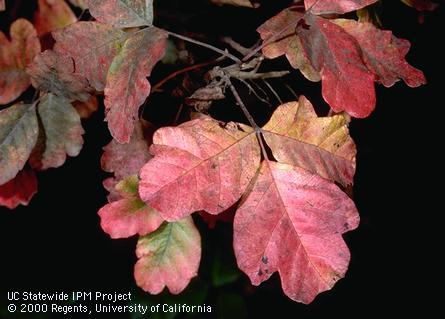
In the fall, leaves turn red and become enriched with urushiol which can result in higher levels of exposure. In winter as the leaves become dry and fall off, the oils are reabsorbed into the stems making the leaves non-allergenic. Bare stems in the winter can result in unintentional contact and if stems are damaged, oil can be released resulting in exposure.

There is currently no preventative treatment for contact dermatitis other than avoidance of exposure (recognition of the plant and wearing gloves, long pants, and long sleeves), use of skin blocking products, and washing with soap and water quickly after exposure.

Hyposensitization using shots or medicine to make one immune to poison oak were available at one time but were taken off the market when they were found ineffective. Other attempts have been made to immunize against poison oak including ingestion of the leaves. None of these measures has definite value either as preventive or as a cure, and sometimes they result in detrimental allergenic effect. Research in this area is ongoing and at the time of publication, a new drug (PDC-APB) is undergoing clinical trials as a vaccine to prevent poison oak dermatitis.

Poison oak fall foliage. Credit: Jack Kelly Clark, UC IPM”

You did not get more immune you got better at spotting it or something else. Advanced Research does not support that as fact. I’m not saying you could not have adapted some but it was likely your habits not your body.

1 Like

It’s interesting the way our body reacts to urushiol (how we catch poison ivy). The poison ivy’s (urushiol) toxic effect is indirect, this explains why animals do not “catch” poison ivy. In fact, deer, goats, and sheep will often eat poison ivy with no I’ll effect.

Urushiol changes the membrane proteins of our skin’s cell when we are in contact with it. Our immune system doesn’t recognize these “changed proteins” as a normal part on the body and attacks the skin cell. The rash is a result of that attack.

Generally the first few times our body is in contact with urushiol there is no rash and we don’t even know we were in contact with it. Our immune system is confused and not sure how to react to the changed cells. With most people’s body the immune system launches out an attack on the changed skin cells after a few exposures, for the few of us lucky ones, our immune system stays confused and decides to do nothing about the changed skin cells.

2 Likes

Do not believe every university based claim. It wasn’t proven ineffective or effective. Results were mixed and non-conclusive based on limited research. Not enough money in it, I guess- no patents involved. I know that I developed a level of resistance and probably from the oral program. I often say that everyone is in love with their own anecdotes. but this was a pretty damn strong one. Something can work for a small percentage of people.

CHAT says- Modern evidence does not confirm oral desensitization as a reliably proven, standard treatment. But it also does not show the opposite. It shows mixed, thin evidence: some older and reviewed studies support partial hyposensitization, one well-known 1987 trial failed, and newer work is still pursuing the same basic principle with safer standardized derivatives.

1 Like

@alan

With Universities and the medical community neither confirming the claim is true its very hard to prove. There is nobody to back up the claim even if it is true for you personally. Generally this belief is classified as a myth.

Well known PBS even disagrees corrobating the medical community and the Universities.

Summer + Outside = Poison Ivy

So, you wore shorts in the woods, and now your skin is itchy, red and swollen. Congratulations, you may have picked up the juice from a member of the family Anacardiaceae, which includes poison ivy, poison oak and poison sumac.

Mangoes and cashews also belong to this family, which might explain the rash you got after chewing on a mango rind. According to the American Academy of Dermatology, more than 50 million people a year get a rash from one of these plants, making it more allergenic than all other plants combined.

Despite that, poison ivy and its pals are often misunderstood. Here’s some common myths about the Anacardiaceae family.

Myth 1: The Rash Is Contagious

Nope. Most people develop a rash only after contact with the plant’s juices, or urushiol (you-ROO-shee-all), an oily blend of chemicals that the skin absorbs quickly. People with high sensitivity to urushiol might break out from second-hand contact with pets or clothes. But fluids from a weeping rash will not cause the rash to spread elsewhere on the body or to other people. Only contact with urushiol will cause a rash.

Myth 2: You Can Develop An Immunity To Poison Ivy

Not true…So don’t start eating their leaves! There’s very little scientific evidence supporting the idea that people can reduce their sensitivity to poison ivy by increasing exposure. In fact, the more times a person is exposed to poison ivy, the more likely they’ll develop a rash. That’s because the rash is your bodies’ immune system responding to what it perceives as a threat. Once your skin recognizes the poison ivy juice, it will trigger a rash again, sometimes within hours.

There’s some funny irony here. Like other allergens, urushiol isn’t toxic or poisonous on its own. But our immune system doesn’t recognize urushiol, so it attacks the exposed skin. The closest scientists have come to providing any kind of immunity was in 2016, when researchers isolated the specific protein in our skin that causes that terrible itching. This might lead to better treatment or prevention options. So that’s good news! Plus, scientists are working on a vaccine to end poison ivy misery.

Myth 3: “I Know I’m Immune To Poison Ivy”

Yes, you could be one of the 10 to 15 percent of the population who tolerates urushiol. But don’t get too excited. You might not have encountered it frequently enough to develop an immune response (see above). Evidence also shows that people’s sensitivity to urushiol can change over time. The first time you’re exposed to urushiol it may take several days to get a rash, but if you get it every year, you’ll probably break out within hours.

Myth 4: “Leaves Of Three, Let It Be”

This is true for poison ivy and poison oak, but not poison sumac (which has between 3 and 15 leaves). All three can be tricky to identify, because they change colors with the seasons. Poison ivy has red-tinged leaves in the spring and transitions to a deep green in the summer and ends the year with fall colors: yellow, gold and red.

Poison oak and ivy can also take the form of a single plant, a shrub or a thick, hairy vine. No wonder so many of us have trouble avoiding them!

Here’s some pro-tips for avoiding and dealing with poison ivy, sumac and oak rashes:

  • Wear long pants when you know you’ll be tromping in the woods. Scrub your skin with soapy water. immediately if you know you’ve been exposed. Urushiol absorbs into the skin quickly.

  • Wash your clothes! Urushiol is very stable and can remain active for years.

  • Once you get a rash, there’s a few ways to make yourself more comfortable, including cold washcloths, topical steroids and patience. The rash will likely disappear in less than two weeks.

  • If the rash becomes severe, doctors may prescribe oral steroids.”
1 Like

Folk medicine is often steered off course by placebo affects but also by the fact that individuals react differently to different treatments. Who knows? Maybe some bodies do respond favorably to being bled. The smartest doctors on the planet stood by that treatment for centuries.

Chat suggests that my observation of so many of my Topanga peers being immune to poison oak may have been because natural resistance led to them to living there in the first place, but I find that doubtful. When I lived there no newcomer left because someone in the family couldn’t take the consequences of the plant. In that part of CA, few inhabitants are 2nd generation.

The issue has not really been extensively studied and experts tend to exaggerate their understanding when it doesn’t really exist- just as tradesmen do.

For example, up until last night I was telling customers that the reason plants become less resistant to cold is entirely the result of more water in their cells as they come out of dormancy- flower buds being killed as the result of cell walls fracturing from the added pressure. I had jumped to that erroneous conclusion without even realizing it was may own logical fabrication. I was aware of the shuttling of water into cells as plants come out of dormancy and went from there via presumption. The consequences of excessively low temps is more complicated than that- too complicated for me to bother memorizing all the mechanisms involved. I’m a tradesman not a botanist. If the brain holds too much minutia, it may miss the big picture. My brain, in any case.

2 Likes

@clarkinks @alan I honestly think that there isn’t enough solid research and studies on urushiol and its affect on peoples bodies to really come to any conclusion. Peoples bodies are affected differently by medicines that are manufactured by scientists, why would our bodies not be affected differently from person to person by urushiol ?

Earlier in this thread I mentioned that rubbing alcohol will neutralize urushiol, I just looked it up on the computer and the search results said NO, it doesn’t neutralize it. It said the urushiol will bond to the alcohol, but when the alcohol evaporates the urushiol is still present and active. It suggest that if you use rubbing alcohol, to wipe the the area dry with a towel so you are lifting away the oils with the alcohol.

My wife is extremely allergic to urushiol, like go to the hospital if the dog walks through poison ivy and then sits on the couch kind of allergic.

Years ago I owned a property management company, one of my services was poison ivy removal. There were days that I was in it head to toe, manually pulling it up by hand and bagging it in trash bags. I didn’t wear one of those hazmat suits, I wore jeans, long sleeve tee-shirt, rubber knee high boots and gloves. Every once in a while my wife would get a little blister of poison ivy between her fingers from putting my clothes in the washer.. My secret, I would routinely spray everything down, tools, clothes, boots, gloves, with rubbing alcohol. Seldom would I bothered wiping it off with a towel, my hands and other exposed skin i would wipe dry.

According to the “research” this will not work, I will just liquify the urushiol and cause it to spread out to cover a larger area.

This has been working for me nearly 100% success for 20 plus years, maybe it doesn’t work that way for everyone, who knows?

Point is, how much does the research really know?

3 Likes

Research suggests, we assume.

I also used to use hot water on bad blisters then wipe them clean with alcohol and the blisters stopped itching and quickly dried up and healed. Researchers love their research and laymen love their anecdotes.

Science took us from the dark ages but scientists are still human and draw mistaken conclusions. Over time, such mistakes are often drawn out by subsequent research. Anecdotes are not corrected that way so often. But most research is driven by the private sector and for medicines that means getting patents that pay out more than the cost of research.

I took the vaccine for Lyme disease and have never gotten it since after having it several times many years ago, but there were certain problems with it and it was taken off the market. CHAT suggests that those problems were sorted out and that the vaccine is now considered adequately affective, but no one seems to think the profits would be high enough to bring it back on the market.

3 Likes

Thank you, I was just thinking about this same fact this afternoon when I was picking my way around some poison ivy sprouts in the woods and was reminded of this thread.

Try the rubbing alcohol, it’s a lifesaver for me.

1 Like

I thought that I had already posted the link to the same video but it turns out that this is the only one already on the forum :cry:.

The video link at the end of the quote is the same one that I’ve also been following, although not for quite as long as Bigdoug03. I watch closely for the plant and simply remember to wash appropriately when I return home. The only times I do get rash reaction is when I didn’t realize that there was poison ivy mixed in with something else.

I was in the National Forest camping lastnight and this morning, I was careful while walking around, but for added protection for my wife’s sake I bring a spray bottle along. A dozen sprays of rubbing alcohol on each leg from the knees down works for us. If I have the slightest amount of urushiol on my pant leg and I don’t spray them, then it transfers to the car seat and then to her. Then I’m in the doghouse and she has a painful rash.

2 Likes

:cry: Has she already discovered the “nearly scalding hot shower water” trick? It takes away the itch long enough to be able to sleep through the night, and then take another shower in the morning in order to get through the day. I’ve now been using this method for over three decades.

1 Like

Yes, the hot water shower is helpful, she hasn’t had a severe case now in many years thanks to my meticulous rubbing alcohol regimen.

Her last 2 bad cases the doctor gave her steroid cream to use, failed to tell her to avoid the sun. It was awful, the sunlight reacted somehow with her skin and steroid cream and made the rash 10 times worse.

3 Likes