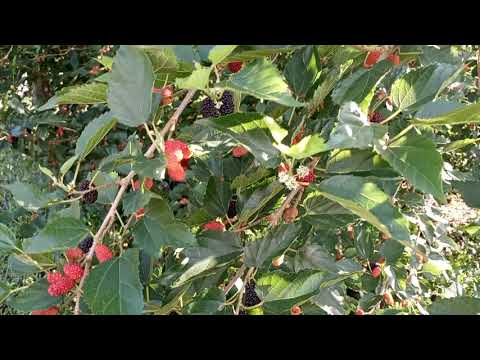
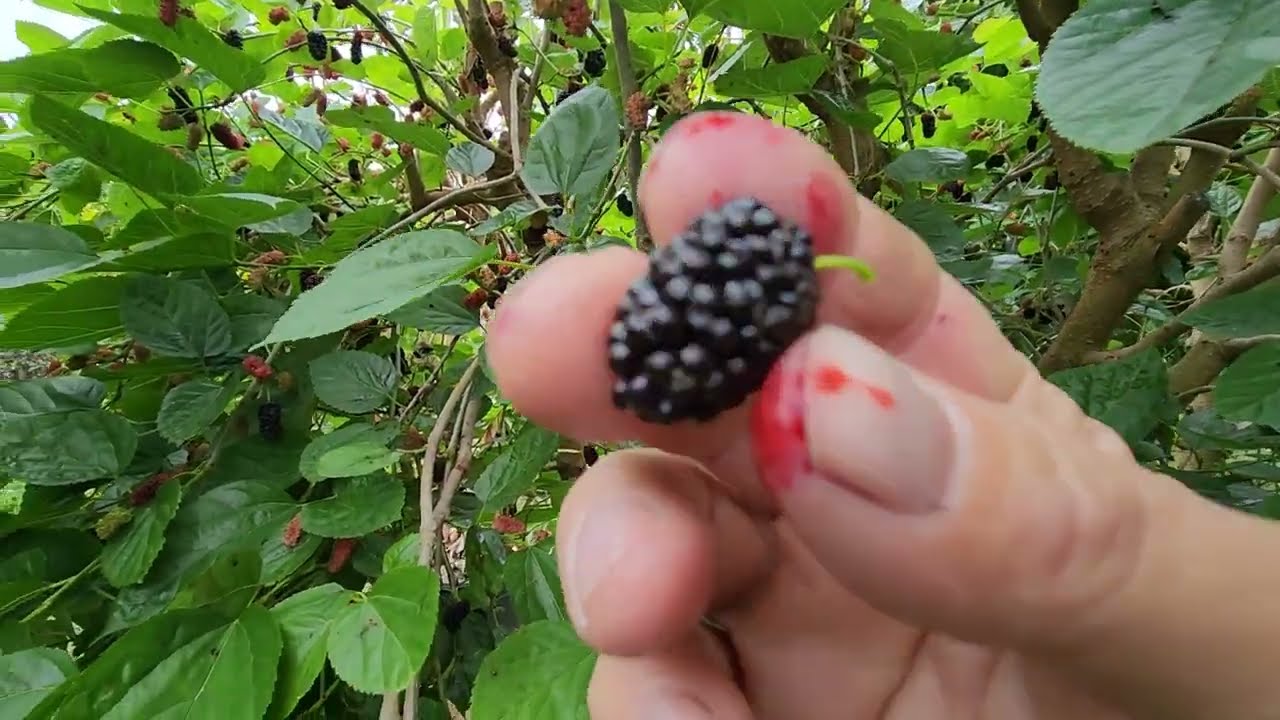
I believe you are correct. Black, M. nigra seems to be the winner.
“the three most popular types are black mulberry (M. nigra), white mulberry (M. alba ), and red mulberry (M. rubra) [33]. Among these, the black mulberry is an edible fruit that is 2–3 cm long, with a complex cluster of several tiny drupes, and is dark purple, almost black, when completely mature. In Xinjiang, a region of China, and Eastern Anatolia, a region of Turkey, black mulberry fruits are used as a traditional medicine for the prevention and treatment of hypertension, tonsillitis, sore throat, anemia, and iron deficiency [34,35]. According to recent studies, black mulberries have more flavonoids, anthocyanins, and antioxidant abilities than red or white mulberries [26,32]. Since this fruit has a high concentration of naturally occurring phenolic compounds, such as phenolic acids, flavonols, and anthocyanins, it shows a wide range of biochemical activities, including antioxidant, anti-hyperlipidemia, and anticancer properties [33,36,37].”
I don’t know why they put Prunes and Raisins in the ORAC chart. Prunes and Raisins are not separate fruits. They are just processed plums and grapes. Of course the ORAC per 100 grams are higher once water is removed.
I am trying Lakeland from Jan. She speaks highly of it and says its a hybrid… and that it should overwinter fine for me…but i guess time will tell. DingDong says its everbearing but she says that it fruits one time so theres that… Maybe he got the wrong cuttings from her?
Its early fruiting and has very small leaves and very prolific… as per her.
I find good tasting fruit to be subjective. @Lucky_P and i love to eat some kieffer pears ever year. We have discussed kieffer a few times on posts here. Im not going to say they are my favorite but i.really like them.
We have always loved eating kiefer pears… we normally have to pick them and store them in the basement a few weeks… they yellow up and get softer and are good for eating.
They make absolutely delicious pear preserves too.
I have one kiefer tree and one improved kiefer tree and one orient tree. I will be glad when they start producing.
I have added 8 grafts of warren, karls fav, potomac, bell to them… and may add some maxine next spring.
Hicks- i think they call it Hicks Fancy in the UK/Australia etc. Not sure if thats true but it looks the same.
As I have mentioned before (with my morus rubra) and i think you can see in Jan’s videos and some others… Alot of mulbs seem to do the best when they as this guy says “the more you punish it the more it rewards you”…
I think alot of the bad reviews of alot of things come with too much love or too good of soil with too much irrigation or moisture… YMMV
I like this guys orchard and high density as well.
That looks nothing like the ‘Hicks Everbearing’, as grown here, from scions sent by Eliza Greenman, sourced from one of the surviving Hicks trees, shown to her by the late A.J. Bullard.
It is the sorriest mulberry I’ve grown.
‘Hicks Fancy’ appears to be, perhaps, a M.nigra, and all references i can find to it categorize it as a nigra - but we all know how many ‘black mulberries’ in the nursery trade are merely black-fruited M.albas.
If a person who has grown 32 varieties of tomatoes writes an article describing the best tomatoes, which varieties do you think they will name? If a person who has grown 3000 varieties of tomatoes writes an article describing the best tomatoes, will their list be different from the person who has grown 32 varieties? If a person has grown 3000 varieties of tomatoes and sold plants grown all over the U.S. and gotten feedback on which were the best performers and best flavored and he writes an article describing the best tomatoes, will his list be different from either of the previous two people?
The article which this thread was started with is pretty close to useless.
Another guy is also taking the credit… and plans on ‘bringing it back’.
even though Eliza already has.
I guess the main credit goes to AJ Bullard who has the original trees and showed them the oldest of the trees nearby where it was created.
Old reviews of ‘Hicks’ are said to be cloyingly sweet. Others report it is bland, some say superior… and as you say sorriest.
Collier and Wellington should be in the same ballpark as Hicks i would think with them all being rubra x alba hybrids… but varying reports on flavors i think based on growing conditions.
The reason i post articles like this is to give us a place to start from. We always learn from the articles because as i said many times the true experts are on this forum. I like to read everything and compare it to other articles. Then i like to do it myself and sometimes find reality to be very different. We have many armchair experts in this world. You gentleman actually grow things and lots of them like i do.