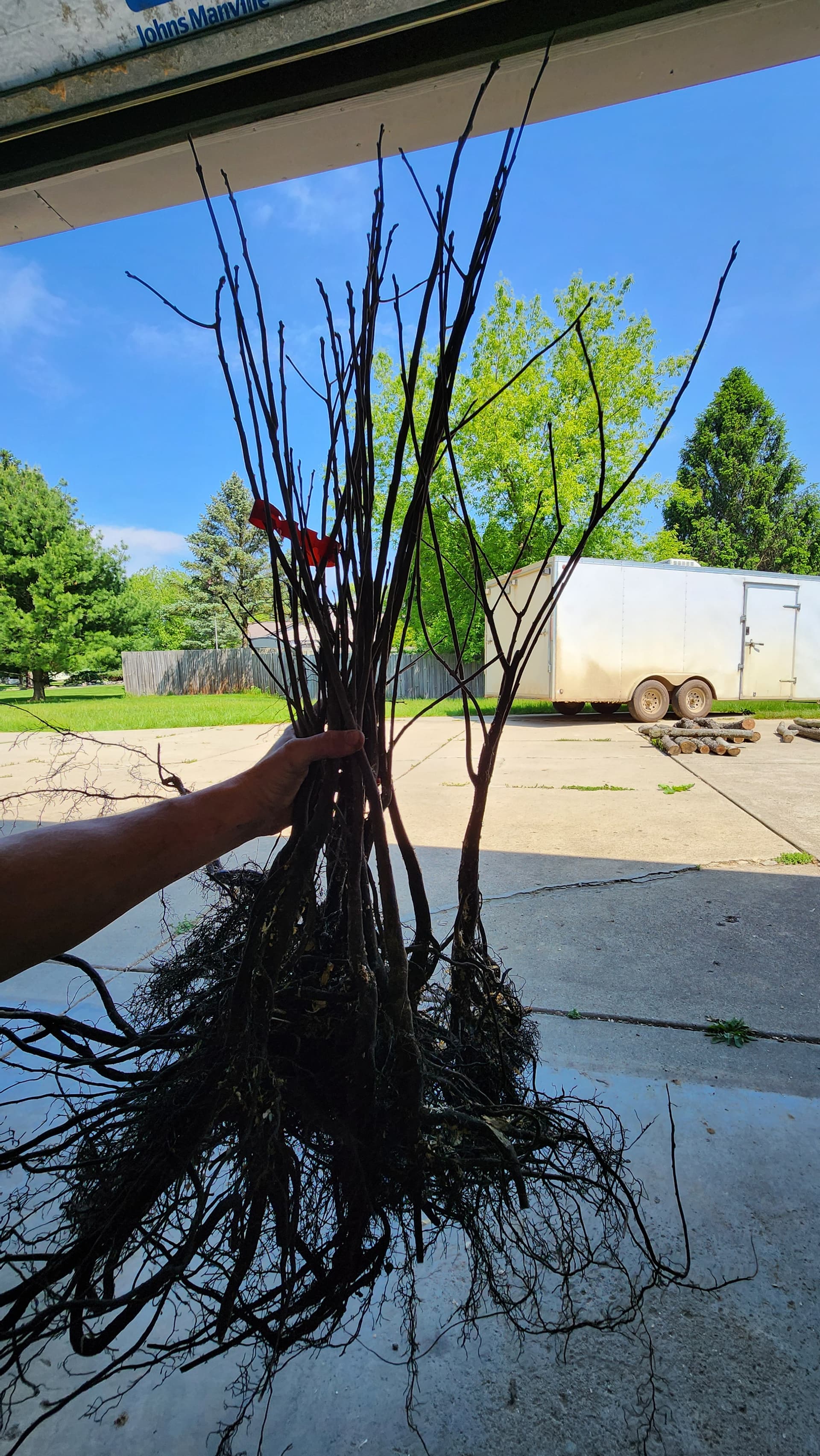
Hi folks, I know there are some huge threads here on American persimmons, some of which I have I have at least tried to read through, but I wanted to ask a couple of targeted questions. I’m hoping to plant my first (and likely only) American persimmon this year. I have never grafted before but am willing to give it a try. A few questions:
Does the rootstock need to be well-established before grafting, or can I plant a bare root rootstock and graft not long thereafter?
Is spring planting okay or is fall better?
My priorities are taste and ability to keep the tree as small as possible with pruning. I’m in Zone 7B (southern NJ) and not too worried about ripening time. From reading, I’m most interested in Lehman 100-46, Claypool H-118 and H63A, and Mohler. If you could pick one of those, what would you choose? Or is there another you’d recommend instead?
I believe you’ll find support here for planting rootstock this spring, get it established one year before grafting Spring 2026. Of your three options I’ve only tasted Lehman’s Delight and it was Fab-U-Lous; known for compact growth habit. A friend grows it; I do not.
I’m in zone 7 also, and generally Fall or Spring planting works fine. Hambone’s giving good advice. Maybe add Szukis to your list of considerations? It has a small growth habit and tends to produce a few male flowers, which may be a good thing (or a bad thing) if you’re just growing one tree. Of course, persimmon pollen isn’t exactly scarce in most of the eastern US…
If you can get a few rootstocks, might be fun to practice grafting this year (and keep a few ungrafted ones aside for next year if you want to let a few get established first). I’ve had 85% success on rootstock grafting in late May or even mid Summer for ‘hard cut’ rootstocks which didn’t recover and leaf out until very late. These were brand new rootstocks not established ones.
Thinking more about this- every time we bench-graft newly purchased rootstock we’re not waiting a year for rootstock to establish before grafting, at least with apples, pears. Should persimmons be different?
See discussions on this forum re (1) bench grafting bare root persimmon seedlings then (2) placing the grafts in a hot callus pipe. It’s exactly what we’d do with apples or pears except the pipe is used to warm the graft.
The premise is that each species has an optimal temperature range for callus formation, which can happen without the rootstock being actively growing. For persimmons, that optimal temperature range is 75-80 F (as I recall from memory).
I made myself a callus pipe intending to try it this year.
Yes, I realize I graft persimmon in May for a reason, when temps are up. But why would persimmon rootstock need another year before grafting, unlike apple, pear?
Pretty sure it’s just to get them up to the right diameter. If high quality rootstocks were available in bulk like apples and pears it wouldn’t be necessary
Two reasons that I can think of: (1) Often, purchased bare root persimmons (e.g., Missouri Extension) are quite small. Grafting onto them can be the equivalent of microsurgery. So the trees need a year or more to thicken. (2) In my experience, when planted, purchased bare root persimmon require a few weeks to a couple months to leaf out. If you choose to graft after the trees leaf out (which was the old rule of thumb), you can be grafting bit by bit from May through July. If you prefer to do your grafting all at once after trees have begun to grow, you have to wait until the next season to get them all in synch.
Last May I planted a bunch of good sized bare root persimmon, and grafted them about 6 weeks later once they were starting to leaf out. This worked well and they put on decent growth. TBD how they survived the winter, but I’m hopeful. I wouldn’t be afraid to use this method again.
if anyone needs graftable american persimmon, 50 pack from Pikes Peak in 18-24" size is available still. I just ordered some as the think they said had 10k total plants still left (not sure if that is in the 18-24" size though or everything combined).
Here is the site, but you prob want to order over the phone to confirm its the larger 18-24" graftable size.
I just ordered some as the Missouri Department of Conservation i just got was decent medium thickness (with half of them in the small thickness range), but i think Pikes Peak was definitive medium-large thickness last year.