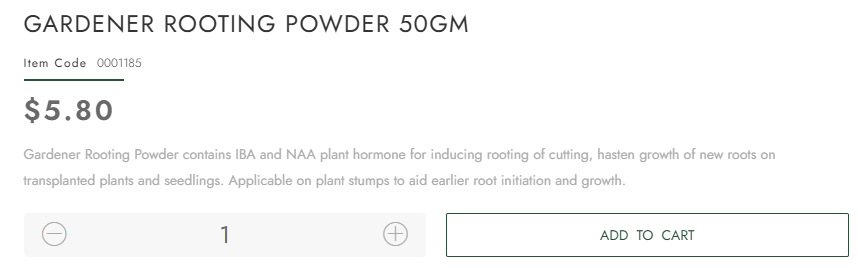
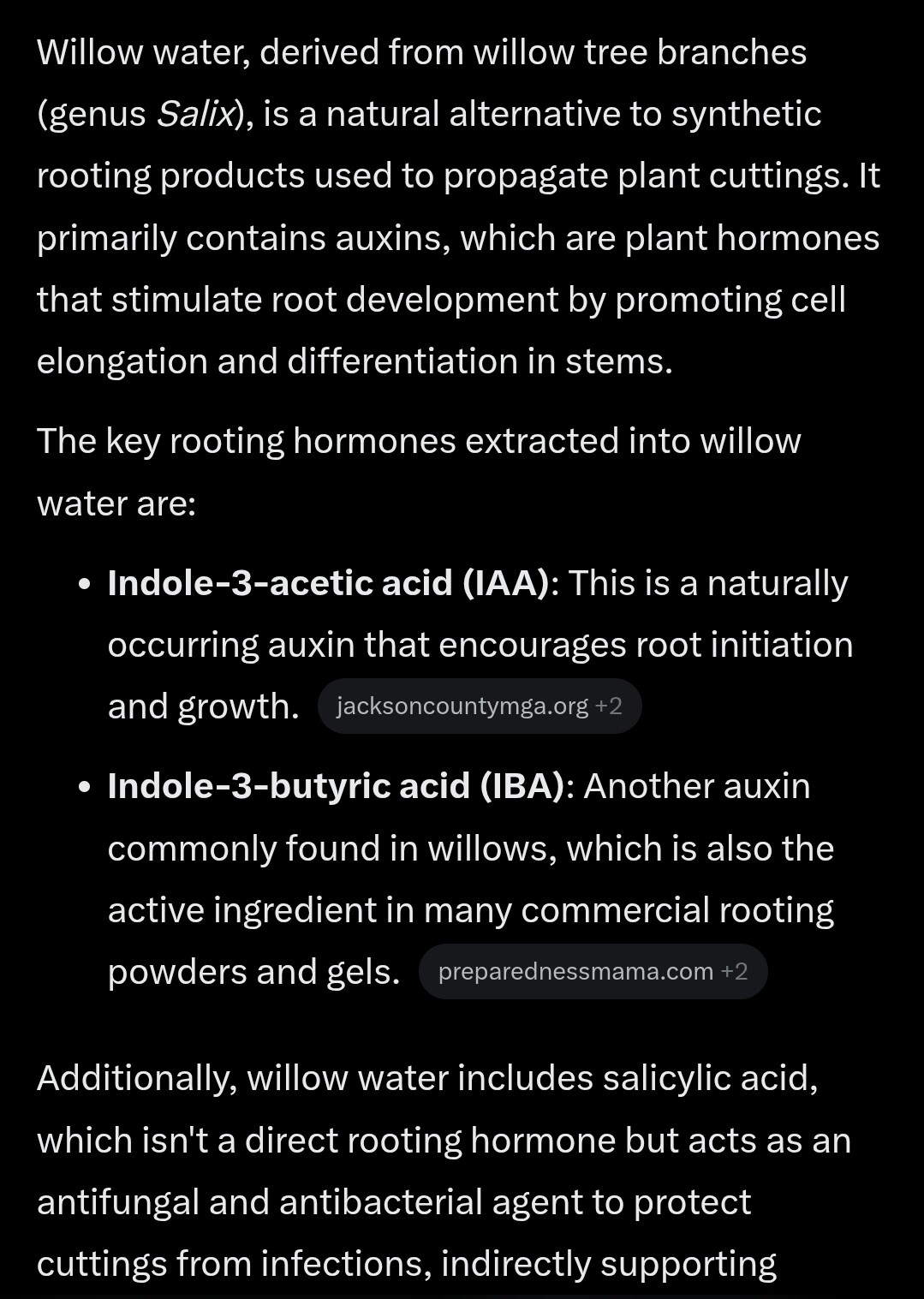
Willow water contains only one rooting hormone. Commercial rooting powders and gels, however, can contain two rooting hormones, which can increase effectiveness. Willow water also provides salicylic acid, but that can be replicated by using aspirin.
This isn’t a knock on willow water, KNF, or natural practices at all. As @a_Vivaldi pointed out, time is money—and that couldn’t be more true.
For what it’s worth, I don’t think @Richard was trying to belittle you. The explanations behind why some of what you said is misinformation take a long time to write out, and not everyone has time for that. What i can tell you is that plants don’t “convert chemicals to food.” The soil microbiology does that. Furthermore, “natural” fertilizers like that fish stuff have to be decomposed by the soil microbes before their components can be made available to the plant. Synthetic fertilizers aren’t bad for plants. They just skip the decomposition step.
Also, willow only has IBA. The other thing it has is salicylic acid, which if you really want you can just add a ground up aspirin pill (that costs less than a cent) to the rooting powder.
Willow water is fine, but it’s silly to claim it’s superior. The exact same hormones are available at low cost and in a much more shelf stable and easily applied forms. And the commercial stuff is at whichever concentration you need. There’s absolutely no way of knowing how much IBA and SA are in your willow water, so you’ve no idea if you’re doing nothing (too low a concentration) or even hindering rooting and killing the cuttings (too high a concentration, especially with SA). The amount of IBA and SA in willow varies by species, climate, season, weather, etc. and the amounts extracted depend on soaking time, how much you cut up the twigs, water temperature, water hardness, etc. and IBA at least is UV sensitive so you also don’t know how much is getting destroyed. For easily-rooted cuttings none of this matters of course, but for more difficult cuttings willow water just isn’t a great option. I’ve no issue with people using willow water if it’s convenient, but I have issue with folks who claim that it’s somehow better and can’t support those claims with true statements.
In my experience, the most dogmatic, close-minded people who refuse to try anything outside their cult are the ideologically-possessed: folks who have an unshakeable faith in a narrow set of ideas that defines how they see the world. Certain brands of politics on both the right and the left are like that, Salafists, certain evangelicals, SSPXers, Permies, etc. are really bad about being dismissive to the point of contempt for anything outside their ideology.
It’s actually normal people, aka sheeple, who are generally the most chill, open-minded, and practical. Just saying, since you brought it up.
I mean, no one really has my interests at heart outside me and my family. Corporations don’t, governments don’t, you don’t, other forum members don’t. Some are more good-natured and charitable and some are more misanthropic, but no one out there will put me above them at the end of the day. I take ‘em as they come, so corporations and governments that are clearly corrupt I put no faith in, but those that seem to be competent and composed of reasonably decent people I am ok with relying on for whatever their competency is. Same with people, there’s no easy rule for who to trust and who to despise, just gotta judge them as they come.
@Noddykitty did a fine job of reading my comment in good faith and responding in equally good faith and with sound reasoning that addressed the points I had raised. I think you’d benefit from emulating his comment.
IBA is converted to IAA inside the plant and functions largely as a precursor to IAA. I’m not criticizing willow water, but it isn’t accurate to describe it as containing two distinct rooting hormones, since IBA ultimately acts through conversion to IAA rather than functioning as a separate hormone class.
Well i apologize, ive been told otherwise all my life. Thanks for clarifying there isnt any difference, i guess you could crushup apsisrin and add to your powder bit thats just as much work for me as willow water and costs money. When my daughter is playing at the park i cut a couple new willow shoots and make sun tea then add natural thickener. Takes me an extra 10 mins worth of work and i have enough to last a long time. I bring this up for those who enjoy gardening and using nature to their advantage instead of companies. For people seeking natural alternatives. I am a libertarian at heart so to each their own. They are your fruit trees, add whatever you want, it doesnt affect me either way. I share what i know.
It’s the indigenous part that I was trying to harp on. It’s one of the things I think this KNF just gets plain wrong. Beneficial soil microbes are actually almost all cosmopolitan, the same major species and genera are by and large present in every soil in every place on earth. It’s the concentrations of them, and their activity, that changes depending on soil conditions. Indigenous microbes on the other hand tend to be more specialized, so they could be fungi that associate with a particular native oak or they could be pathogens native to that area, etc. and so moving them around is either pointless or harmful. I’m as big a proponent as anyone of developing healthy soil, but best I can tell all this stuff about inoculating with indigenous microbes and using brown sugar or vinegar and free amino acids and such is, outside of very niche applications, mostly just nonsense.
There’s a lot that goes into healthy soil, you need aeration and moisture and warmth, a suitable pH, sufficient rainfall to reduce salt buildup, internal and external drainage in the right amounts, good parent material and the proper amount of weathering, the right kind of cultivation, a steady supply of plant matter, plenty of different plants growing in the soil and interacting with the microbes, etc. none of that involves inoculating with indigenous microbes let alone the supposedly highly important application of fermented fish and plant juices. Outside of recently sterilized soils, every soil is going to already have all the important microbes present and will be perfectly capable of breaking down fish or plant juice all by itself. The key to increasing soil microbes is in creating good conditions for them, that means aeration, moisture, warmth, drainage, a balanced pH, and adequate organic matter.
The stuff about using what is locally present and available is fine, but so many times I’ve seen that attitude lead to enormous amounts of wasted effort, time, and opportunity. I grew up on an organic homestead, and while there’s many things about that which I love and cherish, it also left me deeply critical of feel good efficiency that is only efficient along one very narrow line of optimization and, without the horseblinders on, is clearly actually just a colossal waste in every other way.
For example, I remember how we tried to make worm casting tea to fertilize the tomatoes. Nothing wrong with that in principle. We dug out the most worm-rich parts of the compost pile, a compost pile that included all household scraps and the weeds from the garden and even the weeds we cut from the pasture such as dogfennel, picked out the worms so they wouldn’t drown and relocated them to the garden, submerged the casting-rich compost in water and let it stew for a few days, regularly stirring the mixture for aeration and to keep it mixed. Often we’d improve this recipe by collecting fresh cow patties from the pasture and adding those as well to jumpstart the decomposition. Then we’d pour it in the root zone of the tomatoes we were growing. Ok, so we were maximizing the microbial activity of our fertilizer-irrigation combo and being careful not to waste any worms and were even collecting weeds and cow patties from the pasture and using them efficiently as we could?
Yeah no, complete waste of time, effort, and opportunity. With the benefit of hindsight and a bit more knowledge of chemistry, soil science, and engineering, it was all a waste. Our garden was located in deep, excessively well drained sand, any liquid fertigation we applied was going straight down three or four feet and immediately seeping away downhill. Decades of mulching and applying compost did nothing about that because with summers as warm and wet as ours soil organic matter levels above 1-2% are basically impossible to maintain outside of swamps. We’d have been much better served using a tractor to dump a few tons of clay subsoil on the garden and disc it in real good. The native pH of soils in our region is often around 4-5 and as low as 3.5. That acidic sandy soil was never going to support much microbial activity, the microbes in that worm tea likely all died off in a matter of hours because the soil was never going to be able to support them. The nutrients in the tea mostly ended up feeding the pines downhill of the garden or in the swamp downhill from the pines. The worms we relocated so caringly to the garden beds probably died shortly afterwards from drying out, and eve if not they didn’t increase the number of worms in the garden soil because the worm population, just like the microbe population, was already at carrying capacity. An acre of boreal forest or scrubland is only ever going to support one or two deer, releasing a whole herd of deer won’t increase the deer population, it’ll just mean a herd of deer will starve to death, the same principle applies to worms and soil microbes. Adding microbes to the soil will never change the carrying capacity of the soil. The nutrients in the compost and manure would’ve been broken down and made available in the soil regardless, so there was never any benefit to making the tea and spending the time stirring it. Indeed, we likely bled off most of the nitrogen as ammonia–that’s the form of N that soil microbes produce under waterlogged conditions, hard to get more waterlogged than a literal bucket of water. The nutrients in that “nutritious tea” were hot gas blown away in the wind. The compost should have gone directly onto the soil and been covered with mulch, and the cow patties should have been left to fertilize the pastures. And the weeds we should have just been leaving in place, they’d rot just as well buried in the mulch as they would buried in the compost pile. And the dogfennel, man, what a complete waste of time. The total dry mass of all the dogfennel we collected was probably never more than a few hundred pounds, a single trailer load of mulch would have provided more organic matter than years of cutting and collecting dogfennel from the pastures. And we never cleared the dogfennel from the pastures despite all that effort. It’s a weed that the animals don’t eat, so we dutifully cut it down, pulled the roots, and did our best to hand weed it out, which was pointless because even hand pulling won’t get most of the rhizomes and regardless, the whole reason we had so much dogfennel in the pastures anyway was because they were over-grazed. Dogfennel doesn’t compete well with grass, had we just had fewer animals and used the tractor to mow the pastures a few times a year, the dogfennel problem would’ve been solved. Burning a little diesel fuel would have saved us so many hours of largely wasted hard labor. And it’s not like we got many tomatoes anyway, we exclusively grew heirlooms which meant that most years the tomatoes were dead or nearly dead by July and only ever produced a few edible fruit per plant. Two or three modern hybrids would have out-produced and produced better tasting and nicer tomatoes than our dozens of sickly heirloom Brandywines.
It was all narrowminded, super-focused, small picture “efficiency” that in the big picture was deeply inefficient and counterproductive.
I’m very fond of my childhood, but I’m also keenly aware of just how much of my childhood was spent on wasted activities, and just how much store-bough meat, fruit, and vegetables we could have replaced with far superior homemade alternatives had we just been a a bit more practical and pragmatic given the amount of effort we put into homesteading. And I see that pattern of copious amounts of wasted time, effort, and opportunity, and holy smokes money, repeated over and over with other homesteaders, with permies, with organic gardeners, etc. It’s a sad topic to be honest.
That’s very fair. I really do think a lot of this stuff is highly contextual, and within the context that you’re describing, there’s more useful stuff to be pulled from KNF or permaculture or etc. than in my context.
That’s of course not to say there aren’t objectively true or false things. It’s just that the world is a very complex place, and a heck of a lot of things do or don’t apply at times, or there’s a lot of variance in how much they apply.
Funny enough, my wife also doesn’t like gardening at all and is as city-girl as they come. But that’s actually led me in the opposite direction, I don’t even have a compost pile. Food scraps go to the chickens and everything else goes to the trash, including the cardboard I used to save for mulch (we don’t have recycling, our trash company offers it but from what I’ve been able to research less than 1% of it actually gets recycled, so here the green bin is just a more expensive second trash bin. The cardboard I stopped using because of the amount of plastic tap, synthetic wax, PFAS, and flame retardants it has, all stuff that I realize has it’s place in the world but I also realize isn’t what I should be putting in my garden). Despite that, I’d wager good money that I actually add more organic matter to feed my soil than you or @Bogovich or most other forum members do. My county has a free wood mulch program, so anytime I’ve got some time I get a full trailer load (about a ton) and dump it on my beds and landscaping. I do this quite often, so in a given year I probably apply several tens of thousands of pounds of organic matter to my garden, orchard, and landscaping (not that you’d be able to tell haha, in my climate even six-eight inches of hardwood mulch is pretty much completely converted back into CO2 within a year, “building soil organic matter” here is like building sandcastles on the beach). Given those inputs, and given that in most climates healthy soil will fix an adequate amount of nitrogen just with free living azobacteria in the soil regardless of legumes or synthetic fertilizers, I’d probably be fine not fertilizing most of the time. But I have a lot of stuff in pots and a lot of young plants that I want to push pretty hard, so I use commercial fertilizer. That’s my situation, it’s not going to be the same for other people of course.
Yeah, that’s fair. I think, and I’ve not much to point to to prove it but I’m pretty convinced regardless, that there’s a dynamic between initial inoculation and growing conditions, and that in different situations one or the other will just dominate. For highly controlled situations like fermenting wine the right inoculation (with yeast and not LABs) makes almost all the difference, and in very hostile environments like salted fermented food you similarly see just certain microbes flourishing and them or other ones being present initially is very important, situations where you need a very specific microbe to perform a specific role that no other microbe can, like root inoculation or making certain beers, inoculation is super important, lastly in somewhat controlled situations with huge initial colonization like making kefir the inoculation again is what matters. But otherwise, I think growing conditions tend to be the biggest factor, think about mold growing in the walls, every wall on the planet has mold spores in it, but it’s only where there’s enough moisture that moldy walls are an issue. The aforementioned azobacteria are present in all soils, but only do well and produce lots of N in warm, neutral soils with good aeration and decent amounts of soil carbon. Trichoderma require acidic conditions, lots of organic matter and moisture, and similarly need plenty of air. Clostridium is pretty much always present in the soil as well, but it only does well under strongly anaerobic conditions with ample organic matter. Dry, purely mineral soils will strongly favor Streptomyces and similar oligotrophs.
The emphasis KNF puts on inoculation and culturing certain microbes strikes me as misplaced in most cases. Sure, there are instances when it probably works, like drenching leaves with a live culture (either LAB or compost tea or whatever) to reduce leaf scorch (the tea had lots of sugar and was a great environment, whereas a leaf surface isn’t going to support a large bacterial population, so when drenching the leaves you really are just swamping the handful of Xanthomonas or whichever pathogen it is with billions of other bacteria that are very likely antagonistic), and then a heck of a lot of times when it’s probably completely and utterly useless (you can inoculate tilled garden soil however much you like with leaf molds, it’s not going to change the fact that garden soil microbia is a mostly bacterial whereas forest duff is mostly fungal, nor will the acid and extremely high OM loving cultures on the leaf mold thrive in the more neutral and mineral based media with moderate OM content of typical garden soil).
Yeah, that’s for sure one of those contextual differences. What are the ends? In my case, while I deeply enjoy working the land and working with my hands, I feel it has to be directed towards higher goods. If I’m working with my hands or working the land it’s never for its own sake, it’s to produce great food or fix up my house or promote biodiversity and biodensity. Those ends determine the way in which I work with my hands and work the land. If one activity of working with my hands yields marginal results and another yields abundant results, I’m going to favor the more productive one. To be honest, I actually enjoy the activity of making and spreading a few good wheelbarrows of compost more than I enjoy the activity of spreading literal tons of mulch and sprinkling or synthetic fertilizers. But making and spreading compost is just a deeply inefficient use of my time and resources, so regardless of enjoying it for its own sake I don’t bother with doing it.
I’m sympathetic on this point, and will probably just take your word for it. Again I think it’s likely contextual. I’ve argued this point with a few other forum members and on the Permies website, but there’s really a significant difference in the dynamics of microbes, soil, and plants depending on climates. Dry climates and cold climates are more like petri dishes, and cold, dry climates even more so. All this stuff about building soil organic matter, organic pest and disease management, inoculating with microbes, increasing soil microbial activity, fostering diverse microbes, etc. is way, way, way more likely to matter and maybe even work someplace like, idk, eastern Oregon where the summers are dry and the winters are long and cold and even the fall and spring are largely either cool or dry or both. Gardening in those climates is something like gardening in a petri dish. Gardening in the South is more like gardening in the Amazon. Different contexts.
Im sorry worm tea didnt work for you. I add woodchips every year from free sources and knocked them up with wine cap mushrooms mycelium years ago. Compost around each tree.The only problem is free woodchips can give you terrible invasive weeds smh… what a nightmare. I just add a little FAA fertilizer and some LABS. Im going to try JADAM sulphur for brown rot prevention.
Someone should take a poll and see how many people on this forum (especially ones over 60) started in horticulture by growing Weed. I’ve met some very accomplished gardeners who cop to this.Yes, guilty here.
i only started to grow it once it was legalized. then i had family and friends that used for medical reasons that didnt know how to grow it and didnt have the money to buy from the medical shops so i agreed to grow a few for them. i grow them in between my tomatoes and you dont even notice them until you get close or smell them. its been 10 yrs since its been legalized and anyone that has a garden usually has at least a few weed plants. they dont even try to hide them.
Yes, at this point, at least in Vermont where home growing with limits is legal, it’s become unremarkable. I think it’s sort of like any veggie now, share with family and friends.
That’s one reason I don’t use a lot of polyester or nylon, but for light weight jackets I compromise and send them to the landfill when the fabric becomes irreparable. I also use plastic tarps when pruning fruit trees for customers to help me leave sites reasonably clean. I keep them functional for as long as I can with duct tape.
My woods don’t really support Norway Rats and they only showed up last year for the first time. I have been able to use plastic garbage cans for years but when they showed up they gnawed through every one. The galvanized ones Home Depot sells now are for shit. One year of use and they are almost shot. Maybe I should paint them with Rustoleum before I use them.
I also have heard many skilled horticulturists started with this plant that used to be very easy to grow, although new strains are more prone to leaf fungal issues. I grow a couple of plants for my son and it seems the more purple the strain the more prone to that problem. Of course, bud rot is always something of an issue and always has been in the east.
I’m told that Michael, who maybe still owns Edible Landscaping got his start through this plant.