I read you can’t get real wasabi in the USA, it is all phony. And from looking at the powdered wasabi ingredients on the can, that seems to be the case.
What can you grow or substitute for the wasabi kick?
I read you can’t get real wasabi in the USA, it is all phony. And from looking at the powdered wasabi ingredients on the can, that seems to be the case.
What can you grow or substitute for the wasabi kick?
you can buy wasabi roots from a lot of the bare root sellers. no reason i have to believe its fake.
Ive considered it a few times but every time im like, what am i actually going to do with wasabi. nothing.
I want to grow wasabi arugala after someones suggestion, which isnt really a substitute but im still interested
It is not a hardy plant. In zone 6 it would need some sort of protection. There are nurseries who sell the plants. Try nurseries in the Pacific Northwest.
Good ol horseradish. Japanese wasabi is a type of horse radish. I read somewhere that all wasabi paste is made from regular horseradish, as ground up Japanese wasabi losses it’s kick after a while.
I’ll have tons of horseradish in the fall if you need any
I have both, real Wasabi and horseradish. I actually bought some horseradish seeds to grow, but have not started them yet.
I grow Wasabi in the Pacific Northwest in Zone 8B, but it needs protection from arctic air in the winter and from hot weather and sunshine in the summer. And its soil has to be always moist, which invites slugs that need to be eliminated.
Horseradish is often used in place of Wasabi, but it doesn’t really taste like it. Real Wasabi plants are completely edible; the leaves provide an interesting mild kick in a salad.
I found Wasabi plants for sale at a local garden center near Vancouver, BC; I imagine that it will be available at sizable US garden centers. I also started a plant from a fresh Wasabi stem that I bought at a large produce market with ethnic vegetables.
I agree with you. I used to care a lot more about herbs and annuals but in most cases I found it to be a decent amount of work for something I’d rarely use (though some herbs like mint and rosemary are so easy and plentiful i have to give them away). Wasabi would only be useful if you prepare sushi yourself or get takeout. The biggest variable with sushi is the quality of the fish anyway.
The fake part is…fake wasabi powder, etc sold in stores.
Didn’t know that. Here is Google on it.
wasabi (Wasabia japonica) is not a single-season crop
It is a perennial plant, but it is a very slow-growing one that takes roughly 18 to 24 months (up to three years) to mature to the point where the rhizome (the main stem used for paste) is ready for harvest.
Lubera Edibles +2
Here are the key details regarding the wasabi growing cycle:
Long Maturity Time: While the plant is active and produces edible leaves, the main rhizome takes 1.5 to 2 years to grow into a marketable 4-6 inch length.
Perennial Nature: Unlike annuals that die after one season, wasabi lives for multiple years. Some growers report cultivating the same plants for several years, using the offshoots for propagation.
Harvesting: Although the plant is a perennial, the rhizome harvest is usually “destructive,” meaning the entire plant is pulled up, making it a “one-time” harvest after that long waiting period.
Leaf/Flower Harvest: While waiting for the rhizome to mature, you can harvest the leaves and flowers (which appear in spring) to use in salads or for cooking.
Lubera Edibles +4
While it takes 18-24 months for the best results, some specialized, faster-growing cultivars (like ‘Fuji Daruma’) can be ready in closer to one year.
The Spruce +4
I was just curios of what real wasabi tastes like. Curiosity causes me to grow lots of stuff.
I lived in Japan and the real stuff is wonderful and will blow your top off!
Seeds for this just showed up at my door. I’ll let you know how it goes and can send you some.
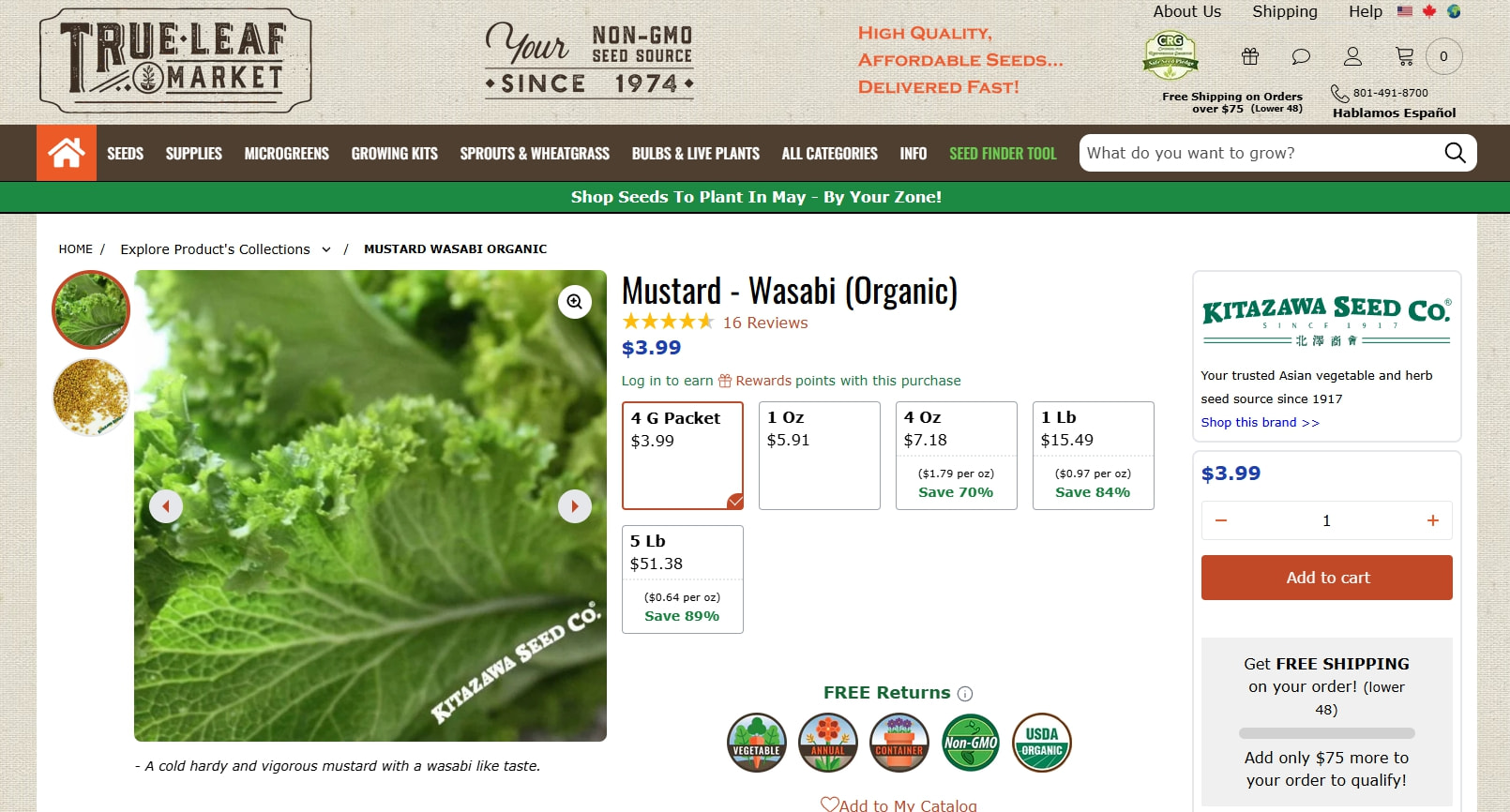
Is this how wasabi root is grown? I guess it starts out as a mustard green and you eat the roots.
You would think they would grow wasabi root in CA and ship around the USA.
Do they sell wasabi root in Japan Town or Korea Town in L.A.? Have you seen the wasabi root in any stores in the USA? I used to go to Japan and Korea Town in L.A. a lot when I lived there. But never thought to look for wasabi.
nah, this is just a variety of mustard that ha a similar flavor to wasabi
A few Asian store in L.A. had wasabi roots when I went last year.
With real Wasabi you eat the stems after they grow sufficiently large. The stems are grated to make sushi Wasabi.
I thought they ate the root like horseradish.
Here is Google on it…
Real wasabi (Wasabia japonica) is rare in the US because it is exceptionally difficult to cultivate, requiring specific, cool, flowing water environments and taking up to two years to mature. Due to high costs ($160+ per kg), short shelf life (flavor lasts ~15 mins after grating), and high demand, most US restaurants use a cheap substitute of horseradish, mustard, and green dye. [1, 2, 3, 4, 5]
Key Reasons for Scarcity
Extremely Difficult Growth: Wasabi requires very specific conditions—a cool, humid climate (not hot), shade, and, crucially, clear, running water. It is prone to disease and slow to grow.
High Cost and Low Yield: Due to the long, laborious, and sensitive cultivation process (often 18–24 months), real wasabi is incredibly expensive, creating high wholesale prices.
Rapid Flavor Loss: Real wasabi must be grated fresh and loses its signature complex flavor, aroma, and heat within roughly 15 to 30 minutes, making it impractical for standard commercial distribution.
Market Dominance of Substitutes: Because authentic wasabi is rare, the vast majority (about 99%) of “wasabi” in the U.S. is actually a mix of horseradish, mustard, and green food coloring.
Supply Shortage: Japan, the primary producer, has seen a 70% decrease in production over the last 20 years due to climate change, reducing availability for export. [1, 2, 3, 4, 5, 6, 7, 8]
While some boutique farms in North America grow small amounts of wasabi, such as in Oregon and British Columbia, the vast majority of what is served in the U.S. remains the horseradish substitute.
Note that Wasabi plants do not require flowing water. It’s their environment in the wild, but the plants don’t need it to be grown successfully. I’ve gotten usable size stems in the past, and the same plants or their offspring have survived for many years in one shady spot. I’ve nearly lost them during some summers from insufficient watering and shading, but they have always recovered.