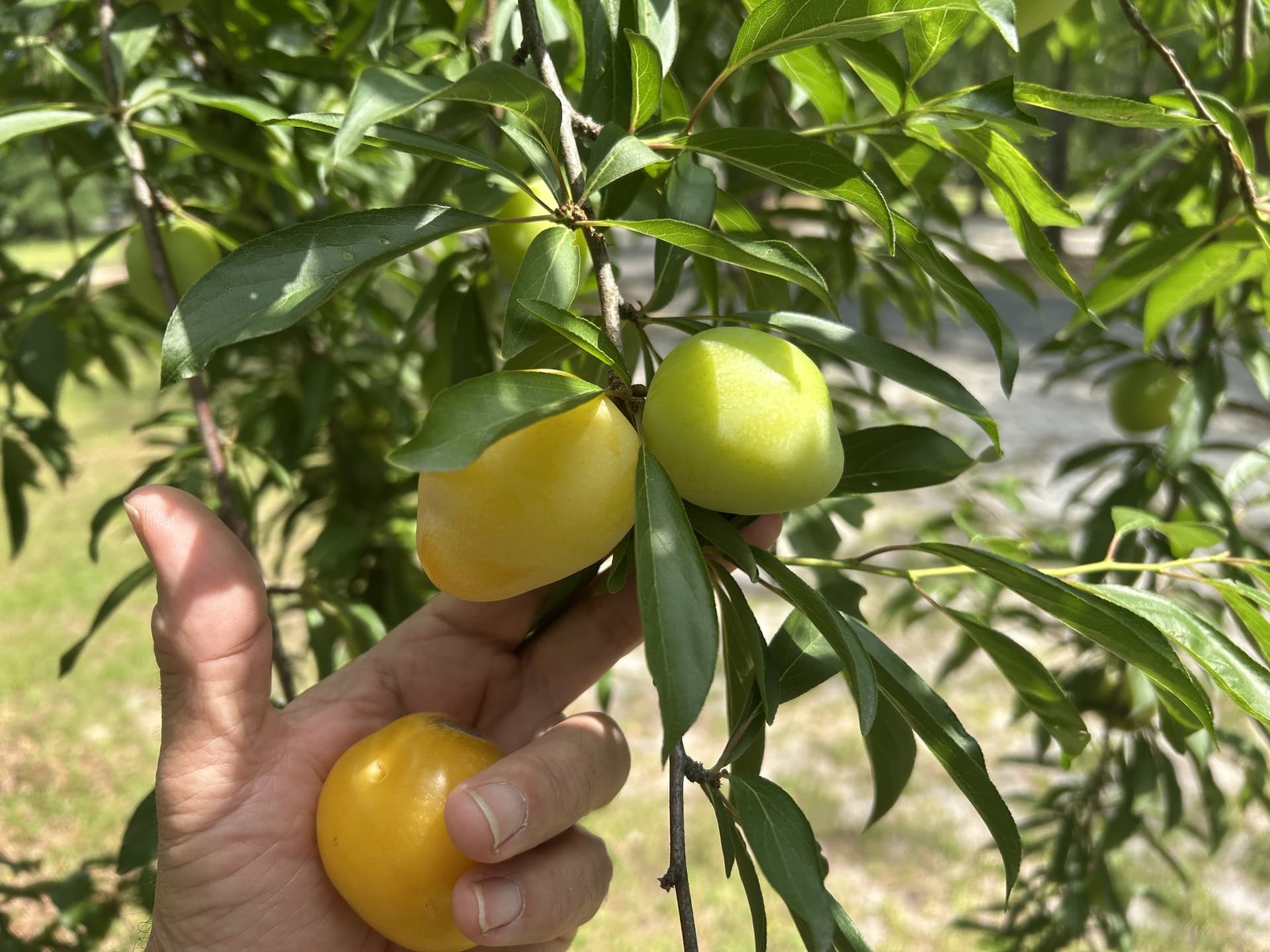
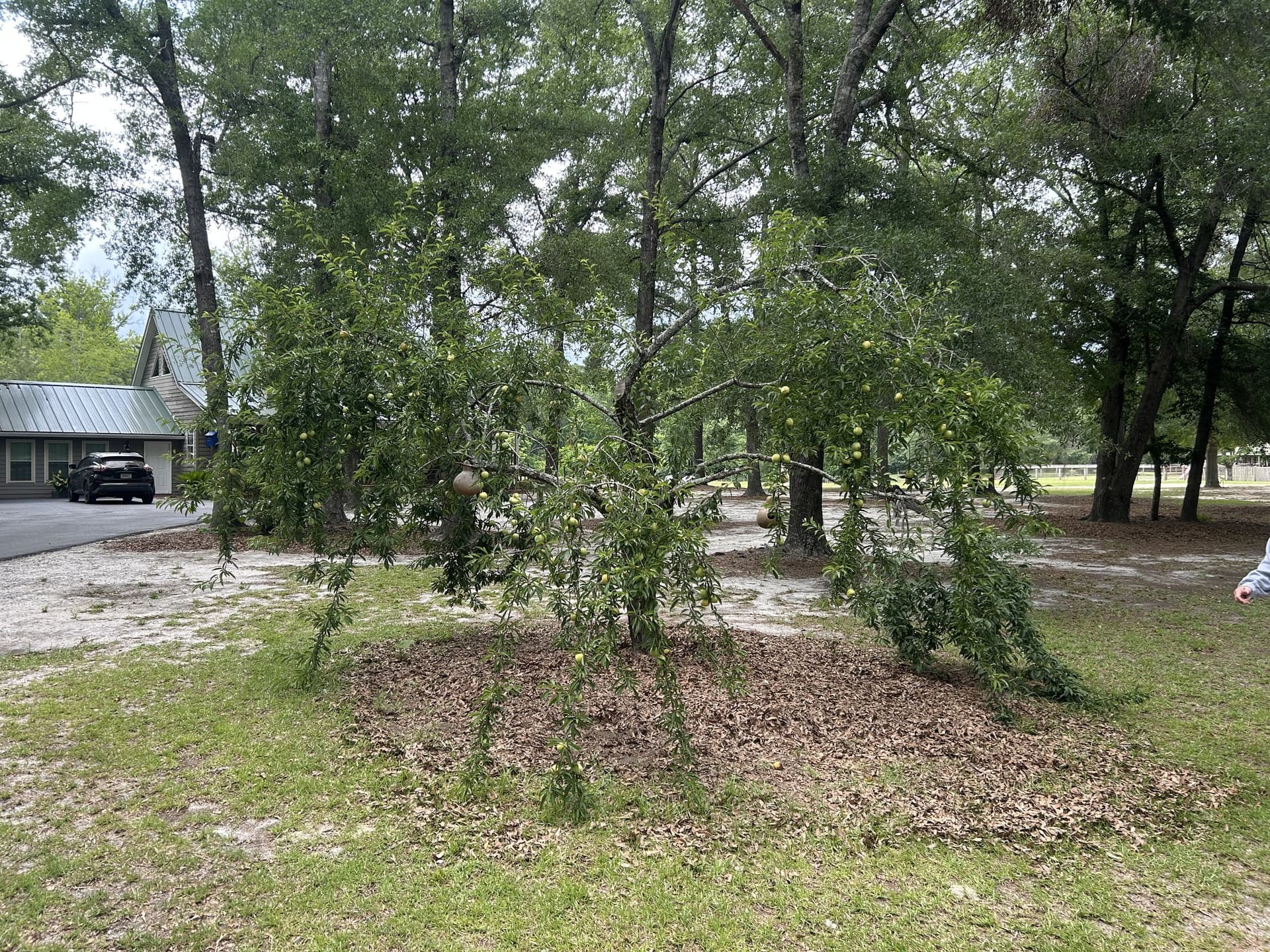
Hi. Some people from church asked me over to identify their plum tree. Plum trees don’t usually stump me anymore, but I have never seen one that looks like this before. See the photos: Vegetatively the tree looks as much like a peach tree as a plum. The leaves are super long and skinny even by chickasaw plum (Prunus angustifolia) standards. The tree looks very, very old, much older than my 15-year-old trees. The tree is so gnarled and has such rough bark that I can’t tell if its grafted or not. It has several suckers, and the suckers have leaves very similar to the adult tree, but there are enough differences that I’m not confident that it’s the same. The bark too rough and blocky to look like any plum bark I’ve seen before. It’s not huge, but it’s been cut way back recently. the trunk is about a foot in diameter at the base. Some of the main branches are about five six inches in diameter. It’s responding to the recent pruning with healthy new growth.
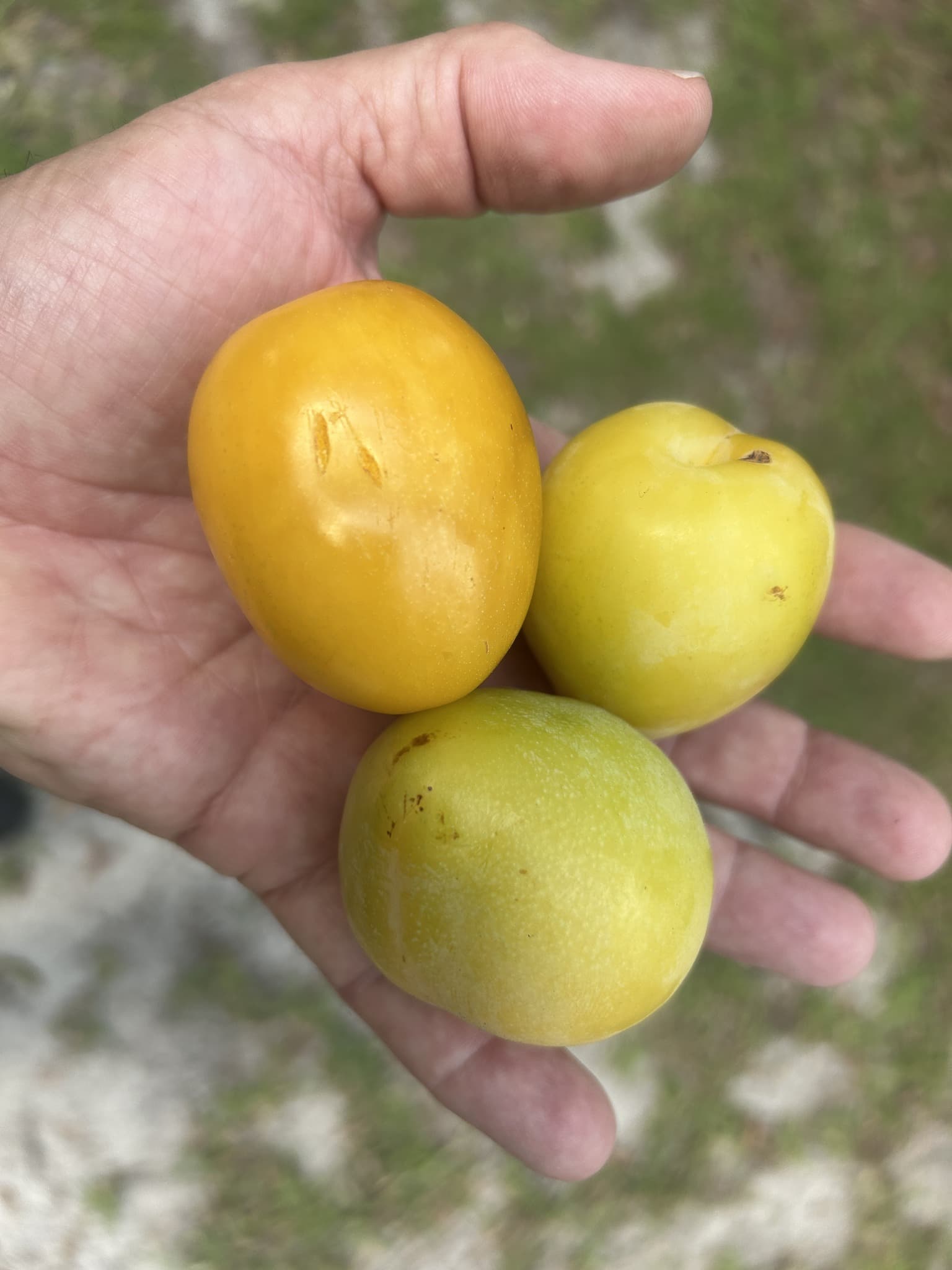
The fruit are as bright of yellow I have ever seen in a plum. Super ripe fruit have a little gold towards the bottom similar to the color of a caution sign. The plums are about 3 inches long and over and between 1 1/2 to 2 inches wide. They are peach shaped with a pointy bottom. The flesh is fleshier than any chickasaw (Prunus angustifolia) cultivar I’ve tasted. The texture of an over ripe one is like an overripe Methley. Flavor, wise the plums are very sweet with some tartness but not much. The flavor is more similar to a chickasaw plum cultivar than to an Asian plum or peach. It has that chickasaw plum aftertaste. Like a lot of chickasaw strains, the plums are kind of bland when super soft ripe. Unlike most chickasaw plums, they are astringent whin slightly green. The skin is unusual for a plum. While it becomes smooth and shinny when you rub it, it has a slight satin feel to it when you first start handling the plums. This is just especially pronounced in the green one. The seeds are really big for plum and seem slightly intermediate with peach. The feel, look and taste of the plums is way more plum like than peach like, and the tree just plain looks more like a peach tree than a plum tree. My hunch is that this is a hybrid between a chickasaw cultivar and peach with more plum in it than peach. When I first saw the tree, my thought was maybe it was a peach X plum hybrid rootstock which survived the scion.
There are lots of chickasaw strains in the Deep South being passed around by rural families from generation to generation. If this is one of them, it’s an unusually good one. It deserves a name and to be distributed among growers. But we need to rule out it already being a named cultivar. The cultivar out there that I know about which has plums that look kind of like these is the Asian plum, Inca. I’m confident that this is not an Inca on account of the long skinny leaves. If this is a named cultivar, the most likely candidate will be some sort of plum X peach rootstock.
Last bit about this plum. Not only is the fruit huge and very good by chickasaw plum standards, but the tree is very old and growing under terrible conditions. It’s in the shade. It’s growing in a very light sand and isn’t getting any irrigation in a very dry season. Every ripe and ripening plum has a curculio. Yet, the plums are still 3 inches long. With some basic care, I think this strain would make an excelent farmers market plum for the Deep South. Oh, one more thing, there is not a second known plum tree on the property. There are about a half dozen active bee hives in the same yard, there are neighbors nearby, and the surrounding habitat is suitable for flatwoods plum (Prunus umbelatta) which is a good pollinizer of Asian type plums. The tree might be self-fertile, but with all those bees a few yards away, likely means that a plum tree does not have to be terribly close by to pollinize it.
19 Likes
Looks like a golden nectar plum to me, including the shiny skin, color, and oblong shape. But bright caution sign yellow flowers? Mine are a faded yellow.
1 Like
It’s hard to know the origins of such things, but chances are, it’s either an old forgotten strain of cultivated Chickasaw plum, or a hybrid of the same with some Asian plum. Any peach content would be highly unlikely. Peach- plum hybrids tend to be highly or completely sterile, and the odds of an old plum of unknown origin being a fertile hybrid with peach seems virtually zero. Definitely a cool find however. Especially if you find it has disease resistance comparable to other Chickasaw cultivars once you’ve grown it a few years.
3 Likes
Hi Marcus,
It’s a very unusual tree. I have about 70 varieties but nothing exactly resembling the foliage of this tree. The foliage is not serrated around the edges like all my plums are. My Wild Goose plum has very slender leaves like this one but they are serrated and pointed on the tip, rather than blunt. The other similarity with Wild Goose is its pentagon fruiting clusters of 5 leaves along each branch. So I suppose it’s a hybrid of a smooth leafed plum with Wild Goose given the fruit size and the penta shaped clusters of leaves. You might check with Okios nursery since they produce Wild Goose trees for sale. Perhaps they have a similar cultivar. When my Wild Goose trees blossom one cultivar has pink flowers and the other is Snow White. My fruitlets in this first year to produce are currently about the size of the head of a straight pin.
Dennis
Kent, Wa
6 Likes
Yes, looks like yellow egg plum, Tippy do you have a plum that is similar?
1 Like
Marcus, Quite a find! Tree looks very healthy and disease free. Worth further evaluation for possible propagation and distribution to growers in the Southeast especially. Sorry if I missed it but…is it clingstone? I would love to try this one for sure. Appreciate you sharing and keep us posted!! Randy/GA
I very much doubt that a European plum of any sort would live to be this old in SE Georgia, especially given the neglect this tree has endured.
I originally wrote bright yellow fruit. LOL, all social media websites like to second guess and create verbiage chaos.
If this is a commercial cultivar strain, golden nectar seems to fit the fruit characteristics best. The owners were not able to tell me anything meaningful about the flowers. They have converted a rundown old hunting preserve over to an Air B&B business and have been focused on renovating badly rundown cabins. They have owned the property about five years and said that this was the first time that the tree bore fruit but were not able to tell me whether it had bloomed before. I asked trying to figure out whether it has too high a chilling requirement for the area and bloomed this year on account of our unusually cool winter. These folks are not gardeners at all. They made the mistake of removing the other plum tree this winter because it was “too tall” to reach fruit without considering the possibility of cutting it way back or the need for it to cross pollinate the other tree.
If you have Golden Nectar, photos of leaves will be helpful. Are they long and super skinny leaves? Does the fruit of golden nectar have a not smooth, almost satin texture when you first touch it? Does it have any reputation for being disease resistant at all? I saw that it has a low chilling requirement. I haven’t found any information yet that eliminates Golden Nectar from consideration, but I have encountered zero information that’s indicates that it’s a good strain for SE Georgia growing conditions. It would take a bullet proof Asian plum cultivar to take SE Georgia for so long under such extreme neglect conditions. This was the first year the tree received any care at all for about a decade. And that care came from someone having zero clue what they were doing.
6 Likes
Thanks. I’m guessing a hybrid or some sort. It has to be disease resistant to survive it’s growing conditions for so long.
Dennis, do you have any experience with Golden Nectar. Fruit characteristics seem suspiciously similar to it. Given that I’ve encountered zero hint from any southern horticultural source about Golden Nectar being a good strain for SE Georgia, I see this as a long shot. However, besides the fruit being the right size, shape and color as Golden Nectar, I found a plant description which said that it had a melon flavor. While I think that the yellow mystery plum generally tasted intermediate between an Asian and Chickasaw plum, there was something slightly off about the flavor not in a terrible way but not in a great way either. Seeing “melon” mention in the description for Golden Nectar allowed me to associate that “off” flavor with that of a honeydew melon. I find honeydew melon to be meh at best.
As for leaf serrations. I paid attention to that detail. The serrations are there but super fine. I looked for and did not see any glands associated with the serrations a feature shared by Asian, Cherry and chickasaw plum. I can’t remember if monson plum has the glands or not. I plan to look later today. Given the astringent nature of the slightly green fruit, Monson plum is a real possibility for being in the ancestry of this tree.
Hi Marcus,
I am not familiar with that variety. The oddity of my Wild Goose foliage has always fascinated me as to how distinct and different they are to all other Prunus varieties and I have natives from Mexico to Canada, but none of them compare at all to your friend’s tree or my Wild Goose. Your friend’s tree is truly distinct and if I just saw its foliage I would not expect a plum to be growing there!
That’s why I mentioned Okios as perhaps in a good part of the country to have seen anything like it.
Here is a note I received from Okios a couple years ago concerning my 2 trees I purchased in 2020: Yes. Same population from 7 plants in that group including the original selection that is grafted. All are from the same grafted parent originally and will cross with one another. As far as I know they are all self fertile. If the trees flower and do not produce fruit for the first 1-3 years, this is normal.”
This tree also reminds me of a plum thicket I often visited as a kid. It was about 1/4 acre as had one big Wild Goose tree surrounded by a Chickasaw thicket. I never could find out from my family any clues as to its origin, but I definitely cherished its fruit which was the size of a bantam chicken egg and about 3 times the Chickasaws. Years later after I graduated from school I went back to discover the thicket and it’s central tree were all extinct, will never forget that trip!
Perhaps that’s my motivation to now try to create my own local thickets here now that I am settled down and no longer moving around the world.
Dennis
4 Likes
My Monson plum which supposedly originated from Okios by way of a third party has tiny astringent fruit. It’s showing promise as a rootstock for some things. But fun fact when I first drove up to the property, my first question was, “where’s the famous plum tree?” The people pointed to it and said that I drove right past it. My response was, really? That doesn’t look like a plum tree? When I drove buy, my brain saw it as a poorly maintained peach tree.
4 Likes
Time to start an air layer!
1 Like
I plan to graft it and try to grow out a sucker long enough to see is the leaves convince me that it’s the same as the original tree.
4 Likes
My hunch is it’s not a grafted tree, else there would be many more like it and some member here would also have a grafted version. I suspect it’s a hybrid seedling that a goose migrating south dropped years ago! Your test should tell though! Look forward to your results
Dennis
1 Like
It does have shiny fruit even while they’re tiny, and long narrow leaves. I don’t have a picture on my phone except when it got shot hole fungus last year and you don’t want to see that! I will try to remember to take a new picture. It’s definitely melon-mild apricot and not at all like my other plums.
Thanks. And I would love to see the picture.
@coolmantoole, that middle picture of the grouping, the one showing the three fruits at various stages of ripening, those fruit remind me of a hybrid that was carried seasonally at a farmers market where I worked many decades ago. I do not recall whether it was labeled as a pluot or as a plumcot but we offered three different varieties: a solid of yellow one, one that was speckled (grey/brown?) over cranberry that I think we called a “dinosaur egg [pluot/plumcot]” and one that was a green a bit more muted than the pod of a fava bean, maybe like a Hass avocado on the way to being fully ripened. Is there any chance that this fruit could be a hybrid in that direction instead?
1 Like
I’d be tempted to ask Andy Mariani of Andy’s Orchard in Morgan Hill, CA. He’s the head of Santa Clara Rare Fruit Growers, and your plums look like some I’ve bought from him. He only grows what tastes good and only picks it ripe and has a devoted following in the San Francisco Bay area. The Kit Donnell peach he developed is the best peach there is. But I digress. Good luck! And thank you for rescuing that tree and possibly that variety itself.
2 Likes