The triploid route is definitely feasible. Last year I made crosses of ‘Nero’ (4x, pollen parent) × ‘Low Scape Snowfire’ (2x, seed parent) for exactly this purpose. Crossing a tetraploid Aronia with a diploid typically produces offspring with a range of ploidy levels, and I’m hoping at least a few of them turn out to be triploid. Unfortunately, it was the plant’s first year flowering, so it produced very little seed.
I’m also growing out a number of Aronia prunifolia plants purchased from Experimental Farm Network/Sheffield’s in the hope that some might be triploid. I’m not holding my breath, though.
‘Bollwiller’ is the same as ‘Baby Shipova’—it’s the parent of ‘Shipova’. The high-anthocyanin accessions at GRIN are UC024, UC031, and UC067; I may request them in the future.
Is there anything preventing nero or viking aronia to be used as a seed parent? Something like having clonal seeds?
I’m almost wondering about collecting a bunch of warren pollen and freeze it in liquid nitrogen in our AI tank and then put a clear tub over one of the aronia bushes and pollinate all its flowers with it.
Would having tetraploid parents help prevent the hybrid Lethality? Also I wonder if someone could make even a tetraploid hybrid, cross between another tetraploid hybrid, then do something like germinate pollen in vitro to reduce the ploidy back to two?
Some tetraploid Aronia do produce a small percentage of zygotic seed along with the apomyctic seed, but it’s usually a low enough percentage to be impractical. However, it could still be attempted.
I know the study well. I think I’ll improve my odds by using hybrids in their first flowering, mixing pollen from different ploidy levels, and applying reciprocal grafting as a preliminary vegetative approximation.
Does anyone have ‘Alaya Krupnaya’? I’m almost certain it will cross with Aronia—so, if you trust Michurin’s disciples, you could potentially create a successful Aronia × pear hybrid easily.
That said, their definition of “hybrid” was much broader than ours. My guess is that ‘Alaya Krupnaya’ was considered a “vegetative hybrid,” and the changes seen in the mountain ash might be due to something like a mentor graft effect or Xenia. Of course, it’s possible it’s a true hybrid— Michurin’s intergeneric hybrids (including ‘Nero’ and ‘Viking’) were almost universally doubted until genetic testing eventually confirmed he was correct.
I’m not endorsing the term, and I think it has meant different things to different people. Most scientists would probably consider those who use it to be quacks.
I don’t know exactly how the Michurin School scientists would have defined it, but I imagine they would have described it as profound changes produced by means other than sexual hybridization. This could include phenomena such as chimeras, as well as effects caused by mentor grafting, xenia, and alien pollen. These concepts were largely mocked or ignored in the West, but more recently, many of them have been shown to be valid.
I remembered why I thought ‘Alaya Krupnaya’ wasn’t a real pear hybrid. Its parentage is listed in several places, including reputable journals, as:
(Sorbus aucuparia L. × pear mixture pollen) × S. aucuparia var. moravica
That’s a bizarre way to list it unless the person who created the cultivar believed that a mixture of pear pollen could produce an effect other than ordinary sexual hybridization.
That formula looks completely normal to me. It just means that they didn’t use one specific pear variety, but rather mixed pollen together from multiple pears in hopes that among them something would prove compatible with the Sorbus. Then one of those offspring was back-crossed again to Sorbus. The real concern would be is it really a hybrid or just a select Sorbus? I’d be curious if the F1 cross used as the mother of ‘Alaya Krupnaya’ exhibited any pear influenced morphology to confirm its hybrid status.
That’s possible, but wouldn’t either of the following make sense—especially since some of the same articles use these terms for similar hybrids?
(Sorbus aucuparia L. × Pyrus spp.) × S. aucuparia var. moravica
Sorbopyrus × S. aucuparia var. moravica
I mentioned possible pollen effects because breeders from the Michurin schools were known to use them, and they often had a much broader definition of what constitutes a hybrid.
That would be a better way to put it. My assumption was European pear, but since they didn’t specify, your way of just putting Pyrus sp. makes more sense. I actually had overlooked that they put the common name in instead of the botanical name.
This one makes less sense since if you’re not gonna spell out the whole pedigree (Sorbus× Pyrus) × Sorbus, then you might as well just shorten it down to Sorbopyrus alone since Sorbopyrus× Sorbus still = Sorbopyrus beaing as it does not add in any new genus to the mix.
Some of the supposed intergeneric hybrids reported out of Eastern Europe have incredibly complex parentage listed. I don’t think anyone is deliberately misrepresenting anything. I see two likely explanations:
Vegetative Hybrids – The scientists may have been using an extremely broad definition of “hybrid,” one that would seem absurd to many Western scientists. For example, a breeder might have mentor-grafted an apple onto a pear and then pollinated the apple with a mixture of pear pollen from several pear trees grafted onto apple rootstock. If any of the apple offspring showed phenotypic shifts toward pear, they might have classified it as an apple/pear hybrid—even while knowing it wasn’t a true sexual hybrid. Michurin bred something similar that he described as an apple/pear “vegetative hybrid.”
Taxonomy – There’s also a fair amount of fluidity in how certain species have been classified. The Malus hybrids may have involved something like Malus florentina, which has been difficult to place taxonomically. Michurin claimed several sexual intergeneric hybrids involving species like this—although when he originally made the crosses, some were already considered intergeneric. For example, Malus florentina was once classified as Malosorbus. Similarly, when Michurin made his Aronia crosses, they were technically interspecific at the time because Aronia was treated as a black-fruited Sorbus. They only became intergeneric later when Aronia was reclassified as its own genus.
Either way, I’d love to get my hands on some of those Eastern European intergeneric hybrids.
I knew that one potential benefit of crossing pear and Aronia would be that the hybrid might bear fruit much earlier than a pear normally would.
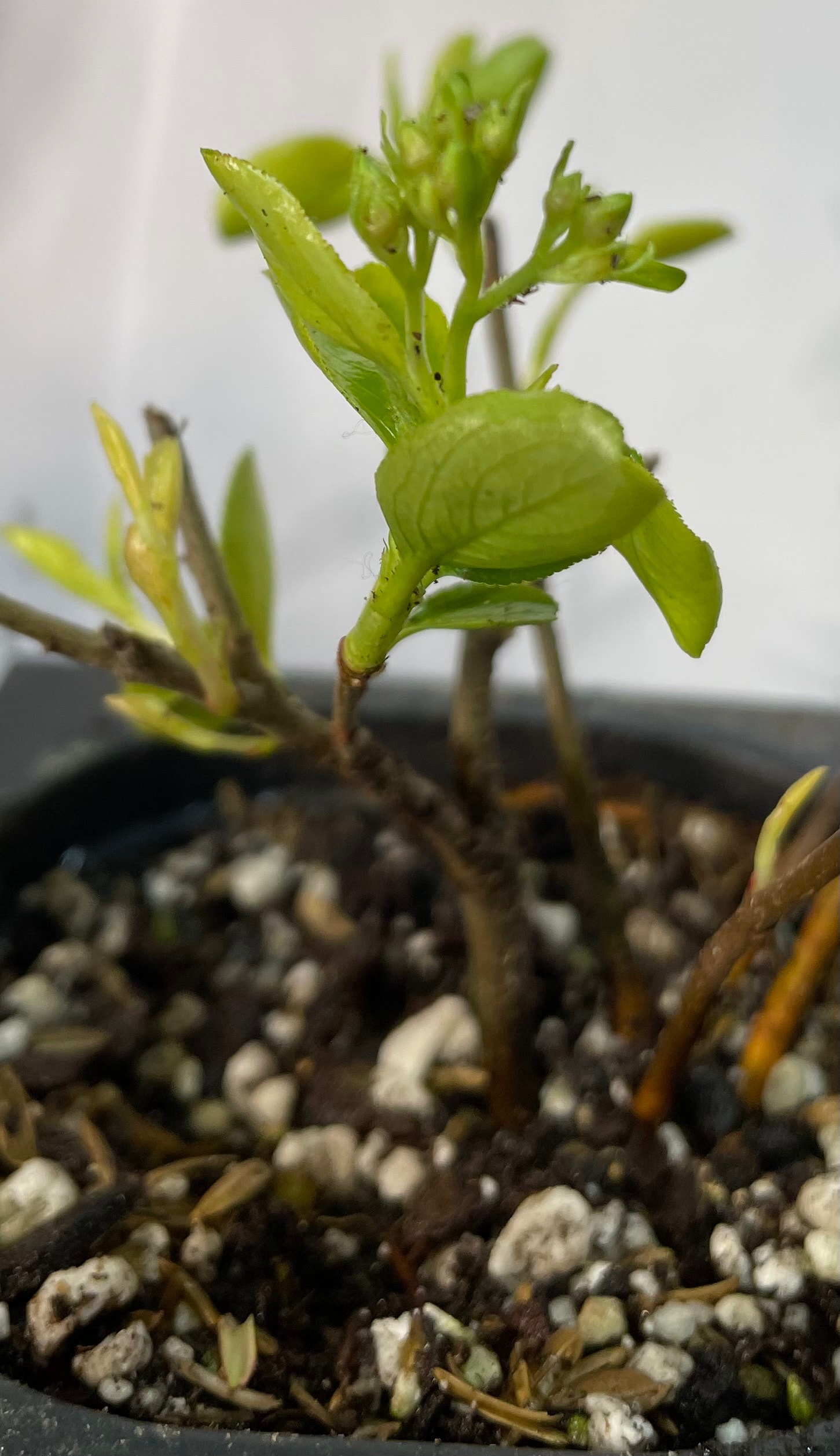
What I didn’t realize was just how precocious Aronia can be until I received this plant in the mail today. I ordered a second ‘Low Scape Mound’ because I was worried the first one might take a long time to fruit since it was so small.
Despite being incredibly small—only about 3 inches tall and in a 4-inch pot—the plant already has flowers forming. I’m obviously not going to let it set fruit, but it’s awfully tempting to collect some pollen. Still, I don’t want to stress it too much given how small it is.