Germinating Tejocote is quite easy. Pyrenes are large and can be opened in a vice to release the seeds. Most are empty, though. Choose only the large ones and discard the small. Seeds germinate after stratification.
4 Likes
I’m almost certain the ones I bought from the grocery store were irradiated. I had no problem cracking them open—once I got the hang of it, I could crack about 7 out of 10 without damaging the seed—but almost every single one turned to mush. A few would partially sprout, but before developing true leaves, they’d rot as well. I tried all kinds of starting media and got the same result every time. I thought scarification might be the answer—several books recommend it, and I believe Dirr mentions it too—but I had no luck there either.
The ones I bought online could still be viable. I didn’t crack any of those, since I had such poor results the first few times with that method. Irradiation would easily explain what I was seeing.
I bought way too many over the last two ponche seasons, and at a ridiculous price. After cracking failed (on what were probably irradiated seeds), I very stupidly doubled down and bought muriatic acid and other supplies for chemical scarification. If I hadn’t gone down that path, I could have bought a couple of Tejocote trees for what I’ve spent on these seeds.
This wouldn’t sting as much if I weren’t already aware of tejocote’s history in the U.S. and knew—at least in the back of my mind—that they still require phytosanitary treatment before import. All I can say is I saw a fruit I wanted to grow and got blinded by plant lust. The clerks in the Hispanic market definitely thought I was nuts—every time, I got, “You know you can’t eat these like this, right?”
4 Likes
Interesting—there were firethorns in Nebraska when I was growing up, or at least what I was told were firethorns. I was always told they were poisonous, but it looks like they’re edible when properly processed. We have them here too—they’re definitely bulletproof and make a great ornamental. I appreciate you thinking of me, and I’ll return the favor any way I can.
2 Likes
Thanks so much kiwinut!
I need to do some ploidy testing on a rare white Birch we are hoping to propagate, which has driven my occasional search for a way to do that.
But for just a $25 test, I could see putting this to use in some genera under discussion here.
Which creates a basic question - how many chromosome pairs would the classic Aronia sorbifolia ‘Viking’ have? We are pretty sure we have been using seed from one of those but need to sort that out. (For once I think using seed from a manipulated plant like that one would actually be a good thing in that the yields it has are what people expect when they purchase a Black Chokeberry).
I have also been studying our local native Amelanchiers extensively and would like to find a resource that might discuss ploidy levels in their species. I hope to really carefully build some small seed production areas for things like Round-Leaf and Dwarf Serviceberry, but if 2 Amelanchiers can see each other, well, purity is pretty much immediately elusive in the characters.
2 Likes
‘Viking’ is ×Sorbaronia mitschurinii. It’s a tetraploid.
3 Likes
Thanks. A tetraploid makes sense.
Here’s the resource I used to help determine ploidy levels of Amelanchier for breeding purposes. The seedlings of ‘Viking’ will almost certainly be tetraploid and apomictic clones of it.
https://bsapubs.onlinelibrary.wiley.com/doi/epdf/10.3732/ajb.1400113
1 Like
Wild Aronia populations are commonly tetraploid, so no, ‘Viking’ would not have more chromosomes than a typical wild Aronia.
2 Likes
Durn. So much for the easy way.
1 Like
That’s great - thanks!
That gives me hope that I will be able to create solid purity by simply confirming diploid status of parent plants, and not using anything but diploids.
Meanwhile I find it quite telling that even that study still had to fall back to lots and lots of “taxonomically unassigned” specimens. Amelanchier identification is……. not always fun.
It does help my work tremendously that U of Michigan Botany distilled the genera down to just 6 local options, including the use of just ‘complexes’ rather than subspecies, a huge help compared to older references with many more than that. But I already know that if I try to sell “Round-Leaf Serviceberry” then customers will expect round leaves to pop out. That is sometimes seen in nature, to perfection of little silver dollar leaves. But far more commonly, “round” is just a suggestion, as is the case with the consistency of soooooo many Amelanchier characters.
3 Likes
is there any way to tell what my black chokeberry is ? diploid or triploid? I can measure the brix for you this year. i just have a straight species one for birds, but i always love to help  I assume tetraploid from this convo
1 Like
That would be awesome—I really appreciate it. High-Brix Aronia would be great regardless of ploidy. Since most Aronia are so precocious, within a couple of years I could probably generate diploid and triploid offspring from a tetraploid by crossing it with a maternal diploid.
If it came from a nursery it’s almost certainly tetraploid unless it’s one of the cultivars in my first post. Identification is possible based on morphology, since tetraploids are generally more robust, with thicker leaves and similar traits. This requires plants to compare to though. Another option is to bag emasculated flowers—if they set fruit, they’re apomictic tetraploids. It’s a lot of work though, so I only go that route if I had specific questions about ploidy based on comparisons. Either way, I should be able to determine the ploidy level if it turns out to be high Brix.
If you’re able to test Brix, that would be fantastic—I’ll gladly return the favor however I can.
3 Likes
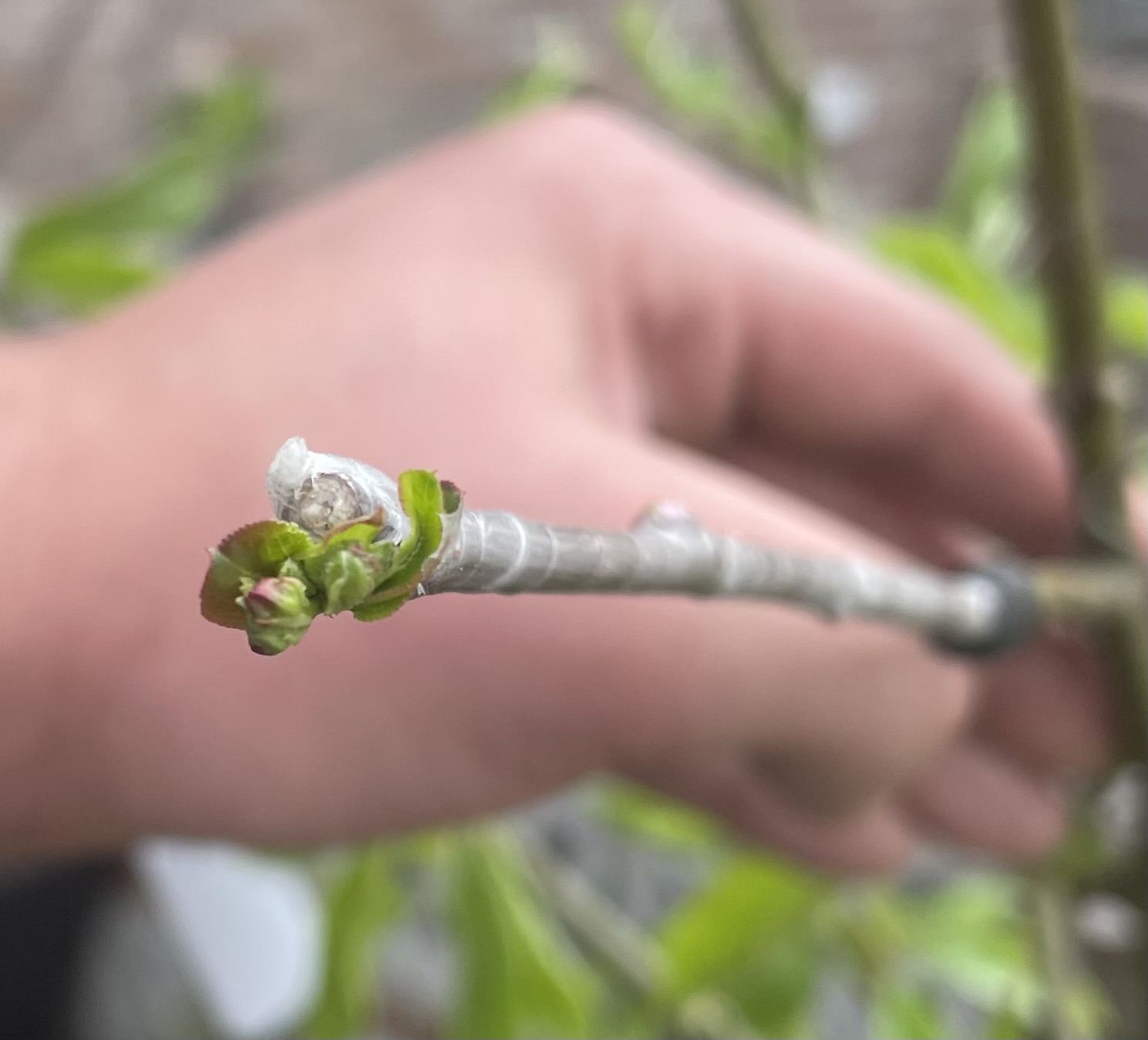
I’ve been grafting pear onto aronia and vice versa in hopes of increasing my chances of crossing the two. I’ve read about inflorescence grafting in various old horticultural magazines, as well as in a few modern studies, and there are some intriguing claims about the effects of grafting with flower buds—so I figured I’d give it a try. Below is a photo of ‘Low Scape Snowfire’ Aronia grafted onto a ‘Williams’ Pear (Mr. Bartlett was a thieving bastard).
I’ve seen flower-bud grafting mentioned in older publications in a couple of different contexts, but one claim I find especially interesting is the potential to bypass the long, multi-year wait required for some pear cultivars to fruit. That’s something I’ll have to test another day.
More recent studies suggest that plants grown from seeds of fruit produced on newly grafted, flowering scions may show increased rates of variation. I also think there’s a small chance this approach could improve the odds of achieving a wide cross. Of course, both ideas depend on the graft taking and the flowers successfully setting fruit—neither of which I’m entirely confident in. Either way, it should be a fun experiment.
3 Likes
Yesterday, I tried grafting chestnut crab apple to some seedling aronia. I didn’t do the best job with the grafts but I’m curious to see what happens. I also planted a few of the diploid lines as ornamental plants, so if those do well, I might be able to join you in trying crosses.
3 Likes
Awesome! Excited to follow your progress. I did an Aronia on apple graft this year, so I’m eager to see how the reverse works. The diploid Aronias really do make great ornamentals — even if none of the crosses work, at least we’ll end up with some good-looking plants.
3 Likes
I’m currently looking to make Aronia hybrids myself (among other hybrids involving members of the Maleae tribe), I’ve got Ground hugger this year but I think I stressed it too much and most of its fruit isn’t developing and but I will be collecting a bunch of wild Aronia melanocarpa seeds later this year. Most reports on Aronia melanocarpa I’ve seen indicate it’s diploid so I’m hoping to avoid apomixis which plagues so many polyploid members of the Maleae tribe.
I’m currently seeking a variety of diploid members of the Maleae tribe to try hybridizing to produce sweet disease resistant fruit trees
I’m also hoping to get diploid serviceberry seeds from wild trees whose locations and poidy were reported in a study of Amelanchier species.
And also hope to be able to get diploid hawthorns from somewhere but haven’t looked into it yet.
I should be getting toyon (Heteromeles arbutifolia) and Peraphyllum ramosissimum (wild crab apple) seeds later this year so eventually will be trying to cross those with Aronia too in several years
Other potential pollen sources I have access to are a variety of crab apples (Malus species), a variety of serviceberry trees of unknown ploidy, a bunch of tetraploid hawthorns, a couple Rhaphiolepis species, Sorbus americana, Callery pear (Pyrus calleryana), several Cotoneaster varieties of unknown ploidy (tetraploidy is common), several kinds of firethorn I have yet to identify, a variety of flowering quince cultivars and I think I might have some neighbors with various cultivars of apple trees that might let me harvest some pollen. Obviously some of these probably aren’t terribly useful for my goals but it doesn’t hurt to try
But I plan on attempting to cross Aronia melanocarpa with basically everything I have access to pollen of
4 Likes
Diploid Aronia melanocarpa are the outliers in the species. Most populations are tetraploid, with some diploid populations on the northern end of their range.
4 Likes
Oh that is unfortunate. Hopefully I can make time to go to regions where the diploid ones are found
1 Like
I think there may be some commercially available diploid selections.
1 Like
Diploid hawthorns are pretty easy to acquire since azarole, Chinese hawthorn, and tejocote are generally all diploid and available from multiple sources. I’ve bought hawthorn scions from Fruitwood Nursery and Cricket Hill Garden. Diploid Amelanchier are a bit harder to find commercially. The only one I know of that’s readily available is ‘Jennybelle.’ If you find any diploid Amelanchier from the locations in the study, I’d love to hear about them, especially if they taste good. All the commercially available diploid Aronia that I know of are listed in the first post in this thread.
The Sorbus pollen you have access to should cross with a maternal diploid Aronia regardless of the Sorbus ploidy. The offspring could potentially be backcrossed to either Sorbus or Aronia. If your lucky, you could end up with something similar to what @JohannsGarden has with ‘Appleberry’.
I’ll have tons of diploid Aronia seed to send out to anyone who wants it next year. I may have some this year as well, but the plants are still young, and the vast majority of the flowers I emasculated and pollinated with pear pollen. Out of roughly 500 attempts, almost all either failed to set fruit or aborted early. Interestingly, many of the aborting fruit accumulated heavy anthocyanin pigmentation that made it appear as if they were ripening before dying around BB size or slightly larger. Maybe this is normal, but I’ve never paid much attention to it until this year. Of all the crosses I attempted, fewer than 10 fruit are still hanging on, and I suspect most of those will probably fail as well. Still, I won’t be deterred. I’m convinced that one day either I or someone else here will get the cross to work.
I’m not expecting much success until the pear seedlings I grafted onto Aronia begin flowering. I currently have several pear seedlings and Sorbopyrus grafted as interstems between two Aronia.
I’m glad others are interested in Aronia crosses, and I’m looking forward to your updates.
5 Likes