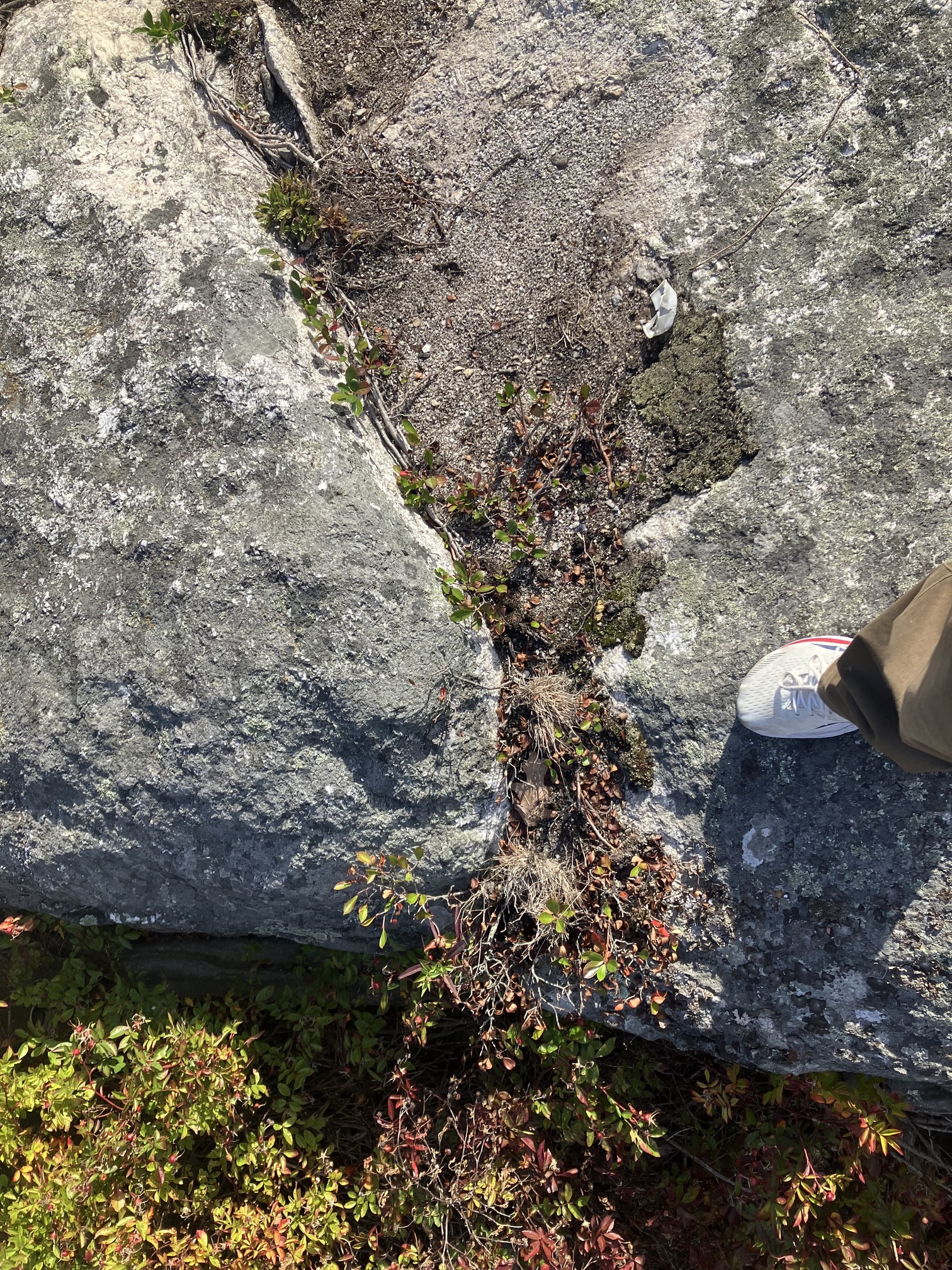
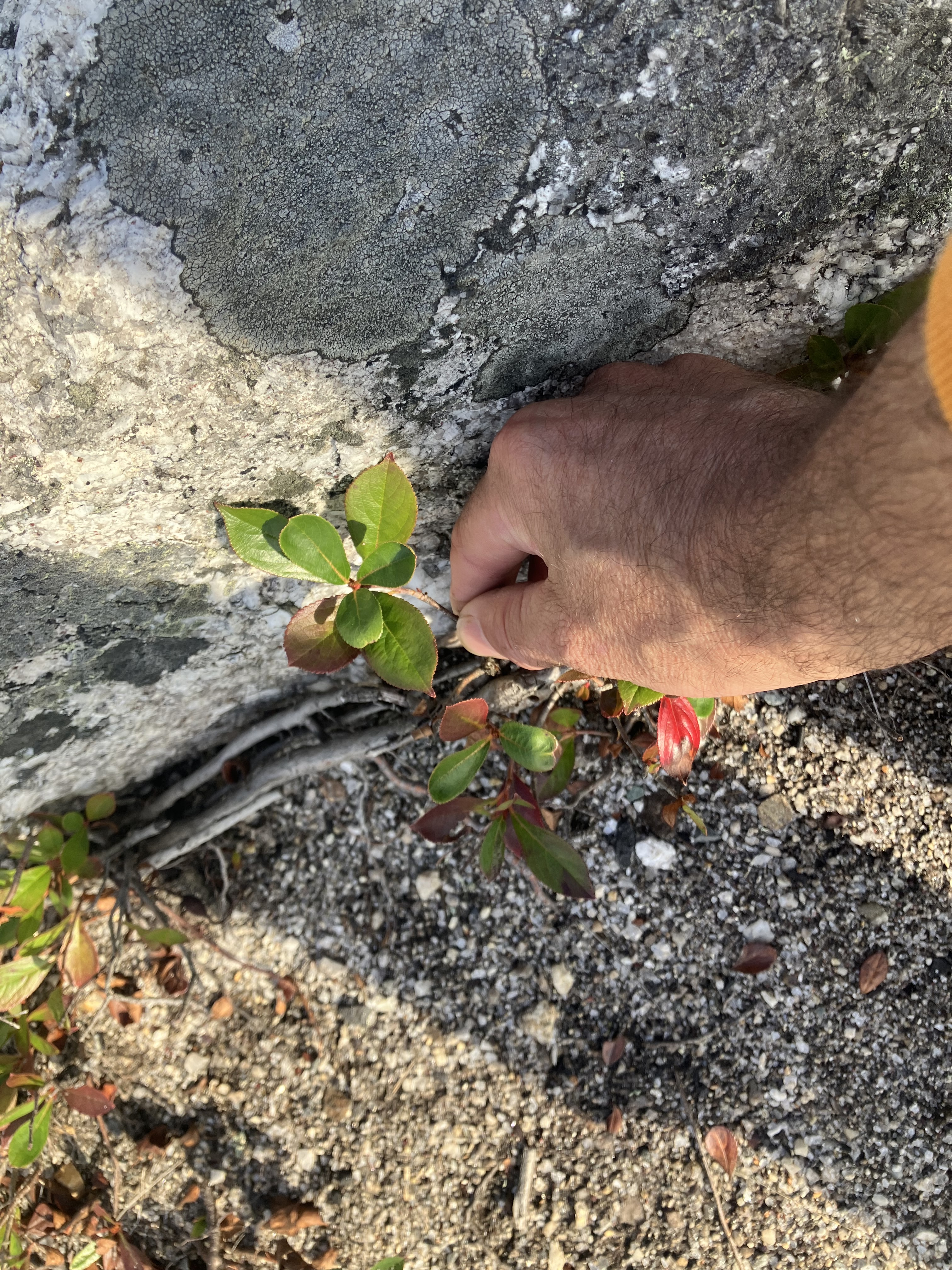
Sitting on the rocks here in mid-coast Maine. Theres an Aronia growing out of a fissure in the granite. Not much soil, and a whole lot of salt to deal with! Thats one tough plant.

2 Likes
Nice photos Hobilus, I’m assuming that’s the wild melanocarpa type rather than the hybrid. Did you taste it? How did it compare to your McKenzie?
Yes, I’ve heard it’s quite a tough plant, very easy to grow from cutting apparently. Growing from seed however, for me has been difficult.
I’ve decided to cover the tray that I sowed the aronia seeds that you sent me with a plastic cover to mimick a greenhouse, as I have a feeling the temperature is too cold as it has been almost a month without germination. Hopefully the cover will make them germinate. Otherwise I’m not sure what went wrong. I hope customs didn’t irradiate the seeds. Wish me luck.
1 Like
Yeah, thats a wild one. Super low dwarf form. Its growing in about 1/2” of sand on a granite outcrop right on the shore. I didn’t try them this time but I have before. They’re a little dry. I think McKenzie is better. Bigger fruit, more juicy. I like the wild dwarf lnes though and always get a kick out of where theyll grow.
I dunno whats up with your seeds. I haven’t grown Aronia from seed, so no useful advice really, except patience. Sometimes double stratification is needed. That can sometimes be the case when seeds dry out, I believe. You might see if the seed is still healthy looking or if it has rotted or otherwise decayed. If not, maybe give it another stratification and resow. Just a thought
1 Like
Found this written on a website selling aronia seeds:
After the cold stratification period they are then brought back to room temperature 20-22C (68-72F) for them to germinate. Germination is about 60 days after the warming period. Do not discard the planting tray, as patience is needed, and they are well worth the wait.
Looks like it might take longer than I expected. Weather is definitely getting warmer now too, so will be interesting.
2 Likes
what’s your preferred vegetative prop method ? Most recommend softwood, though you mentioned hardwood?
1 Like
Softwood is definitely easier and the way to go this time of year. Let’s say you had 1000 you rooted in river sand and controlled humidity with a mister , bags, etc. methods thats a great way to go. In the fall overwintered cuttings are the ones that should be hardwood. @TheDerek @39thparallel do this stuff all the time with cuttings. I usually use a rooting gel like clonex.
1 Like
if you can bend over some young shoots into a pot they will readily root. ive given away probably a doz. over the years that root when they touch soil. ive never tried rooting cuttings but i suspect they would be easy to root.
I tried softwood last year in late June, probably a 20% success rate, I’m trying this year with May harvested material. I have my stock plants stooled in the meantime.
Planted a bunch of seed last summer from ripe fruit, not sure which variety I sowed but they seem to have a very high germ rate.
1 Like
layering would be fun to try but I have a hard time keeping pots watered if they’re not directly in front of me.
put a stone or brick on it, directly on the ground near the mother plant. easy and very successful. scratch the cambium where it will touch the ground.
1 Like
Some plants dont like to root from softwood cuttings if they have been getting too much nutrition. Better to take cuttings from hungry plants than ones that have been fed recently. I think its excess N specifically that can inhibit callus formation and root growth in cuttings.
2 Likes
they should be good candidates then, all they’ve really gotten is mulch from old potting soil, sawdust , pulled weeds from other beds etc.
I wandered through some Aronia threads and this one seems the best fit for my questions.
I work for a Natives nursery; we grow from seed. We sell to environmental restoration projects, not orchards.
I will be collecting Aronia seeds in the coming weeks. They have high persistence on the plants and are much easier to see and pick after leaf drop.
My state Flora (Michigan) prefers the epithet Aronia prunifolia on the concern that Aronia melanocarpa has glabrous leaves, etc. but the natural Aronia here is pubescent.
So it seems the lumpers & splitters once again can’t agree on this one.
For me, that is a be-that-as-it-may. Nevertheless I need to understand if the Aronia prunifolia nomenclature is used much, elsewhere?
What I question about wild Aronia is the productivity. I rarely see it hold more than 2 berries per structure. Many plants often have single berries. What I don’t know is whether its standard site conditions - low fertility acidic Bogs - limit the fruit production? Would same plant bear heavily in a more quality soil?
Meanwhile the Internet has no shortage of pictures of Aronia, always with robust clumps of fruit. The growers at the nursery say it is easy to collect in quantity. However their collections have been from quite civilized areas.
So am now wondering if planted Aronia cultivars and those sneaky part-Sorbus plants manage to migrate into nearby wetlands, and bring that wonderful production with them?
Any thoughts on the reason behind what wild Aronia produces vs. horticultural Aronia would be appreciated.
1 Like
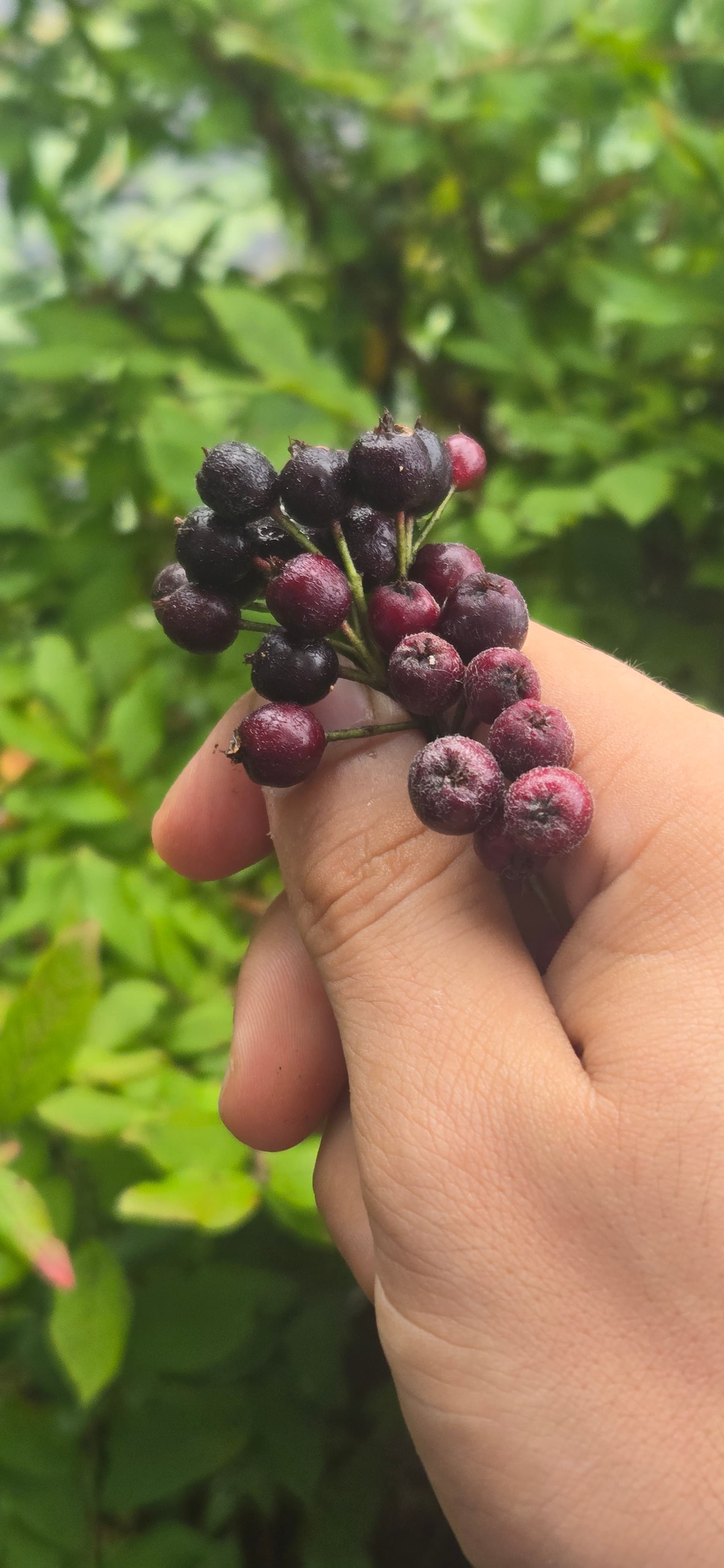
These are from wild ones near me in the woods. Seems like pretty big clusters. I’d be surprised if this was due to cultivated varieties. If that was true, the wild blueberries I found would’ve been bigger 
Let me know if you want the seeds
It should be written as Aronia ×prunifolia with an “×” because although it is reproducing like a species, it is now known to have originated as a natural cross between A. arbutifolia and A. melanocarpa.
I’m not sure why the Aronia in your area aren’t productive. It sure could just be growing conditions, but it could also be genetic variation. I will say that despite being known to grow in poor soils, they do respond very positively to being fertilized, at least as far as overall growth.
3 Likes
Thanks folks. I will try to get a few pictures of wild northern plants soon.
For some reason UofMich Herbarium uses prunifolia as one of two species names for the state despite clearly explaining it as the hybrid in text associated with it. A. arbutifolia was found in the wild once so far in Michigan, in a highly populated county so probably a cultivation escape.
From - Michigan Flora
“Completely glabrous plants have often been recognized as A. melanocarpa (Michx.) Elliott. Some authors believe that pubescent plants are derived from hybridization of the glabrous A. melanocarpa with A. arbutifolia (L.) Elliott, a red-fruited species of the Coastal Plain and southeastern United States, disjunct to one site in Michigan, which has leaves densely pubescent beneath, and would recognize the pubescent hybrid A. ×prunifolia and the glabrous A. melanocarpa in Michigan. Since the alleged hybrid does seem to form independent, self-reproducing populations, it is tempting to recognize it as a stabilized species of hybrid origin. However, it seems to grade insensibly into the glabrous plant and the separation of completely glabrous plants from somewhat or slightly pubescent plants would be arbitrary. More work is needed here.”
Where I will be collecting is so far from any known natural A. arbutifolia sites that a hybrid with it is extremely unlikely. Also quite far from any possible human cultivations.
So I will go with A. melanocarpa
Am also curious about the reports of a dwarfed version growing on rock scree in the northern end of Appalachian mountains. The question would be - do seeds collected from such plants stay dwarfed on better soils, too?
That make sense at first, but one thing I’ve learned about hybrids is that the traits they inherit from their parents sometimes allow them to better colonize sites that one, or even both parents wouldn’t generally be found growing in. Therefore, distance from one of the parent species shouldn’t be used as a factor in ruling out hybrid status.
True that. Be happy if you don’t ever have to untangle what’s happening in wild Amelanchier genes.
Anyhow for this little project I think it will be safe to ignore the chance of any A. arbutifolua being around as I will be collecting a good 300+ miles from the only known MI example, and generally a good many miles from any human habitation.
The collecting goal is a full pound of seed though; without those full corymbs so often photographed, I think it might be quite a hill to climb.
i have a ivans belle hybrid mtn. ash/ aronia cross. i can agree it has hybrid vigor. i didnt like the taste of the fruit and grafted it to all pear. the scions put on over 2ft. of growth in a year.
2 Likes